
Imagine two students who have just completed their Class 12 examinations.
Both have scored 85%. Both are preparing to enter college. Both have similar academic backgrounds.
But there is one important difference.
The first student has spent the last two years focusing almost entirely on textbooks, examinations, and marks.
The second student has also developed communication skills, learned to use AI tools responsibly, worked on a few practical projects, improved problem-solving abilities, and learned how to present ideas confidently.
Now, ask yourself:
When these two students enter college, who is better prepared to explore opportunities, participate in projects, build professional relationships, and adapt to a changing world?
Marks matter. Academic qualifications matter. But they are no longer the only things that shape a student’s future.
As we move deeper into 2026, the conversation around education and career readiness in India is changing. Artificial Intelligence is transforming industries, traditional job roles are evolving, and employers increasingly value people who can combine technical knowledge with human skills.
This brings us to an important concept that every student and parent should understand: The Skill Stack.
If your child is studying in Class 11 or 12, these two years offer an excellent opportunity to build skills that will continue creating value throughout their college education and professional life.
In this guide, we’ll explore what a skill stack means, why it matters for Indian students, and the five essential skills students should start developing before entering college.

A skill stack is a combination of different abilities that, when developed together, make an individual more capable, adaptable, and valuable.
Instead of depending on just one qualification or technical skill, you build a combination of complementary skills.
For example, consider a student who wants to pursue a career in business management.
Having knowledge of business concepts is useful. But imagine combining that knowledge with:
This combination creates a stronger foundation than relying on academic knowledge alone.
That’s the idea behind a skill stack.
One skill makes you capable. Multiple complementary skills make you versatile. And when you continue improving them, their value can compound over time.
Think about how quickly the world of work is changing.
Artificial Intelligence can now help people write content, analyse information, generate designs, automate repetitive tasks, and assist with complex research.
But does that mean human skills are becoming irrelevant?
Quite the opposite.
As technology handles more routine tasks, the ability to think independently, communicate effectively, solve unfamiliar problems, understand people, and make informed decisions becomes increasingly important.
India’s Economic Survey 2025–26 also highlights the importance of foundational capabilities such as literacy, numeracy, reasoning, problem-solving, communication, and socio-emotional skills in an environment where AI is automating routine cognitive tasks.
NITI Aayog’s 2026 report on skilling also recommends building foundational employability and entrepreneurship skills, including communication, digital skills, financial literacy, teamwork, and problem-solving, across school education.
The message is clear: students should not wait until graduation to start developing practical abilities.
The earlier they begin, the more opportunities they have to practise, improve, and apply those skills.
Let’s look at five skills that can help students prepare for college, future employment, entrepreneurship, and changing career opportunities.

Have you ever noticed that some students understand a topic very well but struggle when asked to explain it?
They may know the answer but hesitate to speak in front of others.
Some avoid presentations. Others find it difficult to express their opinions, participate in group discussions, or approach unfamiliar people.
This is where communication skills become important.
In college and professional life, knowing something is valuable. But being able to explain it clearly, discuss it confidently, and communicate your ideas effectively makes a significant difference.
Communication is much more than speaking fluent English.
It includes:
Verbal communication: Expressing your thoughts clearly during conversations, interviews, presentations, and discussions.
Written communication: Writing emails, reports, messages, applications, and professional documents.
Active listening: Understanding what another person is saying instead of simply waiting for your turn to speak.
Presentation skills: Organising information and presenting it confidently before an audience.
Non-verbal communication: Understanding body language, facial expressions, eye contact, and appropriate gestures.
For Indian students, developing communication skills is particularly useful when transitioning from school environments to colleges, internships, interviews, and professional settings.
You don’t need an expensive personality development programme to begin.
Try these activities:
Here’s a simple exercise:
Choose a topic you recently studied. Explain it to a friend or family member without looking at your textbook.
If you can explain a difficult concept in simple language, you’re developing an important communication ability.
Remember: Confidence in communication develops through practice, not simply through knowing more vocabulary.

Today’s students are already comfortable using smartphones, social media, online learning platforms, and digital applications.
But being digitally active doesn’t necessarily mean being digitally skilled.
There is a difference between spending three hours scrolling through social media and spending thirty minutes using technology to research, create, analyse, or solve a problem.
In 2026, students should start developing a healthy and productive relationship with technology, especially Artificial Intelligence.
AI is influencing careers across multiple industries.
Consider a few examples:
Students don’t need to become AI engineers to benefit from AI literacy.
They need to understand what these tools can do, where they can be useful, and where human judgement is still essential.
1. AI Tool Literacy
Learn how to use AI tools for brainstorming, research assistance, organising information, and improving productivity.
2. Prompting Skills
Learn how to provide clear instructions, relevant context, and specific requirements to AI tools.
3. Information Verification
AI-generated answers can be incomplete or incorrect. Develop the habit of checking facts, comparing sources, and verifying important information.
4. Spreadsheet and Data Literacy
Learn the basics of spreadsheets, formulas, charts, and data interpretation.
5. Digital Safety
Understand online privacy, passwords, cybersecurity basics, misinformation, and responsible digital behaviour.
Here’s an activity worth trying.
Choose a topic related to your stream.
For example:
Use AI tools to organise your research, but verify the information independently.
Prepare a short presentation explaining your findings.
This one activity can help you practise digital literacy, research, critical thinking, communication, and presentation skills together.
The goal isn’t to let AI think for you. It’s to learn how to think better while using AI responsibly.

One of the biggest challenges students face is becoming too dependent on ready-made answers.
A question appears in a textbook, and the student searches for its solution.
An assignment is given, and they immediately look for a completed answer online.
Now AI tools can generate answers within seconds.
But here’s an important question:
If technology can provide answers, what happens to the student’s ability to question, analyse, and make decisions?
This is why critical thinking and problem-solving are essential parts of a student’s skill stack.
Critical thinking is the ability to examine information carefully, question assumptions, evaluate evidence, and arrive at reasoned conclusions.
It helps students understand not just WHAT something is, but WHY it happens and HOW different factors are connected.
Imagine a student wants to organise a college-level event.
There are several challenges:
Instead of becoming overwhelmed, the student must identify the actual problems, evaluate possible solutions, prioritise tasks, and take action.
That’s practical problem-solving.
Try these five activities:
Ask Why and How: Whenever you learn something new, ask why it works and how it connects with real life.
Compare Different Perspectives: Read two articles presenting different opinions on the same issue. Identify where they agree and disagree.
Solve Real-Life Problems: Help your family plan a budget, organise an event, or compare products before purchasing.
Play Strategy-Based Games: Chess, Sudoku, logic puzzles, and strategy games can provide opportunities to practise reasoning.
Question AI Answers: Instead of blindly accepting an AI-generated response, ask what evidence supports it and whether alternative explanations exist.
Imagine your school wants to reduce plastic waste.
Don’t immediately suggest banning plastic.
First, understand the problem.
Now develop a practical solution.
This is how students learn to approach real-world challenges.
A student who learns to think independently will be better prepared to handle unfamiliar situations than someone who only memorises information.

This is one of the most underrated skills among school students.
You may have excellent communication skills, access to the latest technology, and strong academic knowledge.
But what happens when you struggle to manage your time, procrastinate, lose motivation, or give up when something becomes difficult?
Your other skills may never reach their full potential.
Self-management is the ability to organise your time, control distractions, manage responsibilities, and work towards goals without constantly depending on someone else to remind you.
Learning agility is the willingness and ability to learn, unlearn, and adapt when situations change.
Together, these abilities help students become more independent.
The skills required in many industries are evolving.
A tool you learn today may change tomorrow. A job role that exists today may involve very different responsibilities a few years from now.
Students who are willing to keep learning and adapt to new situations can respond more effectively to these changes.
1. Create a Weekly Plan
Don’t plan every minute of your day. Identify your important academic and personal priorities.
2. Practise Focused Study Sessions
Set aside uninterrupted periods for studying, with short breaks in between.
3. Reduce Digital Distractions
Keep unnecessary notifications switched off during study time.
4. Set Small Weekly Goals
Instead of saying, “I will improve my communication,” set a measurable goal such as completing two presentations this week.
5. Review Your Progress
At the end of every week, ask yourself:
Parents often remind children to study, wake up early, complete assignments, and manage their time.
But constantly reminding a child doesn’t necessarily develop independence.
Instead, gradually involve them in planning their own routine.
Allow them to make age-appropriate decisions, experience manageable consequences, and learn from mistakes.
The objective is not to control every activity.
It is to help your child develop the ability to manage themselves.

You may be academically brilliant.
You may understand technology better than most people around you.
But can you work with people who have different opinions, personalities, and approaches?
Can you handle disagreements without becoming defensive?
Can you contribute to a team without always expecting to lead?
These are important questions because very few professional environments operate entirely through individual effort.
Whether someone becomes a doctor, engineer, entrepreneur, designer, researcher, or corporate professional, the ability to work with others remains valuable.
Collaboration is the ability to work with others towards a shared objective.
It involves:
Leadership is not about being the loudest person in the room.
A good leader understands the objective, takes responsibility, communicates clearly, and helps others contribute.
You don’t need to become a school captain to develop leadership.
You can practise it through small activities.
1. Participate in Group Projects
Learn to divide responsibilities, coordinate tasks, and complete work together.
2. Volunteer for School Events
Help organise competitions, cultural activities, sports events, or community initiatives.
3. Learn to Handle Disagreements
Understand that different opinions don’t automatically mean someone is wrong.
4. Take Responsibility
If you commit to completing a task, make sure you follow through.
5. Help Others Learn
Explain difficult concepts to classmates and support group learning.
These experiences may seem small during school, but they help students develop habits that can become valuable throughout college and professional life.
Now let’s understand why these five skills should not be developed separately.
Imagine a student who wants to start a small online business while studying in Class 12.
To make it work, the student needs:
Notice something?
One practical activity can develop several skills simultaneously.
And as the student continues practising, these skills can support one another.
Better communication helps with collaboration.
Better digital literacy supports problem-solving.
Better self-management creates more opportunities to practise.
Better critical thinking improves decision-making.
That’s what makes a skill stack powerful.
The real advantage isn’t having five certificates. It’s being able to use five complementary skills together to accomplish something meaningful.
Here’s a simple overview of the five skills, what students can practise, and how these abilities may support their future.
| Skill | What Students Should Learn | Practical Activity | Future Application |
|---|---|---|---|
| Communication | Speaking, writing, listening | Presentations and debates | Interviews, management, client-facing roles |
| Digital & AI Literacy | AI tools, research, data, digital safety | Build an AI-assisted project | Technology, business, research |
| Critical Thinking | Analysis, reasoning, decision-making | Solve real-world problems | Consulting, engineering, finance |
| Self-Management | Time, discipline, adaptability | Weekly goal planning | Higher education and professional life |
| Collaboration & Leadership | Teamwork, responsibility, relationship building | Group projects and volunteering | Management, entrepreneurship, teamwork |
These are broad applications, not guaranteed career outcomes. The right combination will depend on the student’s interests, aptitude, education, and chosen profession.
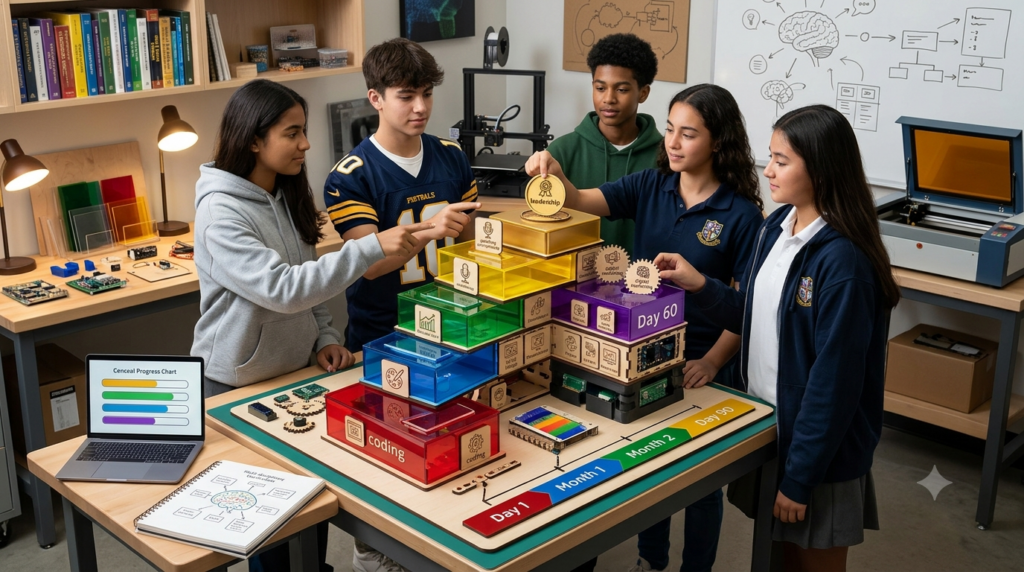
Knowing which skills matter is one thing.
Actually developing them is another.
Many students start enthusiastically, but after a few days, academic pressure and other distractions take over.
That’s why I recommend starting with a simple 90-day plan.
You don’t need to dedicate several hours every day. Even 30–45 minutes of focused skill development on selected days can create a useful starting routine.
Focus: Communication and Self-Management
Activities:
Expected progress:
You begin becoming more comfortable expressing yourself and managing your responsibilities.
Focus: AI Literacy and Critical Thinking
Activities:
Expected progress:
You become more comfortable using technology productively and analysing information independently.
Focus: Collaboration and Practical Application
Activities:
Expected progress:
You begin turning individual skills into practical abilities that you can demonstrate.
Try to build a small portfolio containing:
This portfolio may become useful when applying for college opportunities, internships, competitions, or future projects.
It also helps students explain what they can actually do instead of simply listing skills on a resume.
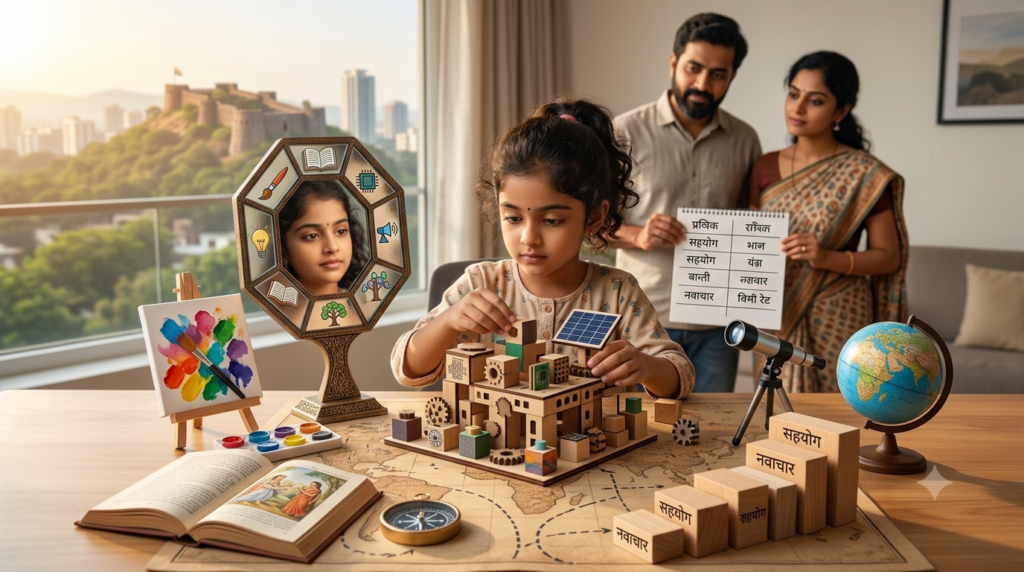
Parents play a significant role in helping children develop these abilities.
However, there is one mistake worth avoiding.
Don’t turn skill development into another academic competition.
Your child is already managing examinations, assignments, tuition, and other responsibilities. Adding five more targets without understanding their interests may create unnecessary pressure.
Instead, create opportunities for exploration.
Allow children to explore different activities, subjects, and interests.
A student interested in photography might learn visual storytelling.
A student interested in business might explore budgeting and entrepreneurship.
A student interested in science might work on simple experiments.
The objective is to connect learning with real-life experiences.
One child may communicate confidently but struggle with time management.
Another may be excellent at problem-solving but hesitant during presentations.
Children develop at different rates.
Focus on individual progress rather than constantly comparing them with classmates, cousins, or neighbours.
When your child faces a problem, don’t immediately provide the solution.
Ask:
This encourages independent thinking.
Allow children to manage small budgets, organise family activities, plan their study schedules, or take responsibility for personal tasks.
These experiences can teach practical decision-making and accountability.
This is perhaps the most important part.
Not every child will enjoy the same activities or develop skills in the same way.
Some students enjoy interacting with people. Others prefer analytical work.
Some are naturally curious about technology. Others are drawn towards creativity, research, or practical activities.
Understanding a child’s interests, abilities, motivations, and areas requiring development can help parents provide more relevant opportunities.
The aim is not to put children into fixed categories.
It is to help them explore possibilities without unnecessary pressure.
One important point: students don’t need to develop every possible skill to the same level.
The five skills discussed above provide a broad foundation, but the way students apply them can differ depending on their interests and future career direction.
Let’s look at a few examples.
Consider developing:
Practical activities could include science exhibitions, coding projects, research presentations, and technology competitions.
Consider developing:
Practical activities could include managing a small budget, analysing a business, organising an event, or exploring entrepreneurship.
Consider developing:
Practical activities could include writing articles, conducting surveys, participating in debates, and creating awareness campaigns.
Consider developing:
Practical activities could include building a design portfolio, creating digital content, and participating in creative projects.
Remember, these are starting points rather than rigid rules. Students can combine skills from different areas depending on their interests.
Absolutely.
Let’s be clear about one thing.
Developing practical skills does not mean ignoring academics.
Class 11 and 12 are important years. Your subject knowledge, examination performance, and eligibility requirements can influence college admissions and future opportunities.
For example, a student aspiring to study medicine must meet the relevant academic and entrance examination requirements.
Similarly, engineering, law, finance, and other professional pathways may have specific eligibility criteria.
A skill stack should complement academic preparation, not replace it.
Think of it this way:
Academic knowledge gives you the foundation. Practical skills help you apply that knowledge.
A student who combines both is better positioned to explore different opportunities.
India’s education framework is also moving towards greater integration of vocational and experiential learning.
The Ministry of Education’s 2026 update describes skill-based and experiential learning across Classes VI–XII, including vocational courses aligned with the National Skills Qualifications Framework.
This reinforces the importance of giving students opportunities to learn beyond traditional classroom instruction.

This is where many parents and students get confused.
After reading about communication, AI, critical thinking, leadership, and self-management, they may ask:
“Where should my child begin?”
The answer is not necessarily to start with the most popular skill.
Start by understanding the student.
Consider these questions:
Career planning should involve more than looking at popular courses or following what friends are choosing.
A structured career assessment can help students reflect on their interests, aptitude, personality-related preferences, and possible career directions.
However, assessments should be interpreted as guidance inputs rather than fixed predictions of a student’s future.
The final decision should also consider academic performance, qualifications, practical exposure, financial circumstances, and the student’s own aspirations.
A skill stack is a combination of complementary abilities that helps students become more capable and adaptable. It may include communication, digital literacy, problem-solving, self-management, leadership, and technical knowledge.
Instead of relying only on academic qualifications, students develop multiple abilities that they can apply in different situations.
Five useful foundational skills are:
Students can gradually develop these alongside their academic studies.
College involves more than attending lectures and passing examinations.
Students may need to participate in group projects, give presentations, manage deadlines, work on internships, and interact with people from different backgrounds.
Transferable skills can help them navigate these experiences more confidently.
Yes, developing basic AI literacy can be valuable.
Students should understand how AI tools work, how to use them responsibly, how to verify generated information, and how to protect their privacy.
They should also understand that AI is an assistant, not a substitute for independent thinking and subject knowledge.
Absolutely.
Skill development doesn’t always require additional courses or long study sessions.
Students can practise communication through presentations, improve time management through study planning, and develop critical thinking through regular academic activities.
The key is to integrate skill development into everyday learning.
Parents can observe their child’s activities, interests, learning experiences, problem-solving approaches, and areas of curiosity.
Conversations with teachers, career counsellors, and structured career assessments can provide additional perspectives.
The goal is to understand the child rather than force them into a predetermined career.
Both matter, but their importance varies depending on the student’s chosen pathway.
Academic qualifications and entrance examination scores may be essential for certain courses, while communication, digital literacy, teamwork, and problem-solving can support the student’s broader development.
A balanced approach is generally more useful than focusing exclusively on either one.
Class 11 and 12 are not just about preparing for board examinations or deciding which college to join.
They are also an opportunity to understand yourself, explore interests, develop practical abilities, and prepare for a world that will continue changing.
Your child doesn’t need to become an expert in five different fields before entering college.
They simply need to start building a strong foundation.
Encourage them to communicate better, explore technology responsibly, think independently, manage their time, and learn to work with others.
Let them experiment. Let them make mistakes. Give them opportunities to discover what they enjoy and where they need improvement.
And most importantly, don’t measure their entire potential through examination marks alone.
The future will not belong only to students who know the most. It will also create opportunities for those who can learn continuously, think clearly, adapt confidently, and apply their knowledge meaningfully.
Start building that foundation today.

At SH Development Academy, we believe that career planning should begin with understanding the student—not simply choosing a popular course or following what everyone else is doing.
Every student has different interests, abilities, aspirations, and areas of development.
That’s why, before recommending a career direction, it is important to understand the individual.
Under the guidance of Santosh Hariharan — DMIT Consultant, Parent & Career Coach, and Success Mindset Coach for Students, SH Development Academy helps students and parents explore career possibilities through structured career guidance and assessment services.
1. Psychometric Career Assessment
Explore your child’s interests, aptitude, personality-related preferences, and potential career directions through a structured psychometric assessment.
Take the next step towards informed career planning:
https://shdevelopment.edumilestones.com
2. Explore 3000+ New-Age Career Options
The world of careers is much broader than the traditional choices of engineering, medicine, commerce, and government jobs.
Explore emerging and established career possibilities across different industries:
https://shdevelopment.edumilestones.com/global-career-library
3. DMIT & Personalised Guidance
Understand our DMIT services and how we approach parent and student guidance.
https://shdevelopmentacademy.lovable.app
Help them understand their interests, explore their strengths, and make informed decisions about their future.
📞 Call / WhatsApp:
+91 8421315400 | +91 7303290862
⭐ Trusted by 400+ Parents and Families
Read our Google reviews:
https://share.google/ac9hkh20zcXadkJs9
At SH Development Academy, our objective is simple: Help students understand themselves better, explore the right opportunities, and prepare for a more confident future.
Because choosing the right career is important. But developing the right skills to grow in that career is equally important.
Success & Happiness are the two most important yet elusive things which every human being yearns to achieve in life. Real success and happiness can be savoured only when one enjoys good health and good family relations, along with a good professional career and sound financial stability.
Our Visitor


 Users Today : 12