

Every year, thousands of students across India reach one important milestone: completing their Class 10 examinations.
And almost immediately, one question takes over their minds.
“Which stream should I choose after 10th – Science, Commerce, or Arts?”
For some students, the answer seems obvious. They have always wanted to become doctors, engineers, chartered accountants, or designers.
But for many others, this decision becomes a source of confusion, pressure, and endless discussions at home.
Parents suggest Science because it offers more career opportunities. Relatives recommend Commerce because it has good financial prospects. Friends are choosing different subjects, and students often feel tempted to follow them.
Some students choose a stream because their marks are high enough to qualify for it. Others select subjects because their parents believe a particular career offers better financial security.
But here’s something I want every student and parent to understand:
Your Class 11 stream should not be selected based only on marks, social pressure, or the popularity of a particular career. It should be selected after understanding your interests, abilities, strengths, learning preferences, and long-term aspirations.
Over the years, while interacting with students and parents through career guidance and counselling, one thing becomes clear: many students don’t lack potential. They lack clarity about how to connect their potential with the right educational direction.
That’s why having a structured Stream Selector Decision Tree can make this decision much easier.
In this guide, we’ll explore Science, Commerce, and Arts in detail, understand which students may be suited to each stream, look at future career opportunities, and provide a practical decision-making framework to help you choose wisely.
Let’s begin.

Class 10 is an important transition point in the Indian education system.
Until Class 10, most students study a relatively common set of subjects. However, after completing their board examinations, they generally begin specialising in different academic areas.
This is where Science, Commerce, and Arts/Humanities enter the picture.
Your stream influences:
For example, a student interested in medicine generally needs to follow the required Physics, Chemistry, and Biology route and meet the applicable NEET eligibility requirements.
Similarly, someone interested in engineering generally needs the relevant Physics and Mathematics combination and must meet the admission requirements of the chosen programme.
A student interested in economics, finance, psychology, law, design, or business may have several different subject combinations and educational routes available.
Therefore, choosing a stream isn’t simply about selecting three or four subjects.
It is about choosing an educational direction that supports your future goals without ignoring your present strengths and interests.
However, remember that your stream does not permanently decide your entire future. Many careers have multiple entry routes, and students can change directions through appropriate qualifications and further education.
The key is to make an informed decision rather than an impulsive one.

A Stream Selector Decision Tree is a structured way of identifying which academic stream may suit a student based on a series of questions.
Instead of randomly comparing Science, Commerce, and Arts, you start by understanding yourself.
The decision-making process considers five important factors:
Let’s understand how this works.
Before looking at individual streams, answer these questions honestly.
Think about the subjects you enjoy studying, even when there is no examination approaching.
Your answers can provide an initial indication of your interests.
Different streams involve different ways of thinking.
For example:
Science-oriented thinking:
You enjoy investigating how things work, analysing scientific problems, conducting experiments, and understanding cause-and-effect relationships.
Commerce-oriented thinking:
You enjoy analysing financial information, understanding business decisions, working with numbers, and solving organisational problems.
Arts/Humanities-oriented thinking:
You enjoy understanding human behaviour, exploring social issues, interpreting information, expressing ideas, and analysing different perspectives.
These are broad tendencies, not fixed personality categories. Students can enjoy more than one type of problem-solving.
Think beyond the traditional career names.
Do you imagine yourself:
Your interests may point towards more than one stream.
This is one of the most important questions.
Ask yourself honestly:
Your answer matters.
A stream selected to satisfy someone else may become difficult to sustain when academic pressure increases.
Before finalising your stream, research the eligibility requirements of your preferred undergraduate courses and entrance examinations.
Some professional pathways require specific subjects in Classes 11 and 12.
Don’t assume that every career is available through every stream.
Your first decision should be about understanding yourself. Your second should be about understanding the educational route required for your goals.
Now let’s explore each stream.
Science is often considered one of the most popular choices after Class 10, particularly among students interested in medicine, engineering, technology, research, and scientific discovery.
But Science is not automatically the best stream for every academically strong student.
It is a demanding academic pathway that requires curiosity, conceptual understanding, consistent practice, and the willingness to explore complex subjects.
The exact subject combinations depend on the school or junior college.
Common combinations include:
PCM – Physics, Chemistry and Mathematics
This combination is generally preferred by students interested in:
PCB – Physics, Chemistry and Biology
This combination is commonly selected by students interested in:
PCMB – Physics, Chemistry, Mathematics and Biology
Some institutions offer this combination to students who want to keep both Mathematics-oriented and Biology-oriented academic pathways open.
However, it involves a heavier subject workload and should be selected only when the student is genuinely comfortable managing it.
Science may be worth exploring if you:
Remember, enjoying Science is more important than simply scoring good marks in Science.
A student scoring 95% may not necessarily enjoy studying Physics or Mathematics at an advanced level.
Similarly, a student scoring 75% may have a genuine interest and the ability to improve with the right guidance and study strategy.
Science offers a wide range of educational and professional opportunities.
| Career Field | Possible Career Options |
|---|---|
| Healthcare | Doctor, Dentist, Veterinarian |
| Engineering | Mechanical, Civil, Electrical Engineer |
| Technology | Software Developer, AI Professional |
| Research | Scientist, Research Associate |
| Life Sciences | Biotechnologist, Microbiologist |
| Data & Mathematics | Data Analyst, Statistician |
| Architecture | Architect (subject to eligibility) |
| Environment | Environmental Scientist |
There are also emerging opportunities in robotics, cybersecurity, biotechnology, computational sciences, and other interdisciplinary fields.
Don’t select Science simply because someone says it keeps all career options open.
Consider:
Science can be an excellent choice, but only when it aligns with your interests, abilities, and educational goals.
Let’s clear up one common misconception.
Commerce is not a secondary option for students who don’t qualify for Science.
It is a distinct academic stream with excellent opportunities in finance, business, economics, entrepreneurship, management, and many other professional fields.
In fact, students interested in understanding how organisations operate, how money moves, how businesses grow, and how financial decisions are made may find Commerce particularly interesting.
Common subjects include:
The exact combinations vary between schools and boards.
Commerce may be a suitable option if you:
You don’t necessarily need to be a mathematical genius to pursue Commerce.
However, you should understand the mathematical requirements of your intended subjects and future courses.
Commerce offers a variety of career pathways.
| Career Field | Possible Career Options |
|---|---|
| Accounting | Chartered Accountant, Accountant |
| Finance | Financial Analyst, Investment Professional |
| Business | Business Manager, Entrepreneur |
| Management | BBA, MBA pathways |
| Economics | Economist, Economic Analyst |
| Banking | Banking Professional |
| Marketing | Digital Marketer, Brand Manager |
| Taxation | Tax Consultant, Tax Professional |
| Corporate Law | Corporate Legal Professional (with the required qualifications) |
Students can also explore newer areas such as financial technology, business analytics, digital entrepreneurship, investment management, and international business.
Ask yourself:
One important point: Some professional courses and undergraduate programmes have specific eligibility conditions. For example, students interested in Economics Honours or certain quantitative programmes should carefully check Mathematics requirements at their preferred universities.
Let’s address a misconception that has affected countless students.
Arts is not a stream for students who cannot handle Science or Commerce.
Humanities offers an extensive range of academic and professional opportunities.
It is particularly interesting for students who enjoy understanding people, society, culture, communication, history, politics, psychology, languages, and creative expression.
In today’s world, careers are not limited to engineering, medicine, and accounting.
Organisations also need psychologists, designers, researchers, lawyers, educators, writers, communication specialists, policy professionals, and creative thinkers.
Depending on the school or junior college, common subjects include:
Students should check the available combinations with their chosen institution.
This stream may be worth exploring if you:
| Career Field | Possible Career Options |
|---|---|
| Psychology | Psychologist (with required qualifications) |
| Law | Lawyer, Legal Researcher |
| Civil Services | UPSC and State Public Service pathways |
| Media | Journalist, Media Professional |
| Design | Graphic Designer, UX/UI Designer |
| Education | Teacher, Education Professional |
| Social Sciences | Researcher, Social Scientist |
| Communication | Content Strategist, PR Professional |
| Public Policy | Policy Researcher, Policy Analyst |
| Creative Industries | Writer, Artist, Creative Professional |
Students interested in psychology should understand that becoming a qualified psychologist requires further specialised education and compliance with the relevant professional requirements.
Similarly, careers in law, teaching, design, and other specialised areas may require specific degrees, entrance examinations, or professional training.
Ask yourself:
Arts/Humanities can lead to meaningful and rewarding careers when students understand the opportunities and plan their education carefully.
This is one of the most common statements heard during Class 10 counselling.
Many parents believe that Science offers more opportunities, Commerce comes second, and Arts has limited scope.
But career opportunities should not be measured by comparing streams in isolation.
They should be measured by how well a student’s interests, abilities, educational choices, and career goals align.
Consider these examples:
A student who loves finance may build an excellent career through Commerce.
A student passionate about psychology may find the Humanities pathway more suitable.
A student fascinated by technology may enjoy Science and pursue engineering or computer science.
A student interested in business and technology may explore interdisciplinary courses, subject to their eligibility.
No stream guarantees success, and no stream automatically limits a student’s potential.
Your growth depends on several factors, including the quality of education, skills, practical exposure, effort, opportunities, and the choices you make along the way.
This is more common than parents realise.
For example:
You don’t necessarily have to fit into one rigid career identity at the age of 15 or 16.
Many modern careers combine different areas of knowledge.
For example:
| Your Interests | Possible Career Areas |
|---|---|
| Psychology + Technology | UX Research, Human-Computer Interaction |
| Biology + Technology | Biotechnology, Bioinformatics |
| Commerce + Technology | FinTech, Business Analytics |
| Design + Technology | UX/UI Design, Product Design |
| Economics + Mathematics | Data Economics, Quantitative Analysis |
| Psychology + Business | Organisational Psychology, HR |
These are illustrative pathways, and the appropriate subject combinations and qualifications depend on the chosen programme.
The important thing is to explore your interests before making a decision.

Beyond academic marks and career interests, there are several other factors worth considering.
Interest is an important starting point.
Think about the subjects you naturally enjoy learning, the topics you research voluntarily, and the activities that make you curious.
Don’t confuse temporary enjoyment with long-term interest, though.
Try to understand whether you enjoy the actual subject matter or simply like the way it is currently taught.
Aptitude refers to your potential or ability to learn and perform in particular areas.
For example, you may have strengths in:
Understanding your aptitude can provide additional information when comparing academic pathways.
However, aptitude is not destiny. Skills can also improve through learning, training, and practice.
Some students enjoy working with people.
Others prefer research, independent tasks, creative work, or analytical problem-solving.
Understanding your behavioural preferences may help you explore careers that fit your working style.
But avoid treating personality labels as permanent limitations.
An introverted student can become an excellent leader, and an extroverted student can become a successful researcher.
Your Class 10 marks provide useful information about your current academic performance.
However, they should not be the only deciding factor.
Look at:
A single examination cannot capture everything about a student’s potential.
You don’t need to know your exact career at 16.
However, exploring broad career categories can help.
For example:
Start with broad interests and gradually narrow your options.
Don’t select a stream based on outdated information or assumptions.
Explore the courses, entrance examinations, qualifications, and skills required for your preferred careers.
Also remember that the job market changes.
Emerging technologies, artificial intelligence, changing business models, and new industries are creating career opportunities that were less visible a decade ago.
Developing adaptable skills and a willingness to learn will remain important regardless of your stream.
A stream may look attractive from the outside, but the actual academic experience can be very different.
Ask yourself whether you are genuinely interested in studying those subjects for the next two years.
Your motivation and willingness to learn matter.
Before making your final decision, complete this simple exercise.
Give each stream a score between 1 and 5 for every factor.
| Decision Factor | Science | Commerce | Arts |
|---|---|---|---|
| My interest in the subjects | /5 | /5 | /5 |
| My current academic strengths | /5 | /5 | /5 |
| My curiosity about the subjects | /5 | /5 | /5 |
| My interest in related careers | /5 | /5 | /5 |
| My willingness to study these subjects | /5 | /5 | /5 |
Add the scores for each stream.
Now, remember something important:
This is a reflection exercise, not a scientifically validated stream-selection test.
The highest score does not automatically mean that you must select that stream.
Instead, examine why you gave each score.
If you scored Science highly but have little interest in its subjects, explore that contradiction.
If you scored Arts highly but are worried about future opportunities, research actual career pathways rather than relying on assumptions.
The purpose is to start a meaningful conversation with yourself, your parents, and a qualified career counsellor.

Sometimes, students are unable to identify their own strengths and interests clearly.
They may say:
“I like everything.”
“I don’t know what I want to become.”
“My parents want me to take Science, but I am interested in Psychology.”
“I score well in Mathematics, but I don’t enjoy it.”
This is where a structured psychometric career assessment can provide additional clarity.
A psychometric career assessment is designed to evaluate specific aspects of an individual’s abilities, interests, personality characteristics, and career preferences through structured assessment methods.
Depending on the assessment, it may help explore:
Understand your relative strengths in areas such as:
Identify the types of activities, subjects, and occupational areas that attract you.
Explore behavioural preferences, interpersonal tendencies, and working styles.
Compare your assessment profile with different occupational areas and educational pathways.
However, a psychometric assessment should not be treated as a final verdict.
It is one input into a larger career guidance process that should also consider academic performance, personal aspirations, practical circumstances, and educational eligibility.
A good career counselling session goes beyond showing a student a list of suggested careers.
It helps the student understand WHY certain options may be worth exploring and WHAT steps they can take next.
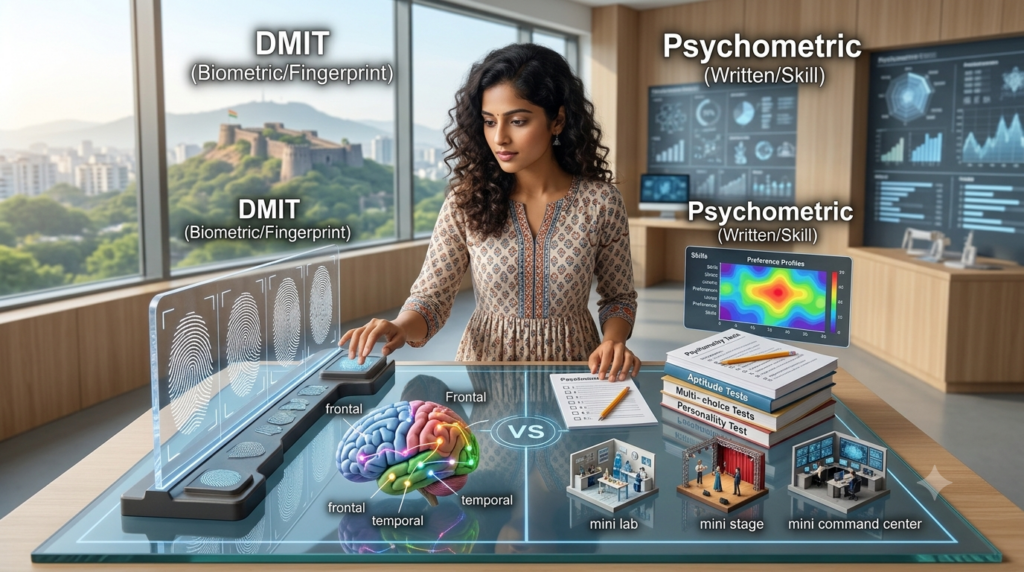
Parents often ask whether DMIT and psychometric career assessments are the same.
They are different approaches.
DMIT (Dermatoglyphics Multiple Intelligence Test) is based on analysing fingerprint patterns and is marketed by some providers as a way to understand multiple intelligences, personality, and potential.
However, there is insufficient robust scientific evidence to establish that fingerprint patterns can reliably determine an individual’s intelligence, personality, learning style, or ideal career.
Therefore, parents should be cautious about treating DMIT findings as scientifically proven career predictions.
Psychometric career assessments, on the other hand, use structured questionnaires and/or standardised tasks to evaluate specific psychological characteristics, aptitude, and interests.
Their usefulness depends on the quality of the assessment, the evidence supporting its reliability and validity, and the way results are interpreted.
At SH Development Academy, we encourage parents to look beyond a report and focus on meaningful career conversations, individual strengths, and practical educational planning.
Dear parents, this section is especially important.
You have spent years investing in your child’s education, health, and future.
Naturally, you want them to make the right decision.
But sometimes, in our effort to protect children from making mistakes, we unintentionally make decisions on their behalf.
Here are a few things to remember.
Perhaps you wanted to become a doctor but couldn’t.
Perhaps you believe engineering offers financial security.
Your experiences are valuable, but your child has their own interests, abilities, and aspirations.
Give them the freedom to explore.
Your neighbour’s child may have selected Science.
Your relative’s daughter may be preparing for CA.
Your child’s best friend may have already decided to pursue law.
But your child’s educational decision should not be based on someone else’s journey.
Instead of saying, “Take Science because it has more scope,” explore different career options together.
Research actual courses, entrance examinations, eligibility requirements, and future opportunities.
Let your child participate in the process.
If your child is confused, don’t immediately interpret it as a lack of seriousness.
Ask questions such as:
Sometimes, listening carefully can reveal more than giving another lecture.
If you and your child are unable to reach clarity, consider consulting a qualified career guidance professional.
An objective assessment and structured counselling session can help bring a different perspective to the discussion.
The ultimate goal is not to select the most prestigious stream.
It is to help your child make a decision they understand and feel prepared to work towards.
There is no universally best stream.
Science, Commerce, and Arts offer different academic and professional pathways. The right choice depends on your interests, aptitude, academic strengths, career aspirations, and the eligibility requirements of your preferred courses.
All three streams can lead to well-paying careers.
Earnings depend on the profession, qualifications, experience, skills, industry, location, and career progression.
Choosing a stream only because someone claims it offers the highest salary can lead to a poor decision.
Yes, several psychology programmes are open to students from different Class 12 streams, depending on the university’s eligibility requirements.
You should check the admission criteria of your preferred undergraduate psychology programmes before selecting your subjects.
Absolutely.
Commerce can provide useful exposure to accounting, economics, business studies, and financial concepts.
However, entrepreneurship is not restricted to Commerce students. Individuals from Science and Arts backgrounds can also build successful businesses.
Yes, depending on the specific career and course requirements.
For example, some design, digital media, communication, and technology-related programmes accept students from different academic backgrounds.
However, technical degrees such as certain engineering programmes have specific subject and entrance eligibility requirements.
Always check the criteria before planning your route.
Not universally.
Some Commerce combinations offer Mathematics or Applied Mathematics, while others do not.
However, certain university programmes, particularly in Economics and quantitative disciplines, may require Mathematics at the Class 12 level.
Check the requirements of your target courses.
Changing streams may be possible, depending on your school or junior college, subject availability, academic regulations, and timing.
However, switching later may involve additional academic work or eligibility complications.
It is better to seek guidance before making the initial selection.
Start by understanding your child’s interests, academic strengths, aptitude, personality preferences, and career aspirations.
A structured psychometric career assessment, combined with individual counselling and research into educational eligibility, can help parents and students make a more informed decision.
Ideally, it should be a collaborative decision.
Parents can provide experience, financial guidance, and practical information. Students should actively participate because they are the ones who will study the subjects and pursue the chosen educational direction.
Professional career guidance can help both sides reach a more informed conclusion.
Ideally, students should begin exploring their interests and career options before reaching the Class 10 stream-selection stage.
Starting early gives them more time to understand different professions, identify skill gaps, and make informed academic decisions.
Choosing between Science, Commerce, and Arts is one of the first major academic decisions a student makes.
But it should never become a decision driven entirely by fear, comparison, marks, or social expectations.
A student who genuinely enjoys understanding the human body may find Science exciting.
Someone fascinated by finance and entrepreneurship may thrive in Commerce.
A student interested in human behaviour, psychology, law, or communication may discover their strengths through Arts/Humanities.
The point is simple:
Don’t ask which stream is the most prestigious. Ask which stream gives your child the right foundation to explore their potential.
And if your child is confused, don’t rush the decision.
Take time to understand their interests, abilities, and aspirations. Explore career options. Check educational requirements. Seek professional guidance when necessary.
Remember, your child’s future is much bigger than one decision made after Class 10.
Make that decision with awareness, not pressure.

Sometimes, students know they want a successful career but have no idea which direction to take.
And sometimes, parents want to guide their children but are unsure whether they are making the right recommendations.
At SH Development Academy, we believe career decisions should be based on understanding the individual rather than following popular trends.
Under the guidance of Santosh Hariharan – DMIT Consultant, Parent & Career Coach, and Success Mindset Coach for Students, we help students and parents explore career possibilities through structured career assessment and personalised guidance.
Our psychometric career assessment is designed to help students explore their:
The assessment is a starting point for meaningful career exploration, supported by guidance and discussion.
👉 Explore Psychometric Career Assessments:
https://shdevelopment.edumilestones.com
Don’t limit your child’s future to the traditional career choices.
Explore emerging and established career possibilities across different industries.
👉 Discover 3,000+ Career Options:
https://shdevelopment.edumilestones.com/global-career-library
Learn more about our DMIT services and approach to parent and student guidance.
👉 Explore DMIT at SH Development Academy:
https://shdevelopmentacademy.lovable.app
We are grateful for the trust and support of parents and individuals who have connected with us over the years.
👉 Read Our Google Reviews:
https://share.google/ac9hkh20zcXadkJs9
For career assessment, stream selection guidance, and consultation enquiries:
Call / WhatsApp:
+91 8421315400
+91 7303290862
Your child’s future deserves more than a random stream selection. Give them the clarity to choose their direction with confidence.
Success & Happiness are the two most important yet elusive things which every human being yearns to achieve in life. Real success and happiness can be savoured only when one enjoys good health and good family relations, along with a good professional career and sound financial stability.
Our Visitor


 Users Today : 26