
Have you ever felt busy throughout the day but still wondered whether you are actually moving towards something meaningful?
You attend classes, complete assignments, prepare for exams, go to work, attend meetings, manage responsibilities, and keep yourself occupied.
But when someone asks you, “Where do you see yourself in the next three to five years?”, do you have a clear answer?
Many students struggle to decide which career to pursue. Working professionals often feel stuck in jobs that no longer excite them. Some people have big dreams but don’t know where to begin, while others keep changing their goals because they aren’t sure what they genuinely want.
The problem isn’t always a lack of ambition.
Sometimes, it’s a lack of direction.
This is where a One-Page Life Plan can make a real difference.
Instead of maintaining complicated planners, writing endless to-do lists, or setting unrealistic New Year resolutions, imagine having one simple page that tells you:
A One-Page Life Plan brings these important questions together in one place.
Whether you are a student preparing for your next academic milestone, a graduate exploring career opportunities, or a working professional considering a job switch, this practical framework can help you move forward with greater clarity.
Let’s understand how to create one.

A One-Page Life Plan is a simple personal planning framework that brings your goals, priorities, skills, and next steps together on a single page.
Think of it as a personal roadmap.
It helps you connect three important things:
1. Goals: What do I want to achieve?
2. Skills: What abilities and knowledge will help me achieve it?
3. Next Steps: What actions should I take to move closer to my goals?
Most people have goals. Some know which skills they need. Others are good at taking action.
But the challenge is connecting all three.
For example, a student may say:
“I want to become a successful software engineer.”
That’s a goal, but it doesn’t explain what the student needs to do next.
A One-Page Life Plan helps break that ambition into smaller, actionable steps.
| Planning Area | Example |
|---|---|
| My Goal | Become a software engineer |
| My Strengths | Logical thinking and problem-solving |
| Skills to Develop | Programming, communication, analytical thinking |
| Immediate Action | Learn Python and complete a beginner project |
| 90-Day Target | Complete a basic programming course and build two projects |
| Progress Review | Every Sunday |
Notice the difference?
The goal is no longer just an attractive statement. It has become a practical direction.
The purpose of a One-Page Life Plan isn’t to control your entire future. It’s to help you make better decisions about your present.
We live in a time when opportunities are increasing, but so are distractions.
Students have multiple academic streams, competitive examinations, online courses, extracurricular activities, and career options to consider.
Working professionals face another challenge: changing technologies, evolving job requirements, workplace competition, and the pressure to keep upgrading their skills.
According to the World Economic Forum’s Future of Jobs Report 2025, technological changes, AI, automation, and evolving business needs are expected to reshape many jobs and the skills required by employers by 2030.
This makes continuous learning and adaptability increasingly important.
But here’s something worth understanding.
Having access to thousands of courses, career options, and learning resources doesn’t automatically mean you know which direction to choose.
Without clear priorities, you may end up:
A One-Page Life Plan helps you pause, evaluate your current situation, and decide what deserves your attention.
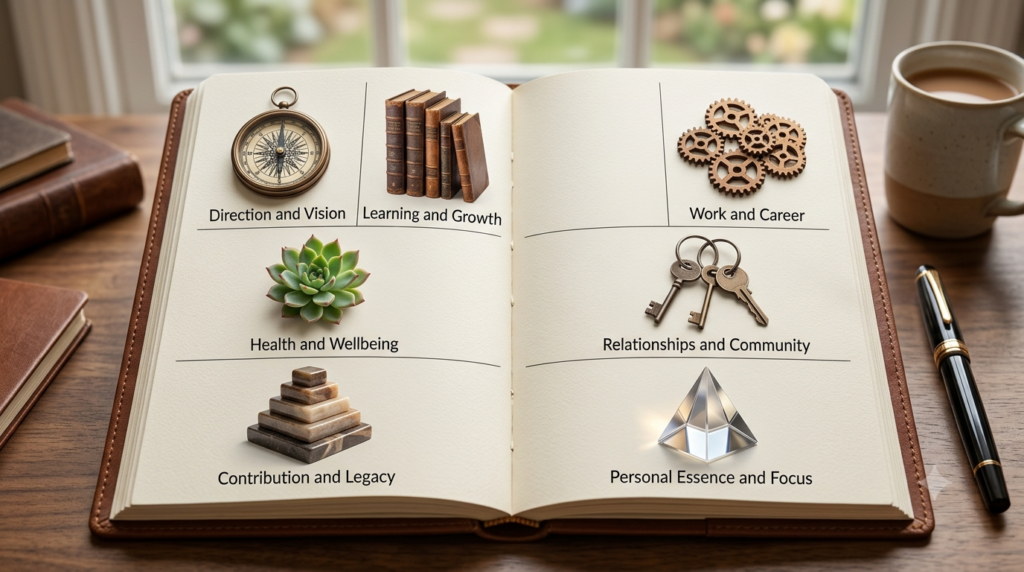
Let’s build your personal life plan step by step.
You don’t need to be an expert in goal-setting. You just need honesty, some reflection, and a willingness to take action.
Before deciding where you want to go, understand where you currently stand.
This is the foundation of your One-Page Life Plan.
Ask yourself:
For students, this could involve identifying academic strengths, interests, learning preferences, and areas that need improvement.
For working professionals, it may involve reviewing professional experience, achievements, communication abilities, leadership qualities, and technical skills.
Example:
Imagine a student who enjoys explaining concepts to friends, participating in group discussions, and organising school activities.
The student may have an interest in communication, leadership, teaching, or people-oriented careers.
Similarly, a working professional who enjoys analysing information, identifying problems, and improving processes may want to explore analytical or operations-related career paths.
The important thing is not to immediately select a career based on one observation.
Instead, use these insights as starting points for further exploration.
Many people set goals based on expectations.
A student chooses engineering because friends are choosing engineering.
A graduate prepares for a government examination because family members expect it.
A professional pursues a managerial position because it appears to be the next logical step.
But have you stopped to ask whether these goals genuinely match your interests and priorities?
Your life plan should reflect what matters to you, not simply what looks impressive to others.
Start by dividing your goals into four categories.
A. Personal Goals
Examples:
B. Academic or Career Goals
Examples:
C. Financial Goals
Examples:
D. Relationship and Family Goals
Examples:
You don’t need ten goals in every category.
Start with one or two meaningful priorities.
Remember:
A clear goal gives your efforts a direction.
This is where your life plan becomes practical.
Let’s say your goal is to become a successful digital marketing professional.
What skills will help you get there?
You may need:
Now consider a student who wants to pursue medicine.
The relevant preparation may include:
Every goal requires a different combination of abilities.
That’s why blindly following someone else’s skill-development plan may not work for you.
Create two lists:
Skills I Already Have
Write down your existing abilities, knowledge, and experience.
Skills I Need to Develop
Identify the gaps between your current abilities and your desired goal.
For example:
| My Goal | Existing Skills | Skills to Develop |
|---|---|---|
| Become a Manager | Communication, teamwork | Leadership, decision-making |
| Become a Graphic Designer | Creativity, visual interest | Design software, portfolio development |
| Become a Business Owner | Sales, networking | Financial planning, operations |
| Become a Software Developer | Logical thinking | Programming, software development |
This gives you a realistic learning direction.
Now that you have identified your goals and skills, think about where you want to be one year from today.
Don’t make this complicated.
Imagine it is November next year.
What would make you feel that you have made meaningful progress?
For a student, it could be:
For a working professional, it could be:
Write your one-year vision in two or three sentences.
For example:
“By the end of the next 12 months, I want to become confident in my chosen career direction, complete two relevant certifications, build a portfolio, and apply for suitable job opportunities.”
Make sure your vision is realistic and within your influence.
You cannot control every opportunity, but you can control the preparation you do.
One of the biggest mistakes people make is setting goals for an entire year and then forgetting about them after a few weeks.
A better approach is to divide your larger goals into smaller 90-day milestones.
Why 90 days?
Because it gives you enough time to develop a skill, complete a project, build a habit, or make measurable progress without making the goal feel too distant.
Let’s take an example.
Goal: Become a Data Analyst
| Timeline | Action |
|---|---|
| Month 1 | Learn Excel fundamentals and basic statistics |
| Month 2 | Start learning SQL and practise queries |
| Month 3 | Complete two beginner data-analysis projects |
Now consider a student preparing for an important examination.
| Timeline | Action |
|---|---|
| Month 1 | Identify weak subjects and create a study timetable |
| Month 2 | Complete important chapters and regular revision |
| Month 3 | Practise mock tests and analyse mistakes |
The idea is simple.
Instead of asking, “How will I achieve my entire goal?”
Ask:
“What meaningful progress can I make in the next 90 days?”
This section is often overlooked, but it can be extremely useful.
Sometimes, the biggest obstacle isn’t a lack of ability.
It’s the number of things competing for your attention.
Think honestly about your daily routine.
Are you spending too much time scrolling through social media?
Are you constantly comparing your progress with others?
Are you saying yes to too many activities?
Are you trying to achieve five major goals simultaneously?
For students, common distractions include:
For professionals, they may include:
Create two small lists.
Things I Need to Reduce:
Things I Need to Increase:
Don’t aim for a perfect lifestyle.
Aim for a better daily routine.
A life plan without regular review can easily become another forgotten document.
That’s why the final section should focus on accountability.
Choose one day every week—Sunday works well for many people—and spend 10–15 minutes reviewing your progress.
Ask yourself:
Don’t use this review to criticise yourself.
Use it to understand what is working and what needs adjustment.
Your goals may change as you gain experience. That’s perfectly normal.
A life plan should evolve with you.
Now let’s bring everything together.
You can copy this template into a notebook, Google Docs, or a simple spreadsheet.
Fill it out honestly. Don’t worry about making it look beautiful.
The objective is to make it useful.
1. MY CURRENT SITUATION
2. MY TOP 3 GOALS
3. MY EXISTING SKILLS
4. SKILLS I NEED TO DEVELOP
5. MY 1-YEAR VISION
Where do I want to see myself after 12 months?
6. MY NEXT 90-DAY ACTION PLAN
7. MY WEEKLY COMMITMENT
MY PERSONAL REMINDER:
“I don’t need to figure out my entire future today. I just need to take the next right step.”

For students, this exercise can be particularly valuable because school and college years involve several important decisions.
From choosing subjects after Class 10 to selecting a college course, preparing for entrance examinations, and exploring career possibilities, students often face pressure to make decisions before they fully understand themselves.
A One-Page Life Plan can help students organise their thinking.
At this stage, the focus should be on exploration rather than making rigid career commitments.
Students can work on:
Parents should encourage curiosity rather than putting unnecessary pressure on children to decide their entire future.
This is an important period for academic and career planning.
Students can use their life plan to:
Most importantly, students should understand the difference between choosing a career because it is popular and choosing one because it genuinely suits their interests, abilities, and circumstances.
The transition from education to employment can feel confusing.
A life plan can help them focus on:
The earlier students start thinking about these areas, the more time they have to explore and prepare.

A One-Page Life Plan isn’t just for students.
In fact, working professionals may benefit from it just as much.
Have you been working in the same industry for several years but feel that your growth has slowed down?
Do you want to switch careers but aren’t sure which direction to take?
Perhaps you want to move into leadership, start a business, or develop skills that will keep you relevant in the changing job market.
Start by reviewing your current professional situation.
List your achievements, responsibilities, projects, and important experiences.
Don’t focus only on your designation.
Identify the problems you have solved and the skills you have developed.
Skills such as communication, problem-solving, teamwork, leadership, planning, and adaptability can be useful across different roles.
Understand how your existing abilities may apply to your desired career.
Study job descriptions and industry requirements for the roles you want.
Identify what you already know and what you need to learn.
Instead of resigning immediately or enrolling in multiple courses, create a practical transition roadmap.
For example:
Your career development should be an ongoing process.
Track your learning, professional opportunities, achievements, and areas that need improvement.
Remember, career growth doesn’t always mean changing companies or getting a higher designation.
Sometimes, it means finding work that better matches your strengths, interests, values, and long-term priorities.
A life plan should simplify your decisions, not create additional pressure.
Here are five mistakes worth avoiding.
Trying to improve everything simultaneously often results in inconsistent action.
Choose a few important priorities instead.
Your friend’s goals, your colleague’s ambitions, or a successful person’s routine may not suit your circumstances.
Build a plan around your own interests, strengths, responsibilities, and aspirations.
Many people focus entirely on what they lack.
But your existing knowledge, experience, and abilities are valuable starting points.
Build on them.
Wanting to learn five skills, change careers, improve your fitness, and build a business within 30 days is likely to create unnecessary pressure.
Set challenging but realistic milestones.
Your life plan should not remain stuck in a notebook.
Review it regularly, celebrate progress, and adjust your next steps when circumstances change.
Progress isn’t always about achieving a major milestone.
Sometimes, progress looks like:
Instead of measuring your life only through salary, marks, job titles, or external recognition, pay attention to whether your actions are taking you closer to the life you genuinely want.
A useful question to ask yourself every month is:
“Am I becoming more capable, more self-aware, and more intentional about my future?”
If the answer is yes, you’re making progress.
A One-Page Life Plan is a simple planning framework that brings your personal goals, career or academic priorities, existing skills, skill gaps, and next steps together on a single page. It helps you understand where you are currently and what actions you should take to move forward.
Start by identifying your current situation, strengths, interests, and challenges. Next, write down your top three goals, identify the skills required to achieve them, create a 90-day action plan, and establish a weekly review routine.
Yes. Students can use it to organise academic goals, explore career options, identify strengths, develop study habits, and plan skill development. It is particularly useful during important academic transitions, such as choosing a stream after Class 10 or selecting a college course after Class 12.
Absolutely. Working professionals can use it for career development, promotions, job switches, entrepreneurship, professional upskilling, and work-life planning. It helps connect existing experience with future career opportunities.
A weekly review is useful for tracking actions and short-term progress. A more detailed monthly review can help you assess your goals, skills, and priorities. You can also update the plan whenever your circumstances or career interests change significantly.
Goal-setting generally focuses on specific outcomes you want to achieve. A life plan takes a broader view by connecting those goals with your strengths, values, skills, priorities, and practical actions. It helps you understand not just what you want, but why it matters and how you can work towards it.
You don’t need to have all the answers immediately. Start by exploring your interests, identifying your strengths, understanding your preferences, and researching different career possibilities. Career counselling and appropriate assessments can also help you organise your thoughts and make more informed decisions.
One of the biggest reasons people feel stuck is that they try to figure out everything at once.
A student wants to know exactly which career will guarantee success.
A working professional wants to know whether changing jobs will make them happier.
A graduate wants to know which skill will give them the best opportunities.
But life rarely gives us complete clarity in advance.
Clarity often develops through self-awareness, exploration, learning, and action.
That’s why a One-Page Life Plan is useful.
It gives you a starting point.
It helps you connect your present abilities with future possibilities and turn vague ambitions into manageable actions.
Remember these three things:
Know yourself. Set meaningful goals. Take consistent action.
You don’t have to achieve everything in one year. You don’t have to follow someone else’s timeline. And you certainly don’t have to have your entire life figured out today.
Just make sure that the steps you take today are helping you move towards a future you genuinely want.

Sometimes, creating a life plan is easy. The difficult part is answering one important question:
“Am I choosing the right direction based on my actual strengths, interests, abilities, and potential?”
This is particularly important for students making academic and career decisions, as well as professionals considering a career change.
At SH Development Academy, we believe better career decisions begin with better self-understanding.
Under the guidance of Santosh Hariharan — DMIT Consultant, Parent & Career Coach, and Success Mindset Coach for Students, we help students, parents, and individuals explore their strengths and make more informed academic and career decisions.
Through our DMIT services and career guidance consultations, we aim to help individuals reflect on:
For working professionals, a career guidance conversation can also help organise thoughts around career interests, existing experience, and possible skill-development requirements.
Remember: No single assessment can determine your entire future or guarantee career success. DMIT reports and other assessments should be considered alongside interests, academic performance, practical abilities, experience, and professional guidance.
Explore our services and learn how we can help you make more informed decisions about your future.
👉 Learn More About DMIT & Career Guidance:
https://shdevelopmentacademy.lovable.app
📞 Call / WhatsApp:
+91 8421315400 | +91 7303290862
⭐ 400+ Google Reviews
See what parents and individuals have shared about their experience with SH Development Academy:
https://share.google/ac9hkh20zcXadkJs9
Your future doesn’t need another complicated plan. It needs clarity, direction, and one meaningful step at a time.
Success & Happiness are the two most important yet elusive things which every human being yearns to achieve in life. Real success and happiness can be savoured only when one enjoys good health and good family relations, along with a good professional career and sound financial stability.
Our Visitor


 Users Today : 15