
Imagine spending four years earning a professional degree, investing lakhs of rupees in education, and finally securing a job, only to discover that artificial intelligence can now perform a significant part of your work.
Sounds worrying, doesn’t it?
This is a question many Indian students, working professionals, and parents are beginning to ask:
“Will the career I choose today still have value in 2030?”
With AI tools becoming increasingly capable of writing content, analysing data, generating designs, assisting with coding, and automating routine office tasks, the traditional idea of a secure career is changing.
Parents who once encouraged their children to pursue engineering, medicine, commerce, or government jobs are now facing a different challenge: understanding which professions will continue to offer meaningful opportunities in an AI-driven world.
But here is something important I want every student and parent to understand:
The future is not necessarily about finding a job that AI cannot touch. It is about choosing a career where your human abilities, professional knowledge, practical experience, and ability to work with AI remain valuable.
In this guide, we will explore the most promising AI-resistant career fields for 2030, the skills students should start developing today, and how to choose a future-ready career based on individual strengths rather than simply following popular trends.

An AI-proof career is commonly understood as a profession that is less likely to be completely replaced by artificial intelligence and automation.
However, there is an important distinction.
No career can be guaranteed to remain completely unaffected by AI.
Even professions such as medicine, law, teaching, engineering, finance, and management are already experiencing changes in how work gets done.
For example:
Does this mean these professions will disappear?
Not necessarily.
In many cases, AI changes the way professionals work rather than eliminating the need for them.
The real value increasingly lies in what humans bring beyond automated tasks:
Therefore, instead of searching for a completely AI-proof job, students should focus on developing an AI-resistant and AI-enabled career.
A few years ago, students generally selected careers based on three major factors:
These factors still matter, but they are no longer enough.
According to the World Economic Forum’s Future of Jobs Report 2025, employers expect approximately 39% of workers’ existing core skills to change or become outdated between 2025 and 2030.
The report also estimates that 170 million new jobs could be created globally by 2030, while 92 million existing jobs could be displaced.
That represents a major transformation in the employment landscape.
The report identifies artificial intelligence, big data, cybersecurity, technological literacy, creative thinking, resilience, and adaptability among the important skills shaping future employment.
For India, the report highlights growing opportunities in areas such as:
This tells us something important.
The future belongs to people who continuously develop relevant skills, not simply those who hold a particular degree.
Source: World Economic Forum – Future of Jobs Report 2025.
Let’s explore seven career categories that offer interesting opportunities in an increasingly AI-driven world.
These are not guaranteed safe jobs. They are fields where human judgement, specialised knowledge, practical involvement, relationships, or accountability can remain important alongside technology.

Healthcare is one of the strongest examples of an industry where technology can improve efficiency but human involvement remains essential.
AI can analyse medical reports, identify patterns in health data, assist with diagnostic imaging, and support treatment planning.
But healthcare involves much more than analysing information.
Patients need someone who can listen to their concerns, understand their circumstances, explain treatment options, provide reassurance, and take responsibility for important decisions.
This human element makes several healthcare professions worth exploring for the future.
Doctors and Medical Specialists
AI can assist doctors with research, diagnostic support, and medical documentation. However, clinical judgement, patient communication, treatment decisions, and accountability remain important.
Nursing Professionals
Nurses provide direct patient care, monitor recovery, communicate with families, and respond to changing patient needs.
Psychologists and Mental Health Professionals
Mental health support involves understanding human emotions, behaviour, relationships, and individual circumstances. AI tools may support these professionals, but responsible human care and judgement remain essential.
Physiotherapists
Physiotherapists work directly with patients to improve mobility, manage physical limitations, and support recovery.
Geriatric Care Professionals
As healthcare needs evolve and populations age, specialised elderly care, rehabilitation, and support services offer important areas of opportunity.
Special Educators
Children with different learning and developmental needs often require personalised educational support, patience, observation, and collaboration with families.
Healthcare involves physical interaction, emotional understanding, specialised training, ethical responsibility, and decisions that can significantly affect people’s lives.
AI can become a valuable assistant, but healthcare professionals must know how to use it responsibly.
Who should explore this field?
Students interested in biology, helping people, understanding human behaviour, problem-solving, and working in service-oriented environments may wish to explore healthcare-related careers.

Here is something interesting.
While many students are focusing on software engineering and desk-based jobs, several practical and technical professions may continue to offer valuable opportunities.
Think about an electrician repairing a complex electrical fault, a technician maintaining industrial machinery, or an HVAC specialist diagnosing an air-conditioning problem at a commercial building.
These professionals work in physical environments where every situation can be different.
A computer program may help identify possible faults, but someone still needs to inspect the equipment, understand the surroundings, make practical decisions, and complete the repair.
These professions require practical knowledge, physical presence, troubleshooting, safety awareness, and the ability to respond to unpredictable situations.
India’s growing manufacturing, infrastructure, electric mobility, and renewable energy sectors also create opportunities for specialised technical professionals.
Students who enjoy:
A traditional office job is not the only route to a successful career.
Sometimes, a specialised technical skill can create excellent professional opportunities.

Can AI negotiate a complex business deal?
Can it build long-term trust with a client who is uncertain about investing millions in a project?
Can it take complete responsibility when an important business decision goes wrong?
AI can support business professionals with market research, customer analysis, presentations, forecasting, and communication.
But leadership involves understanding people, managing uncertainty, negotiating, taking responsibility, and making decisions when there is no perfect answer.
This is why business-oriented careers that combine technology with human judgement remain worth exploring.
Enterprise Sales Professionals
Selling high-value products and services often requires relationship-building, negotiation, understanding customer requirements, and handling complex objections.
Business Development Managers
They identify opportunities, develop partnerships, understand markets, and create strategies for business growth.
Management Consultants
Consultants help organisations solve business problems, improve processes, and make strategic decisions.
Human Resource Leaders
HR professionals manage employee relationships, organisational culture, talent development, and sensitive workplace situations.
Crisis Management Professionals
Organisations need experienced professionals who can respond to unexpected situations, coordinate teams, and make responsible decisions under pressure.
Business Strategy Professionals
These professionals evaluate market conditions, organisational capabilities, risks, and long-term opportunities.
AI can provide information and recommendations, but successful leadership also requires human judgement, accountability, communication, and the ability to influence people.
A useful skill combination for the future:
Business understanding + AI literacy + Communication + Leadership.
Students interested in entrepreneurship, business, management, persuasion, and working with people can explore this category.

One of the biggest misconceptions about AI is that it will eventually replace teachers completely.
Think about your own school experience.
Did you learn everything simply because someone provided information?
Of course not.
A good teacher does much more than explain a subject.
They notice when a student is struggling, understand individual learning challenges, encourage confidence, provide feedback, and help students develop discipline.
AI can generate explanations, practice questions, lesson plans, and personalised learning resources.
But human educators also play an important role in motivation, mentoring, behavioural guidance, and student development.
Education is not simply about transferring information.
It is also about developing people.
Students need encouragement, direction, accountability, feedback, and support when they face challenges.
Similarly, organisations need trainers and development professionals who can help employees apply knowledge in real working environments.
Students who enjoy explaining concepts, helping others, communicating, mentoring, understanding behaviour, and supporting personal development may find this category interesting.

As businesses, governments, hospitals, banks, and individuals become increasingly dependent on digital systems, protecting information becomes essential.
Cybersecurity is not just about installing antivirus software.
It involves understanding risks, identifying vulnerabilities, investigating suspicious activities, responding to security incidents, and protecting important digital infrastructure.
AI is also being used in cybersecurity, both to detect threats and to create more sophisticated attacks.
This makes skilled professionals who understand technology, security, and risk management increasingly important.
Cybersecurity involves an ongoing relationship between defenders and attackers.
Threats evolve, systems change, and security decisions often require investigation and judgement.
Professionals must understand not only technology but also business risks, regulations, and the consequences of security failures.
The World Economic Forum identifies networks and cybersecurity among the fastest-growing skill areas through 2030.
Students who enjoy:
This field requires continuous learning, but it offers several specialised career pathways.

The future of employment is not shaped by AI alone.
Climate change, energy requirements, sustainability, and environmental challenges are also influencing industries.
India’s transition towards cleaner energy and more efficient infrastructure is creating opportunities across engineering, research, energy management, and environmental services.
AI can help analyse environmental data, optimise energy consumption, and monitor systems.
However, implementing real-world solutions requires engineers, scientists, technicians, project managers, and environmental specialists.
Energy infrastructure requires planning, installation, maintenance, safety management, and real-world implementation.
As organisations work towards more sustainable operations, professionals with relevant technical and environmental knowledge can find opportunities.
Students interested in science, engineering, environmental protection, technology, and solving real-world problems may wish to investigate these career options.

AI can now generate images, write articles, create videos, compose music, and produce marketing content.
Naturally, many students pursuing creative careers are wondering whether their future is secure.
The answer is not to abandon creativity.
It is to understand how creativity is evolving.
Producing generic content may become easier to automate. However, understanding human emotions, developing original concepts, creating meaningful experiences, interpreting cultural contexts, and making creative decisions remain valuable capabilities.
Similarly, psychology and human-centred professions involve understanding people beyond what can be captured in a dataset.
The value of these professions often comes from understanding what people need, why they behave in particular ways, and how to create solutions that connect with them.
AI can assist with research, design, and content production, but human insight and responsible decision-making continue to matter.
Important: Psychology, counselling, clinical practice, and other regulated professions require appropriate educational qualifications and professional credentials.
Yes, and students should understand this distinction before selecting a profession.
| AI-Proof Career | AI-Resistant Career |
|---|---|
| Suggests a job cannot be affected by AI. | Recognises that AI may change tasks but not necessarily eliminate the profession. |
| Assumes technology will have little impact. | Encourages professionals to adapt to technological changes. |
| Focuses on finding a completely safe job. | Focuses on developing valuable human and technical skills. |
| Can create a false sense of security. | Encourages continuous learning and upskilling. |
In reality, the second approach is more practical.
For example, a doctor who understands AI-assisted diagnostic tools may become more effective.
A teacher who uses AI to personalise learning resources may improve classroom outcomes.
A business professional who combines relationship-building with AI-powered research may become more competitive.
The objective should not be to compete against AI at everything. It should be to develop capabilities that allow you to work effectively with it.
Choosing a promising career field is only half the decision.
The other half is developing the skills that will help you remain relevant within that field.
According to the World Economic Forum’s Future of Jobs Report 2025, employers expect a combination of technological and human capabilities to become increasingly important.
Here are some of the skills students should start developing.
AI can generate answers, but you need to evaluate whether those answers make sense.
Critical thinking helps you:
Understanding your own emotions and recognising the emotions of others are valuable interpersonal abilities.
Emotional intelligence can support:
Creativity is not limited to drawing, painting, or music.
It also means approaching problems differently, generating new ideas, and developing original solutions.
The ability to learn new tools, adjust to changing situations, and remain flexible will be important throughout your career.
Your degree may remain the same, but the tools and knowledge required in your profession may change.
Most professional environments require people to work with others.
The ability to explain ideas, listen carefully, negotiate, and collaborate can help you stand out.
Avoiding AI is not a sustainable career strategy.
Students should understand how AI tools work, where they are useful, what their limitations are, and how to use them responsibly.
Technology can generate recommendations, but organisations still need people who can evaluate consequences, understand responsibilities, and make ethical decisions.
The important lesson is that future employability will depend on combining technical knowledge with human capabilities.

While exploring future opportunities, it is equally important to understand which types of work may face greater disruption.
According to the World Economic Forum, some of the roles expected to decline include:
Why are these roles more exposed?
Because many of their responsibilities involve repetitive, structured, and predictable tasks.
For example:
A data entry professional may spend most of the day transferring information from one system to another.
A basic administrative role may involve repetitive scheduling, documentation, and record management.
Many of these tasks can increasingly be automated.
However, this does not mean everyone working in these professions will lose their jobs.
Roles evolve, responsibilities change, and employees can transition into more analytical, customer-facing, supervisory, or specialised positions.
The important thing is to recognise changing skill requirements early and prepare accordingly.
This is where I want parents and students to pause for a moment.
When students hear about AI, cybersecurity, robotics, data science, and other emerging fields, they often feel pressure to enter these professions.
But is every student naturally suited to technology?
Does every student need to become a software engineer to have a successful future?
Absolutely not.
A student who enjoys understanding people may find greater satisfaction in psychology, education, or healthcare.
Someone who enjoys practical problem-solving may prefer engineering, robotics, or technical professions.
A student with strong communication and interpersonal interests may explore management, sales, consulting, or entrepreneurship.
A future-ready career is not simply a career that is popular. It is a career that connects your individual strengths and interests with relevant future opportunities.
Here is a practical framework parents and students can use.
Ask yourself:
Your answers can help you identify career categories worth exploring.
Aptitude refers to your ability or potential to learn and perform particular types of tasks.
For example:
Understanding your aptitude can help you evaluate which types of academic and professional activities may suit your abilities.
Remember, aptitude is not a fixed limit on what you can achieve. Skills can improve through education, practice, and experience.
Two students may have similar academic marks but very different personalities and career preferences.
One may enjoy working independently, while another may prefer teamwork.
One may enjoy structured environments, while another may prefer creativity and flexibility.
Understanding these differences can help students explore careers that align with their preferred working styles.
Don’t limit your research to the traditional career options you already know.
Explore fields such as:
Research the qualifications, skills, job responsibilities, and actual employment opportunities associated with each field.
A career may sound attractive, but you should understand the path required to enter it.
Find out:
A little research today can prevent confusion later.
Let me share a situation that many parents will recognise.
A student scores excellent marks in Mathematics.
Naturally, everyone starts suggesting engineering, computer science, or data science.
But what if the student is genuinely interested in psychology, communication, or creative problem-solving?
Should academic marks alone determine the career?
Similarly, a student may have average academic performance but excellent practical reasoning, interpersonal abilities, or creative interests.
A percentage-based approach may not reveal the complete picture.
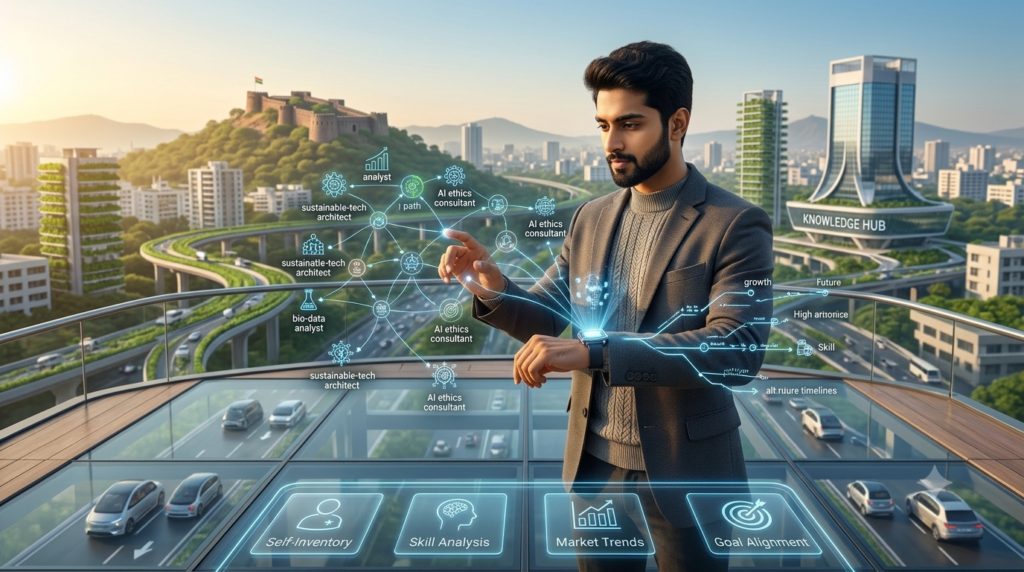
This is why a structured career assessment can be useful.
A good career assessment helps students explore different dimensions of their individual profiles rather than relying only on marks or family expectations.
Depending on the assessment framework, it can evaluate areas such as:
1. Aptitude
Helps explore abilities in areas such as logical, numerical, verbal, and spatial reasoning.
2. Personality
Provides insights into behavioural preferences, interpersonal tendencies, and preferred working environments.
3. Interests
Helps identify the types of activities, subjects, and professional areas that attract an individual.
4. Career Compatibility
Helps connect the individual’s assessment profile with potentially suitable career categories.
5. Career Exploration
Encourages students to explore multiple professional pathways instead of limiting themselves to a few traditional options.
An assessment should not be treated as a final verdict about someone’s future. It is a decision-support tool that works best when combined with counselling, academic performance, personal interests, practical exposure, and informed research.
Dear parents, this section is particularly important.
Every time a new technology becomes popular, a new career trend follows.
A few years ago, everyone wanted to become a software engineer.
Then came data science, artificial intelligence, and machine learning.
Today, many parents are encouraging their children to explore AI-related careers.
There is nothing wrong with exploring these opportunities.
The problem begins when we assume that because a particular field has excellent future prospects, every child should enter it.
Consider these situations:
Your child’s career should not be selected based on what is trending in the market alone.
Instead, try to understand three important dimensions:
That is a much healthier approach to career planning.

One of the biggest challenges in career counselling is that students often know only a limited number of professions.
Ask a student about career options, and you may hear:
Doctor, Engineer, CA, Lawyer, Government Officer, or Software Developer.
But the modern employment landscape is much broader.
There are thousands of specialised and emerging career pathways across different industries.
For example:
Exploring different careers can help students discover opportunities they may never have considered.
At SH Development Academy, students can explore a dedicated career library containing 3,000+ career options.
Explore 3000+ New-Age Career Options Here:
https://shdevelopment.edumilestones.com/global-career-library
Take time to understand different career paths, their responsibilities, qualifications, and future opportunities before making an important decision.
The right preparation depends on the student’s current academic stage.
This is a good time to explore interests and develop foundational abilities.
Focus on:
Don’t put unnecessary pressure on children to finalise a career too early.
The objective should be exploration and self-awareness.
Class 10 is an important decision-making stage because students must begin considering their preferred academic stream.
Before choosing Science, Commerce, or Humanities, explore:
Don’t choose a stream simply because your friends are choosing it.
At this stage, career planning should become more specific.
Students should:
The earlier students understand their options, the more thoughtfully they can plan their next steps.
No profession is completely guaranteed to be safe from AI. However, careers involving human judgement, empathy, physical problem-solving, specialised technical expertise, and accountability may be more resistant to complete automation.
Healthcare, education, skilled trades, cybersecurity, leadership, and certain creative professions are worth exploring.
AI is already changing software development through automated coding, debugging, testing, and documentation.
However, software engineering involves much more than writing code. System architecture, complex problem-solving, security, product understanding, and technical decision-making remain important.
Software engineers who learn to work effectively with AI tools may be better positioned for changing industry requirements.
Jobs involving repetitive, predictable, and highly structured tasks may face greater automation exposure.
Examples include certain data entry, clerical, administrative, and routine processing roles.
However, automation exposure does not automatically mean an entire occupation will disappear.
AI and Machine Learning offer promising opportunities, particularly for students interested in mathematics, programming, statistics, and technology.
However, students should evaluate their aptitude and interests before selecting this path.
It is not necessary for every student to become an AI engineer to have a successful career in the future.
Important skills include:
A combination of technical and human skills will be increasingly valuable.
Absolutely.
Commerce students can explore finance, accounting, fintech, business analytics, entrepreneurship, taxation, management, compliance, and financial risk management.
Technology is changing these industries, but business understanding, financial judgement, and specialised knowledge remain important.
Yes.
Humanities students can explore psychology, law, behavioural science, communication, education, public policy, design, research, and many other fields.
Understanding human behaviour, society, communication, and culture can be valuable across different professions.
Start by understanding your child’s interests, aptitude, personality, academic strengths, and preferred activities.
A structured psychometric career assessment followed by professional career counselling can help bring greater clarity to the decision-making process.
Remember, no assessment can guarantee career success. The final decision should also consider qualifications, opportunities, and the student’s willingness to learn.
There is no reliable basis for assuming that these professions will disappear by 2030.
AI is likely to change how professionals perform many tasks. However, human judgement, specialised knowledge, professional responsibility, and interpersonal relationships will continue to matter.
The biggest mistake parents and students can make today is selecting a career based entirely on what is popular.
The second biggest mistake is assuming that one degree will guarantee lifelong career security.
The employment landscape is changing. New technologies are emerging, industries are evolving, and professional skills are being redefined.
But one thing remains important:
Understanding yourself and continuously developing your abilities will always be valuable.
As parents, instead of asking only:
“Which career has the highest salary?”
Start asking:
A career decision made with self-awareness and proper guidance is more meaningful than one made simply by following a trend.
Remember, the goal is not to predict exactly what the world will look like in 2030.
The goal is to prepare yourself to adapt, learn, and grow regardless of how the world changes.

With thousands of career options emerging, choosing the right direction can feel overwhelming.
At SH Development Academy, we believe career planning should begin with understanding the individual, not simply following market trends.
Under the guidance of Santosh Hariharan — DMIT Consultant, Parent & Career Coach, and Success Mindset Coach for Students, we help students and parents explore career possibilities through structured assessments and personalised career guidance.
Our online Psychometric Career Assessment can help students explore:
✅ Aptitude and reasoning abilities.
✅ Personality and behavioural preferences.
✅ Interests and potential career areas.
✅ Career options aligned with their assessment profile.
✅ Different academic and professional pathways.
The assessment is followed by career guidance to help students and parents understand the results and evaluate suitable options.
Take the First Step Towards a More Informed Career Decision.
👉 Explore Psychometric Career Assessments:
https://shdevelopment.edumilestones.com
Don’t limit your child’s future to the few professions you already know.
Explore emerging and specialised career opportunities across industries.
👉 https://shdevelopment.edumilestones.com/global-career-library/
Learn more about our DMIT services and how we approach child development and parental guidance.
👉 https://shdevelopmentacademy.lovable.app/
We are grateful for the trust and support of more than 400 parents and individuals who have shared their experiences with us.
⭐ Read Our Google Reviews:
https://share.google/ac9hkh20zcXadkJs9
For Career Assessment & Consultation Enquiries:
📞 +91 8421315400
📞 +91 7303290862
SH Development Academy
Helping students and parents make more informed decisions about education, personal development, and career direction.
The future doesn’t belong only to those who know how to use AI. It belongs to those who understand their strengths, keep learning, and know how to use technology wisely.
Success & Happiness are the two most important yet elusive things which every human being yearns to achieve in life. Real success and happiness can be savoured only when one enjoys good health and good family relations, along with a good professional career and sound financial stability.
Our Visitor


 Users Today : 69