
“Don’t do that!”
“How many times do I have to tell you?”
“Stop crying!”
“बस! अब बहुत हुआ!”
If you have a toddler at home, chances are you have said at least one of these. And honestly, you are not a bad parent for losing your patience sometimes.
Parenting a toddler can test even the calmest parent.
One minute your child is happily playing. The next minute they are crying because you gave them the wrong colour cup. 😄
Or they refuse to eat.
They throw a toy.
They scream in a supermarket.
They don’t want to leave the park.
And suddenly, you are wondering:
“Am I being too strict?”
“Should I ignore this behaviour?”
“Should I punish my child?”
“How do I discipline my toddler without constantly shouting?”
This is where positive discipline for toddlers in India becomes important.
Positive discipline doesn’t mean allowing your child to do whatever they want. It means setting clear boundaries while teaching the child how to behave—without fear, humiliation or physical punishment.
UNICEF India encourages parents to use constructive discipline, communication, affection, play and age-appropriate boundaries. (UNICEF)
Let’s look at 7 practical steps you can actually use at home.
Positive discipline is about teaching rather than simply punishing.
The goal isn’t:
“How can I make my child obey me?”
The better question is:
“How can I teach my child the behaviour I want them to learn?”
Toddlers are still developing emotional regulation. Tantrums are a normal part of development, particularly around the toddler and preschool years. (UNICEF)
So when your two-year-old throws themselves on the floor because you said “No,” it doesn’t necessarily mean you have a “naughty child.”
It may mean you have a small child experiencing a very big emotion with very limited ability to manage it.
That’s an important difference.
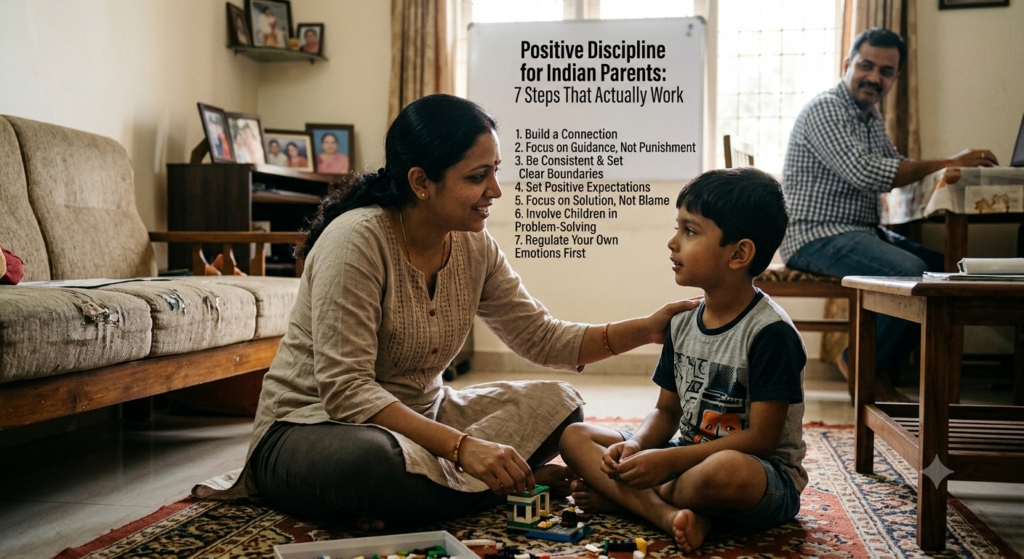
Toddlers cannot remember twenty household rules.
Start with a few simple boundaries:
🟢 “We don’t hit.”
🟢 “Toys stay on the floor.”
🟢 “We eat at the dining table.”
🟢 “We hold hands near the road.”
Keep the rule short, consistent and age-appropriate.
UNICEF India also recommends setting boundaries and creating routines for young children. (UNICEF)
❌ “How many times have I told you not to throw things?”
Try:
✅ “We don’t throw toys. Let’s put the toy here.”
The second statement teaches the behaviour instead of simply expressing your frustration.
Here’s something many parents underestimate:
Children repeat behaviours that receive positive attention.
If your child quietly puts their toys away, don’t assume they “should know better.”
Notice it.
Say:
“Wow! You kept your toys back. That’s helpful.”
Specific praise tells your child exactly what behaviour you appreciated.
The American Academy of Pediatrics recommends positive reinforcement and giving attention to appropriate behaviour as part of healthy discipline. (HealthyChildren.org)
Don’t only notice your child when something goes wrong.
Catch them doing something right.
Toddlers are discovering independence.
So when you repeatedly say:
“Come here.”
“Eat this.”
“Wear this.”
“Don’t touch that.”
they may respond with their favourite word:
“NO!” 😄
Try offering limited choices instead.
“Do you want the red T-shirt or the blue one?”
“Do you want to brush teeth before the story or after the story?”
“Do you want the banana or apple?”
You’re still setting the boundary—but giving your child a little control within it.
Offering small, directed choices is also recommended as a practical strategy for managing toddler tantrums. (HealthyChildren.org)
Toddlers have short attention spans.
Use that to your advantage.
Suppose your child is repeatedly playing with something unsafe.
Instead of:
❌ “Don’t touch that! I said don’t touch it!”
Try:
✅ “That’s not for playing. Come, let’s play with this.”
Move their attention toward an acceptable alternative.
UNICEF India specifically recommends distraction, alternatives and negotiation when managing toddler tantrums. (UNICEF)
You don’t have to win every argument.
Sometimes the smartest parenting strategy is redirection.
Sometimes the behaviour isn’t really about the behaviour.
Your toddler may become extremely difficult because they are:
😴 Tired
🍽️ Hungry
📱 Overstimulated
😟 Frustrated
🏃 Overexcited
🧠 Unable to communicate what they want
Before immediately saying:
“Why are you behaving like this?”
ask yourself:
“What happened just before this?”
UNICEF India recommends paying attention to factors such as hunger, tiredness and the child’s environment when dealing with tantrums. (UNICEF)
Understanding the trigger can help you prevent the next meltdown rather than simply reacting to the current one.
This may be the hardest step.
Your child is not only listening to your words.
They are watching how you handle frustration.
If you scream whenever you’re angry, your child learns:
“Screaming is how we handle anger.”
If you pause, breathe and communicate firmly, you’re modelling another option.
UNICEF India emphasizes peaceful conflict resolution and avoiding shouting, while the AAP recommends calm, constructive discipline rather than harsh verbal or physical punishment. (UNICEF)
Of course, parents lose their temper sometimes.
You are human.
The important part is learning to repair and try differently next time.
This is a small change in language with a big difference.
Instead of:
❌ “You’re a bad boy.”
Say:
✅ “Hitting is not okay.”
Instead of:
❌ “You’re always naughty.”
Say:
✅ “I know you’re angry, but we don’t throw things.”
The first approach attacks the child’s identity.
The second teaches the child about their behaviour.
Your child should know:
“My parents don’t like this behaviour.”
—not—
“My parents don’t like me.”
This is an important conversation for Indian parents.
Many parents grew up hearing:
“एक चपत पड़ेगी तो समझ जाएगा.”
But current child-development guidance does not recommend physical punishment.
The American Academy of Pediatrics advises against spanking, hitting, slapping, threatening, humiliating or shaming children, recommending positive reinforcement, limit-setting and redirection instead. (HealthyChildren.org)
Positive discipline doesn’t mean being permissive.
You can be:
Warm + Firm
You can say:
“I understand you’re angry.”
and still say:
“I won’t let you hit me.”
That’s positive discipline.
This is one of the biggest misunderstandings.
Positive parenting is not:
❌ No rules
❌ No consequences
❌ Giving children everything they demand
❌ Avoiding the word “No”
❌ Allowing aggressive behaviour
It means:
Connection + Boundaries + Consistency + Teaching
Your child still needs limits.
They just don’t need fear to learn them.
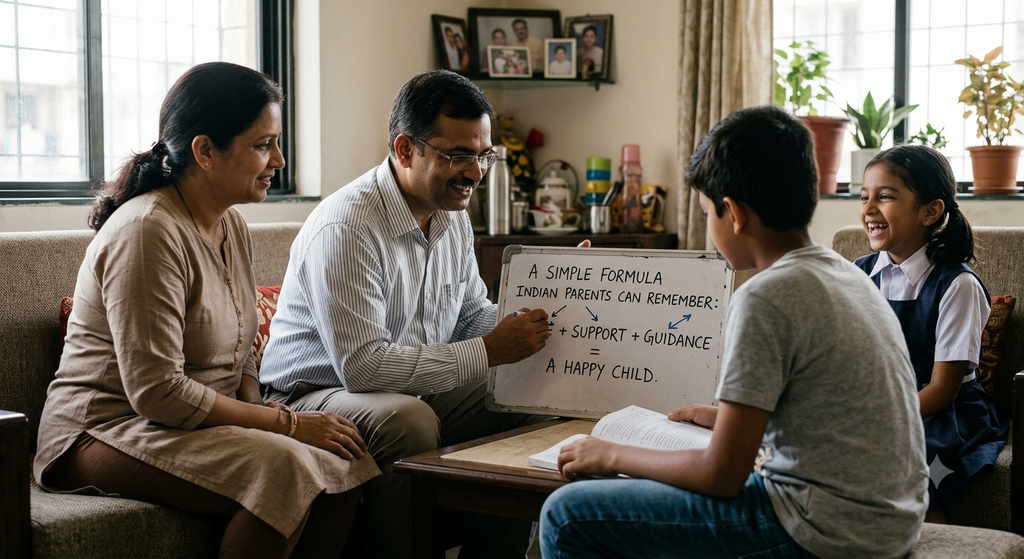
When your toddler misbehaves, try this:
STOP: Don’t react immediately.
CONNECT: Acknowledge the emotion.
“I know you’re angry.”
SET LIMIT: Clearly state the boundary.
“But we don’t hit.”
REDIRECT: Give them the next acceptable action.
“Come, let’s use your hands to play with the blocks.”
Simple.
Practical.
And much easier to remember when you’re standing in the middle of a toddler meltdown.
There is another important part of parenting that is often overlooked.
Every child is different.
Two children of the same age can have completely different:
That’s why effective parenting isn’t simply about learning more parenting rules.
It’s also about understanding your particular child.
This is one area where a professionally interpreted DMIT assessment and parent consultation can provide an additional perspective on a child’s reported strengths, learning preferences and behavioural tendencies.
It should be treated as a guidance tool—not a diagnosis or a substitute for professional medical or psychological assessment.
You don’t need to become a perfect parent.
Your toddler doesn’t need a perfect parent either.
They need a parent who is willing to:
Understand → Guide → Set boundaries → Listen → Try again.
Positive discipline takes practice.
Some days you’ll handle the tantrum beautifully.
Other days you’ll lose your patience.
That’s parenting.
What matters is that you’re learning along with your child.
And perhaps the biggest shift is this:
Don’t ask only, “How do I control my child’s behaviour?”
Ask:
“What is my child trying to communicate, and what can I teach them from this moment?”
That question can completely change the way you parent.
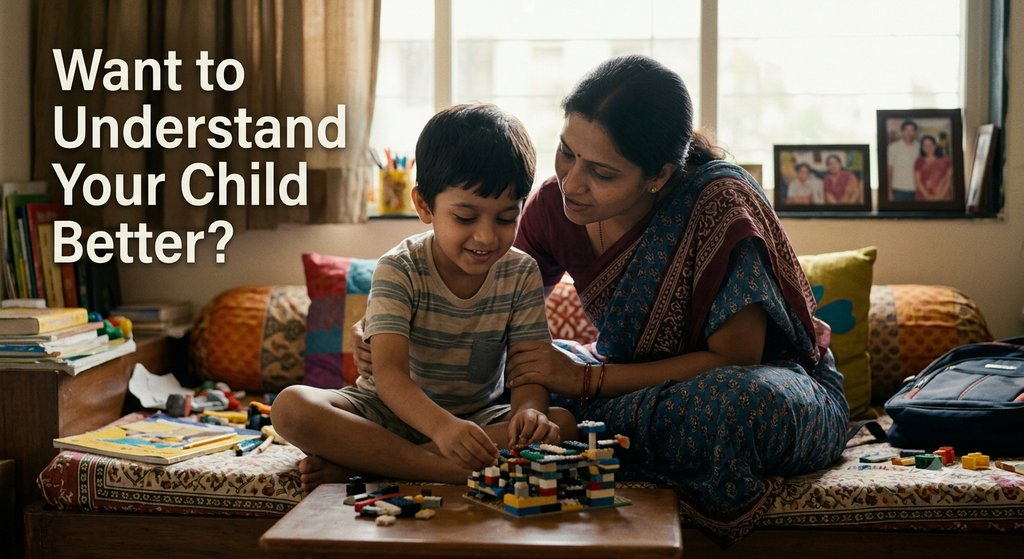
Sometimes the challenge isn’t that parents don’t care enough.
They simply don’t have enough information about how their child is naturally wired.
At SH Development Academy, we help parents understand their child’s strengths, learning preferences and behavioural tendencies through DMIT consultation and parent-focused guidance.
The objective isn’t to put a label on your child.
It’s to help you become a more informed, confident and understanding parent.
👨👩👧 Want to understand your child better?
👉 Book a DMIT Consultation: Book Your DMIT Consultation
📞 8421315400 | 7303290862
⭐ 400+ parents have shared their experience with us: See 400+ Google Reviews
Because better parenting doesn’t begin with controlling the child. It begins with understanding the child.
Success & Happiness are the two most important yet elusive things which every human being yearns to achieve in life. Real success and happiness can be savoured only when one enjoys good health and good family relations, along with a good professional career and sound financial stability.
Our Visitor


 Users Today : 19