
📱 “How much screen time is actually okay for my child?”
If you are a parent in India, chances are you have asked this question more than once.
Maybe your toddler watches cartoons while eating.
Maybe your 7-year-old needs a tablet for school but ends up watching YouTube.
Or perhaps your 11-year-old says, “But everyone in my class has a phone!”
The problem is not simply screens.
The real question is:
Is screen use taking away from the things my child needs more—sleep, physical activity, learning, play, family interaction and real-world experiences?
That is why modern guidance is moving beyond a simple “X hours per day” rule and encouraging families to look at age, content, context and what screen time is replacing. The American Academy of Pediatrics’ updated 2026 guidance specifically emphasizes this broader approach.
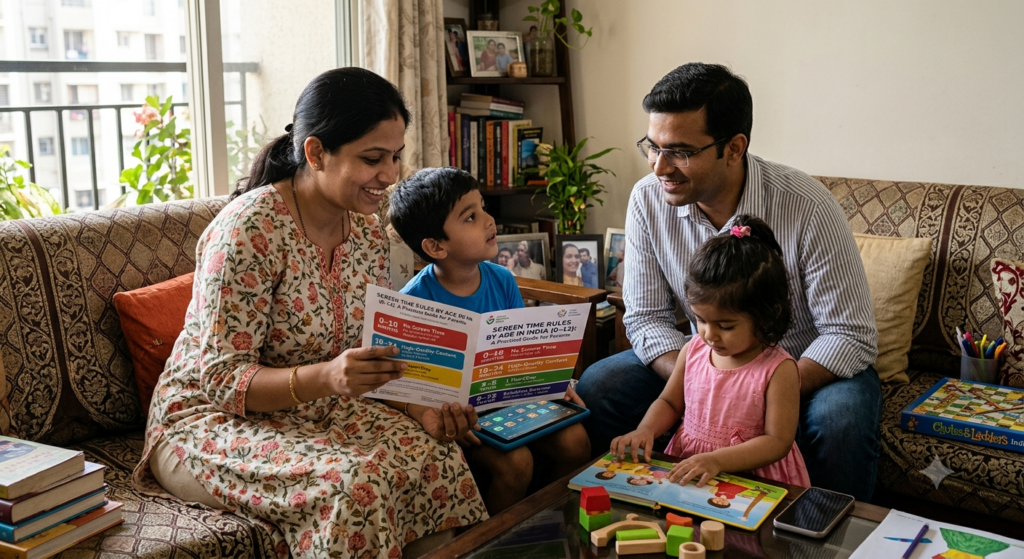
Here is a practical screen time rules by age India guide you can actually use at home.
For babies and very young toddlers, screens should not become a substitute for interaction.
At this age, children learn through:
👀 Looking at faces
🗣️ Listening and talking
🤲 Touch and movement
🧸 Playing
📖 Stories and books
WHO guidance recommends no sedentary screen time for infants under 1, and for 2-year-olds, no more than 1 hour, with less being better.
For parents, the practical rule is simple:
Don’t use a phone or TV as the default solution for boredom, feeding or calming your child.
Video-calling grandparents or occasional co-viewing is very different from leaving a child alone with a screen.
This is the age when many Indian parents start hearing:
“One more cartoon, please!”
And before you know it, 20 minutes becomes two hours.
For preschoolers, aim for limited, purposeful screen use rather than unrestricted entertainment.
Choose:
✅ Age-appropriate educational content
✅ Slow-paced, understandable content
✅ Co-viewing with parents
✅ Fixed screen windows
Avoid making screens the reward for every small task.
Most importantly, protect:
🌳 Outdoor play
📚 Reading
🧩 Creative play
😴 Sleep
👨👩👧 Family interaction
The goal isn’t to raise a child who never uses technology.
It’s to raise a child who doesn’t need technology for every moment of boredom.
Once children enter school, screen use becomes more complicated.
There may be:
This is the stage where parents should create clear family rules.
For example:
📌 Homework before entertainment
📌 No screens during meals
📌 No device in the bedroom
📌 Fixed gaming/video time
📌 Outdoor play every day
📌 Screens off before bedtime
AAP guidance recommends screen-free zones such as meals and bedtime and encourages families to create a media plan that works for their individual routines.
And remember:
Don’t make every screen use a battle.
Make the rule predictable.
When the child knows when screen time starts and ends, there is less room for daily negotiation.
This is an important transition period.
Your child is becoming more independent, and simply saying:
“Give me the phone!”
may stop working.
Instead, start teaching self-management.
Talk about:
📱 Why endless scrolling is difficult to stop
🎮 How gaming affects time management
🔍 How algorithms keep showing similar content
🧠 Why multitasking can affect concentration
🔐 Online privacy and safety
🤝 Respectful online communication
The AAP’s 2026 approach encourages parents to move beyond simply counting minutes and focus on the child’s overall digital environment, including content, communication and what media is crowding out.
At this age, your goal should gradually shift from:
“I control your screen.”
to:
“I am teaching you how to control your screen.”
That is a much more valuable life skill.
There isn’t one perfect number that works for every child.
Age matters—but so do:
A child watching a 30-minute educational programme with a parent is not having the same experience as a child spending 30 minutes endlessly scrolling short videos.
This is why screen time rules by age in India should be treated as a starting framework—not a mathematical formula.
AAP’s current guidance specifically recommends looking at the child, content, calming, what media is crowding out, and communication rather than focusing only on minutes.
Don’t look only at the clock.
Look at your child’s behaviour.
Every screen shutdown becomes an argument.
Late-night screen use or difficulty settling after screens is a warning sign.
Homework constantly gets delayed because of gaming or videos.
The child would rather stay indoors with a device than play, move or interact.
If your child says “I’m bored” within two minutes of putting the device down, it’s time to rebuild their ability to enjoy offline activities.
Children don’t learn digital habits only from instructions.
They learn by watching us.
If a parent is checking WhatsApp during dinner while telling the child:
“Put your phone away!”
the message becomes confusing.
Current AAP guidance also emphasizes parents modelling healthy digital habits.
So create some family rules, not just children’s rules.
Try:
🍽️ No phones during meals
🛏️ Devices stay outside bedrooms at night
👨👩👧 One screen at a time
🚶 Daily offline family time
📵 Notifications off during study/family time
This is where many parents make a mistake.
They take away the phone and then say:
“Now go study.”
But children need something meaningful to replace the screen.
Try:
🎨 Drawing
⚽ Sports
🎵 Music
📖 Reading
🧩 Puzzles
🧑🍳 Helping with cooking
🌱 Gardening
🗣️ Family conversations
🎲 Board games
The AAP recommends making room for reading, outdoor play, hobbies, family activities and other experiences so screens don’t crowd them out.
Technology is now part of childhood.
Children use screens for:
So the goal shouldn’t be to create a completely screen-free child.
The goal is to raise a child who can say:
“I can use technology without technology controlling me.”
That’s the real digital skill we want our children to develop.
Don’t suddenly remove everything overnight and expect the problem to disappear.
Start small.
Step 1: Track how your child currently uses screens.
Step 2: Identify the biggest problem—gaming, YouTube, phone, bedtime, etc.
Step 3: Create 2–3 clear family rules.
Step 4: Replace screen time with attractive offline activities.
Step 5: Be consistent.
Step 6: Involve your child in creating the family plan.
Children are more likely to accept technology limits when they understand the reason behind them and have some involvement in creating the rules.
Two children can have exactly the same screen-time rule and respond completely differently.
One child may easily switch from gaming to homework.
Another may struggle significantly with transitions.
One child may become distracted quickly.
Another may use technology productively for learning.
This is why, in my experience as a DMIT Consultant and Parent & Career Coach, parenting should never become a competition between “what works for someone else’s child” and your child.
The better question is:
“What does MY child need?”
Understanding a child’s natural personality, learning preferences, strengths and behavioural tendencies can help parents make better day-to-day decisions—not just about screens, but about studies, communication, activities and future development.
If you want something practical, start with this:
Before Screen → Responsibility
During Screen → Purpose
After Screen → Transition
For example:
📚 Finish homework → 🎮 Gaming → ⚽ Outdoor play
Instead of:
📱 Gaming → 📱 YouTube → 📱 More YouTube → 😫 “Go study!”
Small changes in the structure of the day can make a surprisingly big difference.
Screen-time problems are sometimes only the visible part of a bigger parenting challenge.
If you’re struggling to understand:
a personalised DMIT Consultation can give you another perspective on your child’s natural strengths, learning preferences and behavioural tendencies.
At SH Development Academy, our DMIT consultations are designed to help parents move from guesswork to greater understanding.
With guidance from Santosh Hariharan — DMIT Consultant, Parent & Career Coach and Student Success Mindset Coach, the focus is not simply on giving you a report. It is about helping you understand how to use the insights in everyday parenting.
⭐ 400+ parents and families have trusted our guidance.
Click here to see 400+ Google Reviews
📞 +91 8421315400 | +91 7303290862
Because better parenting doesn’t begin with having all the answers.
It begins with understanding your child. ❤️
Success & Happiness are the two most important yet elusive things which every human being yearns to achieve in life. Real success and happiness can be savoured only when one enjoys good health and good family relations, along with a good professional career and sound financial stability.
Our Visitor


 Users Today : 15