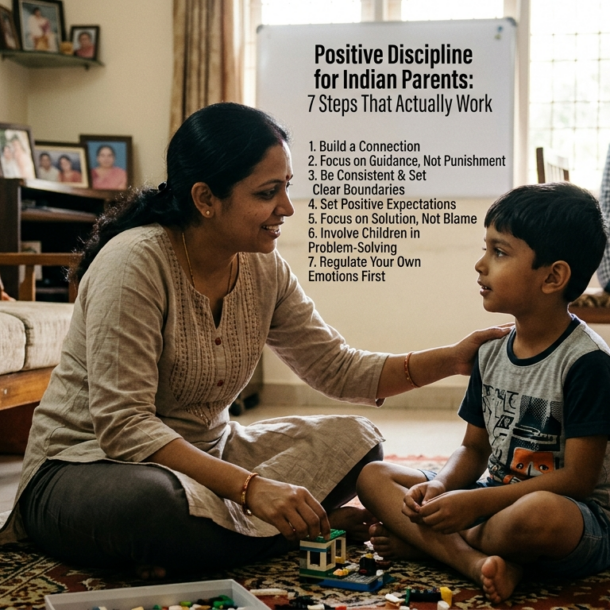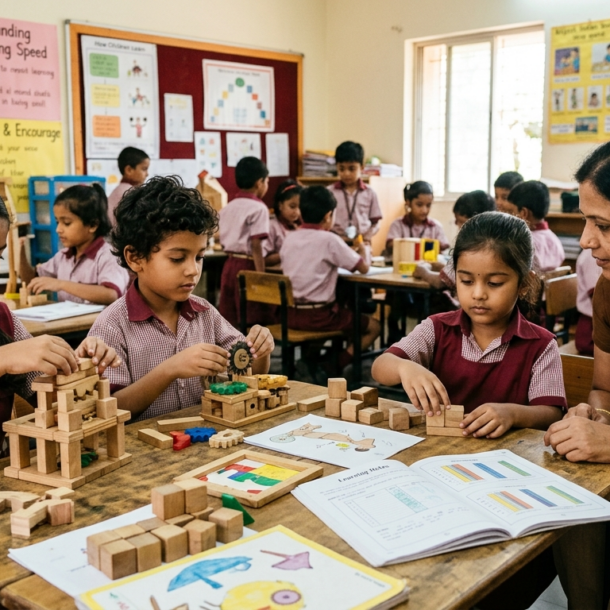

Have you ever wondered why two children raised in the same home can have completely different personalities? Or why one child loves solving math problems while another enjoys music, sports, or art?
As parents, teachers, or even professionals, we often try to understand human behavior through observation. But the truth is, behavior is influenced by a combination of our natural traits, experiences, environment, emotions, and the way our brain processes information.
In this blog, we’ll explore what human behavior is, what influences it, why it matters, and how understanding behavior can help us become better parents, educators, leaders, and individuals.
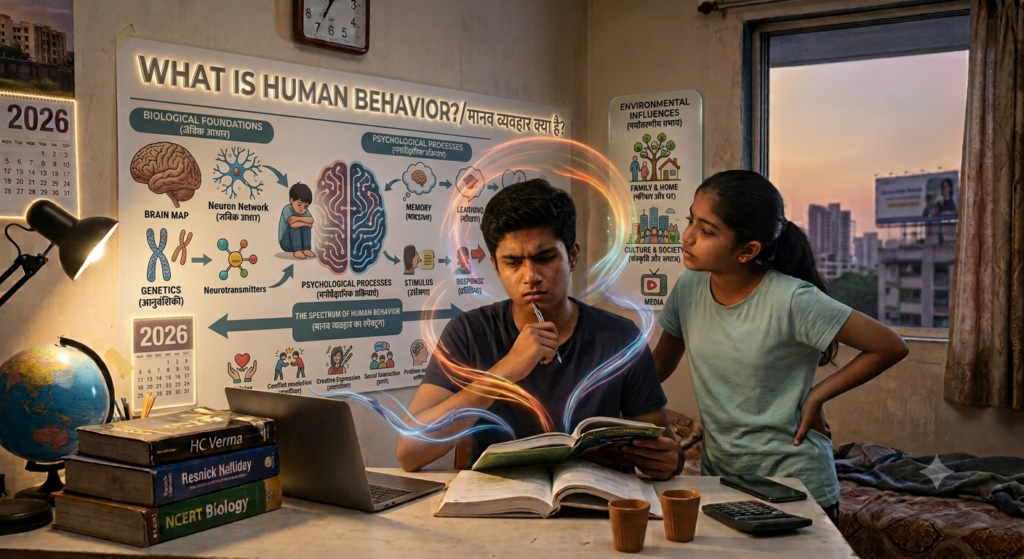
Human behavior refers to the way people think, feel, react, and interact in different situations. It includes every action we take—whether it’s speaking kindly, making decisions, solving problems, expressing emotions, or responding to challenges.
Behavior is shaped by several factors, including:
Simply put, human behavior is the visible expression of how our mind and personality work.
Understanding human behavior helps us build stronger relationships and make better decisions.
For parents, it means understanding why a child behaves in a certain way instead of simply labeling them as “lazy,” “stubborn,” or “naughty.”
For teachers, it helps create better learning experiences.
For students, it builds self-awareness and confidence.
For professionals, it improves communication, teamwork, and leadership.
The better we understand behavior, the better we can respond instead of simply reacting.
No single factor determines behavior. It develops through the interaction of multiple influences.
Every child is born with a unique temperament.
Some children are naturally outgoing, while others are quiet observers.
Some enjoy taking risks, while others prefer structure and routine.
Recognizing these differences helps parents support their child instead of comparing them with others.
A child’s home environment plays a significant role in shaping behavior.
Children learn by observing parents.
The way parents communicate, solve conflicts, encourage learning, and handle emotions often becomes part of a child’s own behavior.
School influences not only academic knowledge but also confidence, discipline, teamwork, and social behavior.
Positive learning experiences encourage curiosity, while repeated criticism may reduce confidence.
As children grow, friends, social media, and society begin influencing their attitudes, communication, and decision-making.
This is particularly important during adolescence.
Fear, happiness, frustration, excitement, and stress all influence behavior.
Children who struggle to express emotions may show it through their actions instead of words.
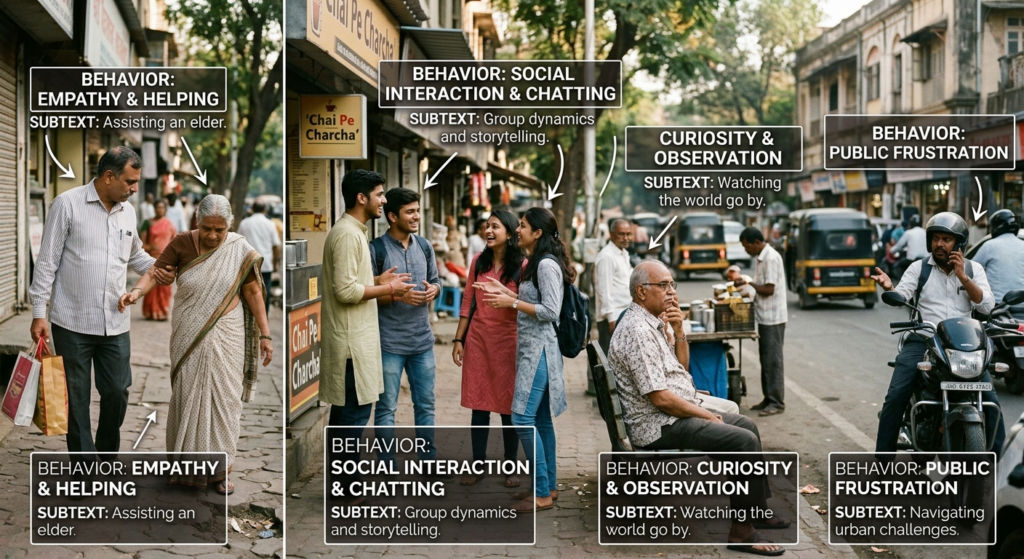
Although every person is unique, behavior is often observed in different patterns.
Actions taken to achieve a specific objective.
Example: Preparing regularly for exams.
How people interact with family, friends, classmates, and society.
Examples include cooperation, empathy, communication, and teamwork.
How individuals respond to emotional situations.
Some express feelings openly, while others keep them inside.
Daily routines developed over time.
Examples include study habits, time management, and discipline.
One of the biggest parenting mistakes is expecting every child to behave similarly.
The reality is:
Every child’s brain develops differently.
Some children learn visually.
Some understand better through listening.
Others learn by doing practical activities.
Some are naturally creative.
Others are analytical thinkers.
Understanding these differences helps parents guide children more effectively rather than forcing them into a single definition of success.
Behavior is closely connected with how children learn.
A child who struggles with classroom learning may actually excel through practical experiences.
Similarly, a child who enjoys reading may not enjoy sports.
Recognizing learning preferences allows parents and teachers to create better learning environments.
Yes.
While some natural traits remain relatively stable, behavior continues to develop throughout life.
Positive influences include:
Children are especially adaptable during their growing years, making early guidance extremely valuable.
False.
People continue learning and growing throughout life.
False.
Every child has different strengths and learning preferences.
Absolutely not.
Academic scores reflect only one aspect of performance.
Many successful people excel because of creativity, communication, leadership, or practical intelligence.
When parents understand their child’s natural behavior, they can:
Parenting becomes less about controlling behavior and more about understanding it.
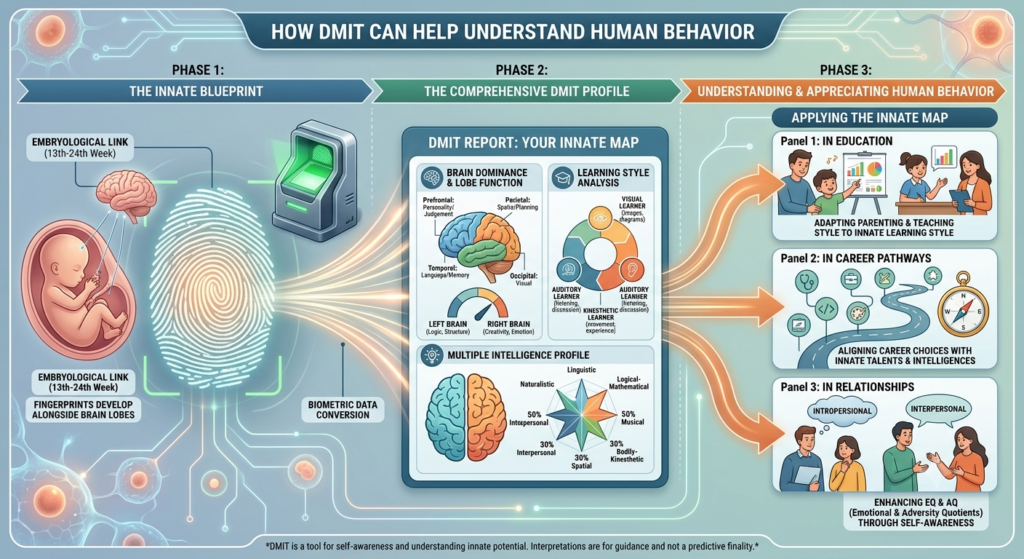
Human behavior is influenced by many factors, and no single assessment can explain everything about a person.
However, a professionally interpreted DMIT (Dermatoglyphics Multiple Intelligence Test) can provide additional insights into a child’s natural learning preferences, personality tendencies, strengths, and areas where they may benefit from more support. When combined with a child’s interests, experiences, and parental observations, it can become a useful guidance tool for parenting and career planning.
Rather than labeling a child, the goal is to help parents understand how their child naturally learns and responds, so they can provide more effective support.
Understanding human behavior isn’t about judging people—it’s about understanding them.
Every child is unique.
Every student learns differently.
Every individual has strengths waiting to be discovered.
When parents shift from asking “What’s wrong with my child?” to “How does my child naturally think, learn, and behave?”, parenting becomes more meaningful and less stressful.
Sometimes, a little understanding can make a lifetime of difference.
Every parent wants to make the right decisions for their child’s future. But without understanding their natural strengths, learning style, and behavioral tendencies, those decisions often become guesswork.
At SH Development Academy, we help parents gain deeper insights through a professional DMIT Consultation guided by Santosh Hariharan—DMIT Consultant, Parent & Career Coach, and Success Mindset Coach for Students.
Whether you’re looking to improve your child’s learning experience, build confidence, or make informed academic and career decisions, we’re here to help.
⭐ Trusted by 400+ parents and students.
👉 Click here to see 400+ Google Reviews: https://share.google/ac9hkh20zcXadkJs9
📋 Book your DMIT Consultation:
https://docs.google.com/forms/d/e/1FAIpQLSd6-u-BEr3ESzoHq2CXjkYZIr41O1eqh3ip97Lj3JbZ-6xSPA/viewform
📞 Call / WhatsApp:
+91 8421315400 | +91 7303290862
Success & Happiness are the two most important yet elusive things which every human being yearns to achieve in life. Real success and happiness can be savoured only when one enjoys good health and good family relations, along with a good professional career and sound financial stability.
Our Visitor


 Users Today : 5