

Parenting becomes interesting—and sometimes confusing—when you realize that every child needs a different kind of parenting.
One child may say:
“I can’t do this…” 😟
Another may say:
“I can do anything!” 😊
And another may say:
“I don’t need anyone to tell me what to do!” 😎
As parents, we naturally want our children to be confident.
But there is an important difference between healthy confidence and overconfidence.
And at the other end, a child who constantly doubts themselves may need a completely different kind of support.
So, how do you handle an underconfident, confident and overconfident child?
The answer isn’t simply “praise them more” or “discipline them more.”
The first step is to understand the child in front of you.
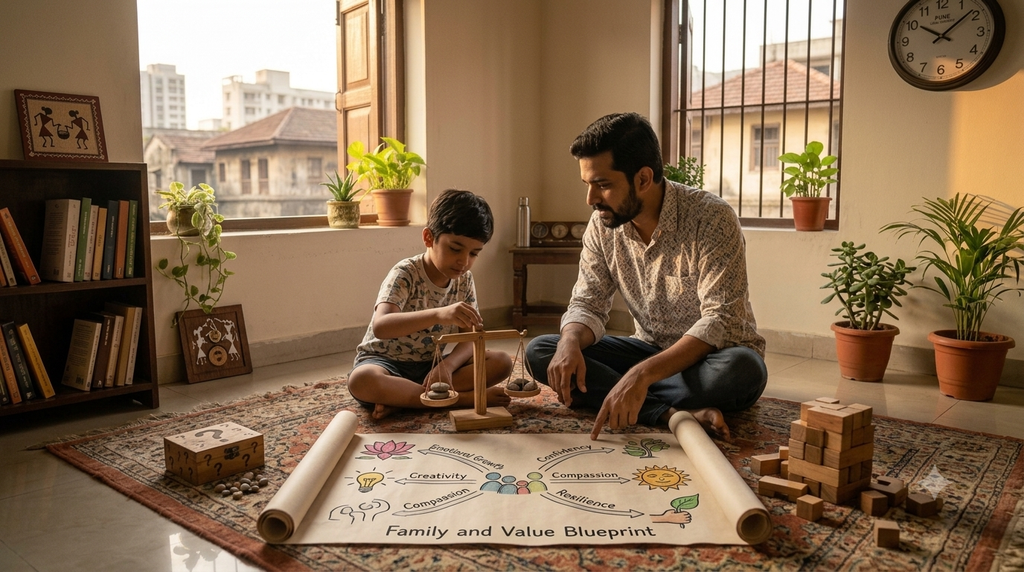
Let’s simplify it.
You may notice that your child:
The American Academy of Pediatrics notes that children with low self-esteem may avoid challenges, give up quickly, become overly sensitive to criticism or show strong self-critical thinking.
The parenting goal:
Don’t do everything for the child.
Instead, create opportunities where they can try, struggle a little, succeed and experience their own competence.
A healthy, confident child generally:
This is the confidence we want to nurture.
Healthy self-esteem grows when children experience competence, responsibility, meaningful choices, encouragement and acceptance of mistakes.
The parenting goal:
Don’t unnecessarily control a confident child.
Give them responsibility, boundaries and opportunities to make age-appropriate decisions.
This is where parents sometimes get confused.
A child may appear very confident but:
Remember:
Confidence says:
“I believe I can handle this.”
Overconfidence says:
“I don’t need to learn anything.”
The parenting goal isn’t to break the child’s confidence.
It is to teach them humility, accountability and self-awareness.
There is no single parenting formula that works for every child.
The CDC’s current positive-parenting guidance emphasizes warmth, predictable responses, routines, appropriate discipline and supporting children’s development toward independence.
Here’s a simple way to think about it:
| Child | What They May Need More Of |
|---|---|
| 😟 Underconfident | Encouragement + small responsibilities |
| 😊 Confident | Independence + healthy boundaries |
| 😎 Overconfident | Accountability + humility + consequences |
The key is not changing your love.
The key is changing your approach.
Avoid:
❌ “Look at your cousin.”
❌ “Your friend is doing much better.”
❌ “Why can’t you be like him?”
Comparison can make an already insecure child feel even less capable.
Instead:
“Let’s see how much you can improve from where you are today.”
Instead of:
“You’re so intelligent!”
Try:
“I noticed you didn’t give up even when that was difficult.”
Specific praise helps children understand what behaviour they should repeat.
Let your child:
Small responsibilities create small wins.
And small wins build confidence.
Don’t confuse confidence with a need for constant praise.
A confident child also needs boundaries and responsibility.
Teach them:
“Being good at something doesn’t mean you stop learning.”
Encourage them to:
The goal is to protect their confidence without creating entitlement.
This requires a slightly different approach.
Avoid:
“You think you’re better than everyone!”
That can turn correction into a battle of egos.
Instead ask:
“What makes you so confident about your answer?”
Then:
“What would you do if you discovered you were wrong?”
You’re teaching the child to question their own assumptions.
If a child refuses to prepare because they believe they will easily succeed, don’t always rescue them at the last minute.
Sometimes experience teaches what lectures cannot.
Of course, consequences should be age-appropriate, safe and proportionate.

This is something I have repeatedly observed while working with parents and students.
Two children can be the same age, study in the same school and have completely different:
So why should the parenting strategy be identical?
Because your child is unique, your parenting approach should be flexible too.

This is where DMIT can become an interesting parenting tool.
A professionally interpreted DMIT report can give parents a structured way to discuss aspects such as a child’s reported learning preferences, strengths, behavioural tendencies and areas that may need support.
Instead of asking:
“Why is my child like this?”
Parents can start asking:
“What approach might work better for my child?”
That change in thinking can make a big difference.
However, DMIT should be viewed as a guidance tool—not a diagnosis, a fixed label or a guaranteed prediction of a child’s future.
Your child’s actual behaviour, interests, school experience, conversations and development should always be considered alongside any assessment.
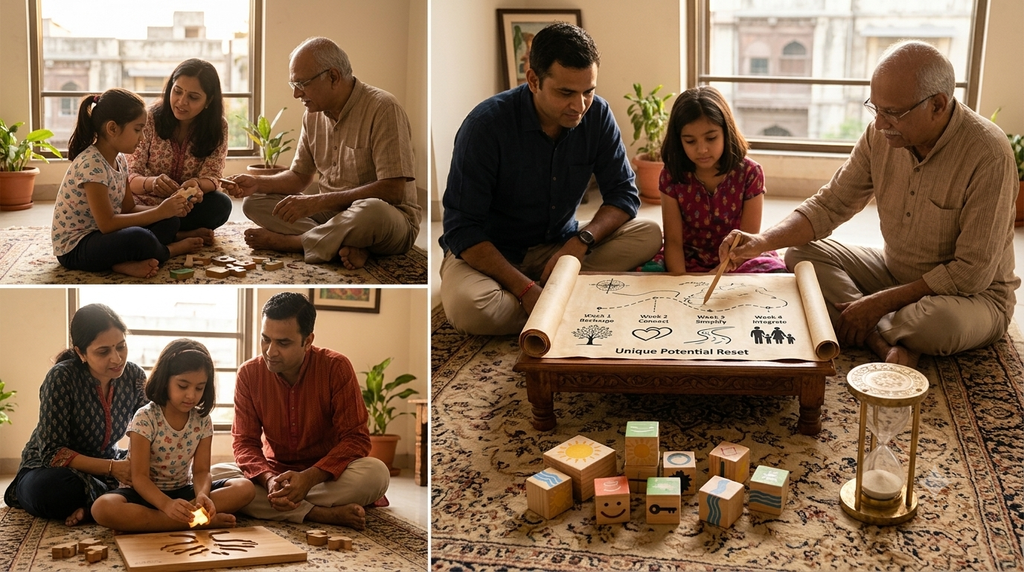
Here’s an analogy I often share with parents.
Every child comes with a different “operating system.” 💡
One child may respond to encouragement.
Another may need structure.
Another may need independence.
Another may need more time before attempting something new.
The mistake is trying to run every child using the same parenting software.
The better approach?
Understand first. Guide second. Correct third.
The 7-7-7 parenting rule is a popular framework that describes three broad stages of parenting:
0–7 years → Bonding, play and emotional security
7–14 years → Guidance, discipline, habits and responsibility
14–21 years → Mentoring, trust and increasing independence
It’s useful as a simple parenting framework, but it shouldn’t be treated as a rigid scientific timetable. Children develop at different rates and need individualized support. Current parenting guidance similarly emphasizes adapting support as children grow.
The bigger lesson is beautiful:
Your role as a parent should evolve as your child grows.
Discipline does not have to mean humiliation, shouting or constant criticism.
Try this approach:
Correct the behaviour—not the child’s identity.
Instead of:
❌ “You’re irresponsible.”
Try:
✅ “You didn’t complete what you promised. Let’s work out how you’ll handle it next time.”
The child needs to understand:
“I made a mistake”
—not—
“I am a failure.”
Clear, consistent and non-harsh discipline is part of positive parenting guidance.
Be careful with this label.
A child who argues, cries, refuses or repeatedly asks for something isn’t automatically “manipulative.”
Sometimes behaviour is communication.
The CDC specifically recommends looking at children’s behaviour as an opportunity to understand and connect, while using clear and consistent responses.
Instead of immediately asking:
“How do I stop my child from manipulating me?”
Ask:
“What is my child trying to communicate through this behaviour?”
Then set an appropriate boundary.
First, don’t label the child:
❌ “You’re so ungrateful.”
Instead, teach gratitude through everyday behaviour.
Try:
Gratitude becomes stronger when children experience responsibility, not just lectures about being grateful.
As parents, we sometimes focus too much on whether our child is:
Topper?
Confident?
Disciplined?
Successful?
But perhaps the better question is:
“Is my child becoming comfortable with who they are while learning to handle responsibility, failure and relationships?”
That’s a much bigger goal.
A child doesn’t need to be extremely confident.
They need healthy confidence.
They don’t need to be perfectly obedient.
They need self-discipline.
And they don’t need parents who always have the answers.
They need parents who are willing to understand before they judge. ❤️
If you’re struggling to understand why your child behaves, learns or responds differently from what you expect, a DMIT consultation can be one starting point for a structured conversation about your child’s strengths, learning preferences and developmental guidance.
At SH Development Academy, Santosh Hariharan works with parents as a DMIT Consultant, Parent & Career Coach, and Student Success Mindset Coach.
The objective isn’t to put your child into a box.
It’s to help you understand your child better—and then make more informed parenting and educational decisions.
But the right understanding can make the parenting journey much easier.
📞 +91 8421315400 | +91 7303290862
⭐ 400+ parents have trusted our guidance.
See our Google Reviews
Note: If a child shows persistent or significant emotional, behavioural, academic, or social difficulties, parents should consider speaking with an appropriately qualified child-development or mental-health professional. A DMIT consultation should not replace professional assessment or care.
Success & Happiness are the two most important yet elusive things which every human being yearns to achieve in life. Real success and happiness can be savoured only when one enjoys good health and good family relations, along with a good professional career and sound financial stability.
Our Visitor


 Users Today : 24