
Parenting has changed.
A few decades ago, parents could often rely on family elders, teachers and personal experience for guidance. Today, parents have access to hundreds of parenting apps, trackers, online resources and digital tools.
But there is one problem…
More information doesn’t always mean more clarity. 🤔
You can download an app to track your child’s sleep, another for screen time, another for activities and another for developmental milestones—and still wonder:
“Am I actually understanding my child?”
That is why the best apps for parenting support should not simply help you track your child.
They should help you understand, communicate and guide your child better.
Here are some practical free tools and ideas you can start using today.
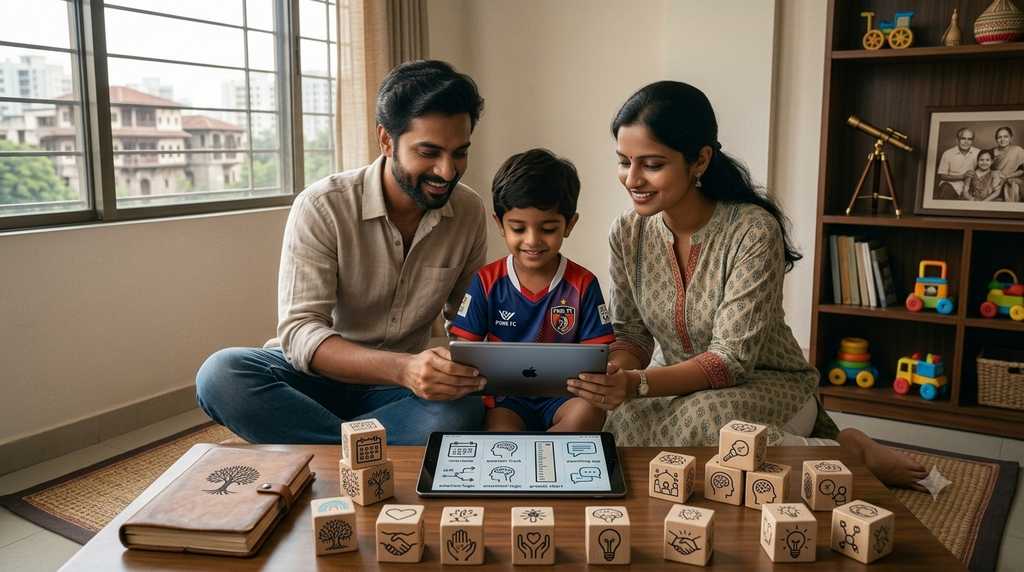
One of the simplest ways to become a more observant parent is to understand what is generally expected at different stages of childhood.
The CDC’s 2026 resources provide free, age-specific information on developmental milestones and positive parenting for children from infancy through the preschool years.
You can use milestone resources to observe areas such as:
🧠 Thinking and learning
🗣️ Language development
🏃 Physical development
❤️ Social and emotional development
Important: A milestone tracker is an observation tool—not a diagnosis.
If something concerns you consistently, discuss it with an appropriate qualified professional.
Let’s be honest.
For many Indian parents today, “mobile phone” is one of the biggest parenting battles. 📱
Instead of repeatedly saying:
“Keep the phone away!”
try tracking the habit for a week.
Look at:
The objective isn’t simply to reduce screen time.
The objective is to understand the pattern first.
Then create family rules around devices.
Sometimes what looks like:
❌ Laziness
❌ Irritability
❌ Poor concentration
❌ Lack of motivation
may also be connected to an unhealthy routine.
A simple sleep tracker can help parents observe:
Bedtime → Sleep duration → Wake-up time → Morning mood → Daytime behaviour
Healthy routines matter for children’s development, and current CDC guidance emphasizes sleep, physical activity, nutrition and limited screen time as important parts of healthy routines.
Don’t obsess over numbers.
Look for patterns.
You don’t even need an app for this.
Create a simple weekly note with five columns:
| What I Observed | When? | What Happened Before? | How Did My Child Respond? | What Worked? |
|---|---|---|---|---|
| Lost focus | Homework | Phone nearby | Became irritated | 20-min study blocks |
| Refused activity | Evening | Tired | Argued | Offered two choices |
This can reveal something powerful:
Behaviour has a context.
Instead of immediately asking, “Why is my child behaving like this?”
start asking:
“What happened before this behaviour?”
That small change can completely change the way you parent.
A few simple templates can become surprisingly powerful parenting tools.
Ask your child:
1. What was the best part of your week?
2. What was difficult?
3. What are you proud of?
4. Is there anything you want my help with?
5. What would you like to do differently next week?
Don’t turn this into an interrogation.
Just listen.
My goal this week: _______
Why it matters: _______
Three small actions:
What I learned: _______
This teaches children something more valuable than simply completing homework:
self-awareness and responsibility.
One of the biggest mistakes parents make is confusing discipline with punishment.
The American Academy of Pediatrics recommends positive discipline approaches such as setting clear limits, modelling appropriate behaviour, using consistent consequences and teaching children what to do—not simply punishing what they did wrong. Harsh physical or verbal punishment is not recommended.
So instead of:
❌ “You’re always careless!”
Try:
✅ “The rule is that homework comes before gaming. Let’s decide how you’ll complete it today.”
The difference may look small.
But one attacks the child’s identity.
The other addresses the behaviour.
Here’s one tool I particularly recommend to parents.
Create three columns:
Drawing, cricket, talking, building things, reading, music, helping others…
Explaining things, remembering details, solving problems, leading friends, creating stories…
What activities make them lose track of time?
Review this every month.
You may begin noticing strengths that marksheets don’t show.
And that’s an important part of parenting:
Don’t only track what your child needs to improve. Track what your child is already good at.
This is perhaps the most important point.
Apps can help you collect information.
Trackers can help you notice patterns.
Templates can help you create routines.
But none of them can replace a parent’s observation, conversation and understanding.
A child is not a dashboard.
A child is constantly developing.
The CDC’s current positive-parenting guidance similarly emphasizes responding predictably, showing warmth and sensitivity, maintaining routines and rules, communicating with children and using appropriate discipline.
Instead of looking for one “perfect parenting app”, think in terms of what problem you want to solve:
📌 Development: milestone trackers and trusted child-development resources
📌 Screen habits: device usage and family media-management tools
📌 Sleep: sleep/routine trackers
📌 Organisation: family calendars and routine planners
📌 Communication: child check-ins and shared family activities
📌 Self-awareness: observation journals and strength trackers
The best tool is ultimately the one that helps you take better action, rather than simply collect more data.
This is where many parents reach a point where an app or tracker isn’t enough.
You may know:
How long your child studies.
But do you understand:
How your child naturally learns?
You may know:
How often your child gets distracted.
But do you understand:
What type of environment helps your child focus?
You may know:
Your child’s marks.
But do you understand:
Their natural strengths, learning preferences and potential areas for development?
This is where a professionally interpreted DMIT assessment and parenting consultation can provide another layer of guidance.
At SH Development Academy, Santosh Hariharan — DMIT Consultant, Parent & Career Coach and Success Mindset Coach for Students — works with parents to help them understand their child’s strengths, learning preferences and developmental needs.
The objective isn’t to put a label on your child.
It is to help you become a more informed parent. ❤️
If you’re constantly thinking:
“I love my child, but sometimes I just don’t know how to guide them.”
You’re not alone.
Parenting doesn’t come with an instruction manual.
But with the right information, observation and professional guidance, you can make better decisions at every stage of your child’s growth.
👉 Book your DMIT Consultation with SH Development Academy:
Book Your DMIT Consultation
📞 Call / WhatsApp: +91 8421315400 | +91 7303290862
⭐ 400+ parents have trusted our guidance.
See our Google Reviews
Because better parenting doesn’t mean becoming a perfect parent.
It means understanding your child a little better—and guiding them a little wiser, every day. 🌱
Success & Happiness are the two most important yet elusive things which every human being yearns to achieve in life. Real success and happiness can be savoured only when one enjoys good health and good family relations, along with a good professional career and sound financial stability.
Our Visitor


 Users Today : 0