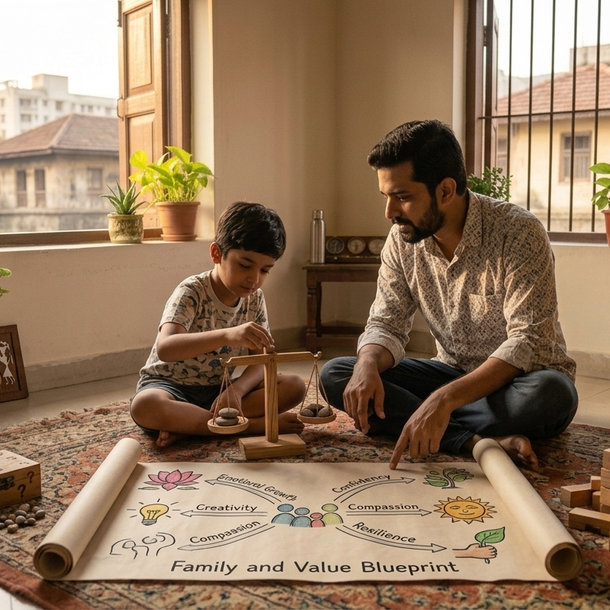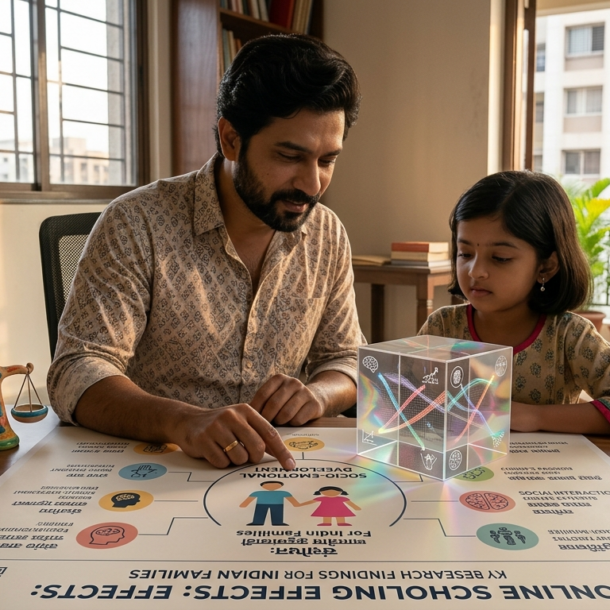
Parenting is one of the most important responsibilities in life—and one of the few for which nobody really gives you a manual.
You learn as your child grows.
First, you wonder how to handle their habits. Then come school, studies, screen time, confidence, friendships, exams, subject choices and, before you realise it, the big question arrives:
“What should my child do in the future?”
This is where a parenting and career coach can make a meaningful difference.
A good coach does not tell parents what to do or tell a student, “This is the career you must choose.” Instead, the role is to help families understand the child better, identify strengths and areas for development, explore realistic options, and make decisions with greater clarity.
In India, career guidance is also becoming an increasingly important part of education. The National Education Policy 2020 specifically emphasises career counselling and helping students identify their interests and talents.

A Parenting & Career Clarity Coach works at the intersection of two closely connected areas:
Understanding the child today → preparing the child for tomorrow.
Parenting guidance focuses on questions such as:
Career clarity focuses on questions such as:
The two are connected.
A child who understands their strengths is often better placed to make thoughtful academic and career decisions later.
For years, career conversations in Indian families have often revolved around marks, entrance exams and familiar professions.
“You score well in Maths, so take Engineering.”
“You are good at Biology, so consider Medicine.”
“Science keeps more options open.”
Sometimes these choices work. But marks alone don’t tell the whole story.
A child’s interests, aptitude, personality, values, motivation and preferred way of learning can also be relevant when exploring future directions.
That is why modern career guidance increasingly uses structured assessments alongside counselling rather than relying only on a parent’s opinion or a student’s latest interest. Current career guidance services in India commonly combine assessment with one-to-one conversations and personalised planning.
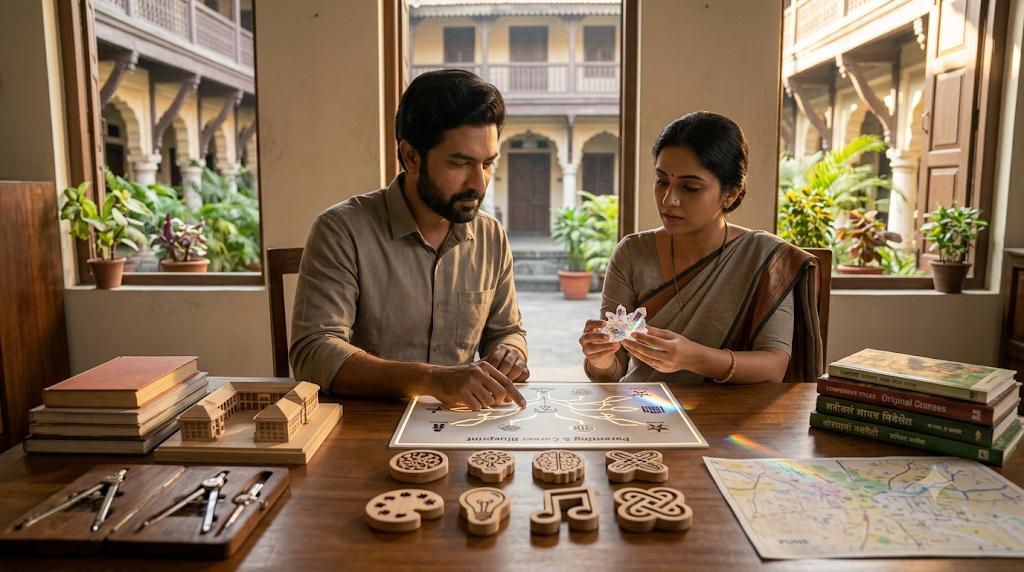
A parenting and career coach can support a family through several stages of a child’s development.
Sometimes the problem isn’t the child.
It is the mismatch between what the child naturally needs and what the environment expects from them.
A coach can help parents look beyond labels such as:
“lazy,” “shy,” “stubborn,” “careless,” or “not serious.”
Instead, the conversation becomes:
“What is actually happening, and what does this child need?”
That shift can change the way parents respond.
Every child has strengths.
But strengths aren’t always visible through school marks.
A child might show strength in:
The objective is not to put a permanent label on the child. It is to understand where their natural interests and abilities may be worth exploring further.
Career clarity is not about predicting a child’s entire future at age 12 or 15.
It is about helping the student answer:
“What could I explore, and why?”
A structured career conversation can connect a student’s strengths, interests and aspirations with possible educational and career pathways.
This is particularly valuable when students are approaching important decisions such as:
One of the biggest challenges in career decisions is that parents and children may want the same thing but approach it differently.
Parents think about:
security + opportunities + future
Students often think about:
interest + identity + independence
A coach can help both sides have a more constructive conversation.
The goal isn’t for the parent to “win” or the child to “win.”
The goal is better understanding and a better-informed decision.
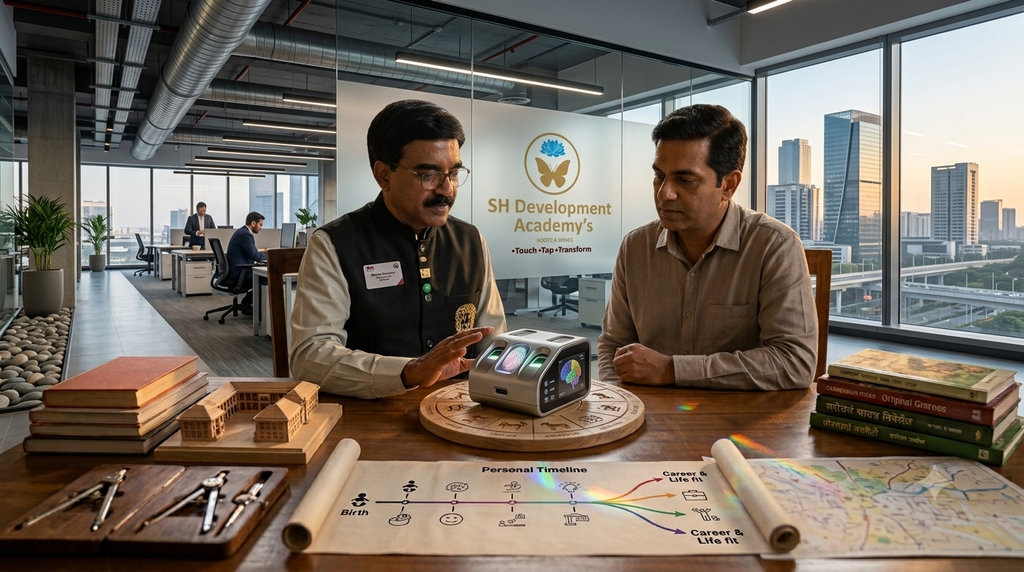
At SH Development Academy, DMIT can be used as one input within a broader guidance conversation.
A DMIT report may provide discussion points around a child’s reported learning preferences, strengths and behavioural tendencies.
But the important part is what happens after the report.
A report sitting inside a drawer doesn’t change parenting.
The conversation around the report can.
Parents can use those insights to reflect on questions such as:
DMIT should therefore be viewed as a guidance tool—not a crystal ball or a guarantee of a particular career.
A meaningful coaching process generally starts with understanding the person before suggesting solutions.
We first look at the actual concern.
Is it:
The student’s interests, strengths, experiences, aspirations and challenges need to be considered.
Where appropriate, structured assessments can add another layer of information.
This is where professional guidance matters.
A report should not simply be handed to a parent with:
“Here are your results. Good luck.”
The findings need to be discussed in the context of the child’s real life.
Instead of jumping to one answer, we explore suitable directions.
The student should understand:
Why this option?
What does it involve?
What skills are required?
What should I do next?
Clarity becomes useful only when it leads to action.
The next steps might include:
A good parenting and career clarity process should ideally leave a family with better questions, better understanding and clearer next steps.
Depending on the child’s situation, the outcomes may include:
✔ Better understanding of the child’s strengths
✔ Greater awareness of learning preferences
✔ More constructive parent-child conversations
✔ Reduced career confusion
✔ Greater awareness of possible career directions
✔ A clearer development roadmap
✔ More confidence in making educational decisions
The objective isn’t to manufacture certainty.
It is to replace guesswork with informed exploration.
You don’t have to wait until your child is in Class 10 or Class 12.
Different stages bring different questions.
The focus can be on:
This is often a useful stage for:
The conversation becomes more focused on:
Guidance can also help when someone is:
Look beyond impressive titles.
A good coach should be able to:
Listen before advising.
Ask questions before giving answers.
Understand the child—not just the marks.
Explain assessment results responsibly.
Avoid forcing a predetermined career.
Give practical next steps.
Most importantly, the coach should understand that every family is different.
There is no universal formula for raising a child or choosing a career.
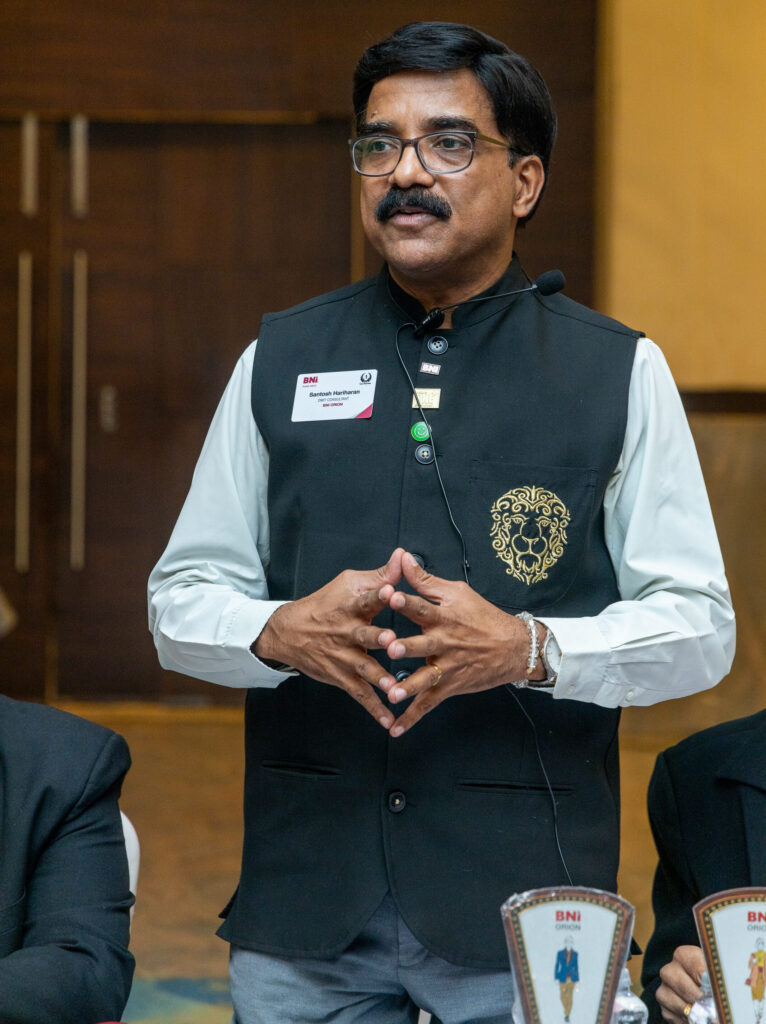
At SH Development Academy, Santosh Hariharan brings together his experience as a DMIT Consultant, Parent & Career Coach and Success Mindset Coach for Students.
His approach is centred around a simple idea:
Before we guide a child toward a career, we should first understand the child.
With years of corporate experience across Sales, Training and HR, followed by independent counselling work with parents and students, the focus is on bringing practical, real-world perspective into conversations around parenting, student development and career direction.
Career decisions can have a long-term impact.
But the answer doesn’t always have to come from one test, one teacher, one parent or one career trend.
The strongest decisions usually come from bringing together:
Self-awareness + assessment + conversation + exploration + action.
That’s the role of a good parenting and career coach—not to make the decision for your family, but to help you make it with greater clarity.
If you are currently wondering:
“Am I understanding my child correctly?”
“Which direction could suit my child?”
“How can I support my child’s career without putting unnecessary pressure on them?”
…it may be worth having a structured conversation.
At SH Development Academy, you can begin with a DMIT Consultation designed to help parents understand their child’s strengths, learning preferences and potential areas for development, followed by personalised guidance.
👨🏫 Guided by Santosh Hariharan
DMIT Consultant | Parent & Career Coach | Success Mindset Coach for Students
⭐ 400+ parents have shared their experience with us.
Read our Google Reviews
📞 Call / WhatsApp: +91 8421315400 | +91 7303290862
Because sometimes, the first step toward helping your child choose the right future is simply understanding who they are today.
Success & Happiness are the two most important yet elusive things which every human being yearns to achieve in life. Real success and happiness can be savoured only when one enjoys good health and good family relations, along with a good professional career and sound financial stability.
Our Visitor


 Users Today : 26