
Your child doesn’t need to decide their entire future at 15. They need the right opportunities to explore it.
Imagine this situation.
Your child has just completed Class 10. The board exam results are out, relatives are calling, friends are discussing admissions, and suddenly everyone seems to have an opinion about what your child should do next.
“Science le lo, options open rahenge!”
“Commerce has excellent opportunities nowadays.”
“Arts? But your marks are so good!”
Sound familiar? 😊
For many Indian parents, especially those navigating the competitive education environment in Pune, choosing the right stream after Class 10 becomes one of the most stressful family decisions.
And the biggest challenge?
Most students are expected to make this important choice without ever experiencing what different careers actually involve.
A student might say, “I want to become an engineer,” simply because they enjoy mathematics. Another may dream of becoming a doctor without knowing what studying medicine or working in healthcare involves.
But liking a subject and enjoying the work associated with a career are not always the same thing.
That’s where the Career Experiment Method for Students comes in.
Instead of asking your child to choose a career based only on marks, family expectations, or what their friends are doing, this practical approach encourages them to explore three possible career directions through small, meaningful experiences before making a major academic decision.
Let’s understand how this method works, why it matters in 2026, and how you can use it at home to help your child make a more informed stream selection.
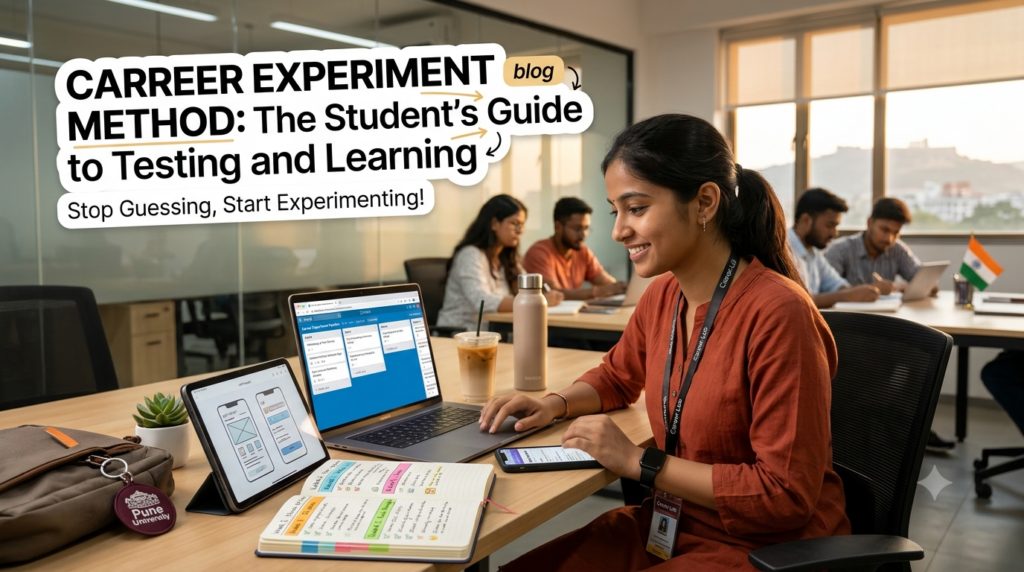
The Career Experiment Method is a practical career exploration approach in which students identify three possible career paths, try a small real-world activity related to each one, reflect on their experiences, and compare what they discover before choosing an academic stream.
Think of it as taking a test drive before buying a car.
You wouldn’t purchase a car simply because someone told you it was excellent. You would want to understand how it feels, whether it suits your needs, and whether you’re comfortable using it.
Why should career decisions be any different?
The method follows four simple stages:
01
Explore
Shortlist three career directions
02
Experiment
Try practical activities in each field
03
Reflect
Record interest, effort and learning
04
Decide
Compare options and plan next steps
This is a practical exploration framework, not a standardised psychological test.
The purpose is not to predict your child’s future with absolute certainty.
It is to help them answer important questions:
For students in Classes 9–12, these answers can be far more meaningful than simply asking, “What do you want to become when you grow up?”

Today’s students have access to more career information than any previous generation.
They can watch videos about artificial intelligence, explore design careers, learn coding, discover entrepreneurship, and follow professionals from almost any industry.
Yet many students remain confused.
Why?
Because having more information doesn’t automatically create more clarity.
A student may be attracted to the title “data scientist” without knowing whether they enjoy working with statistics, programming, and complex problems.
Another might want to become a psychologist because they enjoy listening to friends, without understanding the academic training and professional responsibilities involved.
Career exploration should go beyond attractive job titles.
In many Indian families, stream selection still follows an informal pattern:
High marks? Choose Science.
Average marks? Consider Commerce.
Interested in creative subjects? Maybe Humanities.
But marks alone cannot tell us everything about a student’s interests, motivation, practical abilities, or future goals.
A student who scores well in Science may genuinely prefer economics, law, design, or entrepreneurship.
Similarly, a student who currently struggles with mathematics may improve significantly with better support and practice.
Parents often encourage familiar career paths because they want financial stability and good opportunities for their children.
That concern is understandable.
However, the right decision requires a balance between career opportunities, educational requirements, the student’s abilities, personal interests, and willingness to work towards a goal.
By 2026, discussions around artificial intelligence, automation, digital technology, sustainability, healthcare, and interdisciplinary careers have made career planning more complex.
Students need to understand not only which jobs exist today but also which transferable skills may remain valuable as industries evolve.
This is one reason experiential career exploration can be useful: students begin learning about the actual skills and work involved rather than relying only on career trends.
The first step is to shortlist three possible directions.
Notice that we’re saying directions, not final career decisions.
A Class 9 student does not need to decide whether they will become a neurosurgeon, software architect, or financial analyst.
At this stage, exploring broader fields is often more appropriate.
For example:
| Career direction | Possible careers to explore |
|---|---|
| Science & Technology | Engineering, research, software development, biotechnology |
| Business & Commerce | Finance, entrepreneurship, marketing, management |
| Humanities & Creative Fields | Psychology, law, design, journalism, social sciences |
These categories are only starting points. Careers often overlap, and the stream required for a particular course depends on its eligibility rules.
Start with three conversations.
Conversation 1: What interests you?
Ask your child which subjects, problems, activities, or topics naturally attract their attention.
Conversation 2: What do you enjoy doing?
Does your child enjoy solving puzzles, explaining ideas, creating something, helping people, organising events, or analysing information?
Conversation 3: What would you like to explore?
Sometimes the most interesting career direction is something a student has never seriously considered.
Encourage curiosity rather than immediately judging an idea as practical or impractical.
💡 Parenting tip: Don’t shortlist three careers that you want your child to pursue. Make sure your child’s own interests and questions are represented.
This is where the real learning begins.
Once your child has shortlisted three career directions, design one practical activity for each.
The experiment should be affordable, age-appropriate, safe, and manageable alongside schoolwork.
Let’s take the example of a Class 10 student named Aarav.
Aarav enjoys mathematics, is curious about business, and occasionally creates digital artwork.
Instead of immediately selecting Science or Commerce, his family decides to explore three possible directions.
The challenge: Build or design something that solves a simple problem.
Aarav could:
The goal isn’t to become an engineer in a week.
It is to experience the process of identifying a problem, developing a solution, testing it, and improving it.
After the activity, ask:
“Did you enjoy solving the problem, or were you mainly excited about the final result?”
“Were you curious to learn more when something didn’t work?”
“Would you like to attempt a more challenging project?”
These questions can reveal whether the student wants to continue exploring the field.
The challenge: Develop a small business idea and test its feasibility.
Aarav could choose a simple idea, such as designing bookmarks, creating digital posters, or planning a stationery service.
Then ask him to:
A real sale is optional; the learning comes from planning, calculating, communicating, and evaluating the idea.
Parents should supervise any real transactions and avoid putting financial pressure on the child.
Afterwards, discuss:
“Did you enjoy planning the business?”
“Which part interested you most—numbers, creativity, communication, or decision-making?”
“What would you do differently next time?”
This exercise introduces business thinking without requiring a large investment.
The challenge: Create a design that communicates a useful message.
Aarav could:
Encourage him to consider the audience, clarity, appearance, and purpose of the design.
Then ask:
“Did you enjoy improving the design after receiving feedback?”
“Were you interested in understanding what other people would find useful?”
“Would you like to explore design tools and principles more deeply?”
Through these three experiments, Aarav begins to develop a clearer understanding of what different fields actually involve.
And importantly, he discovers this through experience—not merely through advice.
Now comes the most important part.
After completing the three experiments, don’t immediately ask your child:
“So, which career have you decided?”
Instead, ask:
“What did you discover about yourself?”
There is a big difference between the two questions.
The first creates pressure to decide. The second encourages reflection.
Ask your child to rate each experiment from 1 to 5 based on their experience.
1 means very low, while 5 means very high.
Select a career path, rate the five criteria, and compare your experiences. These are reflection scores, not scientific career suitability scores.Engineering & TechnologyBusiness & CommerceDesign & Creative Fields
Enjoyment
3/5
Curiosity to learn more
3/5
Willingness to practise
3/5
Comfort with challenges
3/5
Interest in related subjects
3/5
Engineering & Technology
15/25
Business & Commerce
15/25
Design & Creative Fields
15/25
Higher totals suggest stronger positive experiences during these particular activities. Do not use the totals alone to select a stream. Copy my results
A high score is interesting, but the conversation behind the score matters more.
For example, a student might score engineering highly because the first coding project was exciting. But would they enjoy learning the mathematics and programming concepts needed to progress?
Another student might find entrepreneurship difficult yet remain deeply interested in improving their idea.
That willingness to persist can be an important observation.
Remember: one enjoyable activity does not prove career suitability, and one difficult activity does not rule out a career.
Use the scorecard to guide further exploration, not to label your child.
Once your child has explored three directions, the next step is to understand which academic subjects and qualifications those careers require.
This is where professional career guidance becomes especially useful.
| Stream | Examples of fields to explore | Important considerations |
|---|---|---|
| Science (PCM) | Engineering, physics, mathematics, certain technology programmes | Comfort with and interest in mathematics and science |
| Science (PCB) | Medicine, healthcare, life sciences, biotechnology | Interest in biology and relevant course eligibility |
| Commerce | Accounting, finance, business, economics, management | Interest in business, numbers, markets and related subjects |
| Humanities / Arts | Law, psychology, media, social sciences, public policy | Interest in people, society, communication and analytical thinking |
These are illustrative pathways, not rigid career boundaries.
For example, law can be pursued after different Class 12 streams, while some economics, design, computing and other programmes have specific mathematics or subject requirements.
Always verify the eligibility criteria of your target courses, entrance examinations and universities before finalising subjects.
Also, students should check which subject combinations their school or junior college actually offers.
In Pune, students may be comparing CBSE, ICSE, Maharashtra State Board and junior-college pathways.
The choice can involve different subject combinations, admission requirements and future entrance-exam preparation.
A good career decision therefore needs to balance three things:
Student’s interests + academic readiness + actual eligibility requirements.
The Career Experiment Method helps with the first. Academic records, teacher feedback, official course requirements and qualified counselling help complete the picture.
Career exploration can begin at different stages, but the objective changes with age.
Discover interests
Explore different subjects, activities and professions without the pressure of making a final decision.
Prepare for stream selection
Test three possible career directions, review academic readiness and verify Class 11 subject requirements.
Explore deeper
Try more advanced projects, interact with professionals and investigate relevant degree programmes.
Plan the next educational step
Compare colleges, courses, entrance examinations, eligibility criteria and alternative pathways.
For Class 10 students, I recommend starting the exploration well before the final admission deadline whenever possible. Even two or three short experiments can generate useful questions and observations.
Parents often ask how to begin without disturbing schoolwork.
Here’s a practical three-week approach.
| Week | Activity | Expected outcome |
|---|---|---|
| Week 1 | Explore the first career path and complete one project | Understand what the work involves |
| Week 2 | Explore the second career path and complete a different project | Identify new interests and challenges |
| Week 3 | Explore the third path, complete the scorecard and discuss findings | Develop a shortlist for further research |
Spend roughly two to four hours on each experiment, depending on the child’s schedule and the activity involved.
The 21-day plan is a convenient starting structure, not a scientifically established duration or a guarantee of career clarity.
Allow your child to answer freely.
Try not to correct every response or immediately explain which career has better earning potential.
First, listen. Then discuss practical considerations together.
Career exploration is increasingly being recognised as an important part of school education in India.
In August 2025, CBSE launched a Career Guidance Dashboard and a counselling support model intended to strengthen structured career guidance and student wellbeing in affiliated schools.
The Ministry of Education, NCERT and UNICEF India have also developed career-guidance resources covering a broad range of professions, including educational pathways and job responsibilities.
These developments reinforce an important principle: students benefit from access to career information and guidance before major academic decisions.
The CBSE Career Guidance Dashboard can be a useful starting point for eligible students and schools.
Parents can also explore NCERT career-guidance materials and official university websites to understand educational pathways.
But remember, reading about a career and experiencing its everyday activities are different things.
Use these resources alongside practical exploration, school feedback and conversations with knowledgeable professionals.
Good marks can indicate academic achievement, but they do not automatically identify a student’s ideal career.
A stream that suits your child’s best friend may not suit your child.
Financial prospects matter, but so do educational requirements, interests, capabilities and long-term satisfaction.
Every academic stream offers meaningful opportunities. The right choice depends on the student’s goals and the subjects required to pursue them.
Even a well-designed psychometric assessment should inform a broader counselling conversation rather than determine a child’s future by itself.
Parents bring valuable experience. Students bring their own interests, aspirations and experiences.
The strongest decisions involve both.
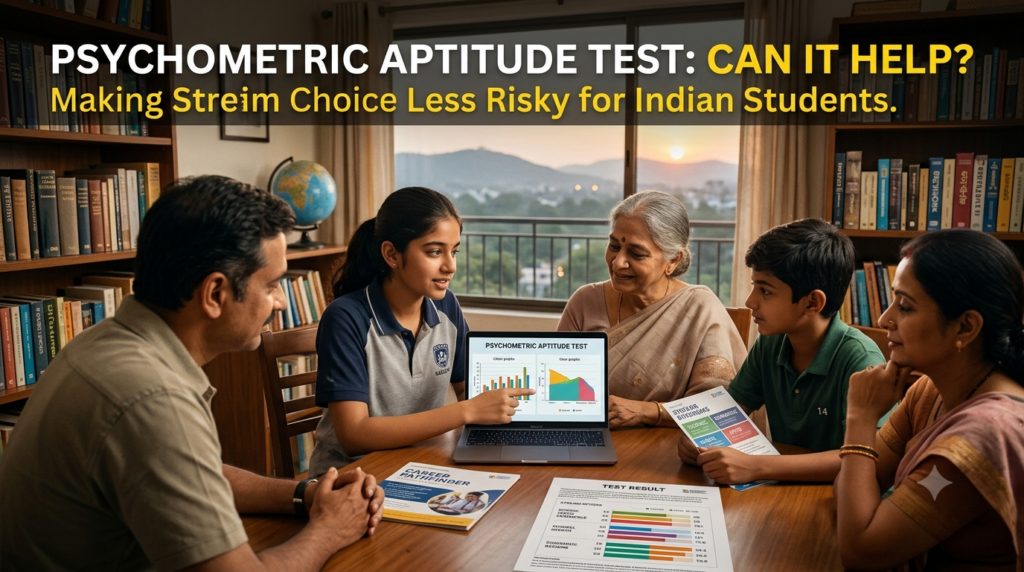
Yes, an appropriately selected and validated psychometric aptitude assessment can provide useful additional information about a student’s abilities, interests and other relevant characteristics.
For example, it may help explore:
However, no assessment can guarantee success in a particular career.
The results should be interpreted alongside academic performance, personal interests, practical experiences and individual circumstances.
DMIT, or Dermatoglyphics Multiple Intelligence Test, uses fingerprint patterns to make claims about intelligence, personality and learning preferences.
While fingerprint patterns are legitimate subjects of dermatoglyphics research, there is insufficient scientific evidence to establish that DMIT can reliably determine a student’s intelligence, talents, learning style or ideal career.
Therefore, DMIT should not be used to decide a student’s academic stream or restrict their career opportunities.
At SH Development Academy, parents exploring career guidance can benefit most from a broader approach that includes meaningful discussion, student experiences and appropriately validated assessment tools.
It is a practical approach to career exploration in which students try small activities related to three possible career directions, reflect on their experiences and use what they learn to support educational decisions.
Consider your interests, academic strengths, career goals, required subjects and course eligibility criteria. Practical career experiments and qualified career counselling can help you compare your options.
No. Class 9 is a useful stage for broad career exploration, provided students are not pressured into making permanent decisions.
That’s perfectly reasonable. Encourage exploration and look for common interests or transferable skills across the options.
Often, yes. However, some courses have specific subject requirements that can limit entry routes. Students should research these requirements before selecting their Class 11 subjects.
Validated psychometric assessments can provide helpful information about aptitude, interests and other relevant factors. They are most useful when interpreted by qualified professionals and combined with broader career exploration.
Three is a practical starting point, not a mandatory or scientifically established number. Students can explore more options or revisit an earlier experiment if they need additional clarity.
Career awareness can begin early, but more structured exploration is particularly useful during Classes 9–12, when students begin making important subject and higher-education decisions.
Every parent wants their child to have a secure, successful and fulfilling future.
But the answer isn’t always another tuition class, another motivational lecture or another conversation about marks.
Sometimes, your child simply needs the opportunity to discover what different careers are really like.
A small technology project might reveal a new interest.
A simple business experiment might introduce a student to entrepreneurship.
A creative assignment might inspire them to explore design.
Or an experiment might help them realise that a career they once admired isn’t what they expected.
All these discoveries are valuable.
The purpose of the Career Experiment Method is not to make your child decide faster. It is to help them decide with greater understanding.
Because the right career decision should be informed by exploration, not driven by fear, comparison or pressure.
Perhaps your child is in Class 9 or 10 and you’re already wondering which stream would be most suitable.
Or maybe they’re in Class 11 or 12, doing reasonably well academically but still unsure about what comes next.
You don’t have to navigate these questions through guesswork alone.
At SH Development Academy, we believe career guidance should begin with understanding the student—not simply recommending the most popular profession.

DMIT Consultant | Parent & Career Coach | Student Success Mindset Coach
With 30+ years of corporate experience across sales, training and HR, and over five years of independent counselling experience, Santosh Hariharan brings a practical perspective to conversations about education, skills and career development.
Our guidance focuses on helping students and parents explore interests, understand strengths, evaluate suitable educational options and make thoughtful decisions about the future.
Explore our services and learn more about DMIT and career guidance.
Explore SH Development Academy
+91 8421315400
+91 7303290862
See what parents and families have shared about their experiences with our guidance.
Your child’s future deserves more than a rushed decision. Give them the opportunity to explore, understand and choose with confidence.
Success & Happiness are the two most important yet elusive things which every human being yearns to achieve in life. Real success and happiness can be savoured only when one enjoys good health and good family relations, along with a good professional career and sound financial stability.
Our Visitor


 Users Today : 7