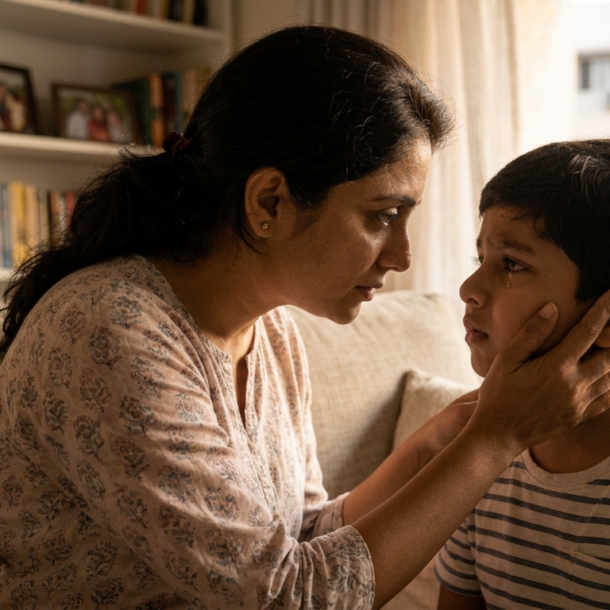

Children don’t always have the words to explain what they’re feeling. Sometimes, a child who refuses to go to school, gets irritated over small things, struggles to sleep, or repeatedly asks, “What if something bad happens?” may be dealing with worries they don’t know how to express.
As parents, we often respond by saying, “Don’t worry,” “There’s nothing to be afraid of,” or “Stop thinking so much.” We say these things because we want our children to feel better. But a child may still struggle to explain what’s happening inside their mind.
What if your child could draw their worries instead of having to explain everything in words? 🎨
That’s the idea behind the Worry Monster Drawing Exercise—a simple, creative activity that encourages children to give their worries a shape, a face, and even a name. Instead of keeping their fears bottled up, they can put them on paper and talk about them with a trusted adult.
The best part? You can try this activity at home in about 10 minutes, using nothing more than paper, pencils, crayons, and a little patience.
For parents looking for practical ways to support their child’s emotional development, this exercise can be a gentle starting point. It isn’t about forcing a child to talk or making every worry disappear. It’s about helping them feel safe enough to express what they’re experiencing.
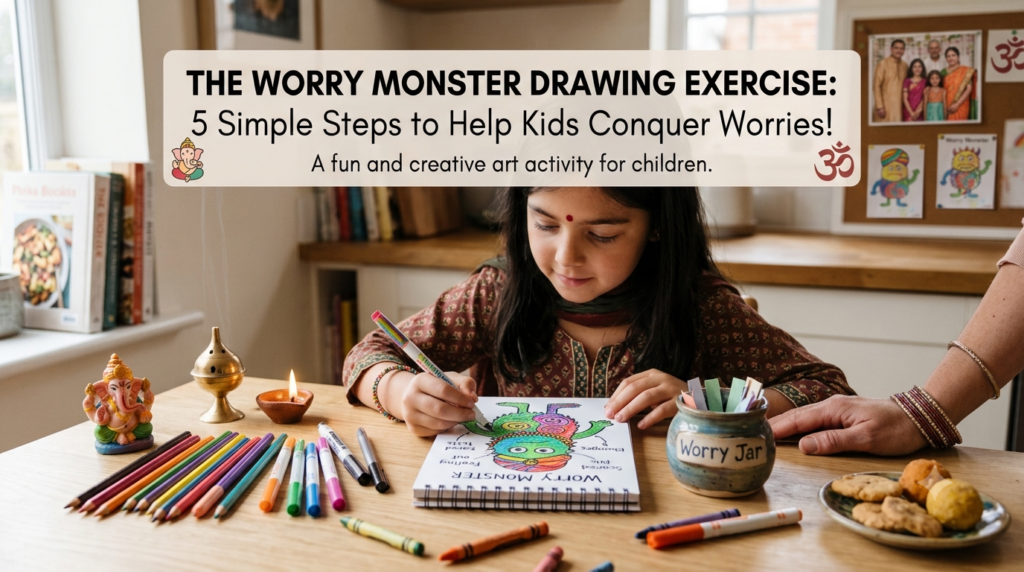
The Worry Monster Drawing Exercise is a simple, child-friendly activity in which a child draws a fictional monster to represent a worry, fear, or uncomfortable feeling.
For example, a child who is worried about an upcoming school exam might draw a monster with huge eyes, sharp teeth, and a speech bubble saying, “What if I forget everything during the exam?”
Another child who feels nervous about making friends might draw a tiny monster whispering, “What if nobody wants to play with me?”
The monster becomes a way to talk about the worry without making the child feel that something is wrong with them.
This approach is related to a psychological technique called externalisation. In simple terms, it means helping a child see that having a worry is not the same as being a worried or weak person. The worry is something they are experiencing, not their entire identity. Externalising a problem is used in child-focused therapeutic approaches to help children discuss difficult feelings in a more manageable way.
For parents, the distinction matters.
Instead of asking, “Why are you always so scared?”, you can ask, “What is your worry monster telling you today?”
That small change can make a conversation feel less like an interrogation and more like an invitation.
Children experience many of the same emotions as adults, but they may not yet have the vocabulary or confidence to describe them clearly. A child might feel anxious without knowing the word anxiety. They may say their stomach hurts, become unusually quiet, get angry, or ask the same question repeatedly.
The NHS identifies signs such as difficulty concentrating, sleep problems, irritability, persistent negative thoughts, and physical complaints as possible signs of anxiety in children. These symptoms can have other causes too, so parents should look at the whole picture rather than jumping to conclusions.
The Worry Monster exercise offers several possible benefits.
Some children can talk about their day for hours but become completely silent when asked what is bothering them.
Drawing gives them another way to communicate. They don’t need perfect words or an impressive drawing. Even a few lines, colours, or shapes can provide a starting point for conversation.
A worry can feel enormous inside a child’s mind. Putting it on paper creates something they can look at, describe, and discuss with a parent.
You might ask, “When does your monster usually appear?” or “What makes it grow bigger?”
These questions can help a child describe situations that trigger worry without feeling pressured to explain everything at once.
The exercise can help children notice what they feel, when they feel it, and what happens in their body.
For example, a child might realise that their monster appears before a class presentation, when they hear adults arguing, or when they think about being separated from a parent.
Recognising these patterns is a useful first step towards finding appropriate coping strategies.
The most valuable part of this exercise is not necessarily the drawing itself. It is the conversation that follows.
When a parent listens patiently instead of immediately correcting, advising, or dismissing a child’s feelings, the child gets an opportunity to feel heard.
Drawing and other visual activities can support emotional expression, although their effects vary by child and situation. They should not be presented as a guaranteed treatment for anxiety.

Take a sheet of paper and a few crayons, coloured pencils, or sketch pens.
Choose a quiet, comfortable place where your child won’t feel rushed. You don’t need special art supplies or drawing skills.

Say something like:
“Sometimes worries feel so big that it’s difficult to explain them. If your worry had a shape or looked like a monster, what would it look like?”
Let your child choose the colours, size, face, and shape. The monster can be scary, funny, tiny, enormous, or completely imaginary.

Ask your child what the monster says when it appears.
For example:
Write the words in a speech bubble if your child wants help.

Gently ask:
Listen without trying to solve everything immediately. Your child may want to talk, or they may prefer simply to show you their drawing.

Ask, “What could help you when this monster visits?”
Together, choose one small action, such as taking three slow breaths, asking a trusted adult for help, practising an exam question, or preparing for the next school day.
Your child can draw the monster feeling smaller, calmer, or less frightening. The aim is not to pretend the worry has vanished, but to remind the child that there are ways to respond to it.
This is a flexible 10-minute activity, not a timed test. If your child needs more time or doesn’t want to finish, that’s absolutely fine.
Your response matters more than the artistic result.
Here are some simple phrases you can use.
| Instead of saying… | Try saying… |
|---|---|
| “There’s nothing to worry about.” | “I can see this is worrying you. Tell me a little more.” |
| “Why are you scared of such a small thing?” | “What feels difficult about this for you?” |
| “Stop thinking negatively.” | “What is your worry monster telling you?” |
| “Don’t be silly.” | “It’s okay to feel worried. Let’s think about what might help.” |
| “You must be brave.” | “You can feel nervous and still take one small step.” |
You don’t have to agree that the feared outcome will happen. You simply need to acknowledge that the feeling is real to your child.
For example, if your child fears failing an exam, you can say, “You’re worried about what might happen if the exam goes badly. Let’s look at what you can do to prepare, and what we can do if you find a question difficult.”
This combines emotional reassurance with practical problem-solving.
Listening carefully, avoiding dismissive responses, and helping children identify manageable coping strategies are also recommended in parental guidance from the NHS.
Children’s worries change as they grow. The activity should therefore match their age, communication skills, and comfort level.
Young children may not be able to explain their emotions in detail. Keep the activity playful and simple.
Avoid making the monster too frightening. Some children may prefer drawing a worry cloud, a little bug, or a funny character instead.
Children in this age group may be able to identify specific worries related to school, friendships, exams, or separation from parents.
Encourage them to add a speech bubble to their drawing and explain what the monster says.
You can then ask, “Is there anything we know that might help us check whether this worry is true?”
For example, a child who fears being unable to answer questions in class could practise answering one question aloud at home.
Teenagers may find a cartoon monster childish, especially if they are already feeling self-conscious about their emotions.
Offer an alternative: they could draw a storm cloud, a tangled ball of thoughts, a character, or even use abstract shapes.
They might also write down what their “worry voice” says and respond to it with a more balanced thought.
For example:
With teenagers, give them more control over the activity. Ask permission rather than insisting they participate.
Even a simple activity can become uncomfortable if a child feels pressured. Here are a few things to keep in mind.
1. Don’t force your child to draw. Some children prefer talking, writing, playing, or using a worry box. Let them choose another way to express themselves.
2. Don’t interpret the drawing as a psychological diagnosis. A dark colour, large monster, or unusual shape does not automatically indicate a particular emotional problem. Ask the child what their drawing means to them instead of making assumptions.
3. Don’t promise to eliminate every worry. Everyone experiences uncertainty. Help your child learn that they can handle difficult feelings with support, rather than expecting never to feel anxious.
4. Don’t turn the activity into an interrogation. Ask one gentle question at a time and allow silence. If your child doesn’t want to explain, respect that.
5. Don’t dismiss a serious worry as imaginary. The monster is imaginary; the feeling or experience behind it may be very real. If your child mentions bullying, conflict at home, or feeling unsafe, listen carefully and address the underlying concern.
6. Don’t use the exercise as a substitute for professional support. It can be one helpful parenting activity, but persistent or severe anxiety may need a more comprehensive assessment.
Not every child will respond to drawing in the same way. Some may enjoy the activity but still feel worried afterwards. Others may struggle to identify their feelings or may not want to share them.
That doesn’t mean you’ve failed as a parent.
You can try a different approach, such as:
These activities are ways to open a conversation, not tests of whether your child is emotionally healthy.
If worry repeatedly affects your child’s sleep, school attendance, friendships, daily activities, or ability to cope, consider speaking with a qualified child mental health professional. Seek appropriate help sooner if your child feels unsafe or reveals possible abuse or harm.
It’s important to understand the difference between a useful activity and a clinically validated treatment.
The Worry Monster is a practical, child-friendly way to encourage emotional expression and separate a worry from a child’s sense of identity. Drawing and visual expression have also been studied in children’s emotional support.
A 2026 systematic review examined 10 randomised controlled trials involving 816 children aged 5–12. It found that drawing- and visual-art-based interventions were associated with lower short-term anxiety in certain settings, particularly medical and procedural contexts. However, the studies varied considerably, and the findings do not establish that the Worry Monster exercise itself treats childhood anxiety or will work for every child.
The practical takeaway for parents is straightforward: use the exercise as an opportunity to connect with your child, understand their concerns, and explore helpful coping strategies. Avoid treating the drawing as a diagnostic tool or expecting a single 10-minute activity to resolve persistent anxiety.
It is a creative activity in which a child draws a character representing a worry or fear. The parent then gently invites the child to describe when the worry appears, what it says, and what might help.
It can be adapted for many children, particularly those in preschool and primary school. Older children and teenagers may prefer a worry cloud, abstract drawing, or written exercise instead.
A simple version takes approximately 10 minutes. Allow extra time if your child wants to talk, and never rush them to finish.
Drawing can provide an alternative way to express feelings and may help some children feel more comfortable discussing their worries. However, its effectiveness varies, and it should not be relied upon as the sole treatment for persistent anxiety.
Respect their choice. You can say, “That’s okay. We don’t have to talk about it now. I’m here whenever you’re ready.” Avoid guessing what the drawing means or pressuring your child to reveal something.
Consider professional support when worries are persistent, intense, or interfering with everyday life, including school, sleep, relationships, or normal activities.
Parenting doesn’t come with an instruction manual. We learn as our children grow, and sometimes the smallest moments of listening can teach us something important about what they need from us.
The Worry Monster Drawing Exercise is one simple way to begin that conversation. Ten minutes, a sheet of paper, and a willingness to listen may give your child an easier way to express a feeling they have struggled to explain.
Remember, the goal isn’t to raise a child who never feels worried. It’s to help raise a child who feels safe expressing worries and knows they don’t have to face them alone. ❤️
At SH Development Academy, we believe that understanding a child is an important part of helping them grow with confidence. Through our child-focused guidance and counselling services, we help parents explore their children’s strengths, challenges, and developmental needs with greater clarity.
If you’re looking for guidance on understanding your child and supporting their development, learn more about our services.
Learn more about DMIT and our child development guidance services at SH Development Academy.
Guided by Santosh Hariharan — DMIT Consultant, Parent & Career Coach, and Success Mindset Coach for Students.Explore Our DMIT Services
Have questions? Contact us
+91 8421315400
+91 7303290862
Looking for feedback from other families?
Every child is different. Start with curiosity, lead with empathy, and remember that understanding comes before guidance.
Success & Happiness are the two most important yet elusive things which every human being yearns to achieve in life. Real success and happiness can be savoured only when one enjoys good health and good family relations, along with a good professional career and sound financial stability.
Our Visitor


 Users Today : 9