
Have you ever watched your child go from perfectly happy to crying, shouting, throwing things, or refusing to listen in a matter of minutes?
Perhaps it happens when you ask them to switch off the TV, finish their homework, share a toy with a sibling, or get ready for school. You try explaining, negotiating, distracting, or even raising your voice—but nothing seems to work.
As a parent, these moments can be exhausting. You want your child to calm down, but in the heat of the moment, your child may not yet know how to do that.
Here is an idea worth trying: a calm-down basket.
It is a simple basket or box filled with inexpensive, child-friendly items that help children slow down, manage overwhelming feelings, and gradually learn ways to regulate their emotions. You do not need expensive toys, fancy sensory equipment, or a dedicated playroom. Many useful items may already be available in your home.
In this guide, we will explore 10 practical calm down basket ideas, how to choose items for different age groups, how to introduce the basket without making your child feel punished, and how parents can use it to build healthier emotional habits.
The goal is not to stop children from feeling angry, sad, or frustrated. It is to help them learn what to do when those feelings become difficult to manage. ❤️
A calm-down basket is a small collection of comforting, sensory, and creative items that a child can use when they feel upset, frustrated, restless, or overwhelmed.
Think of it as a little emotional first-aid kit for your home. 🧺
Instead of repeatedly telling a child, “Stop crying,” “Don’t get angry,” or “Calm down now,” you give them practical options to help manage what they are feeling.
For example, a child who feels frustrated after struggling with homework might squeeze a soft ball, draw their feelings, cuddle a favourite toy, or sit quietly with a picture book.
The important thing to understand is that the basket is a tool, not a magic solution. Younger children, especially, need an adult’s calm presence and guidance while they learn how to manage strong emotions. A calming space works best when it is introduced during peaceful moments and never used as punishment.
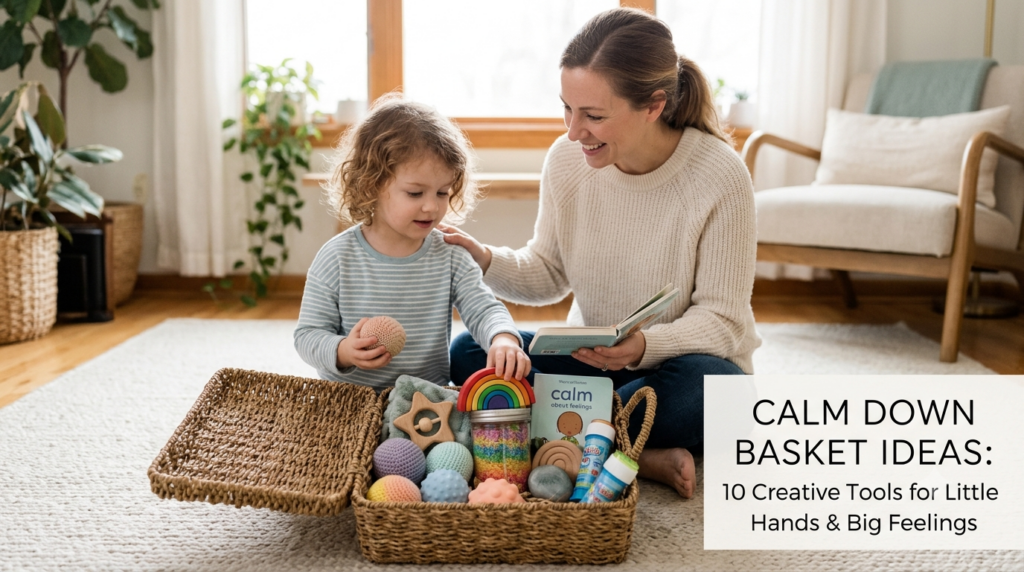
You don’t need to buy all ten items at once. Start with three to five things your child enjoys, observe what helps, and build your basket gradually.

Approximate cost: ₹100–₹300, or use one you already own
Sometimes children cannot explain what is bothering them. They may simply need something familiar to hold while they work through their feelings.
A favourite teddy bear, soft doll, or small cushion can offer a sense of comfort and familiarity. You can gently say, “Would you like to hold your teddy while I sit with you?”
Best for: Younger children, separation worries, disappointment, and moments when a child wants comfort rather than conversation.

Approximate cost: ₹50–₹200
Some children find it easier to settle when their hands have something safe to do. Squeezing a soft stress ball or manipulating a sturdy fidget toy may help them redirect restless energy.
Try it when your child is getting impatient, waiting for a turn, or feeling frustrated by a difficult task.
Parent tip: Choose a durable, age-appropriate item without small detachable parts. A fidget is an option, not something every child will find calming.

Approximate cost: ₹50–₹150
Not every child has the words to say, “I’m disappointed,” “I’m jealous,” or “I feel left out.” Drawing can offer another way to express those feelings.
Invite your child to draw their feelings, make a picture of a safe place, or simply colour freely for a few minutes.
Avoid turning it into an art lesson or asking too many questions. The purpose is expression, not producing a beautiful drawing.
Best for: Children who enjoy creative activities or find direct conversations difficult.

Approximate cost: ₹0–₹50 if homemade
Create a few illustrated cards with easy instructions, such as:
Practise these activities together when your child is already calm. When emotions run high, use a gentle invitation rather than insisting on deep breaths.
Best for: School-age children who are ready to practise simple calming routines.

Approximate cost: ₹0–₹100 if homemade
Draw or print faces showing emotions such as happy, angry, sad, worried, excited, confused, and calm.
When your child is ready, ask, “Which face feels a little like you right now?” This gives them a starting point for naming their emotions.
For younger children, use just three or four faces. Older children can use more detailed words such as disappointed, embarrassed, overwhelmed, or frustrated.
Best for: Helping children build emotional vocabulary and communicate their needs.

Approximate cost: ₹0–₹100
A securely sealed, clear bottle containing water and large, visually interesting objects can provide a quiet activity. Your child can watch the contents move and settle.
You can make a simple version using a sturdy, transparent bottle with securely fixed contents. Check it regularly for cracks or leaks.
Safety first: Avoid loose glitter, beads, small objects, or liquids that a young child could access. Keep the bottle under adult supervision and out of reach of children who may chew or open it.

Approximate cost: ₹0–₹200 if already owned or borrowed
Familiar stories can create a gentle transition away from an overwhelming situation. Choose a book your child already enjoys, or one that explores friendship, frustration, patience, or feelings.
You don’t need to explain a moral after every page. Sometimes, sitting together and reading quietly is enough.
Best for: Children who respond well to stories, predictable routines, and quiet time with a trusted adult.

Approximate cost: ₹0–₹200 if already owned
Some children find familiar textures comforting. A soft cotton cloth, small blanket, or favourite piece of fabric can be something reassuring to hold or touch.
Let your child choose a texture they enjoy. Not every child likes soft fabrics, and some may find particular textures irritating.
Best for: Children who seek tactile comfort. Always supervise infants and young children around loose fabrics, particularly during sleep.

Approximate cost: ₹200–₹600
If your child finds loud sounds overwhelming, suitable noise-reducing earmuffs may make a noisy environment more manageable.
They can be useful during busy family gatherings, noisy household activities, or other situations in which the child finds sound uncomfortable.
Parent tip: Let your child choose whether to wear them. They are optional support, not a requirement. If sound sensitivity regularly interferes with daily life, consider discussing it with a qualified professional.

Approximate cost: ₹0–₹50 if homemade
This may be the most useful item in the entire basket because it helps children practise choosing what they need.
Write or draw simple options such as:
Keep the choices limited and realistic. When a child is overwhelmed, a long list of instructions can make things harder.
Best for: Helping children gradually move from relying on an adult for every step to selecting a familiar coping strategy.
The most useful calm-down basket is not necessarily the one with the most items. It is the one containing safe, familiar options your child is willing to use. Different children respond differently to touch, movement, sound, and quiet activities.
You can put together a useful basket in about 15–20 minutes without making a special shopping trip.
Step 1: Find a simple container
Use an old storage box, a clean cardboard box, or a small laundry basket. It does not need to look fancy.
Step 2: Let your child help choose
Ask, “What helps you feel better when you’re upset?” Include a few familiar items your child genuinely enjoys rather than filling the basket with things you think they should like.
Step 3: Choose a convenient location
Keep the basket somewhere accessible, quiet, and safe. It could be near the sofa, in a reading corner, or in your child’s play area.
Step 4: Explain what it is for
Tell your child, “This is your basket for difficult moments. You can choose something from it when you need help settling down. I’ll help you if you need me.”
Step 5: Practise on an ordinary day
Explore the items together when your child is happy and relaxed. Practise choosing a card, drawing a picture, or using the stress ball. These strategies are easier to remember when the child has experienced them before.
A calm-down basket should remain an invitation, not an order. Children should not be sent to it as a punishment or expected to stop crying immediately.
Children’s emotional and communication skills change as they grow. Choose items according to your child’s developmental stage, interests, and safety needs—not just their age.
| Age group | Items to try | How parents can help |
|---|---|---|
| Toddlers (1–3 years) | Familiar soft toy, sturdy picture book, soft cushion | Stay close, name feelings simply, and offer comfort. Avoid small parts and choking hazards. |
| Preschoolers (3–5 years) | Feelings pictures, crayons, comfort toy, simple breathing game | Model the activity and offer two simple choices. |
| Primary school (6–10 years) | Stress ball, drawing pad, choice cards, storybook | Help your child identify what triggered the feeling and select a strategy. |
| Older children (11–13 years) | Journal, sketchbook, quiet activity, optional noise-reducing earmuffs | Respect their privacy while remaining available for support. |
| Teenagers (14+) | Notebook, music options, calming cards, preferred sensory item | Collaborate on a personalised toolkit rather than imposing a childish-looking basket. |
These are starting points, not strict rules. A child of eight may prefer a soft toy, while another may prefer drawing or spending a little quiet time with a parent.
Important: For infants and toddlers, avoid small detachable objects, magnets, button batteries, cords, and anything that could be swallowed or cause choking. Inspect items regularly and supervise according to your child’s age and abilities.
This is where many parents struggle.
You have prepared the basket, explained how it works, and placed everything neatly inside. But when your child is actually upset, they refuse to touch anything.
That can happen. A child who is extremely distressed may not be ready to make choices, follow instructions, or explain what is wrong.
Instead of insisting that they use the basket, try this approach.
This is called co-regulation: an adult helps a child manage overwhelming feelings before the child gradually becomes more able to regulate independently. It is a skill that develops over time, not something children master simply because they have been told to behave.
Even a thoughtfully prepared basket may not help if the way it is introduced makes a child feel ashamed, controlled, or misunderstood.
A calm-down basket can support emotional learning, but it cannot replace attention to the underlying problem. If your child’s distress is frequent, intense, persistent, or significantly affecting school, relationships, sleep, or everyday life, consider speaking with a paediatrician or qualified child mental health professional.
Start with three to five safe, familiar items, such as a soft toy, drawing materials, a feelings chart, a sturdy picture book, or a stress ball. Add items based on what your child enjoys and finds comforting.
They can help children practise coping strategies and communicate their needs, especially when combined with patient adult support. However, results vary. A basket alone will not automatically stop tantrums or resolve the causes of emotional distress.
You can introduce a simple collection of comforting items in toddlerhood, with close adult supervision. As children grow, you can introduce feelings cards, breathing activities, journaling, and independent choice-making.
You can create a basic calm-down basket for little or no cost by reusing a box, paper, crayons, a favourite toy, and books you already have. If you buy additional items, your budget will depend on the products you choose.
Don’t force it. Your child may need your presence, a quieter environment, or time before they can engage with an activity. Reintroduce the items during a relaxed moment and let your child choose what feels comfortable.
It may provide useful coping options, but frequent anger can have many causes. Observe when it happens, what triggers it, and what helps. If the behaviour is persistent, intense, or disruptive to everyday life, seek professional guidance rather than relying on the basket alone.
A child who cries over a seemingly small issue, refuses to listen, or struggles with frustration is not necessarily trying to make life difficult for their parents.
Sometimes, they simply haven’t learned how to handle what they are feeling.
A simple calm-down basket can be a practical starting point. It gives children a few safe options, creates opportunities for parents to connect with them, and encourages emotional skills through everyday experiences.
But remember, the most important part of a calm-down basket is not what’s inside it. It’s the understanding, patience, and guidance that surround it.
When we begin to understand our children as individuals, we can respond to their needs more thoughtfully instead of relying on the same approach every time.
Every child has a different temperament, set of interests, strengths, and needs. What works beautifully for one child may not work the same way for another.
At SH Development Academy, Santosh Hariharan, DMIT Consultant, Parent & Career Coach, and Student Success Mindset Coach, helps parents explore their child’s strengths and development through personalised guidance and counselling.
A DMIT consultation can be one starting point for a broader conversation about understanding your child. It is important to remember that fingerprint-based DMIT analysis has not been established as a reliable scientific method for diagnosing emotional difficulties, determining parenting needs, or predicting a child’s future. A child’s behaviour is best understood through observation, conversations, and appropriate professional assessment when needed.
If you would like to learn more about DMIT and our services, explore the information below.
Learn more about DMIT, our consultation process, and how we support parents in understanding their children’s individual strengths.
Contact SH Development Academy
+91 8421315400
+91 7303290862
Your child doesn’t need a perfect parent. They need a parent who is willing to understand them, learn alongside them, and guide them with patience. Sometimes, that small change can make a meaningful difference. 💛
Success & Happiness are the two most important yet elusive things which every human being yearns to achieve in life. Real success and happiness can be savoured only when one enjoys good health and good family relations, along with a good professional career and sound financial stability.
Our Visitor


 Users Today : 40