



If you’re a student who has just completed Class 12 or a parent helping your child choose the right career path, you’ve probably come across the terms UG and PG countless times.
You’ll hear people ask questions like:
These questions are completely normal. In fact, every year, lakhs of students across India face the same confusion while planning their higher education.
Choosing the right course isn’t just about selecting a college. It’s about selecting a path that matches your interests, strengths, career goals, and future aspirations.
As a DMIT Consultant, Parent & Career Coach, I’ve met many students who enrolled in a degree simply because their friends chose it or because society considered it a “good option.” Unfortunately, many of them later realized they were in the wrong field.
That’s why understanding the meaning of UG and PG is only the first step. Choosing the right UG or PG course is what truly shapes your future.
In this detailed guide, you’ll learn:
✅ UG Full Form
✅ PG Full Form
✅ Difference between UG and PG
✅ Duration of UG & PG courses
✅ Benefits of each course
✅ Which option is right for you
✅ Career guidance tips before choosing any course
Let’s begin.

UG stands for Undergraduate.
An undergraduate course is the first level of higher education that students pursue after completing Class 12 (Higher Secondary Education).
In simple words,
A UG course is your first college degree.
It provides students with the knowledge, practical skills, and academic foundation needed for a professional career or higher studies.
Most students join undergraduate courses immediately after completing their 12th standard.
Depending on the stream you choose in school, there are hundreds of UG options available.
Some of the most popular include:
With emerging technologies like Artificial Intelligence, Data Analytics, Robotics, Cloud Computing, and Cybersecurity gaining importance in 2026, students today have more career options than ever before.

PG stands for Postgraduate.
A postgraduate course is an advanced degree pursued after completing an undergraduate (UG) degree.
The purpose of PG education is to help students specialize in a particular subject and develop deeper expertise.
For example,
A student who completes:
B.Com
can pursue
M.Com
or
MBA.
Similarly,
A B.Tech graduate may pursue:
depending on their career goals.
Some of India’s most popular PG courses include:
Many graduates also pursue:
These certifications help improve employability in today’s competitive job market.
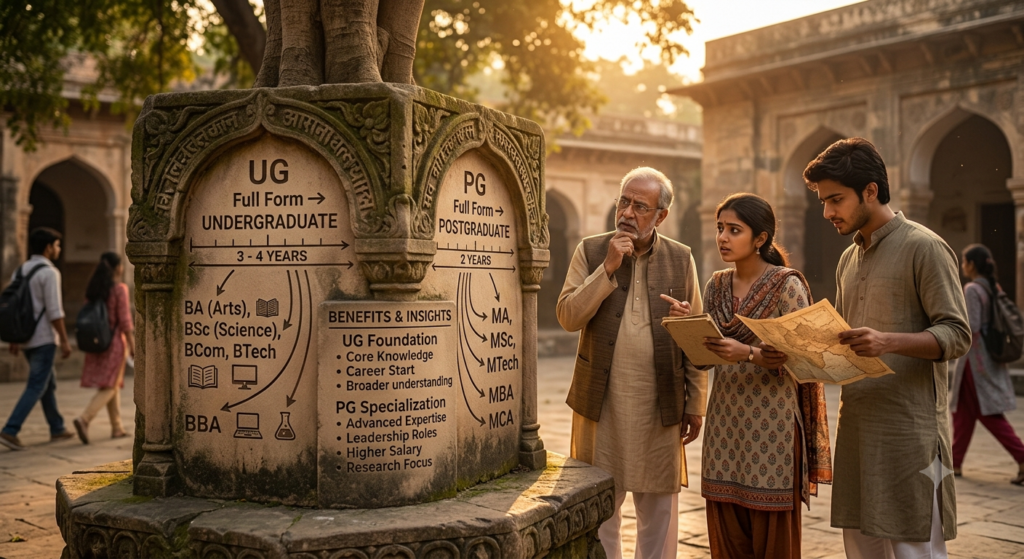
Many students believe that selecting a college is the biggest decision.
In reality…
Choosing the right course is even more important than choosing the college.
Imagine two students.
Student A joins Engineering because everyone in the family is an engineer.
Student B chooses a course aligned with their interests, aptitude, and strengths.
Five years later, Student B is much more likely to enjoy their work, perform better, and build a satisfying career.
This is why career decisions should never be based only on:
❌ Peer pressure
❌ Society
❌ Family expectations
❌ Popularity of a course
Instead, students should consider:
These factors together help identify the right educational path.
During career counselling sessions, I often hear statements like:
“I took Science because everyone said it has more scope.”
or
“I joined Commerce because my friends did.”
or
“I didn’t know what I actually wanted.”
Unfortunately, these decisions can lead to:
This is why career planning should ideally begin before selecting a UG course.
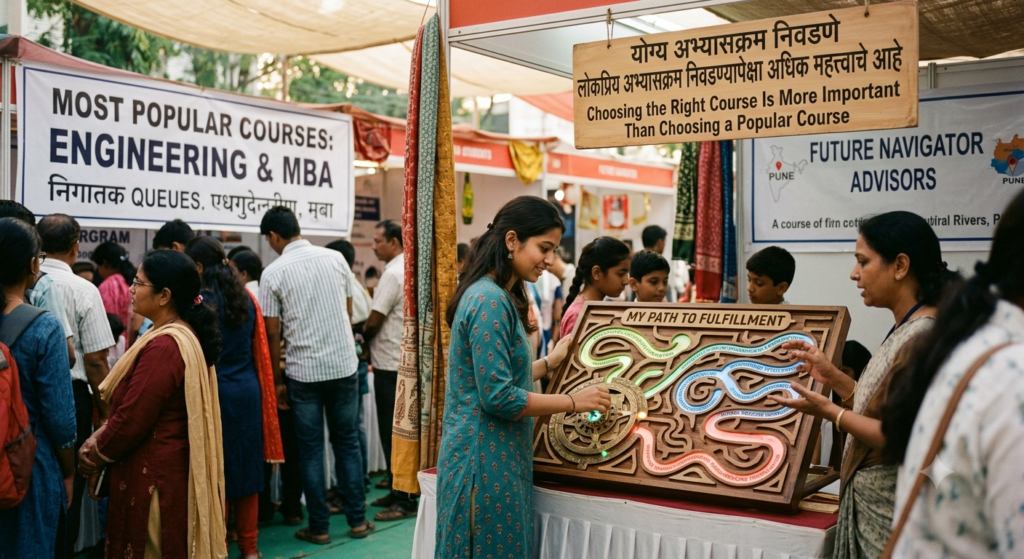
There is no such thing as the “best” course.
There is only the best course for you.
A student with excellent communication skills may excel in law, management, or media.
A highly analytical student may thrive in engineering or data science.
A creative student may build a successful career in design, animation, or digital marketing.
The key is understanding yourself before making decisions that affect your future.
Although both UG (Undergraduate) and PG (Postgraduate) are part of higher education, they serve different purposes in a student’s academic and professional journey.
Think of it this way:
Your UG course builds the foundation, while your PG course helps you specialize in a specific field.
For example, if your dream is to become a marketing manager, you may first complete a BBA (UG) and later pursue an MBA (PG) to gain advanced knowledge and leadership skills.
Understanding this difference can help students and parents make better educational decisions instead of simply following trends.
| Feature | UG (Undergraduate) | PG (Postgraduate) |
|---|---|---|
| Full Form | Undergraduate | Postgraduate |
| Eligibility | After Class 12 | After Graduation |
| Purpose | Build basic knowledge | Gain specialization |
| Duration | 3–5 years | 1–2 years |
| Examples | B.Com, B.Sc, B.Tech, BA, BBA | MBA, M.Tech, M.Com, M.Sc, MA |
| Career Level | Entry-level jobs | Higher-level and specialized roles |
Choosing the right undergraduate course is one of the biggest decisions in a student’s life because it lays the foundation for future education and career opportunities.
Here are the major categories of UG courses available in India.
Ideal for students interested in innovation, problem-solving, and technology.
Popular courses include:
Career opportunities:
Suitable for students passionate about healthcare and helping others.
Popular courses include:
Career opportunities:
Perfect for students interested in finance, accounting, business, and entrepreneurship.
Popular courses:
Career options:
Ideal for students who enjoy communication, creativity, psychology, history, or public service.
Popular courses:
Career opportunities:
Technology continues to be one of the fastest-growing industries in 2026.
Popular courses:
Career options:
For students who love creativity, innovation, and visual storytelling.
Popular options:
Career opportunities:
After completing graduation, students often choose postgraduate programs to specialize in a particular domain.
Some of the most popular PG programs include:
One of India’s most sought-after postgraduate degrees.
Suitable for careers in:
For engineering graduates who want technical specialization or careers in research and development.
Ideal for commerce graduates planning careers in:
Suitable for students interested in research, science, healthcare, or academics.
Popular specializations include:
A popular option for graduates interested in software development and IT careers.
For graduates looking to deepen their knowledge in subjects like:
In 2026, many students are choosing skill-based postgraduate programs in areas such as:
These programs are especially valuable for professionals looking to upgrade their skills quickly.
One of the most common questions students ask is:
“How many years does it take to complete a UG or PG course?”
The answer depends on the program you choose.
| Course | Duration |
|---|---|
| BA | 3 Years |
| B.Com | 3 Years |
| B.Sc | 3 Years |
| BBA | 3 Years |
| BCA | 3 Years |
| B.Tech / BE | 4 Years |
| B.Pharm | 4 Years |
| MBBS | 5.5 Years |
| BDS | 5 Years |
| Course | Duration |
|---|---|
| MBA | 2 Years |
| M.Tech | 2 Years |
| M.Com | 2 Years |
| MCA | 2 Years |
| M.Sc | 2 Years |
| MA | 2 Years |
| PG Diploma | 1–2 Years |
This is a question I hear frequently from both students and parents.
The answer is:
It depends on your career goals—not on what everyone else is doing.
If your chosen profession requires advanced knowledge or specialization, pursuing a PG degree can be a smart investment.
For example:
On the other hand, many industries—such as software development, digital marketing, entrepreneurship, design, and creative fields—often value skills, practical experience, internships, and portfolios as much as formal degrees.
Rather than asking, “Should everyone do a PG?”, ask yourself:
Making your education decisions based on your aspirations—not social pressure—can save years of confusion and help you build a more fulfilling career.
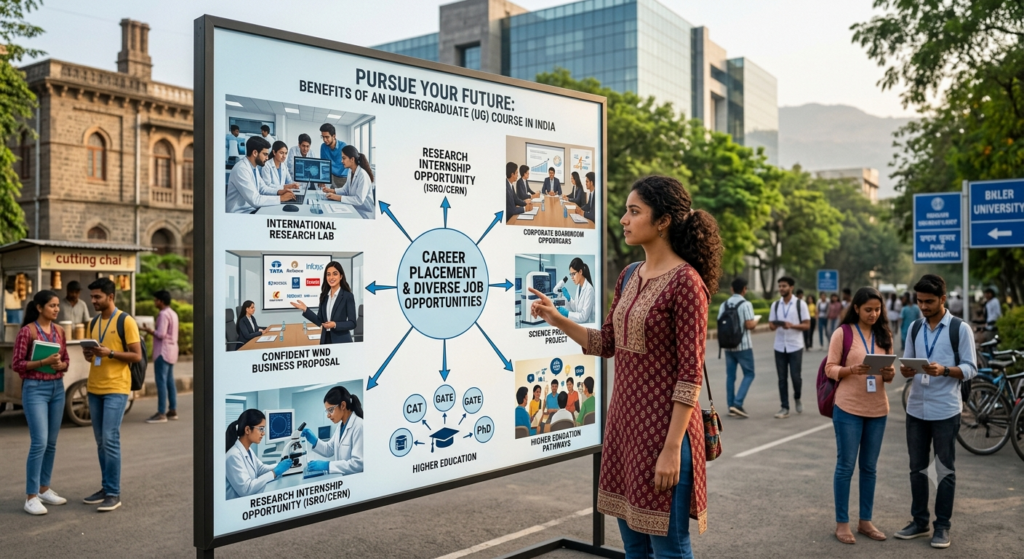
An undergraduate degree is much more than a certificate—it’s the first major step toward building your future. The right UG course not only equips you with academic knowledge but also helps you develop the confidence, skills, and exposure needed to succeed in today’s competitive world.
Here are some of the biggest benefits of pursuing a UG degree.
A UG course introduces you to the fundamentals of your chosen field. Whether it’s engineering, commerce, medicine, law, management, or the arts, this stage lays the groundwork for your future career.
Just like a strong foundation supports a tall building, the right undergraduate education supports long-term career growth.
Many professional careers require a bachelor’s degree as the minimum qualification.
After completing a UG course, students can explore opportunities in:
Your first job may not define your entire career, but your undergraduate education often determines where your journey begins.
College isn’t just about textbooks. It’s where students develop important life and professional skills such as:
These abilities are valued by employers across every industry.
Completing a UG degree makes you eligible for postgraduate programs like MBA, M.Tech, M.Sc, MA, MCA, and many international master’s programs.
It also opens doors to professional certifications and specialized training.
For many students, college is the first experience of making independent decisions.
Managing assignments, internships, projects, and interacting with diverse people helps students become more confident and responsible individuals.
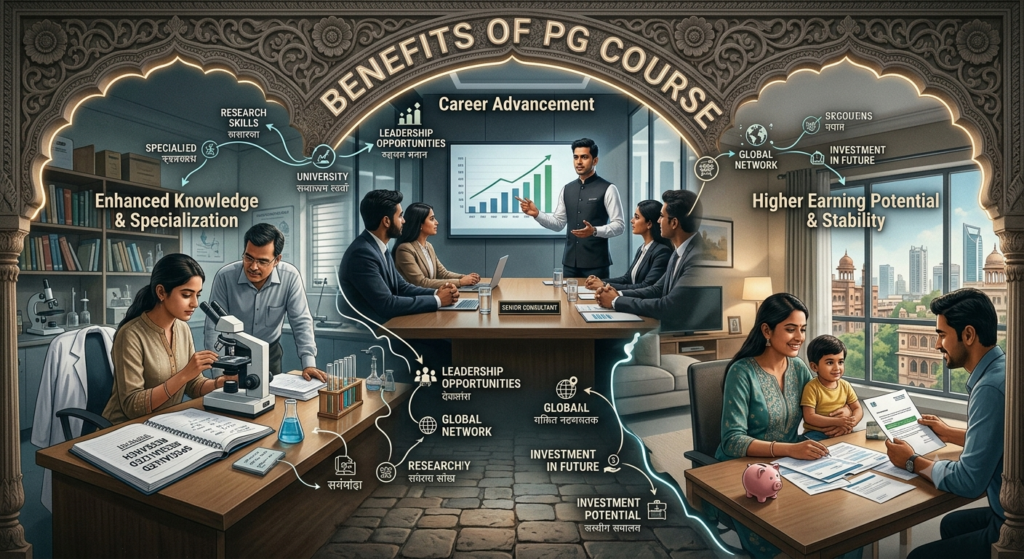
A postgraduate degree allows students to specialize in a particular field and deepen their expertise.
While a PG degree is not compulsory for every profession, it can significantly enhance career prospects in many industries.
Unlike UG courses that provide a broad understanding, PG courses focus on advanced concepts and practical specialization.
This helps students become experts in their chosen domain.
Many leadership and managerial roles prefer candidates with postgraduate qualifications.
A PG degree can increase opportunities for promotions, specialized roles, and long-term career progression.
Although salary depends on skills, experience, and industry, specialized knowledge often improves earning potential over time.
Fields like management, healthcare, engineering, finance, and data science particularly reward advanced expertise.
Postgraduate education encourages:
These skills are valuable not only in academics but also in corporate and entrepreneurial careers.
Many multinational companies and international universities value candidates with advanced qualifications, especially when combined with practical experience.
A PG degree can also strengthen applications for higher studies abroad.
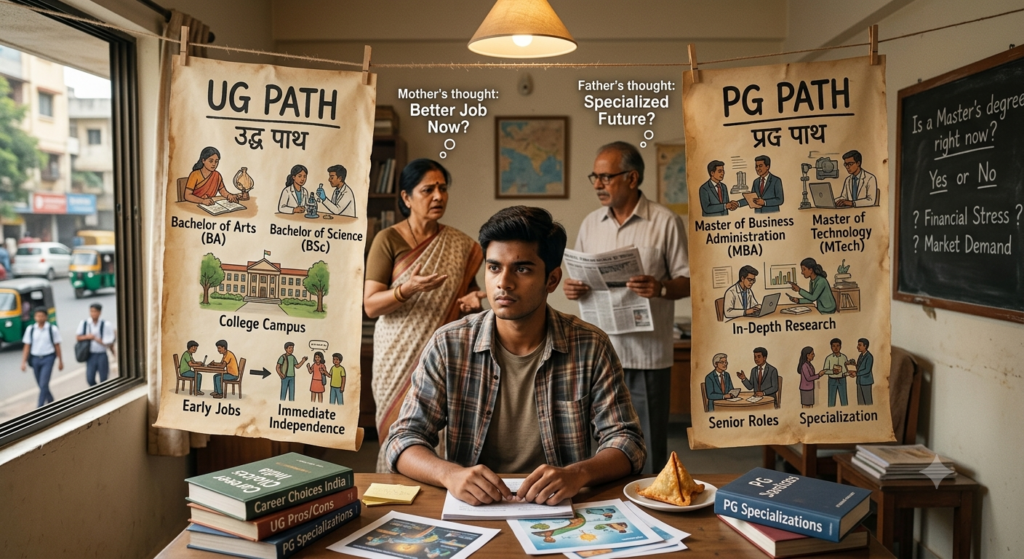
Many students ask,
“Should I stop after graduation or continue with a postgraduate degree?”
There is no universal answer.
Instead, ask yourself these questions:
Your answers will help you make a more informed decision.
As a DMIT Consultant, Parent & Career Coach, I’ve seen students make avoidable mistakes that later lead to frustration and career changes.
Here are some of the most common ones:
Your friends’ interests, abilities, and goals may be completely different from yours.
Never choose a course just because your classmates are choosing it.
Parents naturally want the best for their children, but sometimes decisions are influenced by family expectations rather than the student’s strengths.
The best career is one that aligns with both ability and interest.
Just because a particular course is popular today doesn’t mean it is the right fit for you.
Fields evolve rapidly. A career should be chosen based on long-term suitability rather than short-term trends.
Two students with identical marks may perform very differently in the same profession because of differences in personality, learning style, motivation, and natural abilities.
Understanding these factors before selecting a course can prevent years of confusion.
One of the biggest mistakes students make is deciding their future based only on marks.
Marks tell you how you performed in exams.
They don’t always reveal:
That’s why professional career guidance has become increasingly important in 2026.
A structured career assessment can help students understand themselves before investing years in a degree program.
UG stands for Undergraduate, the first level of higher education pursued after completing Class 12.
PG stands for Postgraduate, an advanced degree pursued after completing an undergraduate course.
Neither is inherently better.
A UG degree builds your foundation, while a PG degree provides specialization. The right choice depends on your career goals.
Yes. Many students start successful careers immediately after completing their undergraduate degree. However, certain professions may require postgraduate qualifications or professional certifications.
No.
A postgraduate degree is beneficial for many careers but is not mandatory for every profession. Your decision should be based on your chosen career path.
There is no single “best” course.
The best UG course is the one that matches your aptitude, interests, personality, and long-term career aspirations.
Choosing between a UG and PG course is not simply about earning degrees—it’s about building a career that aligns with who you are.
In today’s world, success doesn’t come from following the crowd. It comes from making informed decisions based on your strengths, interests, and long-term goals.
Whether you dream of becoming an engineer, doctor, entrepreneur, designer, lawyer, teacher, or business leader, your educational journey should begin with understanding yourself first.
Remember:
The right course chosen for the right reasons can save years of confusion and unlock your true potential.

Feeling confused about which UG or PG course is right for you or your child?
At SH Development Academy, we believe that career decisions should be based on a student’s natural strengths, aptitude, personality, and interests—not on guesswork or societal pressure.
Our Career Guidance Consultation, led by Santosh Hariharan (DMIT Consultant, Parent & Career Coach, and Success Mindset Coach), helps students and parents make informed education and career choices with confidence.
Our consultation includes guidance on:
✅ Suitable UG & PG course selection
✅ Career planning based on aptitude and personality
✅ Stream selection after Class 10 & 12
✅ Understanding strengths and learning styles
✅ Long-term career roadmap
👉 DMIT Consultation Booking:
Book Your Consultation Here
⭐ See why 310+ parents and students trust us:
Read Our Google Reviews
📞 Call Us:
+91 8421315400 | +91 7303290862
Success & Happiness are the two most important yet elusive things which every human being yearns to achieve in life. Real success and happiness can be savoured only when one enjoys good health and good family relations, along with a good professional career and sound financial stability.
Our Visitor


 Users Today : 24