
Choosing a stream after Class 10 is one of the first major decisions that can shape a student’s future. Every year, thousands of students across India—and especially in cities like Pune—find themselves asking the same question:
“Should I choose Science, Commerce, or Arts?”
Unfortunately, many students don’t make this decision based on their natural strengths or interests. Instead, they are influenced by marks, peer pressure, family expectations, or the belief that one stream is “better” than another.
Sound familiar?
As a DMIT Consultant, Parent & Career Coach, I’ve met hundreds of students who chose a stream because:
A few years later, many of these students realize they are unhappy, stressed, or pursuing a career they never truly wanted.
The reality is simple:
There is no “best” stream. There is only the stream that is best for you.
And that’s exactly where an Aptitude Test can make a life-changing difference.
Instead of guessing, an aptitude assessment helps students understand how they naturally think, solve problems, learn new concepts, and where their strengths truly lie. It provides a scientific starting point for making one of the most important academic decisions of their life.
If you’re a parent or student wondering whether Science, Commerce, or Arts is the right choice, this guide will help you understand how aptitude testing can bring clarity before making that decision.

Most students spend only a few weeks deciding their stream.
But the impact of that decision often lasts for decades.
The subjects you choose after Class 10 influence:
That’s why this decision deserves much more thought than simply following trends.
Unfortunately, many students choose a stream without truly understanding themselves.
Imagine asking a fish to climb a tree.
No matter how hard it tries, it will always feel like a failure.
Similarly, when a student’s natural abilities don’t match the demands of their chosen stream, learning becomes stressful instead of enjoyable.
I’ve seen students who loved creativity pushed into Science because they scored 90%.
I’ve also seen students with excellent analytical ability choose Arts simply because their friends did.
Neither decision was based on their real potential.
Choosing the right stream isn’t about choosing the “hardest” option.
It’s about choosing the one where your natural abilities can flourish.
One of the biggest myths in Indian education is:
“If you score high marks, you should take Science.”
While good marks certainly reflect hard work and academic performance, they don’t tell the complete story.
Marks measure what you’ve learned in school.
They don’t necessarily measure:
For example:
A student may score 95% in Mathematics through disciplined study but naturally enjoy storytelling, psychology, and public speaking.
Another student may have average school marks but exceptional logical reasoning and mechanical aptitude.
Both students need different guidance.
That’s why experienced career counsellors today recommend looking beyond report cards.
An aptitude assessment helps identify strengths that school exams often fail to measure.
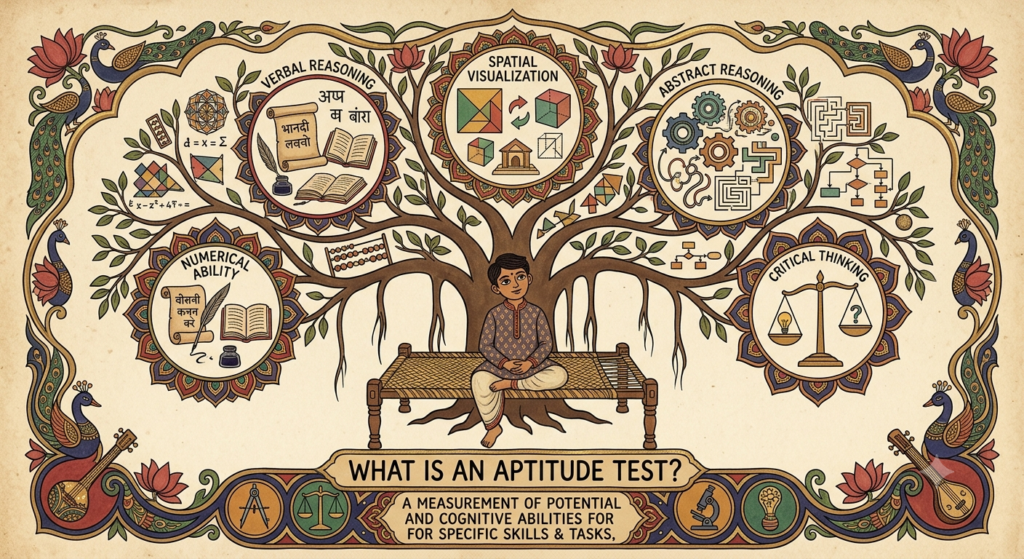
An Aptitude Test is a scientifically designed assessment that measures a person’s natural ability to perform specific tasks or solve particular types of problems.
Unlike school examinations, aptitude tests are not about memorizing textbooks.
Instead, they evaluate abilities such as:
Can you identify patterns and solve problems logically?
How comfortable are you working with numbers and data?
Can you understand, analyze, and communicate ideas effectively?
How well do you recognize relationships between shapes, symbols, and patterns?
Can you visualize objects and understand designs or structures?
How do you respond when faced with challenging situations?
Do you learn better by seeing, listening, or doing?
When combined with personality assessments and career counselling, aptitude tests provide valuable insights into which academic stream and career path may be a better fit.
Rather than telling students what they must become, they help students understand where they are naturally more likely to thrive.
Think of an aptitude test as a compass.
A compass doesn’t walk the journey for you.
But it points you in the right direction.
Similarly, aptitude assessments don’t decide your future—they provide clarity to help you make informed decisions.
For example:
A student who demonstrates:
may naturally feel more comfortable exploring Science-related careers.
Another student with:
may enjoy Commerce-related opportunities.
While a student who shows strengths in:
may discover fulfilling careers through Arts or Humanities.
This doesn’t mean one stream is superior to another.
It simply means different students have different strengths.
The goal is to match those strengths with suitable educational pathways.
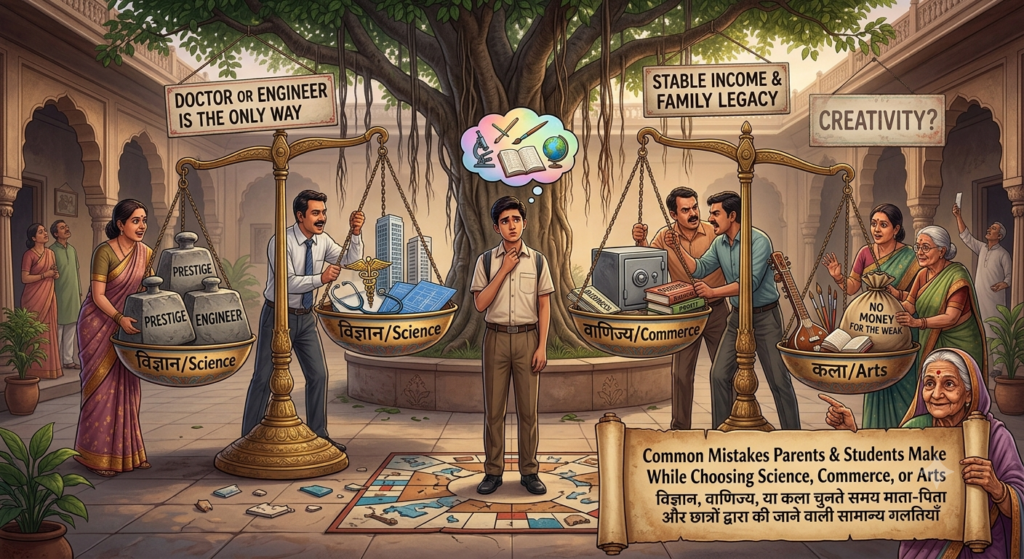
Over the years, I’ve observed the same mistakes repeated by many families.
Avoiding these mistakes can save years of frustration.
Marks tell only part of the story.
A student’s interests, aptitude, and personality matter just as much.
Your friend’s dream may not be your dream.
Every student has different strengths.
Choosing a stream simply because your friends are choosing it often leads to dissatisfaction later.
Many parents still believe:
Today’s job market tells a very different story.
Successful careers exist in every stream.
What matters most is choosing the one that matches your abilities.
Many families spend years preparing for board exams but invest very little time in understanding which career path actually suits the child.
Professional career guidance combined with aptitude assessments can significantly reduce confusion during stream selection.
Students today have access to hundreds of career opportunities that didn’t exist a decade ago.
Artificial Intelligence, Digital Marketing, Data Science, UX Design, Sports Management, Content Creation, Financial Analytics, Psychology, Sustainability, and many other emerging careers are opening exciting possibilities.
Choosing the right stream should be the beginning of discovering these opportunities—not the end of your options.

One of the biggest misconceptions about aptitude tests is that they tell students exactly what career they should choose.
They don’t.
Instead, an aptitude test answers a much more important question:
“Which stream is most aligned with my natural abilities, interests, and way of thinking?”
Think of it this way…
Imagine asking three students to solve the same problem.
One immediately starts calculating numbers.
Another begins sketching diagrams.
The third explains the solution through words and examples.
All three are intelligent.
They simply think differently.
That is exactly what an aptitude assessment helps identify.
Rather than comparing students with each other, it focuses on understanding how each student is naturally wired to learn and perform.
Let’s look at how this works for each stream.
Science is often considered the “default” choice for high-scoring students.
But high marks alone don’t guarantee that a student will enjoy or excel in Science.
Students who usually thrive in Science often demonstrate strengths such as:
✔ Strong logical reasoning
✔ Curiosity about how things work
✔ Analytical thinking
✔ Numerical ability
✔ Scientific problem-solving
✔ Patience for practical experiments
✔ Ability to understand complex concepts
An aptitude assessment evaluates these abilities objectively.
For example, if a student enjoys solving mathematical puzzles, loves experimenting, and naturally thinks analytically, Science may be a suitable path.
On the other hand, if the student struggles with abstract scientific concepts but has excellent communication or creative abilities, forcing Science may create unnecessary stress.
Choosing Science should never be about prestige.
It should be about compatibility.
Commerce has evolved tremendously over the last decade.
Today, careers in:
are among the fastest-growing opportunities.
Students who generally perform well in Commerce often show strengths like:
✔ Numerical reasoning
✔ Business awareness
✔ Decision-making ability
✔ Leadership potential
✔ Financial thinking
✔ Planning and organization
✔ Communication skills
A good aptitude assessment identifies whether these abilities come naturally to the student.
Some students enjoy solving business case studies more than physics problems.
Others are fascinated by markets, entrepreneurship, and economics.
An aptitude assessment helps bring these preferences to light before students make an important academic decision.
Unfortunately, Arts has long been misunderstood.
Many people still believe Arts is a stream chosen only when students don’t qualify for Science or Commerce.
Nothing could be further from the truth.
In today’s world, Arts offers exciting careers in:
Students suited for Arts often display:
✔ Creativity
✔ Strong communication skills
✔ Empathy
✔ Critical thinking
✔ Curiosity about people and society
✔ Imagination
✔ Language proficiency
✔ Problem-solving through ideas
An aptitude assessment helps identify these natural strengths.
When students understand that creativity and communication are valuable career assets, they stop seeing Arts as a “backup option” and begin viewing it as a powerful career pathway.
Every year, countless students choose streams because:
“My relatives said Science has more scope.”
“My best friend is taking Commerce.”
“My teachers think I should become an engineer.”
“My parents always wanted a doctor in the family.”
These decisions often come from good intentions.
But good intentions don’t always lead to the right career choices.
Aptitude assessments reduce emotional decision-making by providing objective insights.
Instead of asking,
“Which stream is more respected?”
students begin asking,
“Which stream matches my strengths?”
That small shift can change an entire career.
An aptitude assessment offers far more than a recommendation.
It helps students gain confidence in their decisions.
Here are some of the biggest benefits.
Many students feel overwhelmed because they simply don’t know where to begin.
An aptitude assessment provides clarity by highlighting natural strengths and suitable career directions.
Instead of feeling confused, students begin exploring careers that genuinely fit them.
Students often lose confidence because they compare themselves with others.
When they understand their own strengths, they stop chasing someone else’s dream.
They begin believing in their own abilities.
That confidence reflects in academics, extracurricular activities, and future career planning.
Parents always want the best for their children.
However, love sometimes leads to assumptions.
Many parents unknowingly encourage careers based on familiarity rather than suitability.
An aptitude assessment creates meaningful conversations between parents and children.
Instead of disagreements, decisions become collaborative.
Changing streams after Class 11 or changing college courses later can be emotionally and financially expensive.
Choosing the right direction from the beginning saves valuable time, money, and unnecessary stress.
Students naturally perform better when they enjoy what they are studying.
When their subjects match their interests and aptitude, learning becomes more engaging.
Motivation increases.
Confidence grows.
Academic performance often improves as a result.
Let’s consider two students.
Scored 92% in Class 10.
Everyone expected him to choose Science.
However, during his aptitude assessment, it became clear that he had exceptional communication skills, business thinking, leadership ability, and entrepreneurial interests.
After discussing the results with his parents, he chose Commerce.
Today, he enjoys studying business and has already started learning about entrepreneurship.
Scored average marks in school.
Teachers assumed Science would be difficult.
However, the aptitude assessment revealed excellent logical reasoning, spatial intelligence, and analytical thinking.
With proper guidance and consistent effort, she chose Science and is now confidently pursuing engineering.
These examples remind us that marks alone never tell the complete story.
Natural aptitude often reveals strengths that traditional exams cannot measure.
The question isn’t:
“Which stream has more scope?”
The better question is:
“Which stream gives me the best opportunity to succeed and enjoy learning?”
Science, Commerce, and Arts all offer outstanding career opportunities in 2026.
The difference lies in choosing the one that matches your abilities, personality, and aspirations.
An aptitude test doesn’t limit your choices.
It empowers you to make smarter ones.
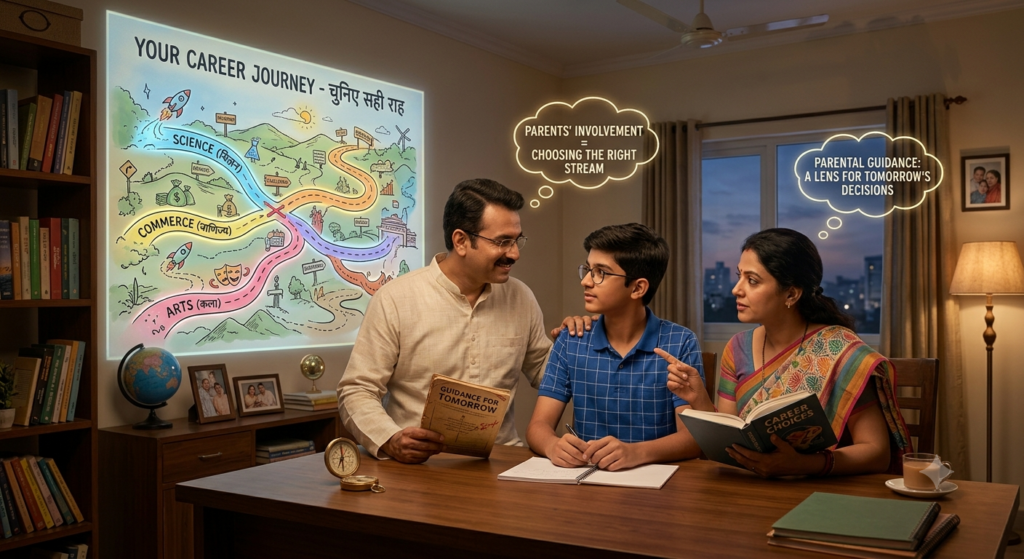
One of the biggest mistakes we see today is that students are expected to make a life-changing career decision at the age of 15 or 16—often without proper guidance.
At the same time, some parents make the opposite mistake by choosing the stream for their child.
The ideal approach lies somewhere in between.
Parents should act as guides, not decision-makers.
A child’s future shouldn’t be based on:
Instead, it should be based on a combination of:
✔ Natural aptitude
✔ Personality
✔ Interests
✔ Career aspirations
✔ Professional career guidance
When parents understand how their child naturally learns, thinks, and performs, they can provide support rather than pressure.
That is exactly what a professional aptitude assessment is designed to do.
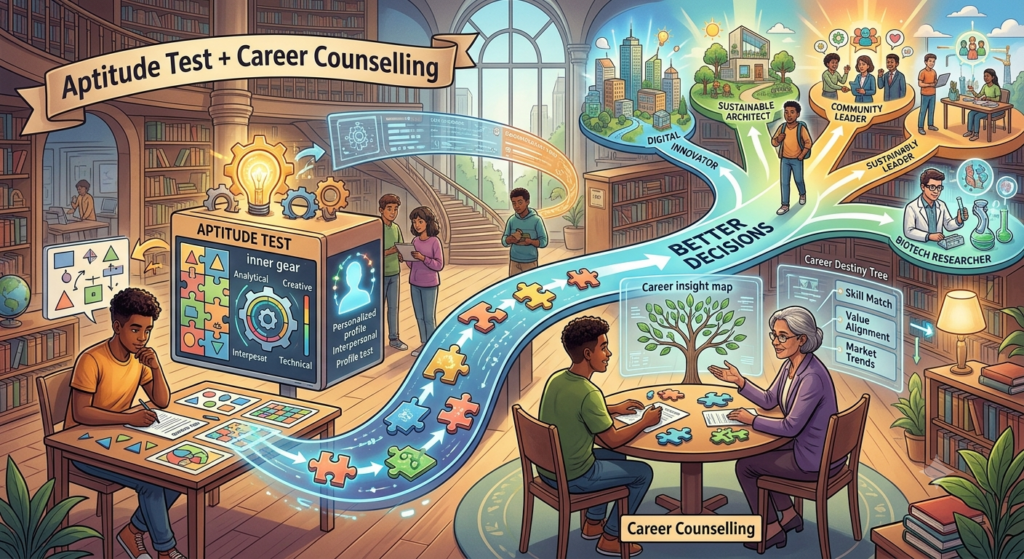
An aptitude test alone provides valuable insights.
But when those insights are explained by an experienced career counsellor, they become far more meaningful.
A report may indicate that a student has strong analytical skills.
But what does that actually mean?
Could they succeed in:
Or perhaps another field altogether?
This is where career counselling bridges the gap.
A good counsellor doesn’t simply hand over a report.
They help students and parents understand:
Career guidance is not about limiting options.
It’s about expanding possibilities with clarity and confidence.

The career landscape has changed dramatically over the past few years.
Today, students can build successful careers in fields that barely existed a decade ago.
Examples include:
With so many opportunities available, choosing a stream based only on traditional thinking is no longer enough.
Parents today are becoming more proactive.
Instead of asking,
“Which stream has the highest salary?”
they are asking,
“Which career matches my child’s strengths and personality?”
That is a far more powerful question.
An aptitude test is a scientifically designed assessment that measures a student’s natural abilities, reasoning skills, problem-solving capacity, learning style, and potential strengths. It helps students make informed decisions about education and career planning.
No.
An aptitude test does not decide your career.
Instead, it provides valuable insights that help you choose careers and academic streams aligned with your natural strengths and interests.
There is no universally “best” stream.
Science, Commerce, and Arts all offer excellent career opportunities.
The best stream is the one that matches your aptitude, personality, interests, and long-term goals.
Professionally developed aptitude assessments are reliable tools for understanding strengths and career preferences.
However, they should always be interpreted along with counselling, personal interests, academic performance, and family discussions.
Absolutely.
Many parents tell us that after understanding their child’s aptitude report, they communicate better, reduce unnecessary pressure, and become more confident while supporting career decisions.
Choosing between Science, Commerce, and Arts is not about choosing the most popular stream.
It is about choosing the stream that allows your child to learn with confidence, grow with purpose, and build a career they genuinely enjoy.
Every child has unique strengths.
Some are born problem-solvers.
Some are natural communicators.
Some are creative thinkers.
Others have leadership qualities or entrepreneurial potential.
The challenge is not finding the “best” stream.
The challenge is discovering which stream is best for your child.
An aptitude assessment helps remove the guesswork from this important decision and replaces it with clarity, confidence, and informed guidance.
Because when students understand themselves better, they make better academic choices—and ultimately, better career choices.
🎯 Still confused about whether Science, Commerce, or Arts is the right choice for your child?
You don’t have to make this important decision based on assumptions or peer pressure.
At SH Development Academy, we help students and parents make informed career decisions through our comprehensive Psychometric Aptitude Assessment, DMIT Consultation, and Personalized Career Guidance Session.
Your consultation will be personally guided by Santosh Hariharan—an experienced DMIT Consultant, Parent & Career Coach, Success Mindset Coach for Students, with over 30 years of corporate experience in Sales, Training & HR and 5+ years of career counselling, helping more than 1,000 parents and students discover the right educational and career path.

✅ Which stream best suits your child’s natural abilities
✅ Strengths, interests, and learning style
✅ Suitable career options based on aptitude
✅ Future-ready career opportunities in 2026 and beyond
✅ A personalized roadmap for academic and career success
📋 Book Your DMIT & Career Guidance Consultation:
https://docs.google.com/forms/d/e/1FAIpQLSd6-u-BEr3ESzoHq2CXjkYZIr41O1eqh3ip97Lj3JbZ-6xSPA/viewform
⭐ See what parents have to say about us:
👉 310+ Google Reviews: Click here to see 310+ Google Reviews
📞 Call or WhatsApp Us:
+91 8421315400
+91 7303290862
Your child’s future should never be decided by marks alone.
It should be guided by their natural abilities, personality, interests, and informed career planning.
The right guidance today can save years of confusion tomorrow.
Help your child choose a path they’ll not only succeed in—but truly enjoy. 🌱
Success & Happiness are the two most important yet elusive things which every human being yearns to achieve in life. Real success and happiness can be savoured only when one enjoys good health and good family relations, along with a good professional career and sound financial stability.
Our Visitor


 Users Today : 6