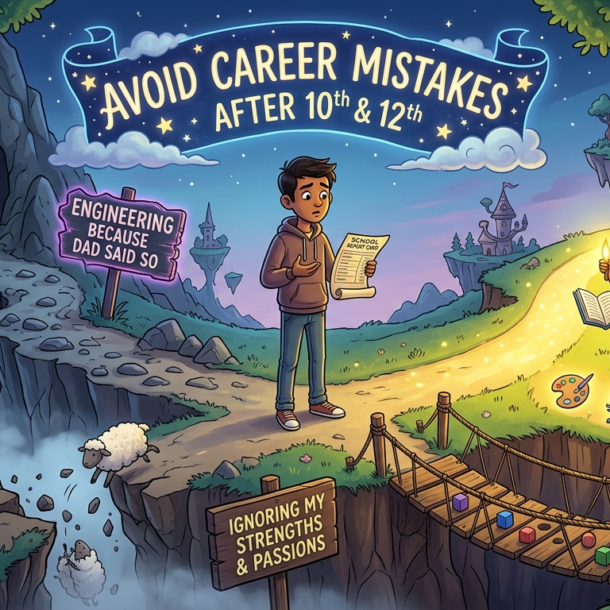

“Every child is a genius. The challenge is not finding intelligence—it’s discovering which kind of intelligence your child naturally possesses.”
As a DMIT Consultant, Parent & Career Coach, one question I hear from parents almost every day is:
“My child is intelligent, but why aren’t they performing well in school?”
It’s a genuine concern. Your child may spend hours studying, attend coaching classes, and work sincerely, yet the results may not reflect their effort. Naturally, parents begin to wonder whether something is missing.
The answer, in many cases, isn’t that the child lacks ability. It’s that we may be measuring every child using the same yardstick.
For decades, success has often been associated with high marks in mathematics and science. While academics are important, they are only one part of a child’s overall potential. Some children express intelligence through music, others through art, sports, leadership, communication, or problem-solving. When these natural strengths are overlooked, children can lose confidence—even though they possess exceptional abilities.
This is where understanding Learning Multiple Intelligences through DMIT can make a meaningful difference.
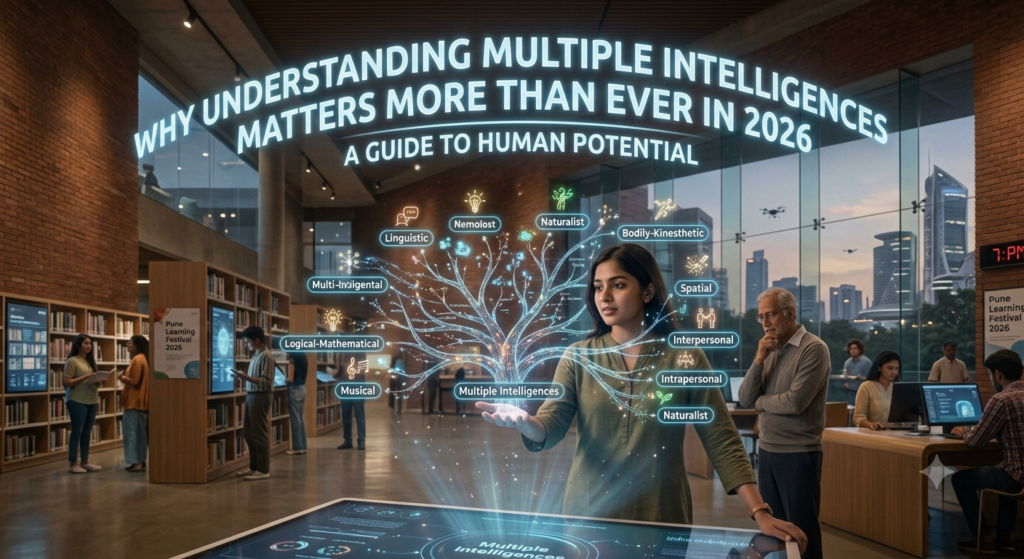
The world our children are growing up in today is very different from the one we experienced.
Artificial Intelligence is transforming industries. New careers are emerging every year. Skills like creativity, communication, adaptability, emotional intelligence, and critical thinking are becoming just as valuable as academic knowledge.
Employers today aren’t simply looking for students with high marks—they’re looking for individuals who can think differently, solve problems, collaborate with others, and continue learning throughout life.
This means parents also need to rethink what “success” looks like.
Instead of asking,
“How many marks did my child score?”
perhaps a better question is,
“What is my child naturally good at, and how can I help them grow in that direction?”
That simple shift in perspective can change a child’s entire future.
Think about two children sitting in the same classroom.
One understands concepts immediately after seeing diagrams.
Another remembers lessons only after listening carefully.
A third struggles to sit still but learns incredibly fast through practical activities and hands-on experiences.
All three children are intelligent.
They simply learn differently.
Yet schools often teach every student using the same methods and expect identical results.
This is one of the biggest reasons many capable children begin believing they are “average” or “weak.”
The truth is that intelligence isn’t one-dimensional.
It comes in many forms.
Recognizing those forms early allows parents to guide children with greater understanding instead of comparison.
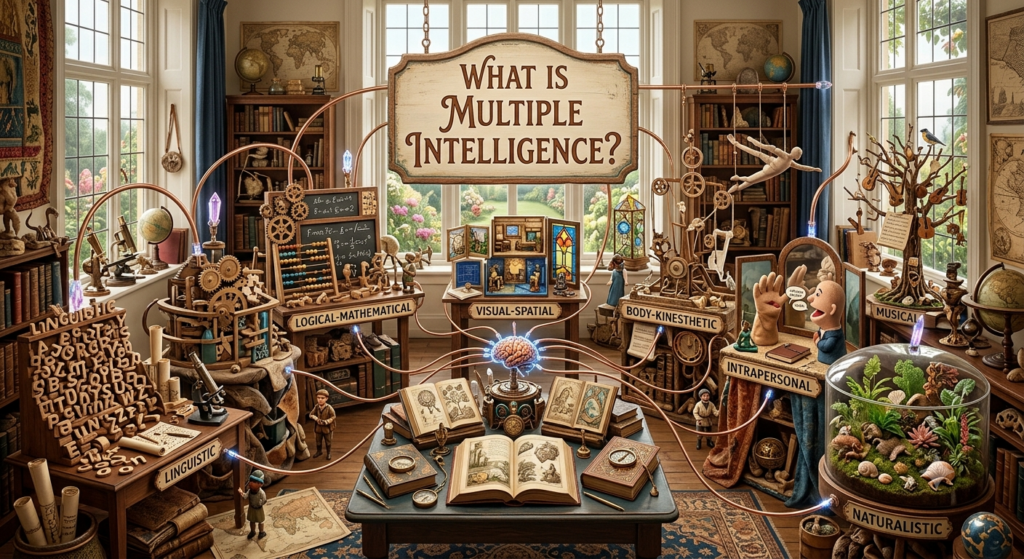
The concept of Multiple Intelligences was introduced by renowned developmental psychologist Howard Gardner.
Rather than defining intelligence solely through IQ or academic scores, Gardner proposed that every individual possesses different types of intelligence, each with its own strengths.
According to this theory, a child may naturally excel in:
No child possesses these intelligences in exactly the same combination.
That is what makes every child unique.
This idea has transformed the way educators, psychologists, and career guidance professionals understand children’s learning and development across the world.
One of the biggest challenges parents face is identifying these natural strengths at an early age.
Children often cannot express them clearly.
Academic marks alone don’t reveal them.
Even teachers may only observe a small part of a child’s personality.
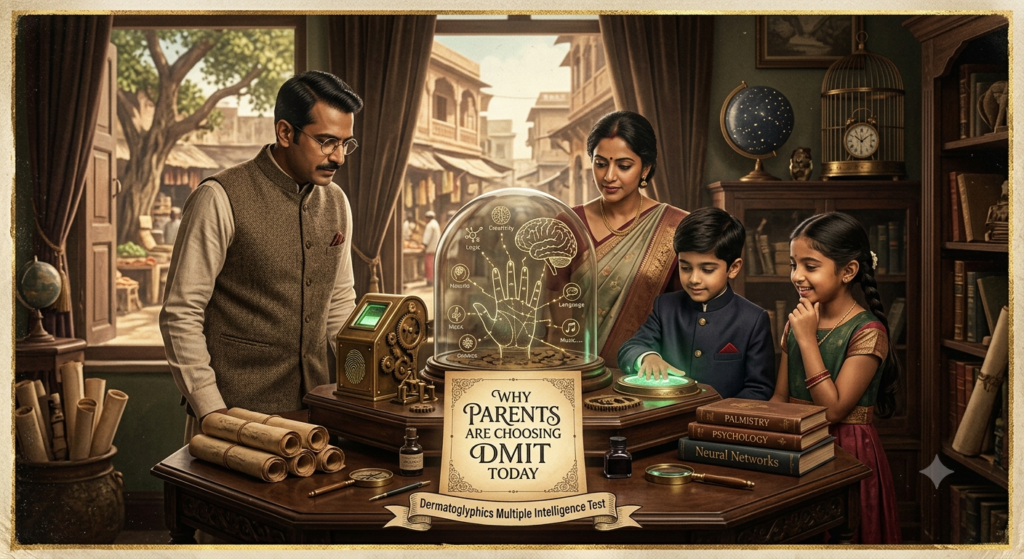
This is where a Dermatoglyphics Multiple Intelligence Test (DMIT) can serve as a valuable guidance tool.
DMIT analyzes fingerprint patterns—which develop during early fetal growth alongside brain development—to provide insights into areas such as:
It’s important to understand what DMIT is—and what it isn’t.
A professional DMIT assessment does not predict your child’s future, nor does it guarantee a particular career or level of success.
Instead, it offers a structured way to understand how your child may naturally learn, process information, and engage with the world. When interpreted responsibly and combined with real-life observation, school performance, and counselling, these insights can help parents make more informed decisions.
As parents, our goal shouldn’t be to force children into predefined careers.
Our goal should be to understand them first.
Only then can we guide them effectively.
In the past few years, we’ve noticed a significant shift in the questions parents ask.
Earlier, most consultations focused on career choices after Class 10 or 12.
Today, parents are seeking answers much earlier.
They want to know:
These are thoughtful parenting questions—not just academic ones.
When parents begin understanding their child’s natural learning style and intelligence profile, they often become more patient, supportive, and confident in their parenting journey.
In my experience, one of the biggest transformations after a DMIT consultation isn’t always in the child.
It’s in the parents.
They stop comparing.
They stop forcing.
They start understanding.
And that’s where meaningful growth begins.
Now that we’ve understood why multiple intelligences matter and how DMIT can help identify them, let’s explore the eight different types of multiple intelligences in detail.
More importantly, we’ll discuss how parents can recognize these qualities in everyday life and nurture them to help children become confident learners—not just high scorers.
Because every child deserves to be appreciated for who they are, not judged by a single report card.
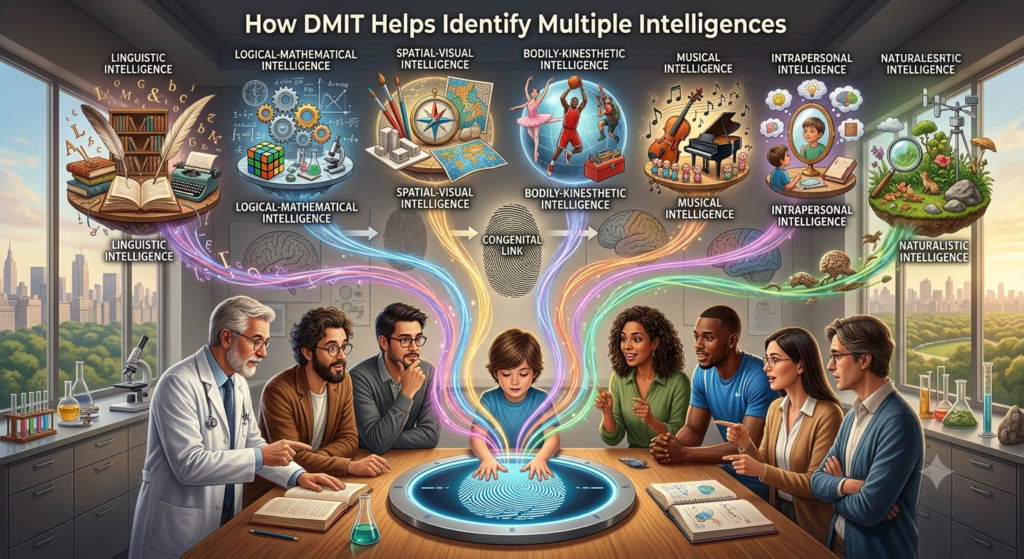
One of the biggest challenges parents face isn’t helping their child succeed—it’s understanding where their child is naturally gifted.
Many parents tell me,
“My child is good at so many things, but I don’t know what to encourage.”
Others say,
“He doesn’t enjoy studying, but he spends hours building models or drawing.”
These are not signs that a child lacks intelligence.
They’re signs that the child’s intelligence may be different from what traditional education measures.
This is where Learning Multiple Intelligences through DMIT becomes incredibly valuable.
A professionally interpreted DMIT report provides insights into your child’s natural intelligence profile. It helps parents understand how a child prefers to learn, think, solve problems, communicate, and express creativity. Instead of relying on guesswork, parents receive structured guidance that can support better educational and parenting decisions.
The most important point to remember is that DMIT does not label children as “good” or “bad,” nor does it predict their future. It is intended to help parents recognize strengths that can be nurtured over time.
Let’s explore the different types of multiple intelligences and how they may appear in everyday life.
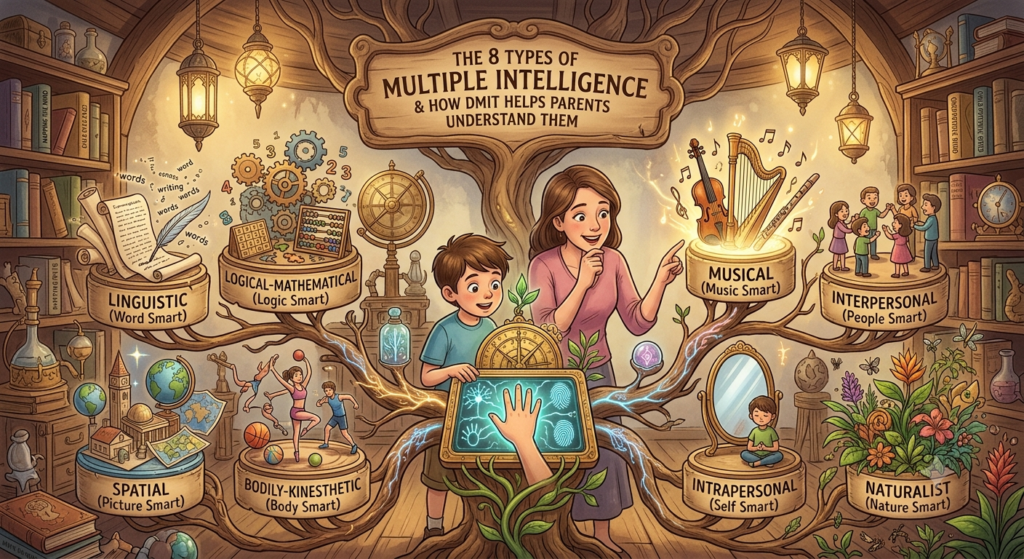
Children with strong linguistic intelligence enjoy expressing themselves through language.
You may notice that your child:
These children often perform well in activities involving communication.
Instead of only focusing on textbooks:
A child who enjoys language today may become tomorrow’s influential communicator.
This is the intelligence most schools traditionally reward.
Children with high logical intelligence enjoy:
They naturally look for patterns and logical explanations.
These children don’t simply memorize—they enjoy understanding how things work.
Some children think in pictures rather than words.
They may love:
They often imagine ideas visually before expressing them.
Parents sometimes mistake these children as “dreamers.”
In reality, they’re often highly creative thinkers.
Creativity should never be treated as a distraction.
It can become a child’s greatest strength.
Some children simply cannot sit still for long periods.
Parents often worry,
“My child is always moving.”
But movement itself may be their learning style.
These children understand concepts better through action rather than lectures.
They usually enjoy:
Instead of forcing long study hours:
Many successful athletes were once labelled “restless” in classrooms.
Some children naturally connect with music.
They quickly recognize:
They may remember songs faster than textbook lessons.
Music develops creativity, discipline, and emotional expression.
Have you noticed children who easily make friends wherever they go?
These children often possess strong interpersonal intelligence.
They enjoy:
They naturally understand people.
Leadership begins much earlier than adulthood.
Some children are naturally reflective.
They:
Parents sometimes worry that these children are “too quiet.”
Often, they are simply highly self-aware.
Quiet children shouldn’t always be encouraged to become louder.
Sometimes, their quietness is their strength.
These children love exploring the natural world.
They enjoy:
They observe details others often miss.
Nature becomes their classroom.
One of the biggest misconceptions is that a child should excel in all eight intelligences.
That’s neither realistic nor necessary.
Every child has a unique combination of strengths.
Some may be strong in logical reasoning and interpersonal skills.
Others may combine creativity with musical intelligence.
Some children develop one intelligence earlier than others.
The goal of parenting isn’t to make every child identical.
The goal is to identify what comes naturally to your child and create an environment where those strengths can flourish.
This is where a professionally interpreted DMIT assessment becomes valuable—not because it decides your child’s future, but because it gives parents a clearer understanding of how to guide, encourage, and support their child based on their natural potential.
One of the biggest myths about intelligence is that children are simply “born smart” or “not smart.”
In reality, every child is born with unique potential. Whether that potential grows or remains hidden largely depends on the environment, encouragement, and guidance they receive.
Think of it like a seed.
A mango seed has the potential to become a magnificent tree, but only if it gets the right soil, water, sunlight, and care. Similarly, your child’s natural abilities need the right nurturing to flourish.
This is why I often tell parents during DMIT counselling sessions:
“DMIT doesn’t change your child’s potential—it changes how you parent that potential.”
Let’s see how this applies at different stages of a child’s life.
These are the years when children are naturally curious. They ask endless questions, explore everything around them, and absorb information like a sponge.
At this stage, parents should focus less on academic performance and more on discovering what excites their child.
If your child loves drawing, let them draw.
If they enjoy music, expose them to different instruments.
If they prefer building blocks over storybooks, don’t assume they’re less intelligent.
Every activity is giving you clues about their natural learning style.
✅ Encourage exploration rather than perfection.
✅ Praise effort instead of comparing results.
✅ Allow children to ask questions freely.
✅ Introduce different activities without forcing any particular one.
The goal isn’t to identify a future career at the age of five.
The goal is simply to understand your child’s natural interests.
This is the stage where children begin comparing themselves with classmates.
Unfortunately, many parents also start comparing.
“My neighbour’s son scored 95%.”
“Your cousin is better at maths.”
Although these comments are often made with good intentions, they can slowly damage a child’s confidence.
Instead of comparison, this is the age to encourage skill development.
If DMIT indicates that your child has strong visual-spatial intelligence, encourage drawing, design, puzzles, and creative projects alongside academics.
If they have strong interpersonal intelligence, involve them in debates, group discussions, leadership opportunities, or volunteering.
Children become more confident when they experience success in areas that match their natural strengths.
Teenage years are often the most challenging for both children and parents.
Students are expected to decide:
Parents also experience anxiety.
They want the best future for their child, but sometimes fear leads to pressure rather than support.
This is where understanding multiple intelligences becomes especially valuable.
For example, a teenager with strong creative and interpersonal intelligence may thrive in careers like design, marketing, media, communication, or entrepreneurship.
Pushing them solely toward engineering because “it’s a safe option” may not align with their interests or strengths.
Likewise, a child with exceptional logical reasoning may genuinely enjoy engineering, finance, or technology.
The key is not to decide based on trends—but based on the child.
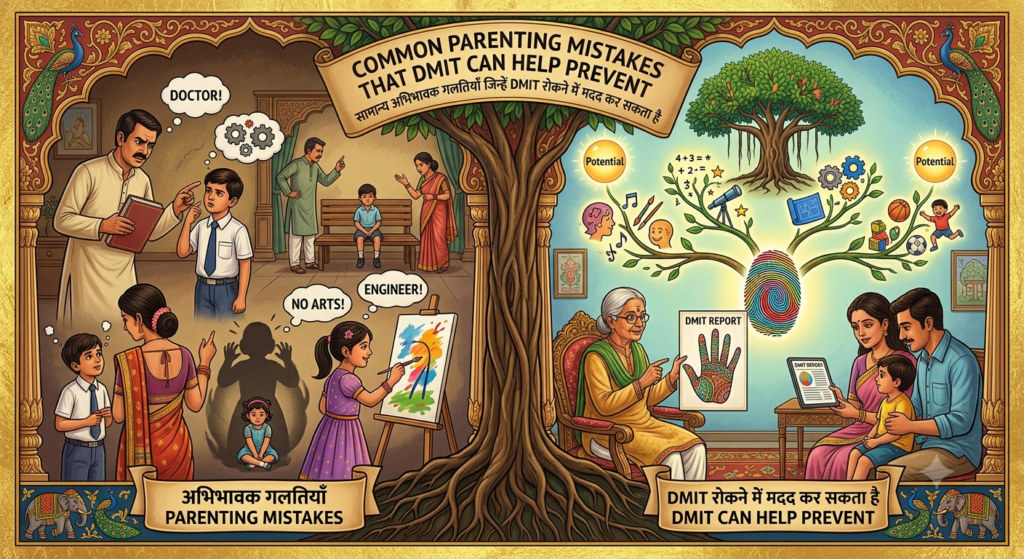
Over the years, I’ve noticed a few patterns that unintentionally hold children back.
No two fingerprints are identical.
Similarly, no two children are identical.
Comparison doesn’t inspire growth—it creates insecurity.
Celebrate your child’s progress instead of measuring them against someone else’s journey.
Academic performance matters, but it isn’t the only indicator of future success.
History is full of successful entrepreneurs, artists, athletes, musicians, and innovators who weren’t school toppers.
Marks measure performance in examinations.
They don’t measure imagination, empathy, resilience, creativity, leadership, or determination.
Every few years, a new career becomes fashionable.
Yesterday it was engineering.
Then medicine.
Then IT.
Today many students want Artificial Intelligence or Data Science.
While these careers are excellent, they may not suit every child.
A successful career isn’t built by following trends.
It’s built by aligning a person’s natural strengths with opportunities.
Many parents invest in tuition classes but overlook emotional development.
Confidence, communication, resilience, emotional intelligence, and self-belief are just as important as academic knowledge.
Children who feel emotionally supported often perform better—not only in studies but in life.
One of the most common questions I receive is:
“Can DMIT predict my child’s future career?”
The honest answer is No.
And any responsible DMIT consultant should tell you the same.
DMIT is not:
❌ A future prediction tool
❌ A guarantee of career success
❌ A replacement for education or professional counselling
Instead, DMIT is a guidance tool.
It helps parents understand a child’s natural preferences, learning style, and strengths so they can make better educational and career decisions.
A child’s future is shaped by many factors, including:
DMIT simply adds another valuable layer of understanding to this journey.

As we move further into 2026, the world is changing rapidly.
Technology can solve equations.
Artificial Intelligence can generate reports.
But qualities like creativity, emotional intelligence, communication, ethical decision-making, leadership, and adaptability are becoming increasingly valuable.
Children who understand their strengths are more likely to:
Parents who understand these strengths can provide the right guidance instead of relying on assumptions.
And that, in my experience, is one of the greatest gifts you can give your child.
As parents, we naturally want our children to succeed.
We invest in good schools, tuition classes, extracurricular activities, and opportunities because we care deeply about their future.
But before deciding what your child should become, it’s worth taking the time to understand who your child truly is.
Every child has unique abilities waiting to be discovered.
When parents recognize and nurture those abilities instead of forcing comparisons or expectations, children often become more confident, motivated, and fulfilled.
Learning multiple intelligences through DMIT is not about limiting a child’s future—it is about helping parents guide that future with greater clarity and understanding.
If you’re wondering:
A professional DMIT Consultation can help you gain valuable insights.
At SH Development Academy, we don’t just hand over a report. We take the time to explain what it means for your child’s learning, personality, and overall development.
Your consultation will be personally guided by Santosh Hariharan—DMIT Consultant, Parent & Career Coach, and Success Mindset Coach—who has helped more than 1,000 parents and students make informed decisions about education, parenting, and career planning.
👉 Book your DMIT Consultation here:
https://docs.google.com/forms/d/e/1FAIpQLSd6-u-BEr3ESzoHq2CXjkYZIr41O1eqh3ip97Lj3JbZ-6xSPA/viewform
⭐ See what parents are saying:
https://share.google/ac9hkh20zcXadkJs9
📞 Have questions? We’d be happy to help.
Call / WhatsApp:
+91 8421315400
+91 7303290862
Because every child deserves guidance based on understanding—not assumptions. 🌱
Success & Happiness are the two most important yet elusive things which every human being yearns to achieve in life. Real success and happiness can be savoured only when one enjoys good health and good family relations, along with a good professional career and sound financial stability.
Our Visitor


 Users Today : 24