

If you’re a parent of a preschooler, you’ve probably heard this advice many times:
“Make your child study every day.”
But here’s the thing — preschool children don’t need hours of worksheets, writing practice, or forced study time.
At this age, play is learning.
A child can learn numbers while counting spoons, language while telling a story, colours while sorting clothes, and problem-solving while building with blocks.
That’s why some of the most effective preschool learning activities at home can happen without a single worksheet.
And you don’t need an elaborate setup either.
Just 15 focused minutes a day can become a beautiful learning routine when the activity matches your child’s age, interests, and natural curiosity. 🌱
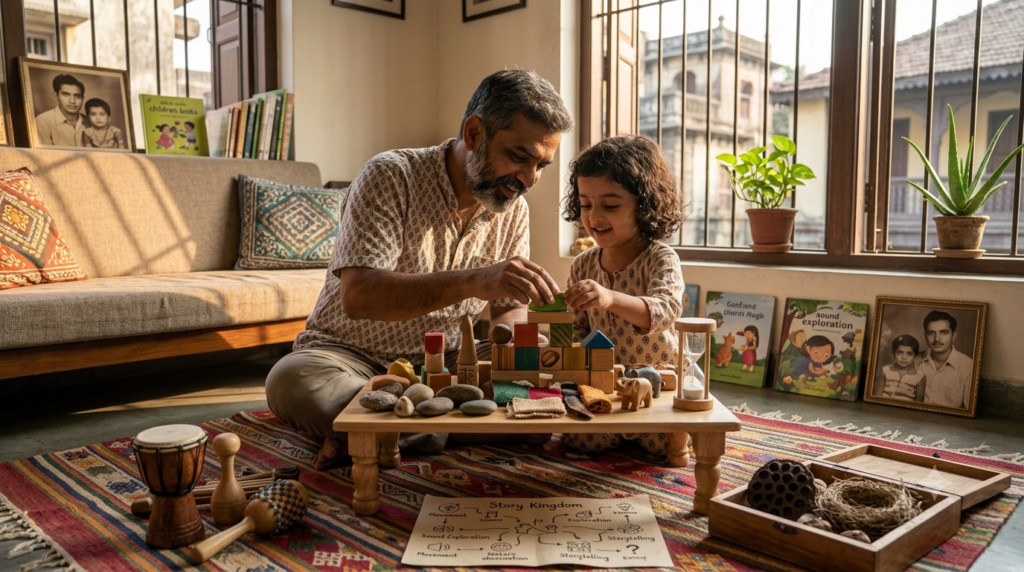
Preschoolers are naturally curious, but their attention is still developing.
So instead of expecting your child to sit at a desk for 45 minutes, try something much simpler:
Short activity → active participation → conversation → praise → repeat.
The objective isn’t to make your preschooler “study.”
The objective is to help your child:
That is real learning.
Here is a simple routine you can use at home.
Start with conversation.
Ask your child something simple:
“What did you notice today?”
Or:
Don’t worry about whether your child’s answer is “correct.”
You’re building language, observation and communication skills.
You don’t need expensive educational toys.
Use things already around you.
Try:
Counting:
“Can you give me 5 spoons?”
Sorting:
“Can you put all the red objects together?”
Size:
“Which bottle is bigger?”
Shapes:
“Can you find something round?”
Matching:
“Can you find the matching socks?”
These simple preschool learning activities at home turn everyday life into a learning environment.
Young children don’t always learn best by sitting still.
So let them move.
Try:
🏃 Jump 5 times and count aloud.
👏 Clap a simple rhythm and ask your child to copy it.
🔴 “Touch something red.”
⬆️ “Stand up when I say BIG and sit down when I say SMALL.”
You are combining movement with memory, listening and thinking.
And your child probably won’t even realise they’re “learning.”
That’s the point.
Finish with something creative.
Ask your child to:
Don’t immediately correct everything.
Instead ask:
“Tell me about it.”
That one question can reveal a lot about how your child thinks and communicates.
If you want more ideas, try these throughout the week.
While preparing food, ask your child to count:
🥄 Spoons
🍎 Fruits
🥕 Vegetables
Simple counting becomes meaningful when connected to real life.
Pick one colour.
Say:
“Let’s find 5 things that are blue!”
Walk around the house together.
This develops observation and colour recognition.
Start a story:
“Once there was a little dog who found…”
Then let your child continue.
Don’t worry about grammar.
You’re encouraging imagination and language.
Ask your child to find:
⭕ Something round
⬛ Something square
🔺 Something triangular
You can do this at home, in the park or while travelling.
Place 3–5 familiar objects on a table.
Let your child look at them.
Cover them and remove one.
Ask:
“What’s missing?”
Start easy and gradually increase the challenge.
Give your child different objects and ask them to sort by:
Then ask:
“Why did you put these together?”
That second question is important because it encourages reasoning.
Create a small pretend shop at home.
Your child can:
One activity can combine language, numbers, social interaction and imagination.
Go outside for 10–15 minutes.
Ask your child to find:
🌿 A leaf
🐦 A bird
🪨 A small stone
🌸 A flower
Talk about what they see.
Learning doesn’t always need four walls.
Give your child blocks or household-safe building materials.
After they finish, ask:
“What did you build?”
Then:
“How did you make it?”
You’re encouraging creativity, sequencing and communication.
Make or identify different sounds.
Ask:
“What made that sound?”
Try:
This can become a fun listening and attention game.
You don’t have to do the same activity every day.
| Day | 15-Minute Activity |
|---|---|
| Monday | Counting + sorting |
| Tuesday | Storytelling |
| Wednesday | Shapes + colours |
| Thursday | Movement game |
| Friday | Building activity |
| Saturday | Nature learning |
| Sunday | Free play + conversation |
The goal isn’t perfection.
Consistency matters more than complexity.
Worksheets aren’t automatically bad.
But they shouldn’t become the definition of learning.
For preschool children, learning can happen through:
Play + conversation + movement + exploration + repetition.
If your child enjoys colouring, tracing or simple worksheets, that’s perfectly fine.
But don’t feel that you have to make your preschooler sit with a stack of worksheets every evening to “stay ahead.”
At this stage, curiosity is something worth protecting.
Don’t force it.
This is where parents sometimes make a small activity unnecessarily stressful.
If your child doesn’t want to count spoons today, try building blocks.
If they don’t want to draw, tell a story.
If they don’t want to sit, let them move.
Follow the child, not just the activity.
Every child has a different temperament, interest level and way of engaging with the world.
Understanding those differences can make everyday parenting much easier.
Sometimes parents ask:
“What activity should I teach my child?”
A better question can be:
“How does my child naturally learn?”
Does your child learn better through:
👀 Seeing?
👂 Listening?
🤲 Doing?
🗣️ Talking?
🎨 Creating?
🏃 Moving?
There isn’t one perfect learning method for every child.
Understanding your child’s individual strengths and preferences can help you choose activities that feel more natural and enjoyable.
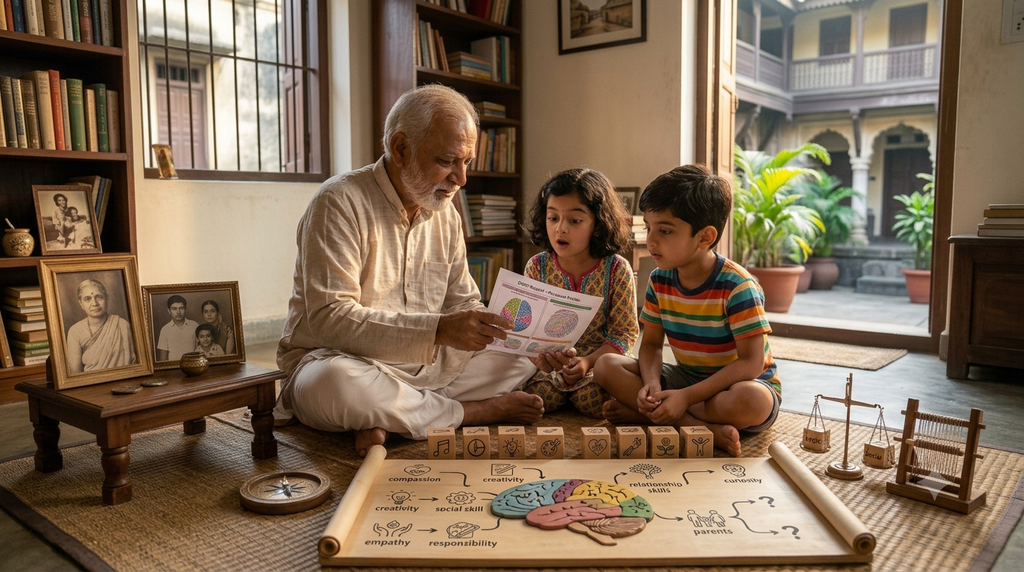
For parents who want deeper insights into their child’s natural strengths, learning preferences and personality, a DMIT assessment can be considered as a parenting and guidance tool.
A DMIT report may provide additional information that parents can discuss with a qualified consultant and combine with their own observations, school feedback and the child’s interests.
It should not be treated as a diagnosis or as a guaranteed prediction of a child’s future.
The most valuable part is often the conversation that follows the assessment — understanding your child better and thinking about how you can support their development.
It’s to raise a child who is:
Curious.
Confident.
Capable of thinking.
Willing to explore.
Comfortable asking questions.
So tomorrow, don’t worry about completing another worksheet.
Take 15 minutes.
Count something.
Tell a story.
Build something.
Go outside.
Ask questions.
And most importantly — listen to your child. ❤️
Those 15 minutes may become far more meaningful than you realise.
If you’re a parent who wants to understand your child’s natural strengths, learning preferences, personality and potential areas for development, SH Development Academy offers DMIT Consultation designed to help parents gain deeper perspective and practical guidance.
The consultation is guided by Santosh Hariharan — DMIT Consultant, Parent & Career Coach, and Success Mindset Coach for Students.
With experience working with parents and students, the focus is not simply on giving you a report.
It’s about helping you understand the report and connect those insights with your child’s everyday behaviour, learning and development.
👉 Book a DMIT Consultation:
https://docs.google.com/forms/d/e/1FAIpQLSd6-u-BEr3ESzoHq2CXjkYZIr41O1eqh3ip97Lj3JbZ-6xSPA/viewform
⭐ Want to know what other parents have experienced?
Click here to see our 400+ Google Reviews:
https://share.google/ac9hkh20zcXadkJs9
📞 Call / WhatsApp: +91 8421315400 | +91 7303290862
Because parenting doesn’t come with a manual. Sometimes, the first step is simply learning to understand the child standing in front of you.
Success & Happiness are the two most important yet elusive things which every human being yearns to achieve in life. Real success and happiness can be savoured only when one enjoys good health and good family relations, along with a good professional career and sound financial stability.
Our Visitor


 Users Today : 14