Group Discussions (GDs) have become one of the most important selection rounds for students aspiring to secure admission into top colleges, business schools, government organizations, or multinational companies. While many students prepare extensively for written exams and interviews, they often underestimate the importance of developing strong group discussion skills. As a result, even academically brilliant students sometimes fail to clear the GD round.
The good news is that group discussion is not about speaking the loudest or dominating others—it’s about communicating your ideas confidently, listening actively, thinking logically, and working effectively as part of a team.
If you’re searching for the best preparation tips and skills to win the group discussion, this comprehensive guide will help you understand exactly what recruiters look for and how you can prepare to stand out from the competition.
Today’s employers and educational institutions are looking beyond marks and academic scores. Artificial Intelligence can evaluate technical knowledge, but qualities like communication, leadership, collaboration, emotional intelligence, and critical thinking remain uniquely human.
That is why companies increasingly use Group Discussions to assess how candidates think, communicate, and interact with others in real-life situations.
Whether you’re preparing for:
strong GD skills can significantly improve your chances of success.
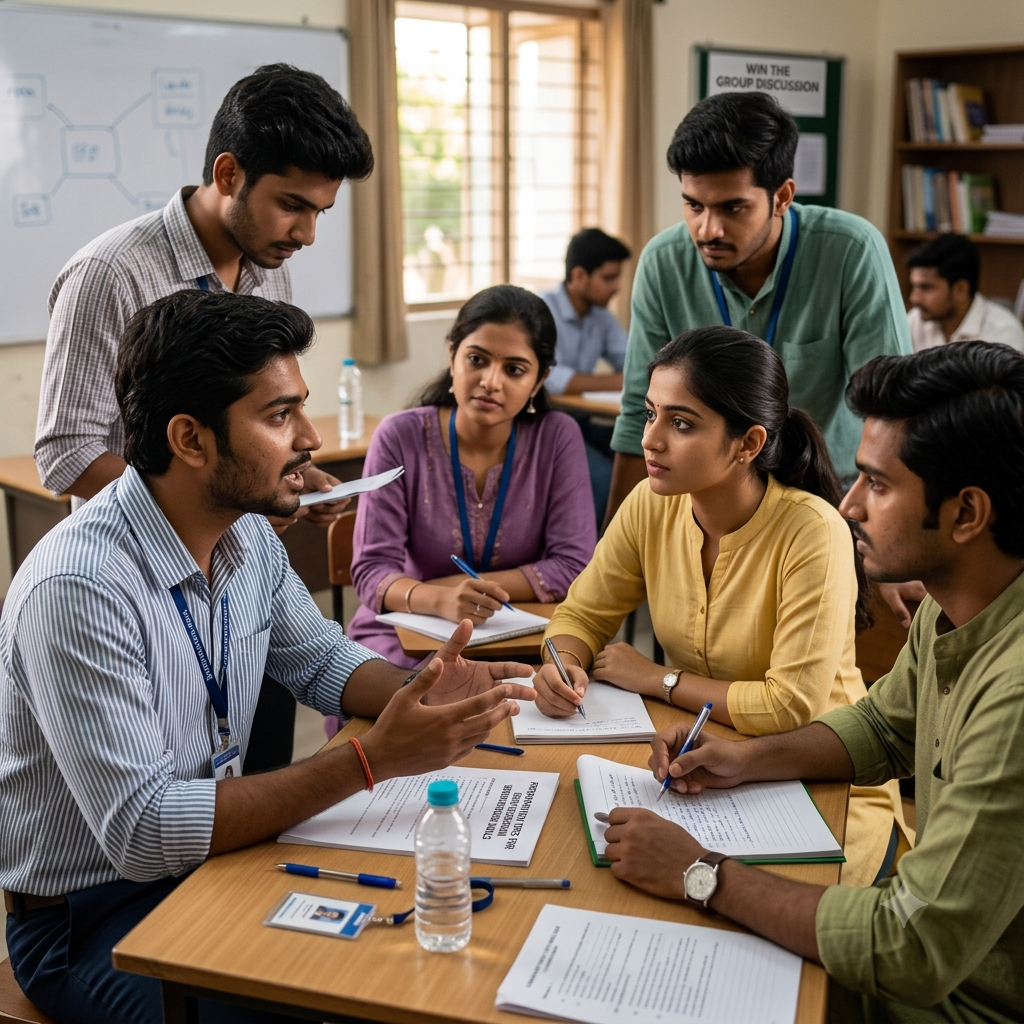
A Group Discussion (GD) is a structured conversation where a group of candidates discusses a given topic within a fixed time, usually between 10 to 20 minutes.
Unlike interviews where you answer questions individually, a Group Discussion evaluates how well you perform while interacting with others.
The objective isn’t to prove everyone else wrong.
Instead, recruiters want to observe:
Simply speaking, a Group Discussion simulates real workplace situations where professionals collaborate to solve problems together.
Many students believe GDs are only about testing English speaking skills.
In reality, recruiters are evaluating much more than language.
During a Group Discussion, they observe:
Can you explain your ideas clearly?
Do others understand your point?
Can you guide the discussion without dominating it?
Can you help the group stay on track?
Can you analyze different perspectives before reaching a conclusion?
Do you encourage participation from others?
Do you interrupt unnecessarily?
Can you remain calm when others disagree with you?
Can you summarize discussions and help the group move toward a meaningful conclusion?
These are the same qualities required in successful professionals across every industry.

Understanding the different formats helps students prepare better.
This is the most common format.
Participants discuss a general topic.
Examples:
Candidates receive a business or social problem and work together to find solutions.
This tests:
These topics test creativity.
Examples include:
There is no right or wrong answer.
Recruiters want to evaluate your imagination and logical thinking.
These discussions revolve around recent events.
Examples:
Students should regularly read newspapers and reliable news sources to prepare for such discussions.
After guiding hundreds of students in career counselling and interview preparation, one pattern becomes very clear.
Many students don’t lose the Group Discussion because they lack knowledge.
They lose because they prepare the wrong way.
Some common mistakes include:
Fortunately, every one of these mistakes can be corrected with proper preparation.
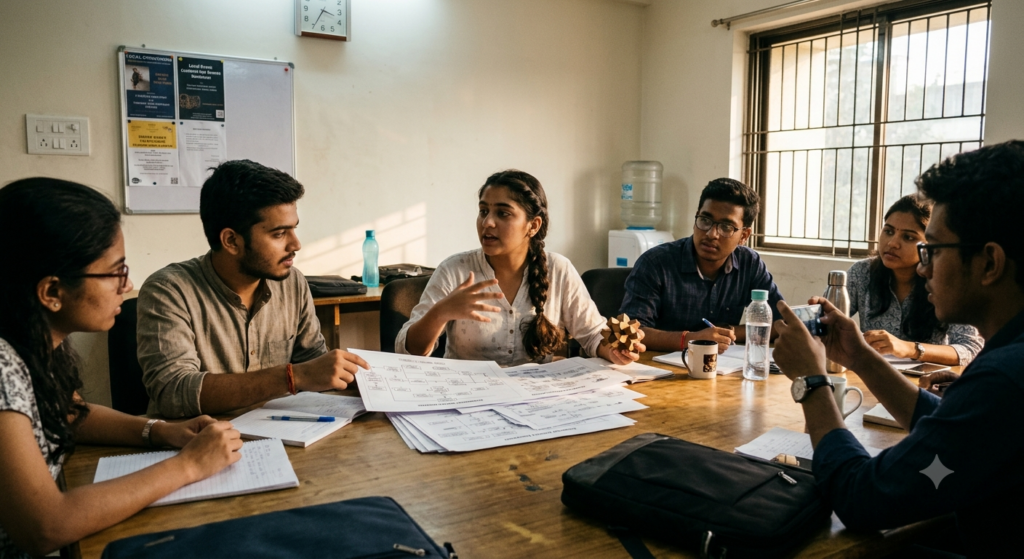
Winning a Group Discussion starts long before you enter the discussion room.
Preparation plays a major role.
One of the biggest advantages you can give yourself is staying informed.
Spend at least 20–30 minutes every day reading:
The more informed you are, the easier it becomes to contribute meaningful points during discussions.
Many GD topics are not directly taken from textbooks.
Develop knowledge about:
This broad understanding helps you speak confidently on unfamiliar topics.
Communication is like a muscle.
The more you practice, the stronger it becomes.
Choose any topic and speak for 2–3 minutes every day.
Record yourself.
Notice:
Small daily improvements create remarkable long-term results.
You don’t need difficult English words.
Simple, clear language always works better.
Instead of memorizing complicated vocabulary:
This naturally improves your speaking ability.
This is one of the most underrated skills.
Strong GD performers are excellent listeners.
Listening helps you:
Remember:
Listening is just as important as speaking.
Before jumping into the discussion, quickly structure your response.
A simple approach is:
Introduction → Main Point → Example → Conclusion
This makes your communication more organized and impactful.
Preparation alone is not enough.
You also need the right skills.
Confidence means expressing your opinion respectfully.
Aggression means trying to prove everyone else wrong.
Recruiters always appreciate confident candidates—not aggressive ones.
Speak calmly.
Maintain eye contact.
Smile naturally.
Stay composed.
Your points should have structure.
Whenever possible, support your opinion with:
Logical arguments are far more convincing than emotional opinions.
Your body language speaks before your words.
Maintain:
Avoid:
Positive body language creates a strong first impression.
Don’t try to impress with difficult words.
Instead:
Clear communication is always more effective than complicated language.
Leadership in a GD doesn’t mean talking the most.
Real leadership means:
Candidates who demonstrate collaborative leadership often leave a lasting impression.
One of the biggest misconceptions about Group Discussions is that the person who speaks the most wins.
That simply isn’t true.
In fact, many recruiters appreciate candidates who know when to speak and when to listen.
Active listening demonstrates:
While someone else is speaking:
✔ Maintain eye contact.
✔ Avoid interrupting.
✔ Take mental notes.
✔ Build upon their ideas before introducing your own.
Using phrases like:
shows maturity and collaborative thinking.
A typical GD lasts between 10 and 20 minutes.
Many students make the mistake of speaking for 2–3 minutes continuously at the beginning, leaving little room for further contribution.
A better strategy is to:
Quality always beats quantity.
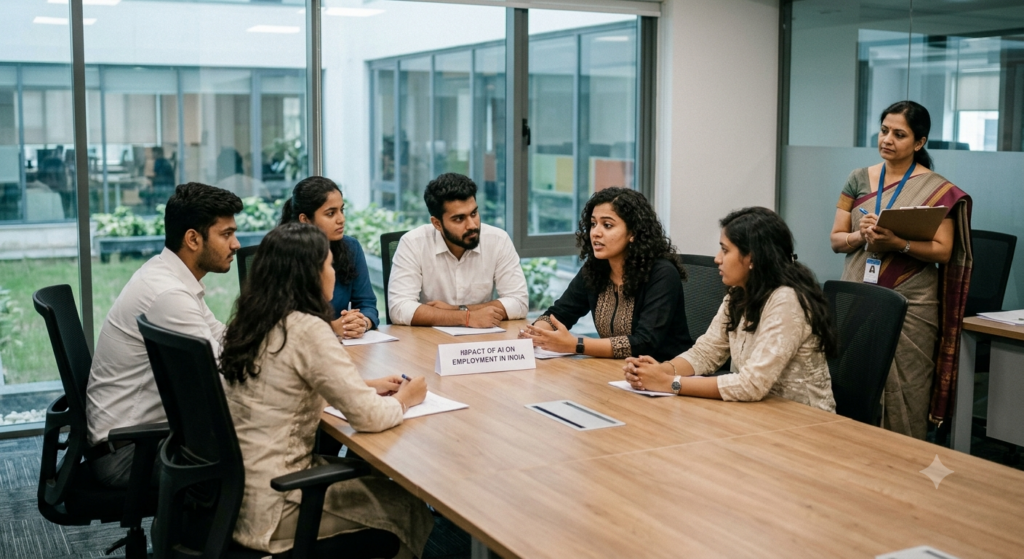
Most students think recruiters only judge fluency in English.
Actually, they evaluate a combination of skills.
Can you express your ideas clearly?
Do you understand the topic?
Can you provide relevant facts and examples?
Are you comfortable sharing your opinion?
Can you guide the discussion positively?
Do you encourage others?
Do you respect different viewpoints?
Can you think logically?
Can you suggest practical solutions?
Can you remain calm even if someone disagrees with you?
These qualities often matter more than perfect English.
Even well-prepared candidates sometimes lose because of avoidable mistakes.
Here are some of the most common ones.
Don’t prepare your next answer while someone else is speaking.
Listen first.
Respond second.
Interrupting repeatedly creates a negative impression.
Wait for an appropriate pause before adding your point.
Some students think talking continuously demonstrates leadership.
Actually, recruiters prefer balanced participation.
Leadership means helping the group—not controlling it.
If you don’t contribute, the evaluator cannot assess your abilities.
Even if you’re nervous, aim to speak at least 3–4 meaningful times.
Always connect your ideas back to the discussion topic.
Irrelevant points reduce your overall score.
Support your arguments with logic rather than emotions.
Use examples, facts, or practical reasoning whenever possible.
Avoid:
Positive body language reflects confidence and professionalism.
Here are some topics students should practice before placements or admissions.
Practicing these topics regularly improves both confidence and communication.
You don’t need expensive coaching to improve.
Follow this routine for just 30 minutes daily.
Read newspaper editorials or current affairs.
Choose a topic and speak aloud for two minutes.
Record yourself.
Learn five new words with their usage.
Watch interviews, debates, or TED-style talks to observe confident speakers.
Consistency is far more important than intensity.
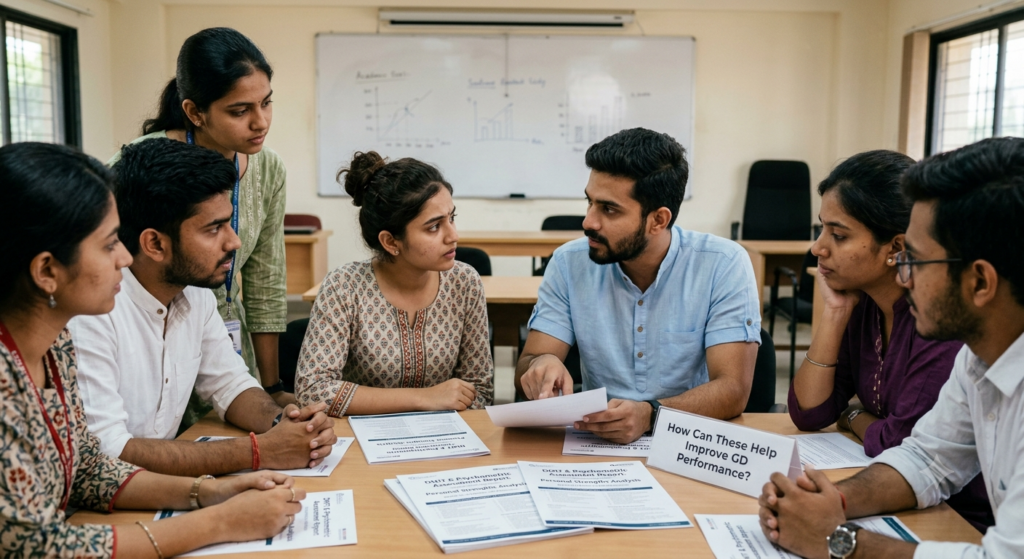
Many parents and students ask whether confidence, communication, and leadership can be developed.
The answer is yes—but first, you need to understand the student’s natural strengths.
A professionally interpreted DMIT (Dermatoglyphics Multiple Intelligence Test) and Psychometric Aptitude Assessment can provide valuable insights into a student’s:
This understanding helps students work on the right skills instead of following a one-size-fits-all approach.
For example, an introverted student may not need to become outspoken—they may simply need strategies to communicate more effectively in group settings.
Similarly, students with strong interpersonal intelligence may naturally excel in Group Discussions with the right guidance and practice.
Prepare thoroughly, stay updated with current affairs, listen actively, communicate clearly, support your points with examples, and maintain positive body language.
No.
Clear communication, logical thinking, confidence, and teamwork are often more important than speaking perfect English.
Aim for 3–5 meaningful contributions instead of speaking continuously.
Listen carefully to other participants.
Understand the discussion before speaking.
Build upon existing points with logical reasoning.
Absolutely.
Many introverted students perform exceptionally well because they are good listeners and thoughtful speakers.
The key is preparation and confidence.
Group Discussions are no longer just a recruitment process—they are an opportunity to showcase your personality, communication skills, leadership potential, and ability to work with others.
Remember, recruiters are not looking for the loudest candidate.
They are looking for someone who can think clearly, communicate confidently, respect different viewpoints, and contribute meaningfully.
These are life skills that will help you not only during interviews but throughout your academic and professional journey.
Start practicing today, stay curious, keep learning, and remember that every Group Discussion is an opportunity to grow.
Success in Group Discussions begins long before the interview room. It starts with understanding how you think, communicate, learn, and interact with others.
At SH Development Academy, we help students go beyond academic scores by identifying their natural strengths through DMIT and Psychometric Aptitude Assessments, followed by personalized career guidance and skill development.
Your consultation will be personally guided by Santosh Hariharan—an experienced DMIT Consultant, Parent & Career Coach, and Success Mindset Coach for Students, who has helped hundreds of students build confidence, improve communication, and make informed career decisions.

Whether you’re preparing for campus placements, MBA admissions, competitive exams, or your first job interview, the right guidance can make all the difference.
👉 Consultation Booking: https://docs.google.com/forms/d/e/1FAIpQLSd6-u-BEr3ESzoHq2CXjkYZIr41O1eqh3ip97Lj3JbZ-6xSPA/viewform
👉 Click here to see 310+ Google Reviews: https://share.google/ac9hkh20zcXadkJs9
Phone: +91 8421315400
Phone: +91 7303290862
Invest in the right guidance today, and you’ll build skills that benefit you not just in a Group Discussion—but throughout your career.
Success & Happiness are the two most important yet elusive things which every human being yearns to achieve in life. Real success and happiness can be savoured only when one enjoys good health and good family relations, along with a good professional career and sound financial stability.
Our Visitor


 Users Today : 6