
Choosing a career after Class 10 or Class 12 is one of the biggest decisions a student will ever make. Every year, millions of students and parents across India face the same question:
“Should I prepare for JEE or NEET?”
It’s a valid question because both exams open doors to prestigious careers—but they are designed for completely different professions.
I’ve met hundreds of students during career counselling sessions who weren’t struggling because they lacked intelligence. They were struggling because they were preparing for the wrong exam.
Some students joined JEE coaching because their friends did.
Others chose NEET because their parents wanted them to become doctors.
Months—or even years—later, they realized the path didn’t match their natural abilities or interests.
As a DMIT Expert, Parent & Career Coach, I always tell students and parents:
“The right career isn’t about choosing the toughest exam. It’s about choosing the exam that matches your strengths, aptitude, personality, and long-term goals.”
In this detailed guide, we’ll compare JEE vs NEET in terms of:
Let’s begin.

JEE (Joint Entrance Examination) is India’s national-level engineering entrance examination conducted for students who wish to pursue undergraduate engineering courses.
Students qualifying in JEE can get admission into:
JEE consists of two stages:
JEE Main is the first stage.
It is conducted several times each year and serves as the qualifying exam for:
Students who qualify through JEE Main become eligible for JEE Advanced.
This examination is conducted for admission into the prestigious Indian Institutes of Technology (IITs).
Competition here is extremely intense because only a limited number of seats are available.
JEE is ideal for students who enjoy:
Students interested in careers like:
generally prepare for JEE.

NEET (National Eligibility cum Entrance Test) is India’s single national entrance examination for undergraduate medical courses.
Students qualifying NEET can pursue courses like:
Unlike engineering, medicine focuses on understanding the human body, diagnosing illnesses, treating patients, and improving healthcare.
NEET is suitable for students who genuinely enjoy:
Students who dream of becoming:
usually choose NEET.
| Feature | JEE | NEET |
|---|---|---|
| Full Form | Joint Entrance Examination | National Eligibility cum Entrance Test |
| Career Path | Engineering & Technology | Medical & Healthcare |
| Main Subjects | Physics, Chemistry, Mathematics | Physics, Chemistry, Biology |
| Mathematics | Mandatory | Not required |
| Biology | Not required | Mandatory |
| Admission Into | IITs, NITs, IIITs, Engineering Colleges | Medical Colleges, Dental Colleges & Allied Health Courses |
| Suitable For | Students interested in technology and engineering | Students interested in medicine and healthcare |
Although both exams are taken after Class 12, their eligibility differs.
Students should have completed Class 12 (or equivalent) with:
PCM is compulsory for engineering admissions.
Students should have completed Class 12 (or equivalent) with:
PCB is mandatory for NEET.
Understanding the exam structure helps students prepare strategically.
The exam generally consists of questions from:
Questions test:
JEE emphasizes solving problems quickly and accurately under time pressure.
NEET includes questions from:
The Biology section carries the highest weightage, making it the deciding factor for many students.
NEET primarily tests:
Both exams cover Class 11 and Class 12 syllabus, but their focus differs.
Major emphasis on:
Students must master:
JEE questions often require multiple concepts to solve a single problem.
Major emphasis on:
Students spend a significant portion of their preparation mastering:
NEET demands excellent conceptual clarity along with strong memory retention.
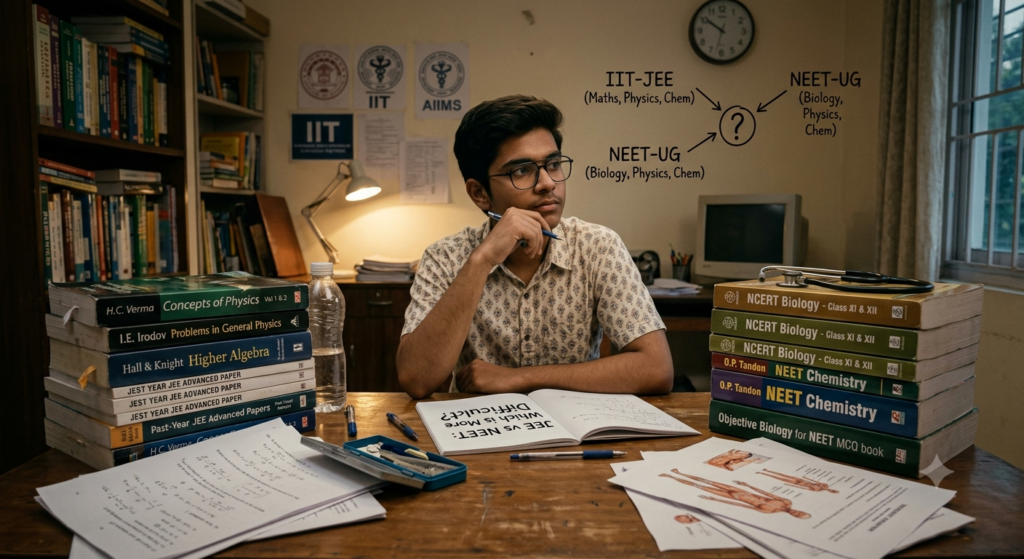
This is probably the most searched question online.
The honest answer is:
Neither exam is universally harder.
They are difficult in different ways.
JEE is considered challenging because:
Students must think analytically rather than simply recalling concepts.
NEET is difficult because:
Success in NEET depends heavily on consistency and conceptual understanding.
Students preparing for JEE should ideally possess:
✔ Strong mathematical aptitude
✔ Logical reasoning ability
✔ Analytical thinking
✔ Curiosity about technology
✔ Problem-solving mindset
✔ Patience to solve complex numerical questions
These skills often come naturally to students who enjoy mathematics and engineering concepts.
Students aiming for NEET generally require:
✔ Strong interest in Biology
✔ Good observation skills
✔ Excellent memory
✔ Patience
✔ Compassion towards people
✔ Ability to understand scientific concepts deeply
Students who genuinely enjoy learning about living organisms and healthcare usually find NEET preparation more engaging.
One of the biggest mistakes I see during career counselling is this:
Many parents compare students with relatives, neighbours, or friends.
But career decisions should never be based on comparison.
Every child has unique strengths, interests, personality traits, and learning preferences.
A student who naturally excels in logical reasoning may struggle in Biology.
Similarly, a student passionate about medicine may never enjoy solving advanced Mathematics.
Choosing the wrong path can lead to years of stress, frustration, and lost confidence.
One of the biggest myths among students is that JEE and NEET are just entrance exams.
In reality, these exams are the gateway to completely different career journeys.
Before choosing between JEE and NEET, ask yourself a more important question:
“What kind of life do I want 10 years from now?”
Let’s understand what each career path offers.
Engineering today is no longer limited to Civil or Mechanical Engineering.
With rapid advancements in technology, students have countless career options after clearing JEE.
Some popular career paths include:
Students can also pursue higher studies in India or abroad or transition into management through MBA programs.
One of the biggest advantages of engineering is its flexibility. Many engineers eventually build careers in consulting, finance, startups, product management, or even civil services.
Medicine is one of the most respected professions in the world because it revolves around serving people and improving lives.
After qualifying NEET, students can choose from several healthcare careers, such as:
The healthcare industry in India continues to grow due to increasing healthcare awareness, an ageing population, digital health technologies, and expanding medical infrastructure.
Medicine is a long journey, but for students who genuinely enjoy biology and helping people, it can be deeply fulfilling.

Parents often ask me,
“Which field has more scope?”
The answer is simple.
Both have excellent scope.
The real question should be:
Which field has better scope for YOUR child?
Artificial Intelligence, automation, electric vehicles, robotics, semiconductor technology, cybersecurity, renewable energy, and data science are creating tremendous opportunities for engineers.
Similarly, healthcare, biotechnology, genetics, telemedicine, preventive medicine, mental health, and medical technology are creating new opportunities for doctors and healthcare professionals.
The future belongs to skilled professionals—not to a particular degree.
Salary depends on many factors:
An IIT engineer may earn significantly more than an average engineer.
Similarly, a specialist doctor may earn much more than a general practitioner.
Instead of chasing salary, students should focus on choosing a career where they can continue learning and growing for decades.
Passion and competence usually lead to better long-term success than choosing a profession only for income.
This is where many students become confused.
Let’s simplify it.
✔ Enjoy Mathematics
✔ Love solving numerical problems
✔ Like technology and innovation
✔ Enjoy logical reasoning
✔ Want to build, design or create products
✔ Feel excited about engineering and computers
✔ Love Biology
✔ Are fascinated by the human body
✔ Want to help people
✔ Have patience
✔ Enjoy scientific concepts
✔ Dream of becoming a healthcare professional
Never choose JEE because:
❌ Your friends are joining engineering coaching.
❌ Your relatives are engineers.
❌ Someone told you engineering has more scope.
Similarly,
Never choose NEET because:
❌ Your parents always wanted a doctor in the family.
❌ Society considers doctors prestigious.
❌ You feel pressured by others.
Career decisions made under pressure often become lifelong regrets.

As a DMIT Consultant and Career Coach, I’ve met students who spent two or three years preparing for an entrance exam only to realise they had chosen the wrong path.
The problem wasn’t intelligence.
The problem was lack of self-awareness.
Imagine investing years in coaching, sacrificing hobbies, and working tirelessly—only to discover that the career doesn’t suit your personality or natural abilities.
That’s why career planning should begin with understanding yourself, not just understanding the exam.
This is one of the most common questions parents ask me:
“Can DMIT tell whether my child should become an engineer or a doctor?”
The answer is slightly different.
DMIT does not predict your child’s future or decide a career.
Instead, it provides valuable insights into a child’s natural strengths, learning preferences, personality traits, and aptitude.
When combined with a professionally conducted Psychometric Aptitude Assessment, it can help parents and students make more informed career decisions.
These assessments can provide clarity about:
Instead of choosing a career based on assumptions, students can make choices based on better self-understanding.
That confidence often leads to better preparation and long-term satisfaction.
As parents, we naturally want the very best for our children.
But sometimes, without realising it, we start chasing our dreams through them.
Every child is unique.
Some are born to become outstanding engineers.
Some are meant to become compassionate doctors.
Some may discover completely different paths that suit them even better.
Our role as parents is not to choose their future.
Our role is to help them discover it.
Both exams are highly competitive but require different abilities. JEE generally demands stronger mathematical and analytical problem-solving skills, while NEET requires extensive Biology knowledge, conceptual clarity, and excellent accuracy.
It is possible only if you have studied Physics, Chemistry, Mathematics, and Biology (PCMB). However, preparing for both exams simultaneously requires exceptional discipline because the preparation strategies and subject focus are different.
Both exams attract a very large number of candidates every year. The level of competition depends on factors such as the number of applicants, available seats, and the course you are targeting.
No.
Biology is compulsory for NEET, while Mathematics is not required.
No.
JEE requires Physics, Chemistry, and Mathematics.
No.
DMIT is not a career prediction tool. It is a guidance tool that helps identify natural strengths, learning preferences, and personality traits. Career decisions should always combine assessment results with a student’s interests, academic performance, and expert career counselling.
Choosing between JEE vs NEET is not about selecting the “harder” or “more prestigious” exam.
It is about choosing the path that aligns with who you are.
When students understand their natural strengths before beginning years of preparation, they often become more confident, motivated, and focused.
A well-informed decision today can save years of confusion tomorrow.

If your child is in Class 8 to 12 and you’re unsure whether engineering, medicine, or another career path is the right fit, don’t leave such an important decision to guesswork.
At SH Development Academy, we believe every child has unique strengths, and career decisions should be based on self-awareness—not comparison or pressure.
Our DMIT Consultation and Psychometric Career Guidance help students gain clarity about:
✔ Natural aptitude and strengths
✔ Learning style and personality
✔ Career interests and potential
✔ Suitable career pathways based on their profile
The consultation is personally guided by Santosh Hariharan—DMIT Consultant, Parent & Career Coach, and Success Mindset Coach for Students—who has helped more than 1,000 students and parents make informed educational and career decisions.
⭐ See what parents are saying:
👉 https://share.google/ac9hkh20zcXadkJs9
📝 Book your DMIT & Career Guidance Consultation:
👉 https://docs.google.com/forms/d/e/1FAIpQLSd6-u-BEr3ESzoHq2CXjkYZIr41O1eqh3ip97Lj3JbZ-6xSPA/viewform
📞 Call or WhatsApp:
+91 8421315400
+91 7303290862
The right career doesn’t begin with choosing JEE or NEET. It begins with understanding your child.
Success & Happiness are the two most important yet elusive things which every human being yearns to achieve in life. Real success and happiness can be savoured only when one enjoys good health and good family relations, along with a good professional career and sound financial stability.
Our Visitor


 Users Today : 19