


When was the last time you learned something simply because you were curious about it?
Not because your company asked you to complete a certification. Not because an examination was approaching. Not because someone told you that a particular course would improve your resume.
But simply because you wanted to understand something better.
Perhaps you watched a video about artificial intelligence, explored a new business idea, learned how to communicate more effectively, or picked up a skill that had nothing to do with your current profession.
That small moment of curiosity is more powerful than you might realise.
We are living in a time when professional knowledge, technology, job roles, and career opportunities are changing rapidly. A qualification that helped someone build a successful career ten years ago may not be enough to navigate the next ten years.
In 2026, having a degree, diploma, or professional certification still matters. Credentials can establish foundational knowledge, demonstrate commitment, and be essential for regulated professions.
But there is another quality that increasingly separates people who adapt from those who struggle to keep up: the willingness to keep learning.
Consider two professionals.
One has several qualifications but believes there is nothing more to learn. The other may have fewer qualifications but regularly explores new ideas, experiments with technology, improves existing skills, and learns from experience.
Who is better prepared for an uncertain future?
In many situations, the second professional has an important advantage.
This is the idea behind the Life-Long Learning Manifesto: Don’t allow your education to end when your formal education ends. Stay curious, keep developing, and remain willing to reinvent yourself.
At SH Development Academy, we believe career growth should not be limited to choosing the right course or collecting qualifications. It should begin with understanding yourself, recognising your strengths, exploring opportunities, and developing the willingness to grow throughout life.
Let’s understand why curiosity is becoming such an important career advantage in 2026—and how students, parents, working professionals, and career changers can make lifelong learning a practical habit.

Lifelong learning is the continuous process of acquiring new knowledge, developing skills, and improving your understanding throughout your life.
It doesn’t begin and end inside a classroom.
It happens when:
All these are examples of lifelong learning.
The important point is that learning doesn’t always require a formal qualification.
It can happen through books, online courses, professional experiences, conversations, experimentation, mentoring, practical projects, and even mistakes.
The International Labour Organization’s 2026 report on lifelong learning and skills for the future recognises learning across formal education, workplaces, and everyday life. It also highlights how continuous learning supports employability, innovation, social inclusion, and resilience. International Labour Organization+1
To understand lifelong learning better, let’s divide it into three practical categories.
1. Formal Learning
This is structured learning through recognised institutions and programmes.
Examples include:
Formal learning provides structure, foundational knowledge, and recognised qualifications.
2. Non-Formal Learning
This includes organised learning outside traditional degree programmes.
Examples include:
You may not always receive a university degree, but you can develop useful, practical competencies.
3. Informal Learning
This is where curiosity plays a particularly important role.
Examples include:
You may not receive a certificate for these activities, but the knowledge and experience can still contribute to your development.
Remember: Education gives you a foundation. Continuous learning helps you build on it.
Let’s be clear: qualifications are not useless.
A doctor needs appropriate medical qualifications. An engineer may need recognised technical credentials. A lawyer needs the required legal education and professional eligibility.
Credentials matter, particularly when a profession has formal entry requirements.
However, the world of work is changing in ways that make continuous skill development increasingly important.
Think about how quickly technology has evolved.
Artificial intelligence is changing how people write, analyse information, design, communicate, automate processes, and solve problems.
A professional who learned a particular software tool five years ago may now need to understand entirely new workflows.
A marketing professional may need to understand AI-assisted content creation, data analysis, customer behaviour, and automation.
A teacher may need to explore digital teaching methods and new ways of engaging students.
A business owner may need to learn how customer expectations and digital platforms are changing.
The common requirement is not simply having learned something once. It is being willing to learn again.
The World Economic Forum’s Future of Jobs Report 2025 provides an interesting perspective.
Among the core skills identified by surveyed employers:
The report also identifies curiosity and lifelong learning among the skills expected to become increasingly important towards 2030. World Economic Forum+1
World Economic Forum — Future of Jobs Report 2025
Analytical thinking
69%
Resilience, flexibility & agility
67%
Leadership & social influence
61%
Creative thinking
57%
Curiosity & lifelong learning
50%
What does this tell us?
Employers are not looking only for people who possess technical knowledge. They also value people who can think critically, adapt to new situations, collaborate, and continue developing their capabilities.
The advantage doesn’t belong only to the person who knows the most today. It increasingly belongs to the person who is willing and able to keep learning tomorrow.
One of the biggest misconceptions about career development is that once you complete a degree or obtain a professional qualification, your learning journey is complete.
But qualification and future-readiness are two different things.
A qualification tells an employer that you have completed a particular course of study or met certain professional requirements.
Future-readiness is about whether you can continue adapting when your responsibilities, technology, and industry expectations change.
Let’s understand this with a simple example.
Imagine two marketing professionals.
| Professional A | Professional B |
|---|---|
| Has a marketing degree | Has a marketing degree |
| Uses the same marketing methods | Regularly explores new marketing methods |
| Relies only on existing knowledge | Learns new tools and technologies |
| Avoids unfamiliar responsibilities | Experiments with new projects |
| Believes experience is enough | Uses experience as a foundation for learning |
Both professionals have qualifications. Both may have years of experience.
But Professional B is actively developing the ability to adapt.
This doesn’t mean that Professional A will necessarily fail. It means that Professional B is deliberately investing in capabilities that may help with future opportunities.
A certificate can demonstrate that you completed a learning programme. However, it cannot automatically prove that you can apply the knowledge effectively in a real-world situation.
For example:
The difference is application.
Learn something. Practise it. Use it to solve a problem. Review your results. Improve.
That is how knowledge gradually becomes capability.

India has a young, ambitious workforce. Every year, students graduate, professionals enter new industries, entrepreneurs build businesses, and technology creates new opportunities.
At the same time, expectations from employers are evolving.
The question is no longer simply:
“What degree have you completed?”
It is increasingly:
“What can you actually do, how well can you adapt, and what can you learn next?”
India’s skills landscape is also changing with the growth of artificial intelligence, data, cybersecurity, digital services, and technology-enabled businesses.
The NIIT India Skills Gap Report 2026, developed with YouGov, highlights digital, data, and cybersecurity capabilities as important future skills. It also points to the growing need for reskilling among mid-career professionals. NIIT Press Release+1
AI is no longer a topic limited to technology companies.
Today, professionals across marketing, education, finance, HR, sales, customer service, and operations are exploring how AI can support their work.
For example:
The lesson isn’t that everyone must become an AI engineer.
It’s that everyone should understand how relevant technology may affect their own profession.
Sometimes, a job title remains the same while the skills required to perform it change.
A sales professional today may need to understand CRM software, digital communication, customer analytics, and AI-assisted productivity.
An accountant may need to understand modern financial software, automation, and data interpretation.
A teacher may need to combine subject knowledge with digital teaching methods and student engagement strategies.
If you stop learning after entering a profession, you risk becoming dependent on methods that may no longer be sufficient.
People no longer necessarily follow one straight career path for their entire working life.
A professional may move from sales to business development, teaching to corporate training, or operations to project management.
But changing careers requires more than enthusiasm.
You need to understand your existing strengths, identify transferable skills, recognise skill gaps, and develop the capabilities required for the new role.
Lifelong learning makes these transitions more manageable.
Experience is valuable because it develops judgement, practical understanding, and problem-solving ability.
But experience becomes even more valuable when combined with continuous improvement.
A professional with ten years of experience who keeps learning may develop a very different level of capability from someone who has repeated the same tasks for ten years without reviewing or improving their approach.
Don’t just count the years you have worked. Pay attention to what you have learned during those years.

Lifelong learning is not about enrolling in every course you come across.
It is about developing an attitude that allows you to keep growing without constantly feeling that you are falling behind.
Here are seven pillars that can help you build that mindset.
Curiosity is the starting point of learning.
Instead of accepting everything as it is, develop the habit of asking:
For example, if you are a student studying biology, don’t restrict your learning to textbook chapters.
Explore how biology connects with genetics, biotechnology, healthcare, and environmental science.
If you are a working professional, explore developments that may influence your industry.
Curiosity encourages you to look beyond immediate requirements.
One of the biggest barriers to learning is the belief that the way you have always done something is the only correct way.
But circumstances change.
Technology changes. Customer expectations change. Industries change.
An adaptable person doesn’t necessarily know every answer. They are willing to explore unfamiliar situations, understand new requirements, and adjust their approach.
Adaptability doesn’t mean changing your identity every time something new appears. It means remaining open to better ways of working.
We live in an information-heavy world.
A simple Google search or AI conversation can generate hundreds of answers within seconds.
But receiving information is not the same as understanding it.
Critical thinking means:
This is particularly important for students who are growing up with easy access to AI-generated information.
Teach them not only to find answers but also to question and evaluate those answers.
Reading about communication is different from communicating effectively.
Watching a coding tutorial is different from building an application.
Studying leadership is different from handling a real team challenge.
Whenever you learn something, ask:
“Where can I apply this knowledge?”
Try a small project, solve a real problem, practise with a colleague, or teach the concept to someone else.
Application helps you understand what you know and what still needs improvement.
Not everyone approaches learning in the same way.
Some people prefer structured explanations. Others learn through practical experimentation, discussion, observation, or independent research.
You may enjoy exploring ideas, while someone else may prefer following a clear step-by-step process.
Understanding your interests, strengths, current capabilities, and learning preferences can help you make more informed learning choices.
This is particularly useful when selecting a course, planning a career transition, or deciding which skills to develop.
Many people start learning with great enthusiasm.
They purchase courses, download books, subscribe to educational platforms, and make ambitious schedules.
But after a few days, the excitement disappears.
The solution is to make learning manageable.
Even 20–30 minutes of focused learning on most days can help you develop a sustainable habit.
You don’t need to master an entire subject in a week.
You need to keep moving forward.
At the end of a project, examination, presentation, or difficult situation, take a few minutes to reflect.
Ask yourself:
Reflection turns experience into learning.
Without reflection, people can repeat the same mistakes for years without understanding why they keep happening.

As parents, we naturally want our children to perform well academically.
We focus on marks, examinations, school performance, entrance tests, and admission into good colleges.
These things are important, but they are not the complete picture of education.
A child who scores excellent marks but never develops curiosity, independent thinking, communication, or problem-solving may find it difficult to apply knowledge in unfamiliar situations.
On the other hand, a child who learns to ask questions, explore interests, experiment, and develop practical skills is building capabilities that can support them beyond school.
1. Encourage questions instead of always providing answers.
When your child asks something, try asking:
“What do you think might be the answer?”
This encourages independent thinking.
2. Allow exploration beyond textbooks.
If your child is interested in space, encourage them to explore astronomy. If they enjoy drawing, let them experiment with different art forms.
Not every interest needs to become a career. Sometimes, exploration itself is valuable.
3. Introduce practical experiences.
Cooking, gardening, budgeting, public speaking, storytelling, simple experiments, and creative projects can all provide opportunities to learn.
4. Teach children that mistakes are part of learning.
A wrong answer should not always become a reason for criticism.
Help children understand what went wrong and how they can improve.
5. Let children see you learning.
Parents are powerful role models.
When children see their parents reading, exploring new technology, learning a language, or developing a new skill, they begin to understand that learning is not limited to childhood.
Are we raising children who know how to score marks, or children who know how to learn?
Ideally, we should be helping them develop both.
Because school education prepares children for important academic milestones, but curiosity and continuous learning help prepare them for situations that no textbook can fully predict.
Let’s consider a professional who has spent eight years working in the same industry.
They have experience, understand their responsibilities, and have built valuable professional relationships.
But they are worried about changing technology, new expectations, and the possibility that their current skills may not be enough for future opportunities.
Should they leave everything behind and start again?
Not necessarily.
A more practical approach is to identify what they already know and build on it.
Step 1: Identify Your Existing Strengths
Make a list of skills you have developed through your education and work experience.
For example:
Step 2: Identify Emerging Skills in Your Industry
Study job descriptions, industry developments, and the requirements of roles you may want in the future.
For example, a marketing professional may need to develop:
Step 3: Build a Practical Learning Plan
Don’t attempt to learn everything simultaneously.
Choose one or two important skills, find credible learning resources, and apply them through actual projects.
This approach allows you to develop your career without dismissing the value of your previous experience.
If you want to make lifelong learning a habit, start with a simple 30-day experiment.
You don’t need to spend hours studying every day.
You need a clear learning goal, a practical routine, and a willingness to stay consistent.
A practical roadmap for students and working professionals.
Week 1
Discover your curiosity
Week 2
Build foundational knowledge
Week 3
Apply what you learn
Week 4
Reflect and plan your next step
What do you want to learn?Daily learning time10 minutes20 minutes30 minutes45 minutesWhy is this important to me?
Copy my learning commitment
At the end of 30 days, don’t judge yourself only by how many videos you watched or how many pages you read.
Ask yourself:
Can I now do something, understand something, or solve something that I couldn’t before?
That is meaningful progress.
One challenge with lifelong learning in 2026 is the overwhelming number of learning opportunities.
Every week, there is a new AI tool, certification, online course, business trend, or career recommendation.
Naturally, people start feeling that they are falling behind.
But learning everything is neither possible nor necessary.
The objective is not to collect more skills. It is to develop the right skills for your interests, goals, and future opportunities.
Before enrolling in your next course, ask yourself these five questions:
For students, this means exploring subjects and career options before blindly following popular courses.
For working professionals, it means developing skills that complement existing experience.
For parents, it means helping children explore their interests without forcing them into every trending activity.
One important part of lifelong learning is understanding how many different career opportunities exist beyond traditional choices.
For years, many Indian students have grown up hearing familiar career suggestions:
These are valuable professions, but they are not the only possibilities.
Today’s career landscape includes emerging and specialised opportunities in:
The important thing is not to choose a career simply because it sounds modern or pays well.
You need to understand whether the career matches your interests, capabilities, values, and willingness to develop the required skills.

Discover career possibilities across different industries, including emerging and specialised professions.Explore the Career Library
Here’s something worth understanding.
Sometimes, people are willing to learn but don’t know what they should learn next.
A student may be interested in several subjects but confused about choosing a stream.
A college student may be unsure about which specialisation to pursue.
A working professional may want a career change but have no clarity about their strengths or suitable directions.
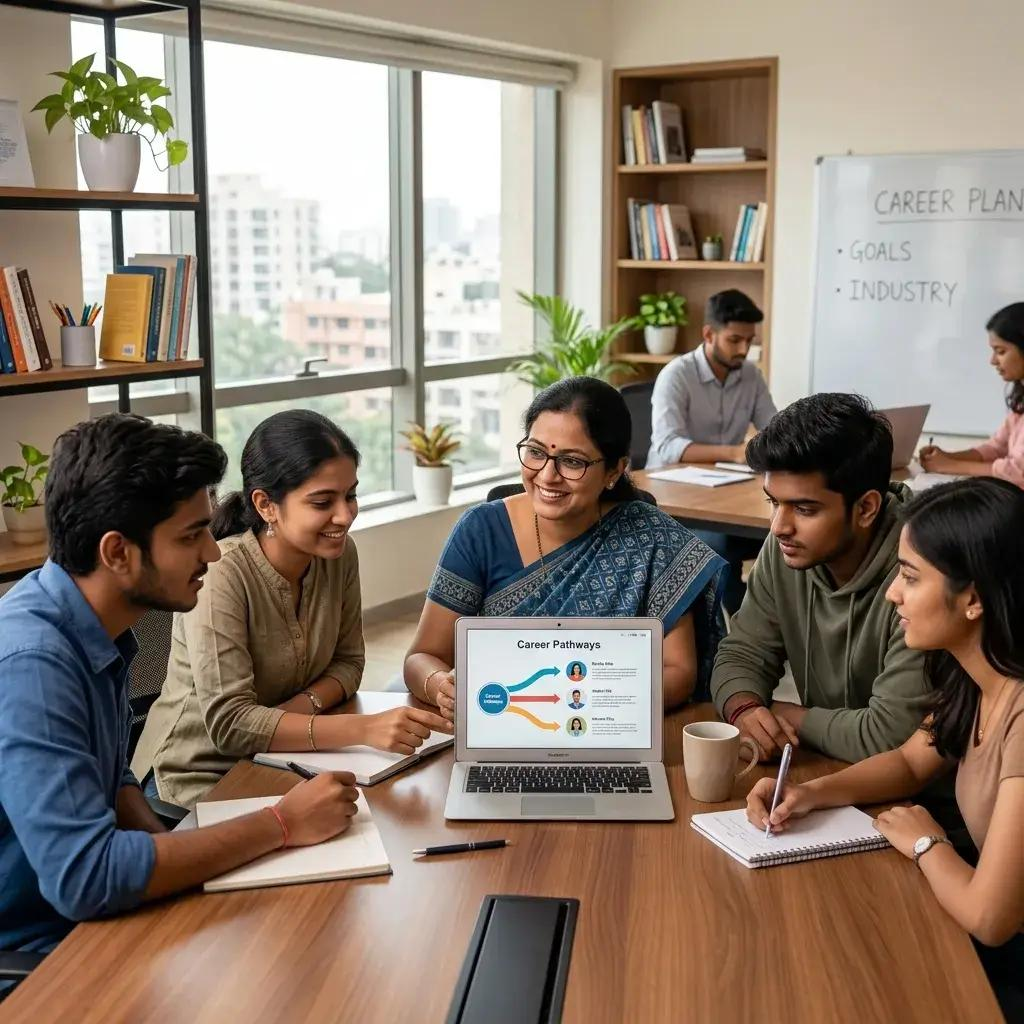
This is where structured career guidance and assessments can support better decision-making.
A good career assessment process can help individuals explore:
However, assessments should be treated as one source of information—not as final instructions about what someone must become.
Career decisions should also consider educational background, actual performance, personal circumstances, opportunities, motivation, and professional guidance.
At SH Development Academy, we believe that understanding yourself should come before deciding what you need to learn.
This is particularly important for students, because choosing the right learning direction early can help them invest their time and effort more thoughtfully.
Explore structured psychometric career assessments and personalised career guidance through SH Development Academy.Explore Psychometric Career Assessments
Let’s bring everything together into a simple manifesto that students, parents, and professionals can follow.
1. Never allow your degree to become the boundary of your knowledge.
Your formal education is a foundation, not the finish line.
2. Stay curious, even when nobody is evaluating you.
Learn something because you genuinely want to understand it.
3. Don’t confuse certificates with capabilities.
What you can practically apply matters.
4. Be willing to unlearn outdated methods.
Sometimes growth requires questioning things that once worked.
5. Learn from people who know more than you.
Mentors, colleagues, teachers, and experienced professionals can offer valuable perspectives.
6. Experiment before judging yourself.
You may discover interests and abilities through experiences you never expected to enjoy.
7. Develop both technical and human skills.
Technology is important, but communication, empathy, critical thinking, and collaboration remain valuable.
8. Don’t compare your learning journey with someone else’s.
Everyone has different starting points, responsibilities, and opportunities.
9. Turn knowledge into action.
A skill becomes more meaningful when you apply it.
10. Remain a student throughout life.
You don’t need to know everything. You need to remain willing to learn.
Lifelong learning means continuously developing knowledge, skills, and understanding throughout your life. It includes formal education, professional training, self-learning, practical experiences, and learning through everyday activities.
Lifelong learning is important because technology, industries, and professional requirements are evolving. Continuous learning helps individuals adapt to new opportunities, develop relevant skills, improve problem-solving abilities, and remain open to career growth.
They serve different purposes. Formal education provides structured knowledge and recognised qualifications, while lifelong learning helps individuals continue developing throughout their lives. The strongest approach combines formal education with continuous learning and practical application.
Students can develop this mindset by asking questions, exploring interests outside their syllabus, reading regularly, participating in practical projects, learning from mistakes, and developing independent thinking.
Working professionals can identify changing skill requirements in their industry, explore relevant courses, learn new technologies, seek mentorship, participate in projects, and regularly review their professional development goals.
Some useful areas to explore include AI literacy, digital skills, analytical thinking, communication, creative thinking, adaptability, problem-solving, data literacy, and collaboration. The right combination depends on your career direction and industry.
Absolutely. Lifelong learning has no fixed age limit. Whether you are a school student, college graduate, working professional, entrepreneur, homemaker, or retired individual, you can continue developing new interests and capabilities.
No. You can learn through books, free educational resources, online tutorials, practical projects, professional discussions, and everyday experiences. Paid courses and recognised qualifications can be useful when they provide the structure or credentials your goals require.
Let’s return to the question we started with.
When was the last time you learned something simply because you were curious?
In a world where information is easily accessible and technology continues to evolve, the biggest limitation is not always a lack of educational resources.
Sometimes, it is the belief that we already know enough.
A degree can open a door. A certificate can establish credibility. Experience can develop judgement.
But curiosity keeps you exploring what lies beyond your current understanding.
As parents, we should encourage our children to become curious learners, not just examination performers.
As students, we should explore our interests rather than limit ourselves to textbook knowledge.
As professionals, we should continue developing our capabilities instead of depending entirely on past achievements.
And as individuals, we should remember that learning is not something we complete at a particular age.
Your education may have a completion date. Your curiosity shouldn’t.
At SH Development Academy, we believe that meaningful career development begins with self-awareness and continues through lifelong learning.
Under the guidance of Santosh Hariharan — DMIT Consultant, Parent & Career Coach, and Success Mindset Coach for Students — we help students, parents, and individuals explore their strengths, interests, and career possibilities.
Whether you’re a parent trying to understand your child’s future direction, a student exploring career opportunities, or a professional looking for greater career clarity, taking the time to understand yourself can be a valuable first step.
Explore our services:
For students and professionals
Psychometric Career Assessments
Explore your interests, aptitude, and career preferences through structured career assessments.Explore Psychometric Career Assessments
Explore 3,000+ New-Age Career Options
Discover career possibilities across traditional, emerging, and specialised industries.Explore the Global Career Library
DMIT & Parenting Guidance
Learn more about our DMIT services and how we support parents in understanding their children’s development.Learn More About DMIT
Speak With Our Team
Have questions about career guidance or our services?
+91 8421315400
+91 7303290862 Copy Contact Numbers
Trusted by 400+ families and individuals
Remember: The best investment you can make in your future is not just what you learn today, but your willingness to keep learning tomorrow.
Success & Happiness are the two most important yet elusive things which every human being yearns to achieve in life. Real success and happiness can be savoured only when one enjoys good health and good family relations, along with a good professional career and sound financial stability.
Our Visitor


 Users Today : 89