

Have you ever caught yourself or your child replaying the same thoughts over and over again?
“What if I fail my exams?”
“Why can’t I stop thinking about this?”
“Is my child overthinking because of ADHD or autism?”
These are questions that many parents ask us during career counselling and parent guidance sessions.
With increasing awareness about mental health in India, it’s natural for parents to become concerned when they notice their child worrying excessively, struggling to focus, or appearing lost in their thoughts.
But here’s the important thing to understand:
Overthinking alone does not mean someone has ADHD or autism.
In fact, overthinking can happen for many different reasons—including stress, anxiety, perfectionism, major life changes, or simply a personality style.
As a DMIT Consultant, Parent & Career Coach, I’ve met hundreds of parents who initially assumed something was “wrong” with their child, only to discover that the real issue was academic pressure, unrealistic expectations, poor study habits, or a mismatch between the child’s natural learning style and the way they were being taught.
In this guide, let’s understand what overthinking really means, how it relates to ADHD and autism, and when it’s time to seek professional help.

Overthinking is the habit of repeatedly thinking about the same situation, problem, or possibility without reaching a solution.
Instead of helping us solve problems, overthinking often creates:
Everyone overthinks occasionally.
The difference is how often it happens and whether it starts affecting everyday life.
For students, overthinking commonly revolves around:
Adults may overthink about:
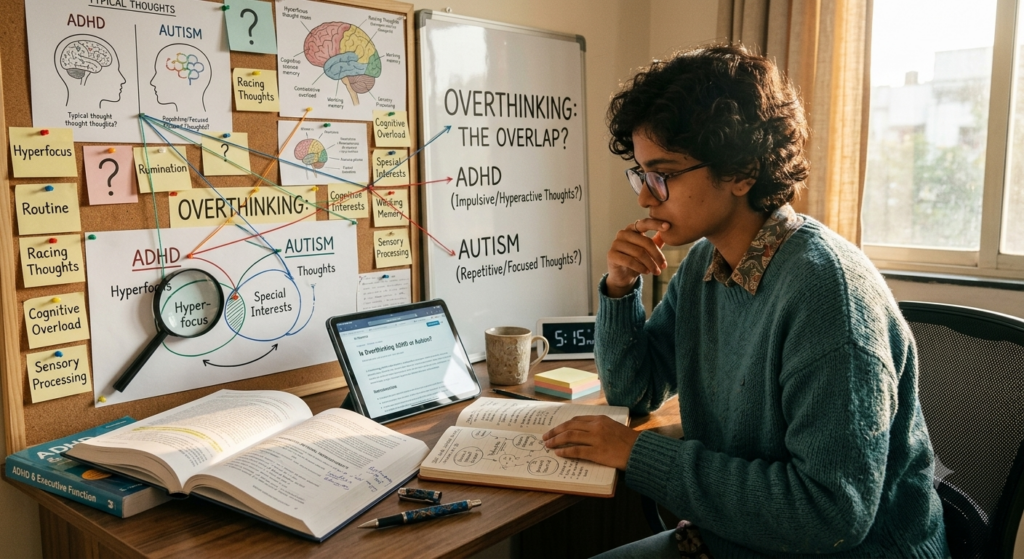
The short answer is:
Not necessarily.
Overthinking by itself is not enough to diagnose ADHD or autism.
Many people who do not have either condition also experience overthinking.
Likewise, some people with ADHD or autism may experience repetitive or intrusive thoughts, but these conditions involve a much broader pattern of characteristics that need to be assessed by qualified healthcare professionals.
A proper evaluation usually considers:
Because of this, it’s important not to self-diagnose based on one symptom alone.

Yes.
Although ADHD is commonly associated with hyperactivity and distractibility, many individuals with ADHD also experience racing thoughts and mental restlessness.
Some people describe it as having many thoughts competing for attention at the same time.
This can lead to:
However, these experiences alone do not confirm ADHD.
Only a qualified psychologist or psychiatrist can diagnose ADHD after a comprehensive assessment.
Some autistic individuals may experience repetitive thinking, especially about routines, social situations, or special interests.
For example, a person might repeatedly replay a conversation to understand what happened or become deeply focused on a particular concern.
However, autism is primarily characterized by differences in:
Again, overthinking by itself does not indicate autism.
In our experience working with students and parents, overthinking is often linked to everyday pressures rather than a neurodevelopmental condition.
Some common causes include:
Many students place enormous pressure on themselves to score high marks.
Fear of disappointing parents can make this even worse.
Anxiety is one of the most common reasons people overthink.
Someone may repeatedly imagine worst-case scenarios even when there is little evidence they will happen.
Children who always want everything to be “perfect” often spend too much time worrying about making mistakes.
Students who constantly compare themselves with others may question every decision they make.
Changing schools, moving cities, exams, or family changes can temporarily increase overthinking.
If overthinking is accompanied by persistent difficulties that affect school, relationships, work, or daily functioning, it may be helpful to seek an assessment from a qualified healthcare professional.
Examples include:
A psychologist, psychiatrist, or developmental pediatrician can determine whether further evaluation is appropriate.
When children struggle emotionally, parents naturally want answers.
However, avoid:
❌ Diagnosing your child based on social media.
❌ Comparing your child with others.
❌ Assuming poor marks automatically mean ADHD.
❌ Labelling your child as lazy.
Instead, observe patterns over time and seek professional advice when needed.
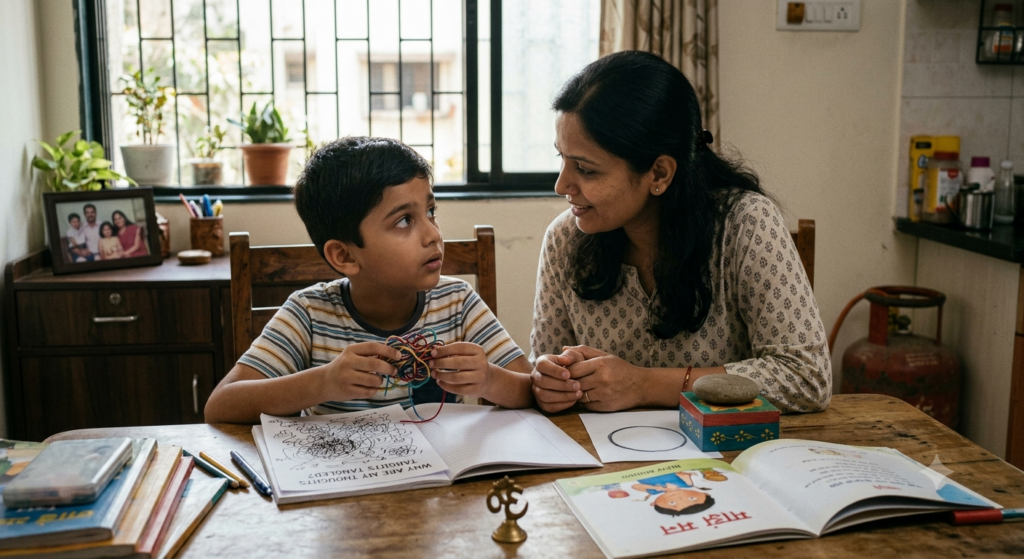
Whether or not a child has an underlying condition, these habits often help reduce everyday overthinking.
Let children express their worries without immediately trying to “fix” everything.
Sometimes they simply need someone to listen.
Celebrate effort instead of only results.
Children who feel accepted are often more willing to learn from mistakes.
Consistent sleep, exercise, study schedules, and relaxation can improve emotional wellbeing.
Instead of asking,
“What if everything goes wrong?”
Encourage children to ask,
“What is one small step I can take today?”
Every child develops differently.
Comparing siblings or classmates rarely motivates children—it often increases anxiety.
As parents, it’s easy to focus on report cards.
But children are much more than their academic scores.
They have:
Understanding these differences helps parents guide children more effectively.
This is one reason many families seek structured career guidance and educational counselling—not to diagnose medical conditions, but to better understand a child’s educational and career direction.

Sometimes parents ask us:
“My child isn’t sure what they want to become.”
“My child studies hard but doesn’t seem interested.”
“My teenager has no confidence about the future.”
These are situations where career counselling and structured aptitude assessments can support decision-making.
It’s important to understand that career guidance assessments and DMIT consultations are designed to explore learning preferences, strengths, and career planning—they are not medical or psychological diagnostic tools for ADHD, autism, or other health conditions.
No.
Many people overthink because of stress, anxiety, perfectionism, or life circumstances.
Some autistic individuals may experience repetitive thinking, but overthinking alone does not indicate autism.
Many children improve with supportive parenting, healthy coping skills, and appropriate professional support when needed.
If overthinking is persistent and significantly affecting daily life, discuss your concerns with a qualified healthcare professional who can recommend the right assessment.
As parents, it’s completely understandable to worry when your child seems anxious, distracted, or overwhelmed.
But remember:
One behaviour does not define a diagnosis.
Overthinking can happen for many reasons, and jumping to conclusions often creates more worry than clarity.
The best approach is to observe your child with patience, communicate openly, and seek qualified professional advice whenever you have concerns about their development or mental health.
At the same time, if your goal is to better understand your child’s learning style, natural strengths, career interests, or educational direction, structured career guidance can be a valuable next step.

If you’re looking to understand your child’s strengths, learning preferences, career interests, and future planning—rather than seeking a medical diagnosis—our Career Guidance Consultation at SH Development Academy is designed to help parents make informed educational decisions.
Your consultation is personally guided by Santosh Hariharan, DMIT Consultant, Parent & Career Coach, and Success Mindset Coach, who has helped hundreds of families gain greater clarity about education and career pathways.
⭐ See why 400+ parents have trusted our guidance:
https://share.google/ac9hkh20zcXadkJs9
📝 Book your Career Guidance Consultation:
https://docs.google.com/forms/d/e/1FAIpQLSd6-u-BEr3ESzoHq2CXjkYZIr41O1eqh3ip97Lj3JbZ-6xSPA/viewform
📞 Call: +91 8421315400 | +91 7303290862
By separating medical concerns from educational and career guidance, you can ensure your child receives the right support from the right professionals at the right time.
Success & Happiness are the two most important yet elusive things which every human being yearns to achieve in life. Real success and happiness can be savoured only when one enjoys good health and good family relations, along with a good professional career and sound financial stability.
Our Visitor


 Users Today : 26