


The internet has become an inseparable part of our everyday lives. We use it to study, work, communicate, shop, make payments, build businesses, explore career opportunities, and stay connected with people across the world.
For today’s children and teenagers, the digital world is not something they occasionally visit. It is where they learn, socialise, express themselves, and increasingly shape their identities.
But here’s an important question:
Are we teaching our children how to use the internet, or are we also teaching them how to use it responsibly?
Knowing how to operate a smartphone, download an application, create a social media account, or search for information doesn’t automatically make someone digitally responsible.
A child may know how to use Instagram but not understand the consequences of sharing a private photograph. A teenager may be comfortable chatting online but struggle to recognise a fake profile. Even adults who use digital payment applications every day can fall victim to phishing messages, fraudulent links, and online impersonation.
This is where the concept of digital citizenship becomes important.
Digital citizenship is about much more than internet safety. It involves understanding your rights, respecting other people’s rights, protecting personal information, evaluating online information, communicating responsibly, and recognising the consequences of your digital actions.
For Indian parents, students, teachers, and working professionals, developing digital citizenship is no longer optional. It is an essential life skill in an increasingly connected society.
In this guide, let’s understand what digital citizenship means, its nine important elements, the rights and responsibilities of internet users in India, common online risks, and practical ways to become a responsible digital citizen in 2026.
Digital citizenship refers to the responsible, safe, ethical, and informed use of digital technology and the internet.
A digital citizen is someone who understands how to participate in the online world while respecting their own rights and the rights of others.
It includes knowing how to:
Let’s understand this through a simple example.
Imagine a teenager in Pune who regularly shares photographs, school achievements, holiday updates, and personal opinions on Instagram.
They may consider these activities harmless. However, they might not realise that:
Digital citizenship teaches them to think before they click, post, comment, or share.
It helps them understand that being responsible online is just as important as being responsible in the real world.

India’s digital ecosystem has grown tremendously. From UPI payments and online education to social media, digital entertainment, and AI-powered applications, technology is now involved in almost every part of daily life.
Children attend online classes, teenagers explore career opportunities through the internet, college students build professional identities on LinkedIn, and working professionals conduct business through digital platforms.
But increased digital participation also creates increased responsibility.
Consider some everyday situations faced by Indian families:
These are not merely technology problems. They are also problems of awareness, judgement, digital behaviour, and decision-making.
1. Online safety is becoming a life skill
Children need to recognise suspicious links, fake accounts, online grooming, scams, and unsafe interactions before they become victims.
2. Personal information needs protection
Your phone number, photographs, address, location, school details, financial information, and passwords should not be shared carelessly.
3. Online behaviour has real-world consequences
A thoughtless comment, offensive post, or forwarded rumour can affect another person’s reputation and emotional wellbeing.
4. Digital literacy helps people make better decisions
Not everything that appears on Google, YouTube, Instagram, or WhatsApp is accurate. Users must learn to question information before accepting or sharing it.
5. Children need guidance, not just restrictions
Taking away a smartphone may reduce access temporarily, but it doesn’t necessarily teach a child how to behave responsibly when they eventually use one independently.
India’s National Curriculum Framework for School Education also highlights cyber safety, appropriate internet use, supervised access, and awareness of online risks for students. ncf.ncert.gov.in+1
The real objective should be to raise children who can make sensible digital decisions even when their parents or teachers are not watching.

Digital citizenship is commonly explained through nine interconnected elements. This framework helps parents, teachers, and students understand that responsible internet use involves much more than avoiding suspicious websites.
1. Digital Access
Having fair and meaningful access to digital technology and online resources.
For example, students should have opportunities to access educational resources, digital libraries, and online learning tools.
2. Digital Commerce
Understanding how to buy, sell, and make transactions safely online.
Indian users should understand UPI payments, online shopping, payment verification, refund scams, and secure transactions.
3. Digital Communication
Communicating appropriately through emails, messaging applications, social media, and other digital platforms.
Respectful language, clear communication, and understanding the impact of online messages are important.
4. Digital Literacy
Knowing how to find, evaluate, understand, and use digital information.
It includes recognising misinformation, checking sources, understanding AI-generated content, and learning new digital tools.
5. Digital Etiquette
Following respectful and responsible behaviour online.
Don’t bully, insult, threaten, spread rumours, or publicly embarrass someone through digital platforms.
6. Digital Law
Understanding that online actions are also subject to laws.
Cybercrime, identity theft, unauthorised access, harassment, and certain forms of harmful content can have legal consequences.
7. Digital Rights and Responsibilities
Understanding privacy, freedom of expression, access to information, and the responsibility to respect others’ rights.
Having the ability to express an opinion doesn’t give anyone the right to harass or threaten another person.
8. Digital Health and Wellness
Maintaining physical, mental, and emotional wellbeing while using technology.
Screen breaks, healthy sleep routines, physical activity, and balanced technology use are important.
9. Digital Security
Protecting devices, accounts, and personal information against online threats.
Strong passwords, two-factor authentication, software updates, and awareness of phishing are essential.
These nine elements work together. A person may be excellent at using technology but still lack digital etiquette or security awareness.
That’s why digital citizenship should be developed as a complete set of life skills.
Being a responsible digital citizen doesn’t mean blindly following rules or avoiding the internet.
You also have rights.
Understanding these rights is important because people often focus only on what they should not do online, without knowing what protections and legal safeguards are available to them.
Here are some important areas Indian internet users should understand.
Your personal information has value.
Your photographs, contact details, financial information, identification details, and other personal data should not be treated carelessly.
India’s Digital Personal Data Protection Act, 2023 (DPDP Act) establishes a framework governing the processing of digital personal data. The DPDP Rules, 2025 were notified in November 2025, with provisions scheduled to commence in stages.
The framework includes provisions concerning consent, transparency, data security, and individual rights, subject to the applicable commencement dates and conditions. E-Gazette+2
For parents, one particularly important aspect is children’s personal data.
The Act defines a child as an individual below 18 years and provides for parental or lawful guardian consent requirements for processing children’s personal data, subject to statutory provisions and exemptions.
What should parents teach children?
India’s Constitution protects freedom of speech and expression under Article 19(1)(a), subject to the reasonable restrictions specified under Article 19(2).
This also matters in the digital world.
People can express opinions, participate in discussions, share ideas, and raise concerns online, within applicable legal limits.
However, freedom of expression is not permission to threaten, defame, harass, or unlawfully harm someone.
The internet gives individuals access to educational resources, government information, public services, and knowledge from around the world.
However, users should learn to distinguish reliable information from misleading or manipulated content.
If someone experiences online financial fraud, identity theft, cyberbullying, or other cybercrime, they should know where to seek assistance.
India’s National Cyber Crime Reporting Portal provides a mechanism for reporting cybercrime complaints.
Official portal: National Cyber Crime Reporting Portal.
For urgent financial cyber fraud reporting, the national helpline is 1930. Cyber Crime Portal+1
Indian laws provide protections against various forms of online offences, including certain forms of harassment, identity-related offences, unauthorised access, and sexually exploitative content involving children.
The Information Technology Act, 2000, applicable criminal laws, and relevant rules may apply depending on the conduct and circumstances.
Remember: Digital rights and responsibilities go together. Understanding your rights also means respecting the rights of others.
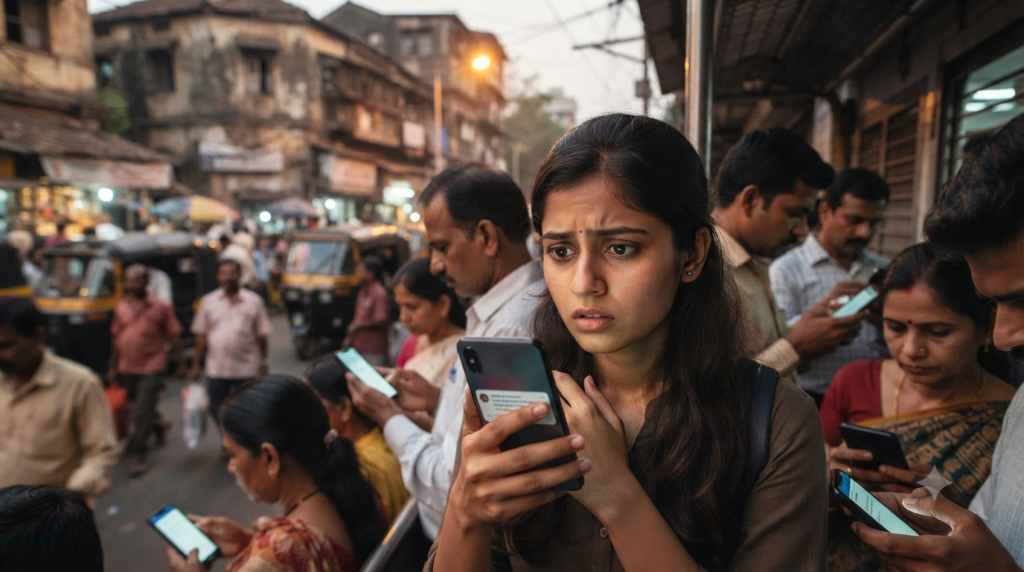
Let’s move from theory to real-life situations.
Most online problems don’t begin with someone deliberately trying to do something dangerous. They often begin with a simple click, a forwarded message, a careless post, or a conversation with someone who appears trustworthy.
Here are some of the most common digital risks Indian families should understand.
Cyberbullying happens when digital platforms are used to repeatedly intimidate, humiliate, threaten, or target another person.
It can happen through:
For children and teenagers, cyberbullying can be particularly distressing because it may follow them even after they leave school.
What should parents do?
Don’t immediately dismiss the situation as a normal friendship issue.
Listen without blaming the child, preserve relevant evidence, block or report the offending account where appropriate, and seek help from the school or relevant authorities when necessary.
Most importantly, make sure your child knows they can approach you without fear of punishment.
Digital payments have made everyday transactions easier for Indian families.
But scammers have also become increasingly creative.
Some common examples include:
One important rule every family member should remember:
You generally don’t need to enter your UPI PIN to receive money. Entering your PIN authorises a payment from your account.
Never share your OTP, UPI PIN, banking password, or screen-sharing access with unknown people.
If you suspect financial cyber fraud, contact your bank immediately and report it through the 1930 helpline and the National Cyber Crime Reporting Portal.
Imagine discovering that someone has created an Instagram account using your photograph and name.
They may use it to contact your friends, request money, spread false information, or damage your reputation.
This is a form of identity misuse that can create serious problems.
Protect yourself by:
WhatsApp forwards are a familiar part of Indian family groups.
A message arrives claiming that a particular food is dangerous, a bank is shutting down, a government scheme is offering free money, or a celebrity has made a controversial statement.
Within minutes, the same message may reach hundreds of people.
The problem?
Many people share information without checking whether it is true.
Before forwarding any information, ask:
Being digitally literate means knowing when NOT to share something.
Not everyone online is who they claim to be.
Some individuals deliberately build trust with children through gaming platforms, social media, or private messaging before attempting manipulation or exploitation.
Warning signs may include:
Parents should discuss these risks in an age-appropriate manner.
Avoid creating so much fear that children become reluctant to discuss their online experiences. They should know that asking for help is always better than handling a threatening interaction alone.
Artificial intelligence has made it easier to create realistic images, videos, voices, and messages.
While these technologies have legitimate uses, they can also be misused for:
Imagine receiving a voice call that sounds exactly like your family member asking for urgent financial assistance.
Would you immediately transfer the money?
A responsible digital citizen learns to verify unusual requests through another trusted communication channel before taking action.
NCERT’s cyber-safety resources also highlight emerging concerns such as online grooming, gaming-related crimes, deepfakes, and AI-enabled abuse. A Constituent unit of NCERT+1

This is perhaps the most important section for Indian parents.
Children are growing up in an environment where smartphones, tablets, online games, and social media are easily accessible.
Many parents focus on controlling screen time.
They may say:
These instructions are useful, but they are incomplete.
Children also need to understand why certain behaviours are unsafe and how to make sensible decisions independently.
Before uploading a photograph, video, or comment, encourage them to ask:
This develops digital awareness rather than dependence on parental monitoring.
Every online activity can contribute to a person’s digital footprint.
This includes:
Some information may remain accessible even after a post is deleted because others may have saved, copied, or redistributed it.
Explain to children that their online reputation deserves the same care as their real-world reputation.
Instead of constantly fighting over mobile phones, establish clear family expectations.
For example:
The aim isn’t to eliminate technology. It’s to prevent technology from controlling the family’s routine.
Ask your child:
These conversations help parents understand their children’s digital environment.
A child who is polite in person should also understand the importance of respectful online communication.
They should learn not to:
A useful principle to teach is:
If something would hurt someone when said face-to-face, think carefully before saying it online.
Parents cannot carry the entire responsibility for digital education.
Schools also play an important role because children spend a significant part of their lives in educational environments.
Digital citizenship should be integrated into school learning rather than treated as a one-time lecture.
Introduce age-appropriate cyber-safety education.
Students should learn about privacy, passwords, cyberbullying, misinformation, and online behaviour.
Discuss real-life digital situations.
Instead of only defining cyberbullying, teachers can present examples and ask students how they would respond.
Promote responsible use of AI tools.
Students should understand the difference between using AI to support learning and submitting AI-generated work dishonestly.
Teach information verification.
Students should learn how to check sources, compare information, and identify misleading content.
Create safe reporting channels.
Children should know whom to approach if they experience online harassment or unsafe interactions.
NCERT’s Central Institute of Educational Technology (CIET) provides resources for students, teachers, parents, and schools on cyber safety, digital footprints, social media safety, and safe online learning.
Explore: NCERT Cyber Safety and Security Resources. A Constituent unit of NCERT+1
Digital citizenship is not only about good manners. Certain online activities can also have legal consequences.
Indian internet users should be familiar with the following legal frameworks.
| Law / Framework | Why it matters |
|---|---|
| Information Technology Act, 2000 | Addresses various computer-related offences and specified online misconduct |
| IT Rules, 2021, as amended | Provides due-diligence and other obligations for intermediaries and digital platforms |
| Digital Personal Data Protection Act, 2023 | Establishes a framework for processing digital personal data |
| Digital Personal Data Protection Rules, 2025 | Provide detailed rules under the DPDP framework |
| Bharatiya Nyaya Sanhita, 2023 | Relevant provisions may apply to certain offences committed using digital platforms |
| Protection of Children from Sexual Offences (POCSO) Act, 2012 | Protects children against sexual offences, including relevant forms of online exploitation |
One important development for digital citizenship in India is the Digital Personal Data Protection framework.
The DPDP Act was passed in 2023, and the DPDP Rules were notified in November 2025.
However, parents and businesses should pay attention to the phased commencement schedule.
As of November 2026, the entire framework is not yet in force. Certain provisions commenced upon publication, while other important provisions have scheduled commencement dates extending into 2027. For example, the main provisions concerning data fiduciaries and individual data-protection obligations are scheduled to commence 18 months after publication of the Rules, subject to the notified commencement framework. E-Gazette+2
This distinction matters because a law being enacted or its rules being notified does not automatically mean every provision is already enforceable.
For families, the broader lesson is simple: understand how personal data is collected, why it is being collected, how it is used, and what protections apply.
For businesses and organisations handling personal data, legal compliance should be reviewed with qualified professionals.
This section is for general awareness and is not legal advice.
You don’t need to be a cybersecurity expert to become a responsible digital citizen.
Start by following these everyday practices.
Tick off the habits you already follow.
Your progress
0/12 completedUse strong and unique passwords for important accounts.Enable two-factor authentication wherever available.Never share OTPs, passwords, or UPI PINs.Verify suspicious links before clicking.Check information before forwarding messages.Respect other people’s privacy and photographs.Avoid posting sensitive personal details publicly.Report cyberbullying, impersonation, and suspicious accounts.Take regular breaks from screens.Think before commenting, sharing, or uploading.Keep devices and applications updated.Discuss online safety openly with children.
Copy checklist
You can also make this a monthly family activity. Sit together, review privacy settings, discuss suspicious messages, and talk about any uncomfortable online experiences.
Digital responsibility becomes much easier when everyone in the family follows the same principles.

The definition of digital citizenship is expanding.
Earlier, being digitally responsible mainly involved understanding websites, social media, online communication, and personal privacy.
Today, artificial intelligence adds another dimension.
Students and professionals increasingly use AI tools to:
But using AI responsibly requires judgement.
1. Verify AI-generated information.
AI tools can produce incorrect or misleading answers. Important information should be checked against reliable sources.
2. Respect privacy.
Don’t upload confidential documents, personal photographs, financial information, or another person’s sensitive data into AI tools without understanding the privacy implications.
3. Be transparent where necessary.
If AI has significantly contributed to an assignment, report, or professional deliverable, follow the relevant institutional or workplace disclosure rules.
4. Respect intellectual property.
Don’t assume that everything generated or found online can be copied and used without restrictions.
5. Never use AI to harm others.
Creating fake identities, impersonating people, producing non-consensual intimate images, or spreading manipulated information can cause serious harm and may have legal consequences.
For children, parents should explain that AI is a tool to support thinking and learning—not a replacement for independent judgement.
These two terms are closely connected, but they do not mean exactly the same thing.
| Digital Literacy | Digital Citizenship |
|---|---|
| Knowing how to use technology | Knowing how to use technology responsibly |
| Finding information online | Evaluating whether information is trustworthy |
| Understanding applications and tools | Understanding the impact of digital behaviour |
| Learning digital skills | Applying digital skills ethically |
| Operating devices and software | Respecting privacy, safety, and rights |
Here’s a simple example.
A student who knows how to create an Instagram account has digital skills.
A student who understands privacy settings, avoids sharing harmful content, respects other users, and recognises fake profiles is demonstrating digital citizenship.
Digital literacy teaches you how to use technology. Digital citizenship teaches you how to use it wisely.
Both are essential for students growing up in a technology-driven world.
Digital citizenship means using the internet and digital technology safely, respectfully, ethically, and responsibly. It involves protecting personal information, respecting others online, identifying misinformation, and understanding your digital rights and responsibilities.
The nine commonly recognised elements are:
Together, these elements explain how individuals can participate responsibly in the digital world.
Students use technology for education, entertainment, communication, and social interaction. Digital citizenship helps them protect their privacy, recognise cyberbullying, avoid online scams, evaluate information, and develop responsible online habits.
Parents can start by discussing online safety, setting reasonable screen-time boundaries, explaining privacy settings, encouraging respectful communication, and creating an environment where children feel comfortable discussing uncomfortable online experiences.
Most importantly, parents should demonstrate responsible digital behaviour themselves.
Examples include:
Poor digital citizenship can lead to cyberbullying, identity theft, financial fraud, privacy violations, reputational damage, misinformation, and legal consequences depending on the nature of the activity.
Indian educational frameworks recognise the importance of cyber safety, responsible technology use, and digital awareness. NCERT’s National Curriculum Framework for School Education addresses cyber safety, while CIET provides learning resources for students, parents, teachers, and schools.
However, the depth of digital citizenship education can differ between institutions.
Cyber safety mainly focuses on protecting people, devices, and information from online threats.
Digital citizenship is broader. It includes cyber safety but also covers digital ethics, online behaviour, communication, digital rights, responsibilities, and wellbeing.
A digital footprint is the trail of information associated with your online activities.
It may include social media posts, comments, photographs, online searches, reviews, and information shared through websites and applications.
It is important to remember that online content can be copied or saved even after the original post is deleted.
You can report cybercrime through the Government of India’s National Cyber Crime Reporting Portal:www.cybercrime.gov.in
For urgent financial cyber fraud, call 1930 as soon as possible and inform your bank.
Technology is changing how we learn, work, communicate, and build relationships.
For children, it offers incredible opportunities to explore knowledge, discover interests, develop skills, and prepare for future careers.
For parents, it creates new ways to support their children’s education and development.
But access to technology without awareness can create unnecessary risks.
We cannot expect children to navigate the digital world responsibly if we never teach them how to do so.
We cannot simply tell them to avoid social media, stop playing online games, or stay away from smartphones.
Instead, we need to help them develop judgement, self-awareness, critical thinking, empathy, and responsible decision-making.
Because the ultimate goal of digital citizenship is not to raise children who are afraid of the internet.
It is to raise individuals who are confident enough to use technology, wise enough to question it, and responsible enough to understand its consequences.
The digital world is here to stay. Let’s prepare our children to navigate it wisely.

At SH Development Academy, we believe that preparing children for the future involves more than academic marks and textbook knowledge.
Children also need self-awareness, critical thinking, responsible decision-making, adaptability, and clarity about their strengths and interests.
Under the guidance of Santosh Hariharan — DMIT Consultant, Parent & Career Coach, and Success Mindset Coach for Students, we help parents and students explore their strengths and make more informed educational and career decisions.
If you are a parent wondering which skills your child should develop, what career opportunities may suit their interests, or how to prepare them for a rapidly changing professional world, the right guidance can be a valuable starting point.
For students and parents
Psychometric Career Assessments
Explore aptitude, interests, personality-related preferences, and possible career directions through structured career assessment and guidance.Explore Psychometric Career Assessments
Explore 3,000+ New-Age Career Options
Discover emerging and traditional career possibilities to help students explore different professional pathways.Explore the Global Career Library
Learn More About DMIT
Understand our DMIT services and explore how personalised consultation can support parenting and child-development discussions. DMIT should be considered a supplementary discussion tool, not a scientifically established predictor of intelligence or career success.Explore DMIT at SH Development Academy
Have questions or want to discuss your child’s career direction?
+91 8421315400 | +91 7303290862
Copy Contact Numbers
Trusted by 400+ parents and families
SH Development Academy — Helping parents and students move towards greater self-awareness, informed choices, and a clearer future.
External authoritative resources worth linking:
Success & Happiness are the two most important yet elusive things which every human being yearns to achieve in life. Real success and happiness can be savoured only when one enjoys good health and good family relations, along with a good professional career and sound financial stability.
Our Visitor


 Users Today : 42