
Parenting in an Indian household often comes with a familiar scene.
You ask your child to put away their toys. They say, “In five minutes.”
You remind them again. Nothing happens.
By the third reminder, your patience is running out. By the fourth, you hear yourself saying, “No mobile phone until you finish your work!”
And suddenly, a simple task like putting toys away becomes an argument.
If this sounds familiar, you are not alone. Many parents struggle to get their children to participate in everyday household responsibilities without constant reminders, threats, or rewards.
The solution isn’t necessarily stricter discipline. Often, what children need is a clear, age-appropriate chores system for kids—one that makes responsibilities predictable, manageable, and part of everyday family life.
For Indian parents, this system needs to work in real homes: busy school schedules, homework, tuition classes, apartment living, limited space, and parents juggling professional and household responsibilities.
The good news? You don’t need an expensive reward chart, a complicated app, or a daily negotiation with your child.
You need a simple system that teaches an important lesson: everyone in the family contributes, and helping at home is part of growing up.
In this guide, we’ll explore how to create a practical chores system for kids, choose age-appropriate tasks, encourage cooperation without threats, and introduce rewards without making children expect payment for every little responsibility.
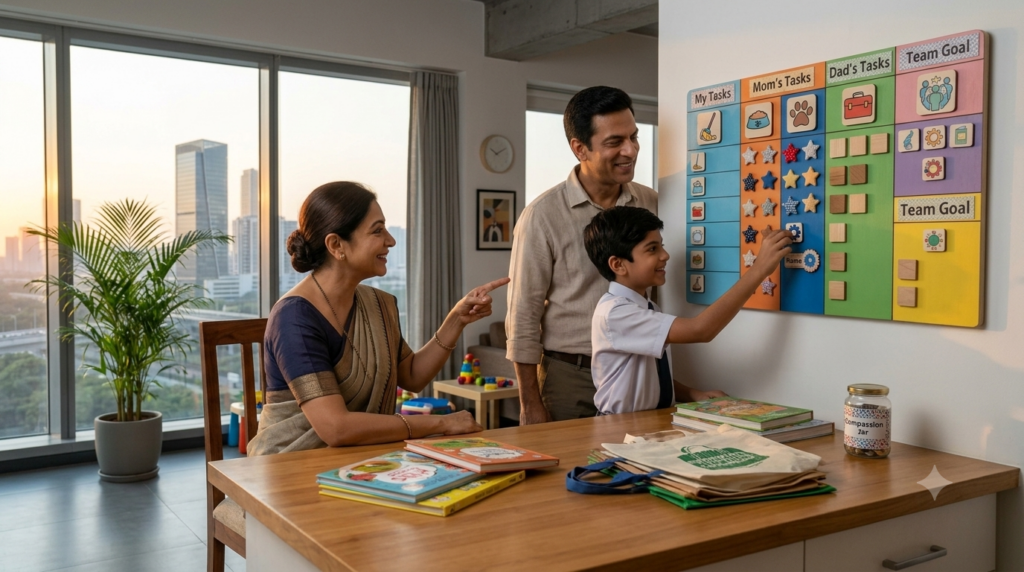
A chores system for kids is a simple family plan that explains which household tasks a child is responsible for, when those tasks should happen, and how the family will encourage consistency.
Instead of asking your child to help only when the house is messy, you make certain responsibilities part of the daily routine.
For example, in a Pune apartment, your family system might look like this:
Notice something important? None of these tasks requires a parent to offer ₹20, extra mobile time, or a chocolate every single time.
The child gradually learns that maintaining a home is a shared responsibility, not a favour done for Mum or Dad.
The American Academy of Pediatrics recommends clear expectations, consistent routines, age-appropriate responsibilities, and encouragement to help children develop responsibility at home.
Let’s look at a familiar situation.
A parent returns home after a long day at work. Dinner needs to be prepared, the kitchen needs attention, and tomorrow’s school preparations are still pending.
Meanwhile, the child has finished tuition, wants to watch YouTube, and doesn’t feel like putting away their books.
The parent says, “How many times do I have to tell you?”
The child replies, “I’ll do it later.”
The parent gets angry. The child becomes defensive. Eventually, the parent does the task themselves.
This pattern creates three problems.
If Mum or Dad always gives five reminders, the child may stop treating the first instruction as something they need to act on.
When every household responsibility comes with shouting, criticism, or threats, children may focus on avoiding the parent’s anger rather than learning the skill.
If a child delays long enough and the parent eventually completes the task, delaying can become a successful way to avoid responsibility.
The answer isn’t to become more aggressive. It is to make expectations clear, keep them realistic, and follow through consistently.
The goal is not to eliminate rewards completely. It is to use them thoughtfully, without teaching children that every ordinary contribution deserves payment.
A useful system has four parts:
1. Expected family responsibilities
These are ordinary, unpaid contributions, such as putting away toys, clearing one’s plate, keeping school supplies organised, and putting dirty clothes in the hamper.
2. Predictable routines
Attach each chore to something that already happens, such as tidying after playtime or clearing plates immediately after dinner.
3. Encouragement and recognition
Appreciate effort, acknowledge responsibility, and give specific praise when your child completes a task independently.
4. Optional bonus chores
Offer extra tasks for an agreed reward, such as pocket money, points toward a family outing, or another age-appropriate privilege.
This approach separates being a responsible family member from earning a reward for additional work. It also gives parents room to recognise effort without negotiating over every small task.
Before introducing a chart, sit down and list the small tasks that keep your home running.
You may be surprised by how many of them can be shared.
For a typical Indian apartment, the list might include:
Now divide these into two categories.
| Expected family chores | Optional bonus chores |
|---|---|
| Putting away personal toys | Helping organise a storage cupboard |
| Taking one’s plate to the kitchen | Helping wash the car with adult supervision |
| Putting dirty clothes in the hamper | Helping sort a large laundry load |
| Keeping school supplies organised | Assisting with a planned family cleaning task |
| Tidying the study desk | Helping with an additional meal-preparation task |
The exact division depends on your child’s age, ability, and your family’s circumstances.
The key principle: Don’t pay your child for every basic act of self-care or family contribution. If you choose to offer pocket money, you can keep it separate from regular responsibilities and use additional tasks to teach earning, saving, and spending.
One of the biggest mistakes parents make is expecting too much too soon—or assuming their child is too young to help at all.
A three-year-old cannot be expected to organise a kitchen the way a twelve-year-old might. At the same time, even a young child can begin learning to put toys into a basket.
Use this age-wise guide as a starting point, not a rigid rule. Adjust tasks to your child’s development, confidence, and safety.

Ages 2–3: Make helping playful
Keep tasks short and supervised.

Ages 4–5: Build simple routines

Ages 6–8: Encourage independence

Ages 9–12: Share meaningful responsibilities

Ages 13+: Prepare for independent living
Age-appropriate household contributions can help children practise cooperation, organisation, and practical life skills. Start with manageable tasks, demonstrate what to do, and gradually increase responsibility as skills develop.
An important safety note for Indian apartments: Keep children away from balconies without secure supervision, electrical appliances, sharp knives, hot cooking surfaces, heavy water buckets, strong cleaning chemicals, and other hazards. Tasks should teach independence without exposing children to unnecessary risks.
Here’s a simple parenting principle I recommend: Don’t make your child remember everything. Build a routine that reminds them what to do.
Instead of saying, “Clean your room sometime today,” make the expectation specific.
For example:
Why does this work better?
Because the child doesn’t have to negotiate a new instruction every time. The task becomes connected to an activity they already perform.
The American Academy of Pediatrics recommends making chores predictable and using clear checklists to help children understand their responsibilities.
In a small apartment, you don’t need an hour-long cleaning session.
Choose one time when the family can spend 10 minutes putting things back in their proper places.
One person organises the living room. Another sorts the books. Your child puts away toys or stationery. Parents handle the tasks that require adult judgement or strength.
Make it a shared routine, not a punishment imposed only on the child.
When children see parents participating, they learn that keeping a home organised is everyone’s responsibility.
If your child repeatedly asks, “What am I supposed to do?” a visual checklist can be more helpful than another verbal reminder.
You can use a simple whiteboard, paper chart, or reusable checklist on the refrigerator.
Here is an example you can adapt for your family.
Sample daily checklist for a school-age childPut away school bag and shoesKeep lunchbox and water bottle in the designated placeTidy toys or books after useTake plate to the kitchen after mealsComplete the 10-minute bedtime reset
0 of 5 tasks checkedReset checklist
This is a sample checklist. Adjust it to your child’s age, abilities, and family routine.
Keep the chart simple. A child who is just learning responsibility does not need 15 tasks, five colours, and a complicated points system.
Start with three or four manageable responsibilities. Once the routine becomes familiar, introduce additional tasks if appropriate.
Not necessarily.
You can use a printed checklist, a notebook, sticky notes, or a reusable board. Commercial routine charts are optional; the consistency of the system matters more than the product.
If your child enjoys visual activities, colourful stickers or magnets can make the process engaging. If your teenager finds charts childish, agree on a simple written checklist or shared family schedule instead.
This is where many parents get confused.
Should you reward children for completing chores? Or should you expect them to do everything without rewards?
My recommendation is to distinguish between appreciation, privileges, and payment.
Instead of a generic “Good boy” or “Good girl,” explain what your child did well.
For example:
This helps the child recognise the behaviour you want to encourage.
You can agree in advance that the family will finish its evening routine before starting recreational screen time.
The message is not, “I’ll pay you to do your chores.”
It’s, “Let’s finish our responsibilities first, so we have time to enjoy the evening.”
Avoid using essential needs, affection, or access to necessary schoolwork as rewards or punishments.
Suppose your child already puts away their toys and clears their plate. These are regular family responsibilities.
But on Saturday, you ask your older child to help sort a large storage cupboard or organise a collection of old books for donation.
You might agree on a small payment or another reward for completing that additional task.
The agreement should be clear beforehand: what needs doing, what counts as completion, and what the reward will be.
Research and professional guidance recognise that rewards can sometimes help establish a new behaviour, while also highlighting the importance of family contribution, encouragement, and motivation beyond material incentives.
Remember: The purpose of a reward is to support learning, not to make your child dependent on receiving something every time they help.
Even the best chores system will have difficult days.
Your child may be tired after school, absorbed in a game, upset about something, or simply unwilling to stop what they are doing.
The goal is to respond consistently without turning every refusal into a power struggle.
Try responding:
“I’m happy to give you five minutes to finish what you’re doing. After that, it’s time to put your books away.”
A clear transition is often more useful than repeating the same command louder.
Try saying:
“You’re right that I’m the parent, and I take care of many things for our family. Everyone in this home also has responsibilities that match their age. This is one of yours.”
You are explaining a family expectation, not trying to win an argument.
Suppose your child throws all their clothes into one drawer and declares the room clean.
Instead of saying, “You never do anything properly,” explain what completion looks like.
For example:
“Let’s fold these two items and put them in the right drawer. I’ll show you once, and then you can try.”
Children need to learn the standard before they can consistently meet it.
Stay calm and follow the agreement you made in advance.
If the family rule is that recreational screen time starts after the agreed routine, hold that boundary without shouting, threatening, or inventing a new punishment in the heat of the moment.
At the same time, ask whether the task is too difficult, unclear, or poorly timed.
Consistency does not mean ignoring your child’s needs. It means responding thoughtfully instead of changing the rules every day.
Children can become bored when they are assigned the same task every day. A little variety can help, especially with older children.
For example, a family living in a Pune apartment might rotate some shared responsibilities each week.
| Week | Child’s shared task | Parent’s role |
|---|---|---|
| Week 1 | Water balcony plants | Check watering needs |
| Week 2 | Organise the living-room bookshelf | Help with heavy items |
| Week 3 | Sort clean towels | Show how to fold them |
| Week 4 | Help arrange groceries | Handle fragile or heavy items |
Personal responsibilities, such as putting away one’s own school bag, can remain consistent while shared tasks rotate.
Avoid turning this into a competition between siblings. Children have different abilities, schedules, and levels of independence. Fairness means giving each child an appropriate contribution, not necessarily assigning identical tasks.
If your family currently struggles with chores, don’t try to change every habit overnight.
Use this seven-day plan to introduce the system gradually.
Have a family conversation
Explain why everyone will begin sharing responsibilities. Ask your child which tasks they feel ready to manage.
Choose three simple chores
Start with tasks that are easy to understand and realistically achievable.
Demonstrate each task
Show your child what needs to be done instead of assuming they already know.
Connect tasks to routines
Link chores to breakfast, playtime, or bedtime so they become easier to remember.
Notice effort
Praise specific actions, especially when your child starts a task independently.
Review what is working
If a task is consistently difficult, simplify it, explain it again, or change its timing.
Celebrate the family’s progress
Discuss what has become easier and agree on the next small step. Don’t expect perfection in one week.
A week is enough to introduce a routine, but establishing a lasting habit may take longer. Continue adjusting the system to fit your family.
Even well-intentioned parents can accidentally make household responsibilities harder than necessary.
A long list can overwhelm a child who is just learning to manage responsibilities. Begin with a few tasks and expand gradually.
A child’s first attempt at folding clothes may not look like a parent’s. Teach the skill before criticising the result.
If every basic responsibility comes with a reward, your child may begin negotiating over tasks that should be part of normal family life.
Threats often escalate conflict. Clear expectations and calm follow-through are more constructive.
Avoid comments such as, “Your sister does this without being told. Why can’t you?”
Comparison can create resentment without teaching the child the actual skill they need.
One child may happily follow a written checklist, while another needs a verbal reminder or a task broken into smaller steps.
Adjust your approach to your child’s needs rather than assuming the same method will work for everyone.
The American Academy of Pediatrics advises parents to account for children’s individual temperaments and abilities, while keeping chores realistic and providing support as children learn.
The real value of a chores system goes far beyond a tidy bedroom.
When children participate in everyday household responsibilities, they get opportunities to practise several important life skills.
These are opportunities to learn, not guaranteed outcomes from using a chore chart. Children develop at different rates, and the quality of parental guidance matters.
The American Academy of Pediatrics highlights chores as a way to practise cooperation, responsibility, and useful everyday skills.
Before assuming that your child is lazy, take a step back and observe the situation.
Ask yourself:
Sometimes the problem is not unwillingness. The child may need a clearer instruction, a smaller task, a visual reminder, or more practice.
For example, “Clean your room” is a broad instruction that may feel overwhelming.
“First, put your books on the shelf. Then place your dirty clothes in the hamper” is much easier to follow.
If difficulties with everyday responsibilities are persistent and also affect school, relationships, or other areas of daily life, consider discussing your concerns with a qualified child-development professional or paediatrician.
The goal is not to label your child. It is to understand what support will help them learn and grow.
Children can begin with simple, supervised tasks from toddlerhood, such as putting toys in a basket. As they grow, responsibilities can gradually expand to include organising belongings, helping with meals, folding laundry, and managing more complex household tasks. Choose activities based on development and safety rather than age alone.
Not necessarily. Everyday responsibilities, such as putting away toys or clearing one’s own plate, can remain unpaid family contributions. You may choose to pay for additional tasks or use an agreed reward system to teach financial responsibility. The most important thing is to explain the distinction clearly.
Start with a small number of clear responsibilities, connect them to daily routines, and use a visible checklist. Give your child time to transition between activities, demonstrate unfamiliar tasks, and follow through calmly on agreed expectations.
Good options include putting away toys, organising books, keeping school bags in place, folding clothes, watering balcony plants safely, setting the table, and helping sort groceries. Avoid tasks involving balconies without secure supervision, hot appliances, heavy objects, or hazardous cleaning products.
You can establish a family routine in which agreed responsibilities are completed before recreational screen time begins. Explain the rule in advance and apply it consistently. Avoid using screen restrictions in ways that interfere with schoolwork, necessary communication, sleep, or other essential needs.
The best chart is one your family will actually use. A paper checklist, whiteboard, magnetic chart, or simple notebook can all work. Keep it age-appropriate, easy to understand, and flexible enough to change as your child’s abilities grow.
Dear parents, the purpose of a chores system is not to make your child work harder around the house.
It is to help them understand that they are a valued member of the family who can gradually learn to take responsibility.
You don’t have to eliminate every reminder overnight. You don’t have to reward every completed task. And you certainly don’t have to turn every unfinished chore into a battle.
Start small. Explain clearly. Demonstrate patiently. Appreciate genuine effort. Keep your expectations realistic.
Most importantly, remember that children learn responsibility not only through what we tell them, but also through what we model every day.
When parents participate, communicate respectfully, and follow consistent routines, household responsibilities can become an opportunity to build life skills and strengthen family cooperation.
Every child has a different temperament, interests, strengths, and support needs. Understanding those differences can help parents make more thoughtful decisions about communication, learning, and development.
At SH Development Academy, Santosh Hariharan—a DMIT Consultant, Parent & Career Coach, and Success Mindset Coach for Students—helps parents explore their children’s potential and make more informed parenting and educational decisions.
If you’re interested in learning about the DMIT assessment and how its report is interpreted as part of a broader parenting and child-guidance discussion, you can explore our service details here:

Learn more about the assessment, the report, and the guidance available to parents.Explore DMIT Services
Have questions? Speak with us.
+91 8421315400
+91 7303290862
Read feedback from parents who have trusted our guidance.
One important note: DMIT should not be treated as a proven way to determine a child’s temperament, behaviour, or parenting needs from fingerprints alone. Use any assessment report as a discussion aid rather than a diagnosis or a fixed label for your child. Your everyday observations, your child’s own perspective, and appropriate professional guidance remain essential.
The best parenting approach begins with curiosity: What is my child finding difficult, what support do they need, and how can I help them become more independent?
That is a much stronger foundation for raising responsible, confident children than threats ever will be.
Success & Happiness are the two most important yet elusive things which every human being yearns to achieve in life. Real success and happiness can be savoured only when one enjoys good health and good family relations, along with a good professional career and sound financial stability.
Our Visitor


 Users Today : 14