

In today’s digital world, screens are everywhere 📱
From online classes and YouTube videos to gaming, Instagram reels, cartoons, and mobile entertainment — children are spending more time on screens than ever before.
And as a parent, you may already be noticing signs like:
The scary part?
This is not “just a habit” anymore.
Experts worldwide are now warning parents about the serious impact of screen addiction in children and how it affects brain development during the most important growing years.
As a DMIT Expert, Parent & Career Coach, we regularly meet parents who say:
“My child was very active earlier… now he only wants mobile.”
“My daughter gets irritated without YouTube.”
“Focus and memory have become weak.”
If you are seeing similar changes in your child, this blog will help you understand:
✔ How screen addiction affects child brain
✔ Signs of unhealthy screen dependency
✔ Long-term effects on learning & behavior
✔ What parents should do in 2026
✔ How to balance technology in a healthy way
Let’s understand this deeply.
Screen addiction refers to excessive and uncontrolled use of:
where children start becoming emotionally dependent on screens.
It becomes a serious issue when a child:
In 2026, child psychologists and parenting experts are increasingly calling screen addiction a “silent developmental challenge” for modern children.
The human brain — especially a child’s brain — is still developing..
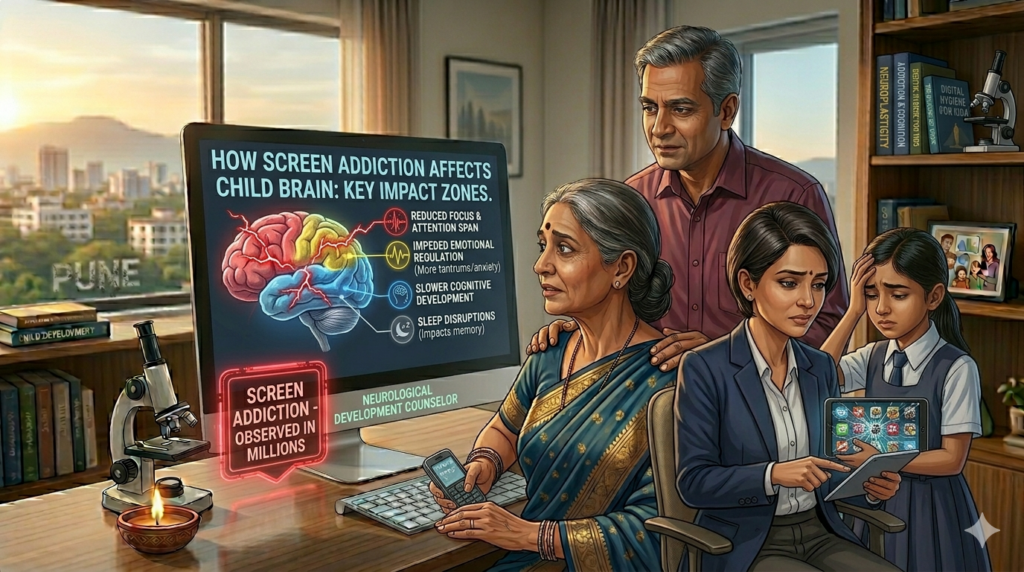
And excessive screen exposure during growing years can directly affect:
Let’s understand the major effects.
One of the biggest effects of screen addiction in children is poor concentration.
Short-form videos, rapid animations, gaming rewards, and constant scrolling train the brain to expect:
⚡ Instant stimulation
⚡ Fast entertainment
⚡ Constant dopamine hits
As a result, children struggle to focus on:
This is why many parents now complain:
“My child cannot sit and study for even 15 minutes.”
The brain gradually becomes addicted to quick stimulation.
Excessive screen exposure can overload the brain.
Children consuming continuous digital content may show:
Why?
Because real learning requires:
🧠 Patience
🧠 Reflection
🧠 Concentration
🧠 Active thinking
But screen addiction often promotes passive consumption.
Many parents notice behavioral changes due to excessive screen time.
Common signs include:
Gaming and fast-paced digital content overstimulate the nervous system.
When screens are removed, children may experience withdrawal-like reactions.
This is becoming increasingly common among children in India in 2026.
Using screens before bedtime affects melatonin production — the hormone responsible for sleep.
This can lead to:
🌙 Late sleeping habits
🌙 Poor sleep quality
🌙 Brain fatigue
🌙 Reduced energy
🌙 Morning laziness
Poor sleep directly impacts:
Earlier, children used to:
Today, excessive screen consumption leaves little room for creativity.
When a child constantly consumes ready-made entertainment, the brain gets fewer opportunities to think independently.
This affects:
🎨 Creativity
🎨 Curiosity
🎨 Problem-solving ability
Screen-addicted children often spend less time interacting with:
This can affect:
🗣 Communication skills
🗣 Emotional intelligence
🗣 Confidence
🗣 Relationship-building ability
Some children become socially withdrawn or emotionally disconnected.
One of the most common consequences of screen addiction is declining academic performance.
Children may experience:
Over time, this creates stress for both parents and children.
Yes — especially during early developmental years.
Research in recent years suggests that excessive screen exposure during childhood can affect areas related to:
This does not mean technology is “bad.”
But uncontrolled and excessive use without balance can negatively affect healthy brain development.
Here are some common warning signs 🚨
In 2026, screens are no longer optional.
Children now use devices for:
The challenge is not removing screens completely…
The challenge is creating a healthy balance.
Modern parenting now requires:
✔ Digital awareness
✔ Emotional guidance
✔ Activity balance
✔ Brain development focus
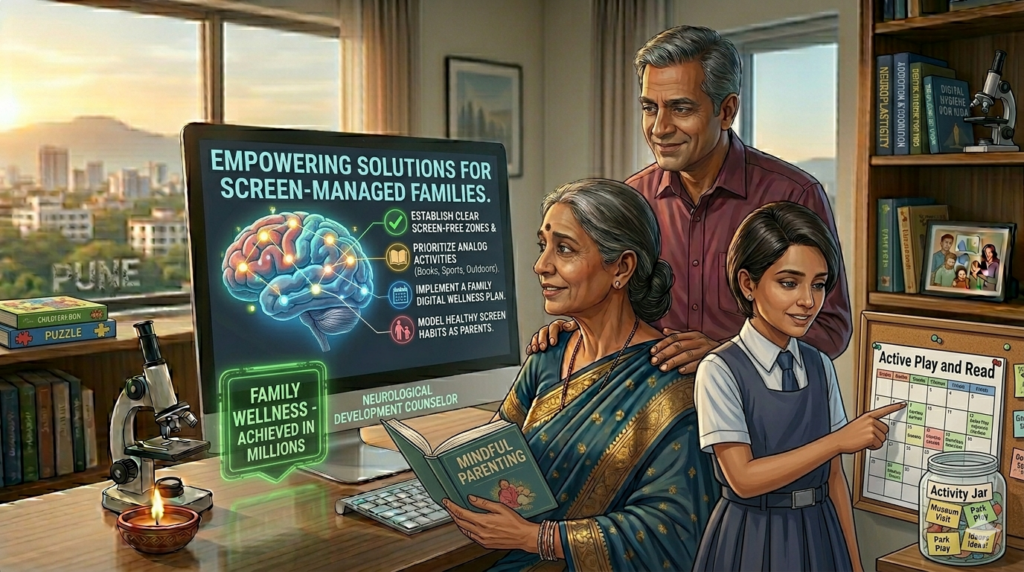
Here are practical strategies that actually work 👇
Create fixed timings for:
Consistency matters more than strict punishment.
Outdoor play improves:
⚽ Brain development
⚽ Focus
⚽ Emotional health
⚽ Physical fitness
This creates emotional dependency on devices.
Encourage real conversations instead 🍽️
Children imitate parents.
If parents are always on mobile phones, children naturally copy the behavior.
Encourage:
🎨 Art
🎵 Music
📖 Reading
🧩 Puzzles
🏃 Sports
🎤 Public speaking
These activities stimulate healthy brain growth.
Many children become overdependent on screens because they lack meaningful engagement.
Understanding your child’s:
can help parents guide them toward productive activities.
No.
Educational and limited screen usage can be beneficial when balanced properly.
The problem starts when:
❌ Screen replaces real-life interaction
❌ Screen becomes emotional dependency
❌ Screen affects studies, sleep, and behavior
Healthy digital habits are the key.
Technology is part of modern life.
Children cannot completely avoid screens in 2026.
But parents can create:
✔ Healthy boundaries
✔ Better routines
✔ Skill-building activities
✔ Strong emotional connection
This helps children use technology wisely instead of becoming controlled by it.
Screen addiction in children is becoming one of the biggest parenting challenges in modern times.
And the effects are not just academic — they impact:
The earlier parents understand these patterns, the easier it becomes to guide children in the right direction 🌱
Remember:
Children do not need unlimited entertainment.
They need guidance, balance, purpose, and meaningful growth.
At SH Development Academy, we work closely with parents and students to help children improve:
✔ Focus & concentration
✔ Learning ability
✔ Confidence
✔ Brain development habits
✔ Career clarity & natural strengths
Through our DMIT & Psychometric Career Guidance Consultation, parents can better understand their child’s:
🧠 Learning style
🧠 Personality traits
🧠 Hidden talents
🧠 Strengths & improvement areas
Guided personally by Santosh Hariharan — DMIT Consultant, Parent & Career Coach, and Success Mindset Coach for Students.
📞 Call Now: +91 8421315400 | +91 7303290862
⭐ Click here to see our 310+ Google Reviews:
Google Reviews – SH Development Academy
👉 Book your consultation today and help your child build a healthier, brighter future 🚀
Success & Happiness are the two most important yet elusive things which every human being yearns to achieve in life. Real success and happiness can be savoured only when one enjoys good health and good family relations, along with a good professional career and sound financial stability.
Our Visitor


 Users Today : 2