
Starting solids is one of those parenting milestones that sounds simple until you actually reach it.
Suddenly, everyone has an opinion.
👵 “Give the baby dal water.”
👩🍼 “Start with fruit.”
👨👩👧 “Try rice porridge.”
📱 And then the internet gives you 50 different answers.
So what should you actually do when your baby turns six months?
The good news is that you don’t need expensive baby food or complicated recipes. Traditional Indian home-cooked foods can be excellent complementary foods when they are prepared in the right consistency, offered in suitable portions, and introduced safely.
According to current WHO and UNICEF guidance, complementary feeding generally begins at around 6 months, while breastfeeding can continue alongside complementary foods up to 2 years and beyond. At this stage, the goal isn’t to replace milk overnight—it is to gradually introduce your baby to a wider variety of nutritious foods.
Let’s look at some practical Indian options.
For most healthy babies, complementary foods are introduced at around 6 months (about 180 days).
Before six months, exclusive breastfeeding is recommended when possible. Once the baby reaches around six months, breast milk alone may no longer meet all nutritional requirements, so complementary foods are introduced while breastfeeding continues.
And remember: weaning doesn’t mean stopping breastfeeding.
Think of it as adding food—not suddenly removing milk.
At six months, your baby doesn’t need a huge bowl of food.
In fact, the first few weeks are more about learning than eating large quantities.
Your baby is learning to:
WHO guidance recommends starting with small amounts and gradually increasing quantity, consistency and variety as the baby grows.
So don’t worry if your baby initially eats only a few spoonfuls.
That’s completely different from an older child refusing an entire meal.
Indian kitchens already have many simple foods that can be adapted for babies.
The key is not just what you give, but how you prepare and serve it.
Here are some practical options.
A simple rice porridge can be one of the easiest first foods.
How to prepare:
Cook rice until very soft and mash it thoroughly. You can gradually make the texture thicker as your baby becomes comfortable.
Avoid adding salt or sugar.
This is where traditional Indian food can really work in your favour.
A well-cooked combination of rice and moong dal can provide carbohydrates and plant-based protein.
Cook both until very soft and mash them well.
You can later gradually increase the thickness rather than keeping everything watery.
Ragi is a familiar Indian staple and can be prepared as a smooth porridge.
Cook the ragi properly and serve it in an age-appropriate consistency.
Don’t feel the need to make it sweet with sugar or jaggery.
At this stage, the baby is learning the natural taste of foods.
Banana requires almost no cooking and can be easily mashed into a soft consistency.
Choose a ripe banana and mash it thoroughly.
Start with a small quantity and observe how your baby responds.
Soft vegetables such as:
🥕 Carrot
🎃 Pumpkin
🥔 Potato
🍠 Sweet potato
can be steamed or cooked until soft and then mashed.
The important thing is to avoid hard chunks that could create a choking risk.
Well-cooked dal can be introduced as part of a varied diet.
Instead of relying only on thin dal water, gradually move toward the actual cooked dal, appropriately mashed or blended for your baby’s developmental stage.
The objective is to provide nutrient-dense food, not simply flavoured water.
Depending on availability and your baby’s tolerance, you can introduce soft fruits such as:
For firmer fruits, cook or steam them until soft and mash them appropriately.
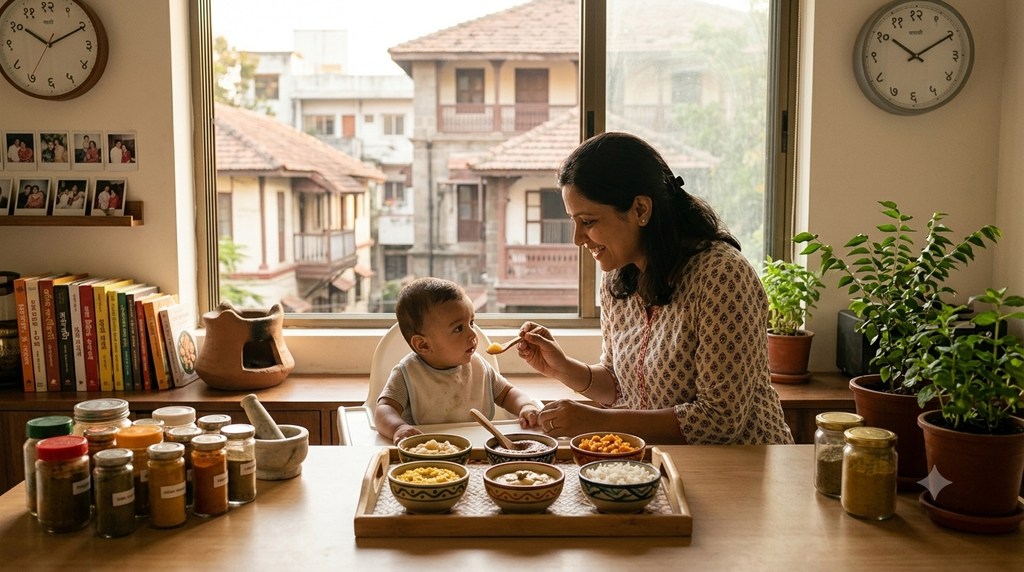
You don’t need a complicated seven-day diet chart.
Start small.
For babies aged 6–8 months, WHO recommends complementary foods around 2–3 times a day, alongside continued milk feeds. The amount can begin with just a few spoonfuls and gradually increase according to the baby’s appetite.
A simple pattern might look like:
Morning: Breast milk/formula
Late morning: Small serving of mashed banana or soft fruit
Afternoon: Soft rice + moong dal
Evening: Breast milk/formula
Later meal: Ragi or vegetable mash, depending on the baby’s routine
This is an example—not a prescription.
Every baby’s appetite, growth, development and feeding pattern is different.
This is one of the most common mistakes parents make when starting complementary feeding.
There is a tendency to make baby food extremely thin and watery.
But as your baby develops, food should gradually become thicker and more varied in texture, according to their ability to manage it. WHO recommends progressing from pureed, mashed and semi-solid foods toward more textured foods as the child grows.
So instead of staying with:
“Rice water → dal water → vegetable water”
think:
“Soft, mashed, nutrient-dense food → gradually thicker textures → appropriately textured family foods.”
Introducing solids isn’t only about nutrition.
Safety matters just as much.
Don’t give a six-month-old hard or round foods that can become lodged in the airway.
Examples include whole nuts, whole grapes and raw carrot pieces. Foods should be prepared in a texture and shape appropriate for the baby’s developmental ability.
Always supervise your baby while eating.
Honey should not be given to babies under 12 months. UNICEF specifically highlights this safety point for six-month-old babies.
Babies don’t need their food sweetened or salted to make it appealing.
WHO recommends that complementary foods should not have added salt or sugars.
Let your baby gradually discover the natural taste of different foods.
Wash hands before preparing food and keep utensils and feeding surfaces clean.
Food should be freshly prepared and handled safely because young babies are particularly vulnerable to infections from contaminated food.
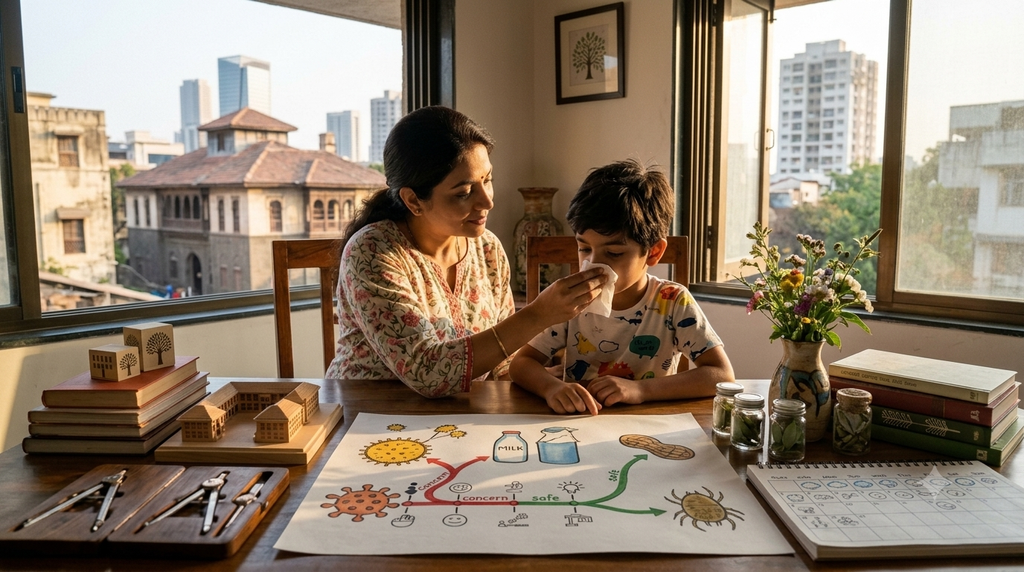
Food allergies are another area where parents often feel nervous.
Rather than avoiding potentially allergenic foods indefinitely, discuss introduction of specific allergenic foods with your paediatrician, particularly if your baby has eczema, an existing food allergy, or a strong family history of allergies.
Introduce unfamiliar foods carefully and observe your baby.
If your child develops symptoms such as swelling, breathing difficulty, repeated vomiting or other signs of a serious allergic reaction, seek urgent medical care.
Here’s something every new parent should remember:
Your baby doesn’t have to finish the bowl.
WHO recommends responsive feeding—recognising hunger and fullness cues, feeding patiently and encouraging the child without forcing them to eat.
If your baby:
they may be telling you they’ve had enough.
Mealtimes should gradually become a positive experience rather than a daily battle.
Variety matters.
As complementary feeding progresses, children should gradually be exposed to foods from different food groups. WHO notes that dietary diversity is associated with better nutrition and that inadequate variety can increase the risk of nutrient deficiencies.
Think beyond just rice and dal.
Over time, introduce a variety of:
🌾 Cereals and grains
🥣 Pulses and legumes
🥚 Eggs and other animal-source foods, where appropriate
🥬 Vegetables
🍌 Fruits
🥛 Dairy foods where suitable
🥜 Nuts/seeds only in safe, age-appropriate forms
You don’t have to introduce everything in the first week.
Build variety gradually.
One of the beautiful things about Indian food traditions is that many everyday ingredients can be adapted for babies.
You don’t necessarily need:
❌ Expensive imported baby foods
❌ Fancy recipes
❌ Multiple ingredients in every meal
❌ Added sugar to make food appealing
You can start with simple, familiar ingredients prepared appropriately.
Rice. Dal. Ragi. Banana. Vegetables. Fruits.
Simple food can be nutritious food.
Every Indian family has a “baby food expert.” 😊
Grandmother has a recipe.
Neighbour has a suggestion.
A WhatsApp group has another.
And Google has hundreds more.
Traditional wisdom can be valuable, but when it comes to a baby’s nutrition, not every traditional practice is automatically safe or appropriate for a six-month-old.
If your baby was premature, has poor weight gain, swallowing difficulties, allergies, digestive problems, or another medical condition, speak with your paediatrician or a qualified infant nutrition professional before making major feeding changes.
Starting solids at six months doesn’t have to be stressful.
The basic idea is simple:
Start around 6 months → begin with small amounts → offer nutritious foods → gradually increase texture and variety → continue breastfeeding → follow your baby’s hunger and fullness cues → keep food preparation and choking safety a priority.
And don’t compare your baby with the neighbour’s baby.
One baby may happily eat three spoonfuls.
Another may take several attempts to accept a new food.
That’s okay.
Your job isn’t to make your baby finish the bowl.
Your job is to offer safe, nutritious food and help your child develop a healthy relationship with eating.
The first few months of complementary feeding can feel like a small thing.
But these are the months when your child is beginning to discover an entirely new world of tastes, textures and family foods.
So take it slowly.
Keep it simple.
Keep it safe.
And most importantly, don’t let the pressure of getting every meal “perfect” take away the joy of feeding your baby. ❤️
This article is intended for general educational information and is not a substitute for personalised medical advice. If you have concerns about your baby’s growth, feeding, allergies, swallowing, digestion or readiness for complementary foods, consult your paediatrician or qualified healthcare professional.

At SH Development Academy, our work with parents goes beyond assessments—we believe that understanding a child is the first step toward guiding them better.
If you’re a parent looking for professional guidance about your child’s learning, strengths, personality and future direction, you can book a DMIT Consultation with Santosh Hariharan, DMIT Consultant, Parent & Career Coach and Success Mindset Coach for Students.
👉 Book a DMIT Consultation:
https://docs.google.com/forms/d/e/1FAIpQLSd6-uBEr3ESzoHq2CXjkYZIr41O1eqh3ip97Lj3JbZ-6xSPA/viewform
📞 Call / WhatsApp:
+91 8421315400 | +91 7303290862
⭐ See what 400+ parents have shared about their experience:
https://share.google/ac9hkh20zcXadkJs9
Success & Happiness are the two most important yet elusive things which every human being yearns to achieve in life. Real success and happiness can be savoured only when one enjoys good health and good family relations, along with a good professional career and sound financial stability.
Our Visitor


 Users Today : 6