
You check WhatsApp while having breakfast.
Then Instagram while waiting for your child’s school bus.
A quick YouTube video becomes 20 minutes of scrolling.
At night, after everyone has gone to sleep, you tell yourself, “Just five minutes.”
And suddenly it is midnight.
If this sounds familiar, you are not alone.
For many Indian parents, social media has quietly become part of almost every part of the day—parenting groups, school updates, family WhatsApp groups, Instagram reels, news, shopping, work messages and endless notifications.
The problem isn’t necessarily having a smartphone.
The problem is when the phone starts deciding where your attention goes.
That is why a social media detox for parents can be useful.
A detox doesn’t necessarily mean throwing your phone away or disappearing from WhatsApp for a week. It means deliberately reducing unnecessary social media use, breaking automatic scrolling habits and creating more space for family, sleep, conversations and your own mental peace.
And there is another important reason for parents to do this:
Your children are watching.
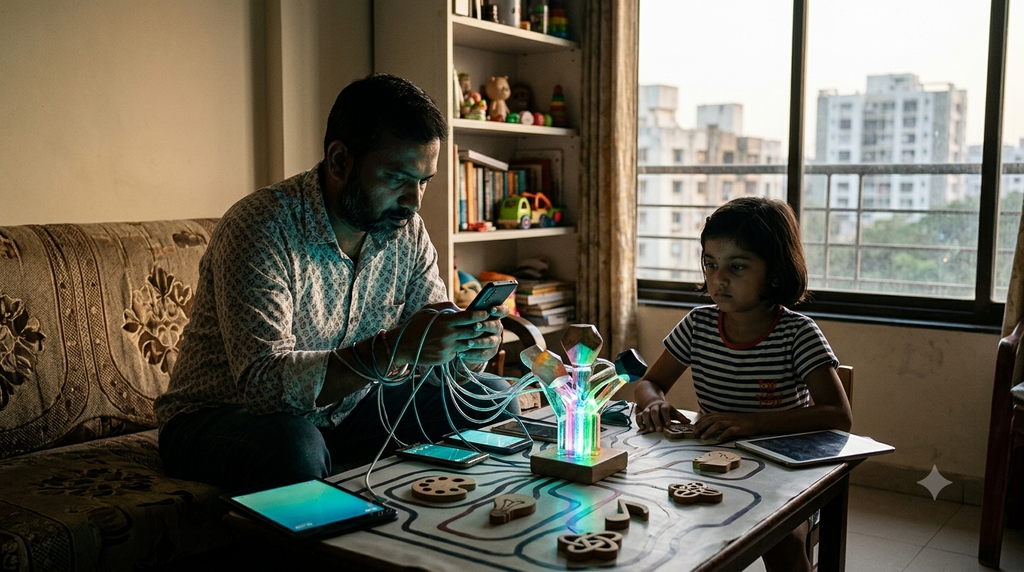
When we repeatedly tell children, “Stop using your phone,” while checking our own phone every few minutes, the message becomes confusing.
Children learn a lot more from what we do than from what we say.
So, instead of trying to become a completely “digital-free” family overnight, let’s try something more practical.
Here is a 7-day social media detox plan for Indian parents that you can actually follow.

A social media detox for parents is a planned period of reducing or temporarily stopping non-essential social media use to regain control over digital habits.
It can involve:
Importantly, a detox does not mean becoming anti-technology.
Parents still need their phones for work, school communication, banking, navigation, emergencies and staying connected with family.
The goal is simple:
Use technology intentionally instead of automatically.
Let’s be honest.
Parenting already comes with enough mental load.
There are school schedules, homework, tuition classes, meals, work, household responsibilities, family commitments and constant decisions about your child’s future.
Then social media adds another layer.
You see another parent’s child winning a competition.
Someone’s child gets admission into a prestigious school.
Another family posts their holiday.
Someone else shares how their child is already learning coding, piano or a new language.
And slowly, without realizing it, comparison begins.
This is where FOMO—Fear of Missing Out—can quietly enter parenting.
Sometimes the real problem isn’t that your child is behind.
It is that you are constantly looking at someone else’s highlight reel.
This is an important distinction.
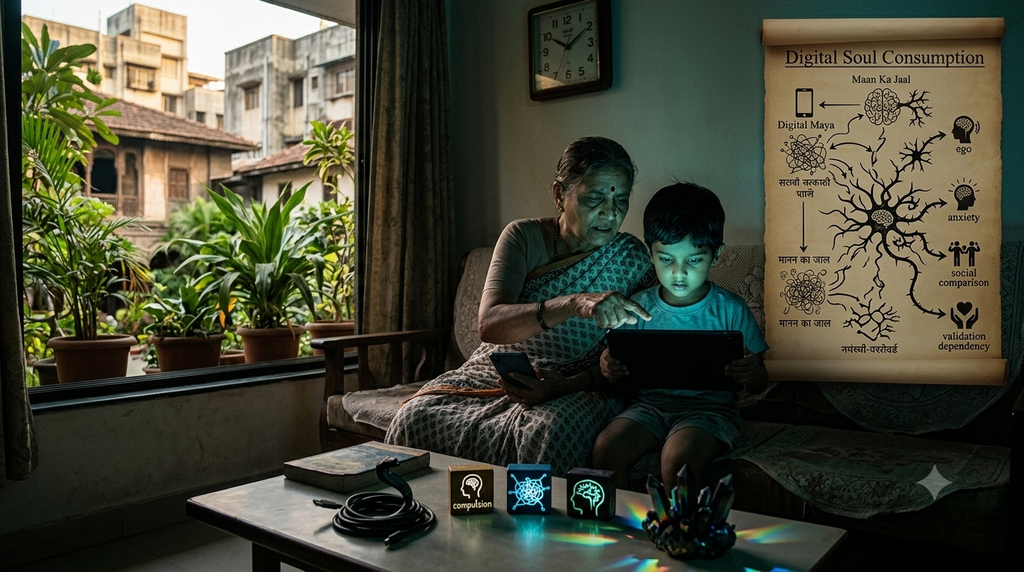
A parent can spend only 60 minutes on Instagram but still feel mentally exhausted if those 60 minutes are filled with:
So don’t measure your detox only by the number of minutes saved.
Also ask:
“What happened to my mind after I used social media?”
Did you feel:
😊 Calm?
😟 Anxious?
😤 Irritated?
😔 Inadequate?
🤯 Mentally overloaded?
That awareness is the beginning of a healthier digital relationship.
Parents don’t use social media in isolation.
Their digital habits can influence the atmosphere at home.
Imagine this:
Your child is telling you something important.
You are looking at your phone.
You say, “Yes, yes, I’m listening.”
But your eyes are still on the screen.
Your child may not say anything.
But they notice.
Now reverse the situation.
Your child is using the phone while you are talking.
You immediately say:
“Put that phone down when I’m talking to you!”
This is where parents need to pause.
Children don’t just listen to our rules. They observe our relationship with technology.
A parent’s digital behaviour can therefore become part of the child’s digital education.
You don’t need to delete every app on Day 1.
Let’s make this practical.
Don’t try to become perfect today.
Just observe.
Check your phone’s screen-time report and ask yourself:
Don’t judge yourself.
Awareness comes before change.
Write down your three biggest social media triggers.
For example:
Boredom → Instagram
Stress → Reels
Waiting → WhatsApp
Today, don’t fight your willpower.
Reduce the triggers.
Turn off non-essential notifications from:
Keep important notifications such as:
The objective isn’t to disconnect from people.
It’s to stop every notification from interrupting your attention.
No unnecessary notification for 24 hours.
You may be surprised by how quiet your phone suddenly feels.
Choose one area or activity where phones are not allowed.
For many Indian families, the easiest place to start is:
🍽️ The dining table.
No phone while eating.
Not for parents.
Not for children.
Instead, talk.
Ask:
“What was the best thing that happened today?”
Or simply discuss school, work, friends, plans or something funny.
You don’t need a complicated parenting activity.
Sometimes a 20-minute conversation is more valuable than another parenting reel.
One completely phone-free family meal.
How you start your morning can influence the rest of your day.
If the first thing you do after waking up is check Instagram, WhatsApp and news, your brain immediately starts processing everyone else’s priorities.
Try something different.
For the first 30 minutes after waking up, avoid social media.
Instead:
☀️ Drink water
🧘 Sit quietly
🚶 Take a short walk
📖 Read a few pages
👨👩👧 Talk to your family
📝 Plan your day
You don’t need a perfect morning routine.
You simply need a morning that belongs to you, rather than the algorithm.
This is where many detox attempts fail.
You delete Instagram.
Two hours later, you reinstall it.
Why?
Because you removed the habit without replacing the behaviour.
Instead, prepare a list of alternatives.
When you feel like scrolling, try:
📚 Reading
🚶 Walking
☕ Having tea with your spouse
🎲 Playing a board game with your child
🏸 Going outdoors
🎵 Listening to music
🧩 Doing a hobby
💬 Having a real conversation
Even 15 minutes of meaningful activity can feel very different from 15 minutes of passive scrolling.
Don’t make the detox only about yourself.
Talk to your child.
Instead of saying:
“You use your phone too much.”
Try:
“I think our family is spending a little too much time on screens. Let’s experiment with reducing it together.”
This changes the conversation from punishment to partnership.
Create a simple family rule.
For example:
Or:
The exact rule matters less than consistency and parental participation.
Congratulations.
You have completed seven days.
But the goal was never to survive a seven-day detox.
The goal was to discover:
What kind of digital life actually works for your family?
Now decide what you want to continue.
For example:
📵 No phones during meals
🌙 No social media 30–60 minutes before bedtime
🛏️ Phones stay outside bedrooms
👨👩👧 One screen-free family activity every day
📱 Social media checked at specific times rather than continuously
🚫 No phone while talking to your child
Keep the rules realistic.
A rule that works for your family is better than an impressive rule nobody follows.

That’s perfectly fine.
A social media detox doesn’t have to mean zero social media.
For many parents, a better goal is:
Instead of opening Instagram whenever you have a free moment, decide:
“I’ll check it at 1 PM and 7 PM.”
Instead of watching 50 reels:
Watch what you intentionally came to see and leave.
Instead of sleeping with the phone beside you:
Charge it somewhere outside the bedroom.
Small boundaries can create surprisingly large changes over time.
It isn’t simply getting one extra hour every day.
It is getting your attention back.
Your child may not remember whether you replied to every WhatsApp message immediately.
But they may remember:
❤️ You listened.
❤️ You played with them.
❤️ You ate dinner together.
❤️ You noticed when they were upset.
❤️ You were present.
Parenting is not only about providing things.
It is also about being emotionally available.
And attention is one of the most valuable things a parent can give a child.
This is something I often remind parents:
You don’t have to become a perfect parent.
You need to become a more aware parent.
You will still check your phone.
You will still use social media.
You will sometimes lose patience.
You will sometimes get distracted.
That’s normal.
The goal is not perfection.
The goal is to notice when your habits are taking you away from the kind of parent you want to be—and make a conscious correction.
There is a deeper lesson hidden inside this seven-day challenge.
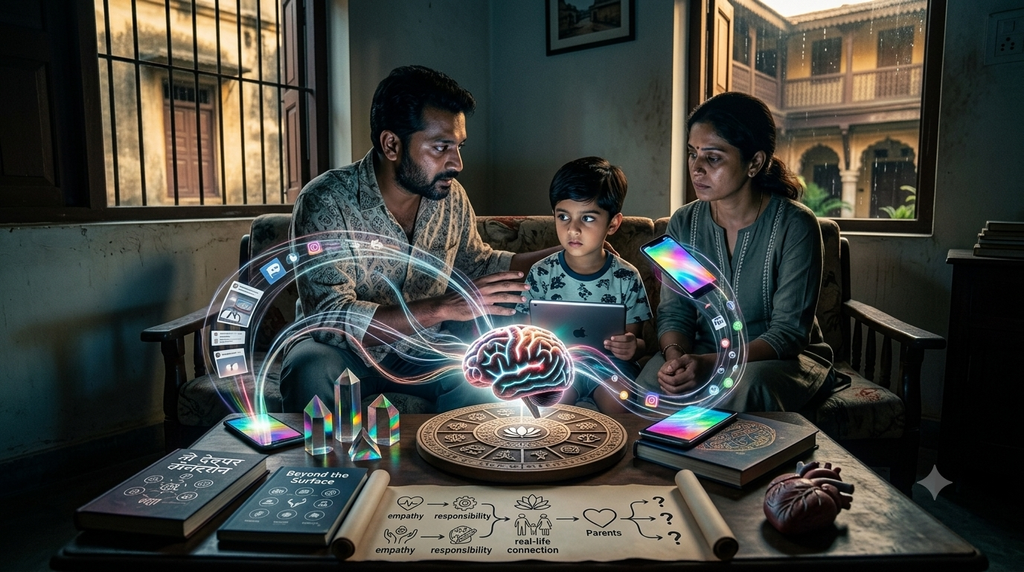
When parents start observing their own habits, they often become more understanding of their children’s struggles with screens.
Instead of asking:
“Why can’t my child control the phone?”
you may start asking:
“What makes the phone so difficult for all of us to put down?”
That shift—from blaming to understanding—is an important part of conscious parenting.
And once you understand your child’s individual nature, learning style, strengths and behavioural tendencies, parenting becomes even more personalised.
Sometimes excessive screen use is only the visible symptom.
A child may be avoiding studies because of:
This is why I always encourage parents to look beyond the behaviour.
Don’t simply ask, “How do I stop this behaviour?”
Ask:
“What is this behaviour trying to tell me?”
That question can completely change the way you parent.
A social media detox for parents isn’t about becoming disconnected from the modern world.
It is about becoming more connected to the people who matter most.
Your phone can wait.
The algorithm can wait.
The next reel can wait.
But your child’s childhood doesn’t.
So start small.
Put the phone away during dinner tonight.
Listen a little longer.
Take a walk together.
Have a conversation without a screen between you.
And notice how different your home feels.
Sometimes, becoming a better parent doesn’t require learning one more parenting technique.
Sometimes, it simply requires putting the phone down long enough to see your child clearly. ❤️

Every child is different.
One child may be naturally focused and analytical.
Another may need movement to learn.
Another may be highly creative.
Another may struggle with confidence even though they have strong abilities.
As parents, we aren’t given a manual when our child is born.
But understanding your child’s natural strengths, learning preferences, personality and areas that may need support can make parenting decisions much easier.
At SH Development Academy, I help parents understand their children through DMIT assessment and personalised counselling.
I’m Santosh Hariharan — DMIT Consultant, Parent & Career Coach and Success Mindset Coach for Students, with years of experience working with parents and students.
If you want to understand your child’s unique potential and learn how to guide them more effectively, you can explore a DMIT Consultation.
📞 +91 8421315400 | +91 7303290862
Because sometimes the first step toward better parenting isn’t changing your child.
It’s understanding them better.
Success & Happiness are the two most important yet elusive things which every human being yearns to achieve in life. Real success and happiness can be savoured only when one enjoys good health and good family relations, along with a good professional career and sound financial stability.
Our Visitor


 Users Today : 6