You know you need experience to build a strong resume.
But here’s the question many students and freshers struggle with:
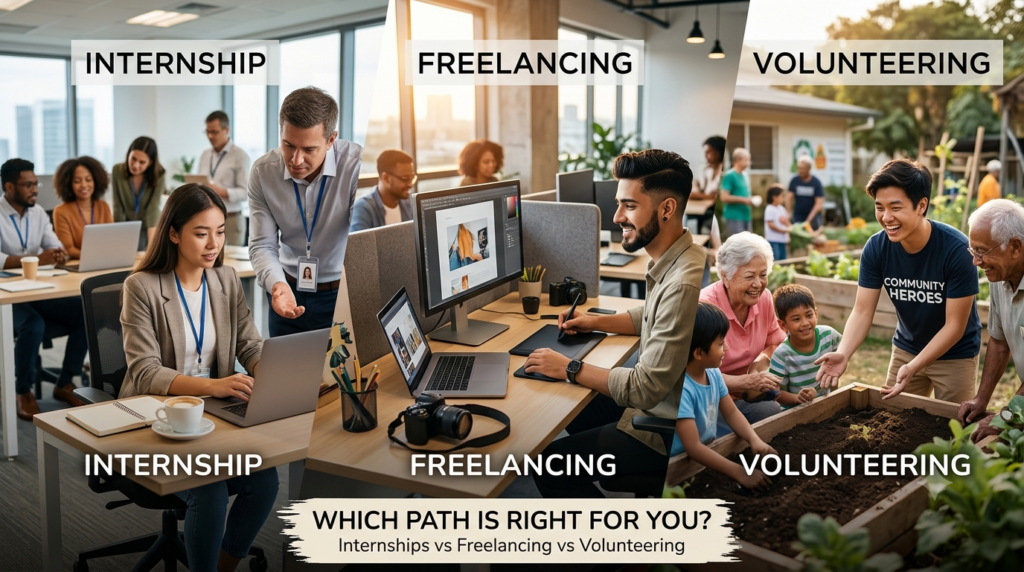
Should I do an internship? Start freelancing? Or volunteer for an organisation?
It’s a genuine career dilemma.
An internship may give you a recognised company name and structured workplace experience. Freelancing can help you build a portfolio and earn money. Volunteering can give you practical exposure, skills, and professional connections—even if the work is unpaid.
So, which one builds your resume faster?
As a Career Coach, my honest answer is: there is no single winner for everyone.
The right choice depends on where you are in your career journey, what skills you already have, and—most importantly—where you want to go next.
Let’s break it down in a practical way.
Here’s a simple way to look at it:
| If Your Main Goal Is… | Best Starting Option |
|---|---|
| Learning how a professional workplace works | Internship |
| Building a portfolio and earning from your skills | Freelancing |
| Exploring a field and gaining experience | Volunteering |
| Getting mentorship and structured learning | Internship |
| Working independently and building client experience | Freelancing |
| Building networks while contributing to a cause | Volunteering |
Internships typically offer structured workplace exposure, skill development, and professional connections. Freelancing is more independent and portfolio-driven, while volunteering can provide practical experience and networking opportunities—especially for students who are still exploring their interests. Dr. Zubair Khalid, Veterinarian
But let’s go deeper.
Before comparing internships vs freelancing vs volunteering, it’s important to understand one thing:
A fancy title alone doesn’t make a resume strong.
A recruiter or employer usually wants to know:
For example, compare these two resume statements:
❌ Worked as a Social Media Intern.
Now compare it with:
✅ Created 25 social media posts for a local business and improved monthly engagement through content planning and performance tracking.
The second statement tells a story.
That’s why, whether you choose an internship, freelance project, or volunteer role, the quality and relevance of your experience matter more than simply collecting certificates.
Career guidance resources consistently recommend recording specific skills, completed projects, feedback, and measurable outcomes so that your experience can be presented effectively on future resumes and applications. Dr. Zubair Khalid, Veterinarian

An internship is a temporary opportunity where students or freshers gain practical experience within a company or organisation.
For someone entering the professional world for the first time, an internship can be incredibly valuable.
You get to experience things that textbooks rarely teach:
Internships remain one of the most structured ways for students and freshers to gain practical, industry-relevant experience and build professional confidence.
A good internship can strengthen your resume because it gives you:
You learn how an organisation actually functions—not just how the industry looks in theory.
A good manager or mentor can help you identify gaps in your skills and improve faster.
Your supervisor may later become a valuable reference.
If your internship is relevant to the role you’re applying for, it can make your career direction easier for employers to understand.
An internship is usually a strong choice if you are:
Not every internship is equally valuable.
A three-month internship where you learn real skills and contribute to projects can be more useful than six months spent doing repetitive work with little learning.
Before accepting an internship, ask:
What will I actually learn and what work will I be able to show on my resume?
That question can save you a lot of time.

Freelancing works differently.
Instead of joining a company as an intern, you offer a specific skill or service to clients.
For example, a student might freelance as a:
Freelancing can give you something extremely powerful:
Proof of work.
Instead of saying, “I know graphic design,” you can show:
Freelance work is particularly useful for building independent work experience, client relationships, and a portfolio of completed projects.
Many students think freelancing is only about the skill itself.
But real freelancing teaches you much more:
These are valuable professional skills.
Freelancing may be a good option if:
Freelancing requires self-discipline.
There is no manager telling you what to do every morning. You may need to find your own clients, manage deadlines, and handle difficult feedback.
So, for a student with zero practical skills, jumping directly into freelancing may be frustrating.
In that situation, learning a skill first—through education, an internship, volunteer work, or personal projects—may be a smarter starting point.

When students hear the word volunteering, they often think:
“It’s unpaid, so how will it help my career?”
This is where many students miss an opportunity.
A relevant volunteer role can provide:
Volunteer experience can be particularly valuable for students and early-career professionals whose resumes don’t yet contain much paid work experience. The key is to choose relevant work and clearly explain what you contributed and achieved. Career Connections Center
Imagine you’re interested in digital marketing.
You approach a local NGO and offer to help manage its social media for two months.
During that time, you:
Now you have real experience.
You can honestly add that work to your resume and discuss what you learned in an interview.
The work was unpaid—but the skills and experience can still be valuable.
Volunteering can be a great option if you:
| Factor | Internship | Freelancing | Volunteering |
|---|---|---|---|
| Structured learning | ⭐⭐⭐⭐⭐ | ⭐⭐ | ⭐⭐⭐ |
| Portfolio building | ⭐⭐⭐ | ⭐⭐⭐⭐⭐ | ⭐⭐⭐⭐ |
| Mentorship | ⭐⭐⭐⭐⭐ | ⭐ | ⭐⭐⭐ |
| Flexibility | ⭐⭐ | ⭐⭐⭐⭐⭐ | ⭐⭐⭐⭐ |
| Income potential | Varies | High potential | Usually unpaid |
| Networking | ⭐⭐⭐⭐⭐ | ⭐⭐⭐ | ⭐⭐⭐⭐ |
| Best for beginners | ⭐⭐⭐⭐⭐ | ⭐⭐ | ⭐⭐⭐⭐ |
| Independence | ⭐⭐ | ⭐⭐⭐⭐⭐ | ⭐⭐⭐ |
| Resume credibility | ⭐⭐⭐⭐⭐ | ⭐⭐⭐⭐⭐* | ⭐⭐⭐⭐ |
*Freelancing becomes especially powerful when you can show genuine projects, outcomes, and a professional portfolio.
The important point is this:
There is no universally “best” option. The best experience is the one that moves you closer to your career goal.
Here is my honest verdict.
If you’re a student or fresher who wants to understand how a professional environment works, start with an internship.
You will gain workplace exposure, learn from experienced professionals, and begin building your network.
If you can design, write, code, edit videos, analyse data, or offer another valuable service, freelancing can help you build a portfolio faster.
You may also earn while gaining experience.
Volunteering can be an excellent first step when you don’t yet have professional experience.
Choose a role related to your future career wherever possible.
Don’t volunteer just to collect a certificate.
Volunteer to do meaningful work.
Here’s something I often tell students during career guidance sessions:
Your career journey doesn’t have to follow one straight line.
You can combine these experiences.
For example:
Take a course, build personal projects, and practise regularly.
Use your skill for a student organisation, NGO, or community project.
Get structured workplace experience and learn from professionals.
Use your growing skills and portfolio to take on paid projects.
This combination can give you something powerful:
Skills + Experience + Portfolio + Network
The three pathways can complement one another rather than compete. A student might combine structured internship experience with volunteer projects or freelance assignments to demonstrate different aspects of their skills. Dr. Zubair Khalid, Veterinarian

This is where many students make a mistake.
They complete an internship, freelance project, or volunteer role—and then simply write the organisation’s name and job title.
Don’t stop there.
Use this formula:
For example:
Weak:
Volunteer at XYZ NGO.
Stronger:
Planned and managed weekly social media content for XYZ NGO, creating 30+ posts and improving consistency in online communication.
Can you see the difference?
Your resume should show evidence of your abilities, not just a list of places where you spent time.
Work experience is particularly useful when you can demonstrate skills and achievements that you can discuss in future job applications and interviews. Oxford University
Before accepting an internship, freelance project, or volunteer role, ask yourself:
Choose relevant experience whenever possible.
Be specific.
Don’t accept an opportunity simply because the title sounds impressive.
A project, portfolio piece, measurable result, or reference can add real value.
Your education and wellbeing also matter.
Don’t overload yourself just to make your resume look busy.
Sometimes the most valuable experience is the one that helps you realise:
“This career is not for me.”
That’s still valuable career learning.
As a Parent & Career Coach, I often see students under pressure to collect certificates.
One course.
Another workshop.
Three internships.
Five online certificates.
But when I ask:
“What did you actually learn?”
There is often no clear answer.
A strong career profile is not built by collecting the highest number of certificates.
It is built by developing:
✔ Real skills
✔ Practical experience
✔ Self-awareness
✔ Communication ability
✔ A clear career direction
One meaningful internship can be more valuable than several irrelevant certificates.
One genuine freelance project can demonstrate more than simply claiming you have a skill.
And one volunteer experience can help a student discover an interest or develop a valuable professional connection.
Focus on learning and contribution—not just adding another line to the resume.
It depends on the student’s situation. An internship is generally better for students who need structured workplace experience and mentorship. Freelancing can be a strong choice for students who already have a marketable skill and want to build a portfolio independently.
Yes. Relevant volunteer experience can demonstrate skills, initiative, commitment, and practical experience. Be honest about the nature of the role and focus on what you contributed and achieved.
Yes, if your schedule allows it. Some students complete an internship for structured learning while taking occasional freelance projects to build their portfolio. However, avoid taking on so much work that your studies suffer.
For many freshers, an internship or relevant volunteer role can be an easier starting point because both can provide practical exposure. Once you develop stronger skills and confidence, freelancing may become another option.
Both can be valuable. A relevant internship demonstrates workplace experience and teamwork, while freelance work can demonstrate independence, client management, and proven results. Employers are often interested in the relevance and quality of your work—not just the category of experience.
If you’re asking “Internships vs freelancing vs volunteering—which builds my resume faster?”, don’t choose based only on what sounds impressive.
Start with this question:
“What experience will help me become better prepared for the career I want?”
That answer may be different for every student.
Your career is not a race to collect the most certificates or job titles.
It’s a journey of discovering your strengths, developing useful skills, gaining practical experience, and gradually moving toward work that suits you.

Sometimes the real problem isn’t finding an internship or freelance opportunity.
It’s not knowing which direction to move in.
At SH Development Academy, we help students and parents gain greater clarity about career interests, strengths, aptitude, and future possibilities.
Santosh Hariharan, DMIT Consultant, Parent & Career Coach, and Success Mindset Coach for Students, guides students toward more informed education and career decisions.
Before choosing your next internship, freelance project, or volunteer opportunity, it helps to understand your broader career direction.
👉 Learn more about our DMIT and student guidance services
📞 +91 8421315400
📞 +91 7303290862
⭐ Trusted by 400+ parents and families:
Click here to see our Google reviews
The right experience can strengthen your resume. But the right direction can strengthen your entire career.
Success & Happiness are the two most important yet elusive things which every human being yearns to achieve in life. Real success and happiness can be savoured only when one enjoys good health and good family relations, along with a good professional career and sound financial stability.
Our Visitor


 Users Today : 7