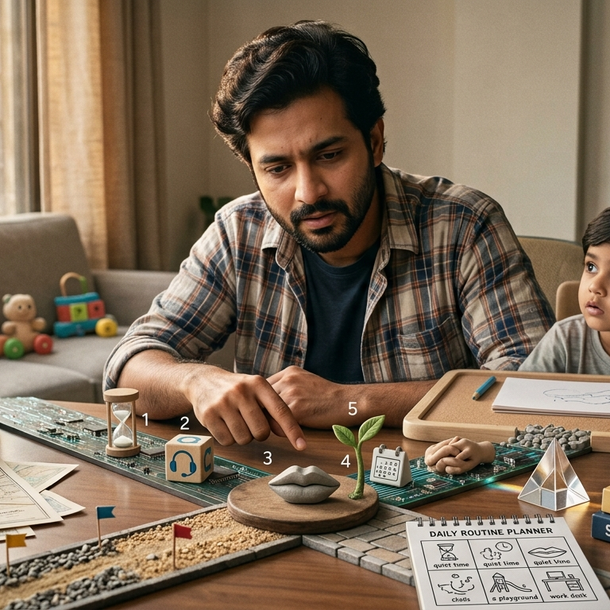

Working from home sounds convenient—until you have a toddler asking for your attention every 10 minutes while your laptop is open beside you. 😅
If you’re searching for hybrid work with toddlers, you’re probably not looking for another unrealistic “wake up at 5 AM, exercise, work for 8 hours and become a super-parent” routine.
You need something that works in real homes, with real children.
And with children between 0 and 5 years, the biggest mindset shift is this:
Your child is not a distraction from your work. Your child is part of the environment you need to plan around.
The goal isn’t to keep your toddler quiet all day. The goal is to create a flexible rhythm where work, childcare, meals, play and rest have their own windows.
Children aged 0–5 don’t understand the concept of an “important Zoom meeting.”
To them, your laptop doesn’t mean “Mom/Dad is working.”
It often means:
“Mom/Dad is sitting there, so I can go and talk to them.” ❤️
Toddlers naturally need:
So instead of expecting a young child to behave like a small adult, parents need to design the workday around the child’s natural rhythm.
With toddlers, flexibility matters more than a perfect timetable.
Instead of saying:
9:00–10:00 = Deep Work
try thinking in terms of:
High-focus work → Child connection → Independent play → Snack → Work → Nap/rest
Your schedule should have anchors, not rigid rules.
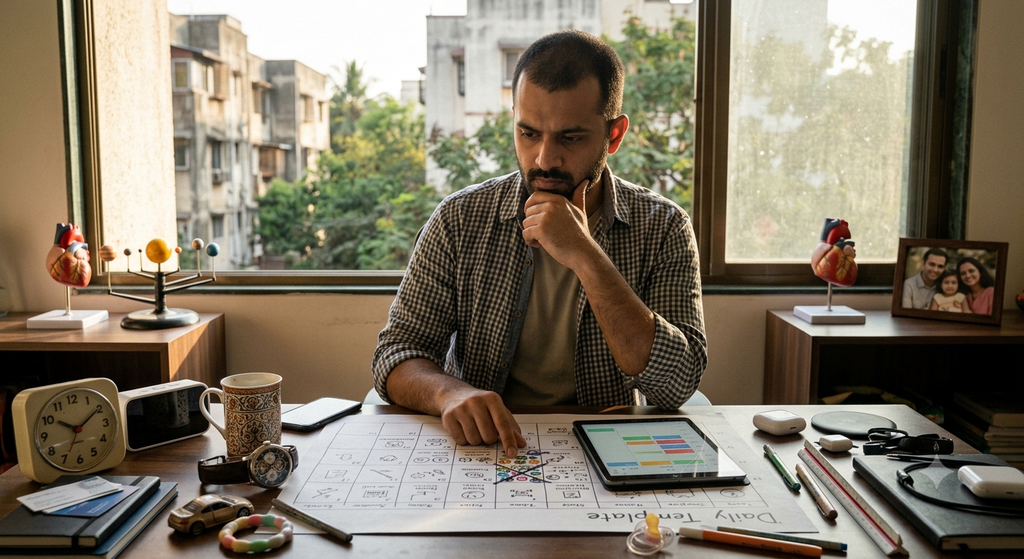
Here’s a practical example for parents working from home with children aged 0–5.
Don’t immediately start working after waking up.
Use this time for:
A few minutes of undivided attention can sometimes make the transition to independent play much easier.
This is your opportunity for the day’s most important work.
If another caregiver is available, this is an ideal time to take advantage of that support.
If you’re alone with your child, prepare a small “work-time activity basket.”
For example:
🧩 Puzzles
📚 Picture books
🖍️ Drawing materials
🧱 Building blocks
🧸 Pretend-play toys
Rotate activities instead of putting everything out at once.
Take a proper break.
Give your child your attention instead of trying to answer emails while feeding them.
Play together, talk, walk around the house or simply sit with them.
This isn’t “lost work time.”
It is part of your parenting day.
Use this window for tasks that don’t require your deepest concentration.
Good options include:
Save demanding work for your stronger focus windows whenever possible.
For younger children, this may be nap time.
For children who no longer nap, introduce quiet time.
The purpose isn’t necessarily sleep.
It could simply mean:
📖 Looking at books
🧸 Quiet play
🎧 Listening to stories
🧩 Simple activities
If your child sleeps, use part of this period for your highest-priority work.
Energy levels often change during the afternoon.
Don’t fight it.
Use a combination of:
For toddlers, movement is important.
A child who has been physically active may find it easier to settle into quieter activities afterwards.
This is where many remote-working parents struggle.
The laptop is technically closed—but work continues mentally.
Try creating a clear work shutdown ritual.
For example:
✔️ Close laptop
✔️ Write tomorrow’s top 3 tasks
✔️ Put work materials away
✔️ Switch into family mode
Children benefit from predictable routines, and parents do too.
This is probably the biggest fear for parents working with toddlers.
Here’s the practical approach:
Tell your child simply:
“I have a meeting. I’ll come back when this timer rings.”
For very young children, words alone may not work. Use a visual cue such as a timer or a simple “work card.”
Have a prepared activity nearby.
Don’t panic.
You are not the first parent whose toddler has appeared on a professional video call. 😄
If possible, mute yourself, acknowledge your child briefly and return to the meeting.
The objective isn’t perfection.
It’s having a system that reduces unnecessary chaos.
This is particularly important.
Two children of the same age can have completely different:
One child may happily play independently for 20 minutes.
Another may need frequent interaction.
That’s normal.
Instead of asking:
“Why doesn’t my child behave like other children?”
ask:
“What kind of environment helps MY child cooperate and thrive?”
This is where understanding your child’s individual nature becomes extremely valuable.

Parents often focus on what their child is doing.
A better question is:
“Why might my child be behaving this way?”
Understanding a child’s individual strengths, preferences, learning tendencies and behavioural patterns can help parents make better everyday decisions.
This is one reason some parents explore assessments such as DMIT as part of a broader parenting and child-development consultation.
However, DMIT should be treated as a guidance tool—not a diagnosis or a guaranteed predictor of a child’s future.
The most useful approach combines assessment insights with:

A few minutes of genuine attention can be more useful than repeatedly saying:
“Don’t disturb me.”
Don’t wait until a meeting starts to search for something your child can do.
Use your child’s nap, quiet time or available caregiver support strategically.
Some days will work beautifully.
Other days won’t.
That’s parenting.
Your child’s temperament isn’t necessarily the same as your friend’s child or your neighbour’s child.
Find what works for your child.
When working from home with young children, remember:
Connection → Predictability → Independent Activity → Focused Work → Break → Repeat
You don’t need a perfect schedule.
You need a flexible system that respects both your child’s needs and your professional responsibilities.
If you repeatedly find yourself thinking:
…it may be worth getting a professional perspective.
Sometimes the solution isn’t another parenting hack.
It’s understanding the child in front of you.
There is no instruction manual that comes with parenthood.
And there certainly isn’t one routine that works for every child.
At SH Development Academy, we help parents understand their child’s individual strengths, behavioural tendencies, learning preferences and developmental needs through personalised DMIT Consultation & Parent Guidance.
The consultation is guided by Santosh Hariharan — DMIT Consultant, Parent & Career Coach, and Success Mindset Coach for Students.
If you’re wondering “What approach will work better for MY child?”, let’s understand your child first—and then build the right guidance around them.
📞 +91 8421315400 | +91 7303290862
⭐ 400+ parents and families have trusted our guidance.
Because better parenting doesn’t mean becoming a perfect parent.
It means understanding your child a little better every day. ❤️
Success & Happiness are the two most important yet elusive things which every human being yearns to achieve in life. Real success and happiness can be savoured only when one enjoys good health and good family relations, along with a good professional career and sound financial stability.
Our Visitor


 Users Today : 0