
Thinking about changing your career? Don’t resign yet. Test it first.
This may sound obvious, but it is one of the biggest mistakes I see people make when they are unhappy with their current career.
They think:
“I don’t enjoy my current work anymore, so maybe I should do something completely different.”
Then they start watching YouTube videos, reading career-change posts, talking to friends—and suddenly a new career looks exciting.
Digital marketing.
Counselling.
Data analytics.
Teaching.
UX design.
Entrepreneurship.
AI.
Content creation.
Everything looks attractive from the outside.
But here is the uncomfortable question:
How do you know you will actually enjoy doing that work every day?
That is where the 30-Day Career Test can help.
Instead of making a major career decision based only on imagination, take 30 days to experience the work through small, practical projects.

Testing a career doesn’t mean taking another degree or spending ₹1–2 lakh on a course immediately.
It means creating a small experiment that allows you to experience the real activities involved in that career.
For example, suppose you are considering becoming a digital marketer.
Don’t simply ask:
“Do I like digital marketing?”
Ask:
That’s a much better test.
You are not testing the job title. You are testing the work.
A career decision can affect your income, lifestyle, family responsibilities and long-term growth.
So why make that decision based on one feeling?
A 30-day experiment gives you an opportunity to collect evidence.
During those 30 days, you can discover:
✅ Whether you actually enjoy the work
✅ Whether you have an aptitude for it
✅ Whether you are willing to learn the required skills
✅ Whether the day-to-day work matches your expectations
✅ What difficulties you face
✅ Whether you want to explore it further
And perhaps most importantly:
You may discover that you don’t want the career—and that’s also a successful outcome.
Finding out before resigning is much better than finding out six months after switching.
You don’t need a complicated system.
Think of your experiment in four stages:
Explore → Experience → Evaluate → Decide
Let’s break it down.
Before doing anything, research what people in that profession actually do.
Don’t just search:
“Is digital marketing a good career?”
Search:
“What does a digital marketing manager do every day?”
Look for:
Better still, speak to one or two people already working in that field.
Ask them:
“What is the part of your job that people outside the industry usually don’t understand?”
That question can reveal a lot.
Now comes the most important part.
Do the work.
Don’t spend another week watching career videos.
Create a small project related to the career you are considering.
Write five useful articles or create a small content calendar.
Take a publicly available dataset and create a simple analysis or dashboard.
Prepare and deliver a short lesson to someone.
Create five designs around a fictional brand.
Research the field, understand ethical requirements and speak with an experienced professional before attempting any client-facing work.
Try selling a small service or product rather than only planning a business.
The objective isn’t to become an expert in 30 days.
The objective is to experience the work.
Now make the project slightly more realistic.
The first week may feel exciting because everything is new.
The second challenge tells you much more.
Ask yourself:
“Do I still want to do this when the work becomes repetitive, difficult or frustrating?”
For example, if you’re exploring content creation, don’t just make one Instagram post.
Create content consistently for a week.
If you’re exploring coding, don’t stop after completing a tutorial.
Try solving a small problem independently.
If you’re exploring sales, don’t just watch sales training videos.
Try having real conversations and handling objections.
Interest is easy to feel. Commitment is harder to fake.
At the end of the experiment, don’t simply ask:
“Did I enjoy it?”
Use a more structured scorecard.
Give yourself a score from 1–10 for:
| Question | Score |
|---|---|
| Did I enjoy doing the actual work? | /10 |
| Did I naturally want to learn more? | /10 |
| Did I have some aptitude for it? | /10 |
| Was I willing to practise when it became difficult? | /10 |
| Can I imagine doing this regularly? | /10 |
| Does this career fit my lifestyle? | /10 |
| Does it align with my strengths? | /10 |
| Does the career offer realistic opportunities? | /10 |
Then look at the pattern—not just one score.
This is where many career decisions go wrong.
You may love the idea of being a photographer.
But do you enjoy:
You may love the idea of entrepreneurship.
But do you enjoy:
A career is not its Instagram image.
A career is the work you repeatedly do.
This is a common concern, especially for working professionals.
You don’t need to spend eight hours a day on your experiment.
Even 30–60 minutes a day can give you useful information if you use that time intentionally.
For example:
Monday: Research one real-world problem
Tuesday: Learn the basic skill
Wednesday: Work on your micro-project
Thursday: Speak to someone in the profession
Friday: Improve your project
Saturday: Complete a practical task
Sunday: Reflect and record what you learned
Repeat the process for four weeks.
The goal is consistency, not perfection.
This distinction is extremely important.
During your first few attempts, you may struggle.
That doesn’t automatically mean the career is wrong for you.
Ask yourself:
“If I became better at this, would I enjoy doing it?”
Sometimes the problem is lack of skill—not lack of interest.
On the other hand, if you are becoming reasonably competent but still dislike the actual work, that’s valuable information too.
Salary matters.
But don’t make it the only factor.
Before switching, consider four things:
Do you genuinely want to do the work?
Do your natural abilities support this type of work?
Are there realistic opportunities in the market?
Does the career fit the kind of life you want?
A career that pays well but makes you miserable may not be a good long-term decision.
Likewise, loving a career without considering financial reality can create problems later.
Good career decisions balance both purpose and practicality.
Not necessarily.
The 30-day test is designed to help you make a better decision, not force you to resign.
If the results are positive, your next step could be:
In some cases, you may be able to transition gradually instead of making a sudden jump.

This is where self-assessment can help.
Before experimenting with careers, understand yourself better.
Consider:
A professional psychometric assessment can provide an additional perspective and help narrow down career options worth exploring.
It doesn’t make the career decision for you.
Instead, it can help you ask better questions.
The same principle applies to students.
If you’re in 9th, 10th, 11th or 12th standard and thinking:
“Should I choose engineering, medicine, commerce, design, law, management or something else?”
Don’t rely only on what friends are choosing.
Start exploring.
Try:
The earlier you explore, the less pressure you may feel when the actual career decision arrives.

You don’t need to have your entire future figured out today.
You simply need to reduce uncertainty one step at a time.
Instead of asking:
“Should I change my career?”
Ask:
“What small experiment can I run this month to find out whether this career is actually right for me?”
That’s a much more powerful question.
After years of working with students, parents and individuals around career decisions, I’ve learned one important thing:
People often choose careers based on what a profession looks like—not what it feels like to actually do the work.
Before you make a major career switch, give yourself 30 days.
Explore the field.
Talk to people.
Do the work.
Build something.
Struggle a little.
Then evaluate.
You may discover that your original career idea was exactly right.
Or you may discover that it wasn’t.
Either way, you have gained something valuable: clarity.
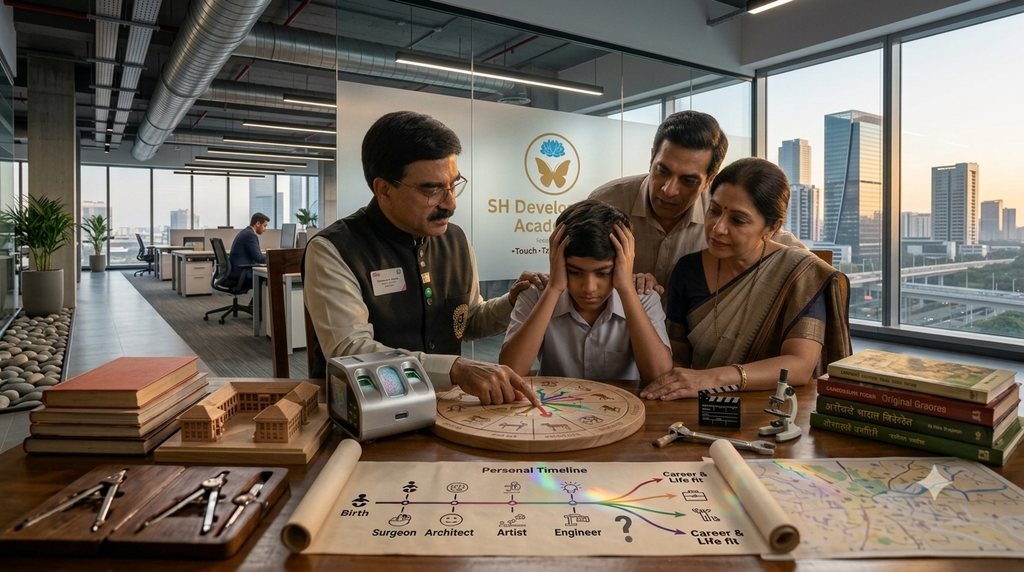
Sometimes the problem isn’t simply “Which career should I choose?”
The deeper question is:
“What kind of work actually fits my strengths, aptitude, personality and interests?”
At SH Development Academy, we help students and career seekers get greater clarity through professional career guidance and psychometric assessment.
Your assessment can be followed by a personalized Career Guidance Consultation with Santosh Hariharan, DMIT Consultant, Parent & Career Coach and Success Mindset Coach for Students.
The goal isn’t to tell you:
“This is the career you MUST choose.”
The goal is to help you understand yourself better, identify realistic career directions, and make a more informed decision.
Book Your Career / DMIT Consultation
📞 +91 8421315400 | +91 7303290862
⭐ 400+ parents and clients have trusted our guidance.
See 400+ Google Reviews
Don’t make a permanent career decision based on a temporary feeling. Test it first.
Success & Happiness are the two most important yet elusive things which every human being yearns to achieve in life. Real success and happiness can be savoured only when one enjoys good health and good family relations, along with a good professional career and sound financial stability.
Our Visitor


 Users Today : 24