
Imagine two professionals working in the same industry.
One has spent 10 years mastering a particular job, software, and process. The other has spent those same 10 years developing problem-solving abilities, communication, adaptability, creativity, and the habit of continuously learning new things.
Now imagine their industry undergoes a major technological change. Artificial Intelligence (AI) starts automating several tasks they perform every day.
Who is more likely to adapt?
The answer isn’t necessarily the person with more experience. It could be the person who has developed skills that can be applied across different roles, industries, and situations.
This is exactly why future-proof skills have become so important in 2026.
We are living in a time when job roles are changing, AI tools are becoming part of everyday work, businesses are restructuring, and entirely new career opportunities are emerging.
A qualification or a particular job title may help you enter an industry, but your ability to learn, think, communicate, solve problems, and adapt will influence how well you grow within it.
According to the World Economic Forum’s Future of Jobs Report 2025, employers expect approximately 39% of workers’ existing skill sets to be transformed or become outdated between 2025 and 2030. The report also identifies analytical thinking, resilience, flexibility, leadership, creative thinking, and technological literacy among the important skills required in today’s workforce.
So, what should students, graduates, working professionals, and parents focus on developing?
Let’s explore the 12 future-proof skills that can help you remain relevant, employable, and adaptable regardless of how the job market changes.

Future-proof skills are abilities that help individuals remain adaptable and effective as industries, technologies, job responsibilities, and workplace expectations evolve.
These skills are not limited to one particular profession.
For example, communication is useful whether you become a doctor, engineer, entrepreneur, teacher, HR professional, or business consultant.
Similarly, critical thinking helps you make better decisions whether you are managing a business, analysing financial information, solving technical problems, or choosing your career path.
Future-proof skills generally combine three important areas:
1. Human Skills: Communication, empathy, emotional intelligence, leadership, and collaboration.
2. Cognitive Skills: Critical thinking, creativity, analytical reasoning, and problem-solving.
3. Digital and Adaptive Skills: Technological literacy, data interpretation, AI awareness, and continuous learning.
The objective isn’t to master every new technology or become an expert in everything.
It is to develop abilities that help you learn new things, work with different people, and handle unfamiliar situations confidently.
Let’s be honest. The job market your children will enter may look very different from the one their parents entered.
Earlier, having a professional degree, technical qualification, and a few years of experience could provide a relatively predictable career path.
Today, the situation is more dynamic.
AI can assist with writing, research, data analysis, customer support, coding, and several administrative activities. Automation is changing how businesses operate. Employers increasingly expect professionals to work with digital tools rather than simply perform repetitive tasks manually.
But this doesn’t mean human skills are becoming irrelevant.
In fact, the ability to think independently, understand people, make decisions, communicate effectively, and use technology responsibly is becoming increasingly important.
The World Economic Forum’s Future of Jobs Report 2025 surveyed more than 1,000 employers representing over 14 million workers across 55 economies.
Some important findings include:
The report also identifies AI and big data, technological literacy, cybersecurity, creative thinking, and adaptability among the skills expected to grow in importance towards 2030.
These numbers tell us something important:
The future belongs neither exclusively to technology experts nor exclusively to people with traditional human skills. It belongs to individuals who can combine both.
For Indian students and working professionals, this means developing technical knowledge alongside communication, independent thinking, adaptability, and practical problem-solving.
Source: World Economic Forum, Future of Jobs Report 2025.
Let’s break down these 12 abilities, understand why they matter, and explore how you can start developing each one.

We live in an information-heavy world.
Every day, we come across thousands of opinions, social media posts, advertisements, news updates, AI-generated answers, and online recommendations.
But how many of us actually stop and question the information before accepting it?
Critical thinking is the ability to examine information objectively, question assumptions, evaluate evidence, and arrive at logical conclusions.
It means not believing something simply because everyone else believes it.
Imagine a student choosing an engineering course because all their friends are doing engineering.
Or a working professional investing in an expensive certification because someone on LinkedIn claims it guarantees a high-paying job.
Both decisions may be influenced by social pressure rather than proper evaluation.
Critical thinking helps individuals ask:
De-biasing is another important part of this ability. It involves recognising common thinking errors, such as confirmation bias, where we favour information that supports what we already believe.
Remember: A person who can think independently will always have an advantage over someone who simply follows instructions without understanding them.

Not every problem comes with a textbook solution.
In school, students are often given questions with specific methods and expected answers.
But real professional life is different.
You may face a customer complaint, a business challenge, a technical failure, a project delay, or a situation where multiple people have conflicting expectations.
Complex problem-solving is the ability to understand such situations, identify their underlying causes, evaluate possible solutions, and take appropriate action.
Consider a simple example.
A company is losing customers.
An inexperienced approach might be to immediately increase advertising expenditure.
But someone with strong problem-solving abilities will first investigate:
Instead of treating the visible symptom, they investigate the actual problem.
This ability is useful in almost every profession, from healthcare and engineering to entrepreneurship, education, and management.

One of the biggest mistakes people make is looking at problems in isolation.
Systems thinking means understanding how different elements interact and influence one another.
Let’s understand this through an example.
Suppose a student is consistently performing poorly in examinations.
A parent might immediately assume that the child isn’t studying enough.
But what if the actual situation involves several interconnected factors?
Improving only one area may not solve the entire problem.
A systems thinker tries to understand the complete picture.
Businesses, technology, healthcare, education, and financial systems are interconnected.
Professionals who understand these connections can often identify problems earlier, make better decisions, and anticipate unintended consequences.
For example, a business leader needs to understand how marketing decisions affect sales, customer experience, employee workload, and profitability.
The ability to see the bigger picture is what separates someone who simply completes tasks from someone who understands how things work.

Many people believe creativity belongs only to artists, designers, writers, or musicians.
That’s not true.
Creativity is equally important in business, science, technology, education, marketing, and everyday problem-solving.
It is the ability to generate original ideas, explore different possibilities, and connect existing knowledge in new ways.
Synthesis takes this a step further.
It means combining information, ideas, and experiences from different areas to create something meaningful.
Imagine a marketing professional struggling to generate leads for a client.
Instead of repeating the same advertising strategy, they combine:
The result may be an entirely new marketing approach.
That is creativity combined with synthesis.
In a world where AI can generate thousands of ideas, the ability to identify meaningful opportunities and combine ideas intelligently becomes particularly valuable.

You don’t need to become a data scientist to develop data literacy.
Data literacy simply means being able to read, understand, interpret, and communicate information presented through numbers, charts, reports, and statistics.
Today, almost every industry generates data.
Hospitals track patient information. Schools monitor academic performance. Businesses analyse customer behaviour. Marketing teams measure campaign performance.
But collecting data is not enough.
The real value comes from understanding what it means and using it to make better decisions.
Imagine a marketing executive who reports:
“We generated 500 leads this month.”
That sounds impressive.
But a data-literate professional will ask:
See the difference?
One person reports numbers. The other uses numbers to make decisions.
Data literacy is increasingly useful even in non-technical roles.

Technology is changing faster than many traditional education systems can update their curriculum.
A tool you learn today may be replaced or significantly upgraded within a few years.
This is why technological adaptability matters more than memorising how to operate one particular software.
It means being comfortable exploring unfamiliar tools, understanding their purpose, learning new digital workflows, and integrating technology into your work.
Consider two employees.
Employee A knows how to use one particular software but struggles whenever the company changes its system.
Employee B understands the underlying workflow and is willing to learn new tools.
Who is more adaptable?
Clearly, Employee B.
The second employee is not necessarily more technically skilled. They simply have a stronger willingness and ability to learn.
In 2026, technological adaptability is no longer limited to IT professionals. It is relevant to teachers, accountants, marketers, business owners, HR professionals, and students.

You can be academically brilliant and technically skilled, but still struggle professionally if you cannot understand or work effectively with people.
This is where emotional intelligence (EQ) becomes important.
Emotional intelligence involves recognising emotions, understanding how they influence behaviour, managing your own emotional responses, and responding appropriately to other people’s feelings.
Empathy means trying to understand another person’s experience or perspective.
Imagine a team leader whose employee has missed an important deadline.
One response is to immediately criticise the employee.
Another is to understand what happened, identify the problem, communicate expectations, and find a constructive solution.
The second approach doesn’t mean avoiding accountability.
It means managing the situation with emotional awareness.
Self-awareness: Understanding your emotions, strengths, limitations, and reactions.
Self-management: Regulating your emotions and responding thoughtfully.
Social awareness: Recognising the feelings and perspectives of others.
Relationship management: Building healthy professional and personal relationships.
Whether you become a manager, entrepreneur, doctor, teacher, or consultant, your ability to understand people will remain valuable.

Having a great idea is one thing.
Making other people understand its value is another.
Persuasive communication is the ability to present ideas clearly, build trust, influence decisions ethically, and explain why something matters.
Storytelling makes communication more memorable by connecting information with relatable situations and experiences.
Imagine two professionals presenting the same business proposal.
The first uses complicated terminology, lengthy explanations, and technical language.
The second explains the problem, presents the solution, shares relevant evidence, and helps the audience understand the expected outcome.
The second professional may be more effective, even if both have similar technical knowledge.
Communication is not just about speaking more. It is about helping others understand what you mean.

Today’s workplace is increasingly connected across geographical and cultural boundaries.
An Indian professional may work with clients in the United States, colleagues in Europe, and vendors in Southeast Asia.
Even within India, professionals regularly interact with people from different languages, regions, backgrounds, and cultural environments.
Cross-cultural competency is the ability to communicate, collaborate, and work respectfully with people whose experiences and perspectives may differ from your own.
Imagine a professional working with an international client.
A communication style that feels normal in one culture may be interpreted differently in another.
Understanding these differences can help prevent misunderstandings and build stronger professional relationships.
This skill is particularly valuable for professionals working in multinational companies, international sales, consulting, technology, and global customer support.

If there is one mindset that can protect your career against changing circumstances, it is the willingness to keep learning.
Think about how technology has changed over the last decade.
Professionals who learned only one specific process may have struggled when their industries changed.
Those who remained curious, explored new tools, and updated their knowledge had more opportunities to adapt.
Continuous learnability is more than attending courses or collecting certificates.
It is the ability to understand how you learn, identify knowledge gaps, and acquire new skills when circumstances demand it.
This is also connected with metacognition, which means thinking about your own thinking and learning processes.
The World Economic Forum estimates that 59 out of every 100 workers will need training by 2030 under the workforce transformation scenarios discussed in its Future of Jobs Report 2025.
This highlights the importance of upskilling and reskilling.
Don’t learn something just because it is trending.
Learn something because it adds value to your capabilities and career direction.

Life rarely follows a perfect plan.
You may fail an examination, miss a promotion, lose a client, face a career setback, or discover that the industry you work in is changing.
What matters is how you respond.
Resilience is the ability to recover, adjust, and continue moving forward after challenges.
Cognitive flexibility is the ability to change your thinking or approach when the situation demands something different.
Imagine a professional whose company introduces AI-powered automation.
Instead of spending all their energy worrying about losing their existing responsibilities, they begin learning how AI works and explore how their experience can be applied to higher-value tasks.
That is an example of adaptability combined with resilience.
Resilience does not mean ignoring stress or pretending everything is fine.
It means recognising difficulties, seeking support when needed, and developing healthier ways to navigate them.

Many people believe leadership begins only after receiving a promotion.
But leadership is not always connected to a designation.
Micro-leadership means taking initiative, helping others, influencing positive action, and accepting responsibility even when you do not have formal authority.
Imagine a junior employee notices that their team repeatedly faces delays because information is not being shared properly.
Instead of waiting for the manager to solve the issue, the employee suggests a simple tracking system, coordinates with colleagues, and helps improve the workflow.
That is leadership in action.
Modern workplaces increasingly depend on collaboration.
Projects often involve people from different departments, locations, and professional backgrounds.
Individuals who can coordinate, influence, motivate, and take ownership become valuable contributors.
You don’t need a manager’s designation to demonstrate leadership.
Start with the responsibilities you already have.
Now comes the most important part.
Reading about these skills is useful, but understanding your current strengths is even more valuable.
Use this checklist to reflect on your development.
| No. | Future-Proof Skill | Self-Assessment Question |
|---|---|---|
| 1 | Critical Thinking | Do I question information and evaluate evidence before making decisions? |
| 2 | Complex Problem-Solving | Can I solve unfamiliar problems without depending entirely on others? |
| 3 | Systems Thinking | Can I understand how different factors influence one another? |
| 4 | Creativity & Synthesis | Can I connect different ideas to develop new solutions? |
| 5 | Data Literacy | Can I understand numbers, reports, and basic data insights? |
| 6 | Technological Adaptability | Am I comfortable learning and using new technologies? |
| 7 | Emotional Intelligence | Can I understand and manage my emotions effectively? |
| 8 | Persuasive Communication | Can I explain my ideas clearly and influence others ethically? |
| 9 | Cross-Cultural Competency | Can I work respectfully with people from different backgrounds? |
| 10 | Continuous Learnability | Do I regularly update my knowledge and skills? |
| 11 | Resilience & Flexibility | Can I adjust my approach when situations change? |
| 12 | Micro-Leadership | Do I take initiative even without formal authority? |
For every skill, give yourself a rating:
Don’t treat this as a scientific assessment or a competition.
The purpose is to identify areas where you feel confident and areas that deserve more attention.
Your lowest-rated skills are not weaknesses to be ashamed of. They are opportunities for growth.
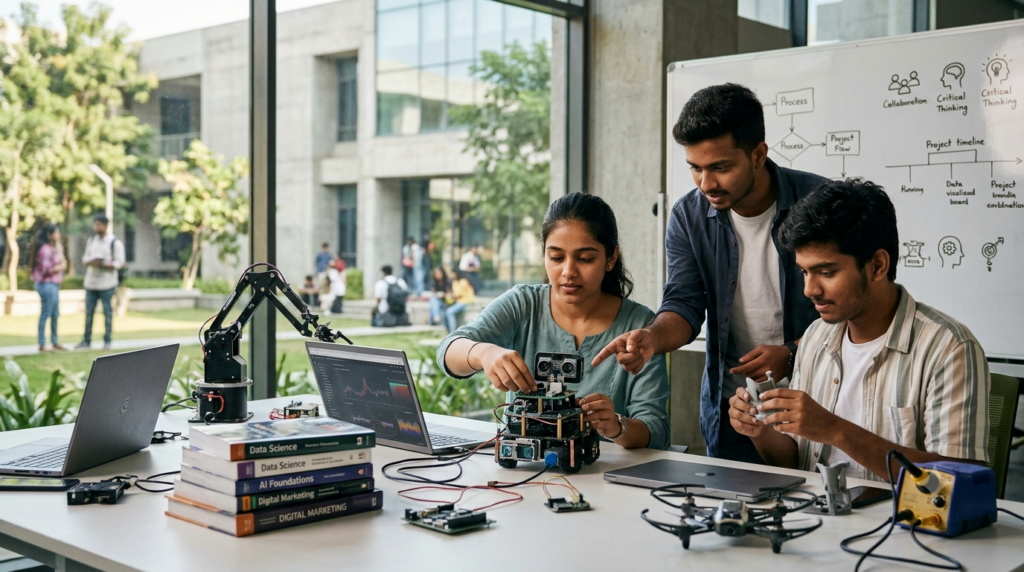
One mistake we often make as parents and educators is waiting until a child enters college or starts looking for a job before discussing employability skills.
But these abilities can be developed much earlier.
A student doesn’t need a corporate job to learn communication, leadership, critical thinking, or problem-solving.
These skills can grow through everyday activities.
Team projects, sports, competitions, and classroom activities help students understand collaboration and responsibility.
Instead of making every decision for them, encourage children to evaluate options and understand consequences.
Reading, writing, storytelling, discussions, and presentations help children express their thoughts more effectively.
When a child asks questions, don’t always rush to provide answers.
Encourage them to explore, investigate, and think independently.
Children should learn how technology works and how to use digital tools productively rather than consuming content passively.
Not every competition needs to be won. Not every examination needs a perfect score.
Help children understand that mistakes can provide valuable learning experiences.
A child who enjoys building things may benefit from practical projects. A child who enjoys storytelling may benefit from writing or speaking activities.
Different interests create different opportunities to practise valuable abilities.
The objective is not to turn every child into a future CEO or technology expert.
It is to help them become confident individuals who can think, learn, communicate, and adapt.
If you are already working, you don’t need to resign from your job or start another degree to begin developing future-proof skills.
You can start with your existing responsibilities.
Here is a practical approach:
Step 1: Evaluate your current role.
Identify which tasks are repetitive and which require independent thinking, communication, decision-making, and problem-solving.
Step 2: Identify changing industry requirements.
Study job descriptions, industry reports, and emerging technologies relevant to your profession.
Step 3: Choose two skills to develop.
Avoid trying to master all 12 abilities simultaneously.
For example, a marketing professional might prioritise data literacy and AI adaptability.
A manager might focus on emotional intelligence and systems thinking.
Step 4: Practise in real situations.
Use your current projects as opportunities to develop new capabilities.
Step 5: Build evidence of your skills.
Document projects, achievements, measurable results, and examples that demonstrate your abilities.
Step 6: Review your progress every three months.
Ask yourself whether your skills are becoming more relevant to your future career goals.
Remember, future-proofing your career is an ongoing process, not a one-time activity.
This is one of the biggest questions professionals and students are asking in 2026.
Will AI replace human workers?
Will technical degrees lose their value?
Will communication and creativity become more important?
The reality is more nuanced.
AI is changing tasks within jobs rather than simply eliminating every profession that involves technology or information processing.
Some repetitive activities can be automated, while other responsibilities are evolving to include AI-assisted workflows.
For example:
| Traditional Work Activity | How Work Is Evolving | Valuable Human Ability |
|---|---|---|
| Basic report preparation | AI-assisted reporting | Data interpretation |
| Routine customer responses | AI-supported customer service | Empathy and complex communication |
| Basic content drafting | AI-assisted content creation | Creativity and storytelling |
| Repetitive data processing | Automated data workflows | Critical thinking |
| Routine project tracking | AI-powered project tools | Leadership and decision-making |
| Basic research | AI-assisted information gathering | Evaluation and judgement |
This doesn’t mean human abilities are impossible to automate or that every job is safe.
It means professionals should learn how to combine their expertise with technology.
The International Labour Organization’s 2026 report, Changing Landscape of Skills in the Age of AI, also highlights increasing demand for cognitive, socio-emotional, digital, and AI-related skills.
The important lesson is simple:
Don’t compete with technology only on speed. Develop the judgement, creativity, empathy, and problem-solving abilities that help you use technology intelligently.
You may be wondering: Out of these 12 abilities, where should I start?
The answer depends on your age, interests, existing strengths, career goals, and the industry you want to enter.
However, a practical starting point could look like this:
| If You Are… | Skills Worth Prioritising |
|---|---|
| A school student | Critical thinking, communication, creativity, curiosity |
| A college student | Problem-solving, technological adaptability, teamwork, continuous learning |
| A fresher | Communication, data literacy, adaptability, initiative |
| A working professional | AI literacy, systems thinking, resilience, problem-solving |
| A team leader | Emotional intelligence, leadership, communication, decision-making |
| An entrepreneur | Creativity, data literacy, systems thinking, adaptability |
These are starting suggestions, not fixed rules.
For example, a student interested in technology may need to develop communication and emotional intelligence just as much as technical knowledge.
Similarly, a working professional with excellent communication skills may benefit from strengthening data literacy and technological adaptability.
The best skill-development plan is one that addresses your actual requirements rather than blindly following popular career trends.

Here is something I would like every parent, student, and working professional to understand.
You cannot create an effective development plan without first understanding where you currently stand.
Many students select courses because their friends have selected them.
Many graduates apply for jobs because a particular industry is trending.
Many working professionals change careers because they are dissatisfied with their current position.
But how often do we pause to understand our own strengths, interests, abilities, and areas that need improvement?
Career planning should not begin with the question:
“What is the highest-paying career available?”
It should begin with:
“What am I good at, what interests me, what skills do I need to develop, and where can I apply them meaningfully?”
This is where structured career guidance and self-assessment can be helpful.
Understanding your interests, aptitude, existing competencies, personality-related preferences, and career expectations can help you make more informed decisions.
It is equally important to remember that no single assessment can determine your entire future. Career decisions should consider multiple factors, including individual interests, demonstrated abilities, educational qualifications, practical experience, and changing industry requirements.
The world of work will continue changing.
New technologies will emerge. Some job roles will disappear, others will evolve, and entirely new opportunities will develop.
You cannot control every change in the job market.
But you can control how willing you are to learn, adapt, improve, and prepare yourself.
Whether you are a student choosing your first career, a graduate entering the workforce, or a professional considering a career change, remember these 12 abilities:
You don’t need to become an expert in all 12 tomorrow.
Start by identifying your existing strengths, choosing the abilities most relevant to your goals, and practising them consistently.
Because ultimately, your job title may change, your industry may evolve, and technology may transform your workplace—but your ability to learn and grow can help you navigate those changes.

Sometimes, the biggest challenge isn’t a lack of opportunities.
It’s a lack of clarity.
You may have multiple interests, different abilities, and several career options in front of you—but still feel confused about which direction to take.
At SH Development Academy, we believe meaningful career decisions begin with understanding the individual.
Under the guidance of Santosh Hariharan – DMIT Consultant, Parent & Career Coach, and Success Mindset Coach for Students, we help parents, students, and individuals explore their strengths, interests, aptitude, and career possibilities through structured assessment and personalised career guidance.
Our objective is not to tell you which career you must choose. It is to help you understand yourself better, explore suitable possibilities, and make more informed decisions about your future.
If you are a student trying to identify your strengths, a parent looking for the right direction for your child, or a professional exploring your next career move, let’s have a conversation.
Explore our DMIT and career guidance services:
Learn More About SH Development Academy
📞 Call / WhatsApp:
+91 8421315400
+91 7303290862
⭐ 400+ Google Reviews – Explore What Parents and Individuals Say About Us
Click Here to Read Our Google Reviews
Your future is not decided by the job market alone. It is also shaped by the skills you choose to develop today.
Start building those skills today. Your future self will thank you.
Success & Happiness are the two most important yet elusive things which every human being yearns to achieve in life. Real success and happiness can be savoured only when one enjoys good health and good family relations, along with a good professional career and sound financial stability.
Our Visitor


 Users Today : 6