

Imagine this.
You have completed your education, attended multiple interviews, finally received your offer letter, and your first salary is about to hit your bank account.
₹20,000. ₹30,000. ₹45,000. Or perhaps even more.
For the first time, you have money that you have earned yourself. You can buy that phone you’ve been planning for, order food without asking anyone, shop during sales, subscribe to OTT platforms, or finally start contributing towards your family’s expenses.
It feels exciting, doesn’t it? 😊
But here’s something nobody tells you during college placements:
Getting your first salary is one achievement. Knowing how to manage it is an entirely different skill.
Many young professionals spend their first salary without a clear plan. A few months later, they wonder where all the money went. Credit card bills start accumulating, EMIs become regular expenses, UPI transactions happen almost unconsciously, and saving becomes something they promise to start “from next month.”
The problem isn’t necessarily that they earn too little.
Often, they have never been taught the basics of managing money.
Whether you’re a fresh graduate in Pune, an IT professional starting your career in Hinjewadi, a management trainee in Mumbai, or someone beginning their first job in Bengaluru, understanding a few money basics before your first salary can make a significant difference to your financial future.
In this guide, we’ll cover three essential areas:
Let’s start with the basics.

Think about your education.
You may have spent years learning Mathematics, Science, Commerce, Communication, or Computer Programming. You may have completed professional courses, attended interviews, and developed skills to become employable.
But how many times has someone actually taught you:
These are practical life skills, yet many young adults begin their careers without understanding them.
Your first salary is not just an opportunity to spend. It is an opportunity to develop financial habits that can support you for years.
And remember, financial discipline is not about becoming miserly. It is about having control over your money instead of allowing your money to control you.

Let’s begin with the most important money habit: budgeting.
A budget is simply a plan for how you will use the money you earn.
It helps you understand:
Without a budget, spending decisions happen randomly.
You receive your salary, pay a few bills, order food, shop online, travel with friends, and suddenly realise that the month is almost over.
A budget gives you a direction before that happens.
One simple budgeting framework beginners can explore is the 50-30-20 rule.
It divides your monthly income into three broad categories:
50% – Needs
Essential expenses that you cannot easily avoid.
Examples:
30% – Wants
Expenses that improve your lifestyle but are not essential.
Examples:
20% – Savings and Financial Goals
Money you keep aside for your future.
Examples:
The 50-30-20 rule is a starting framework, not a compulsory formula. If you’re living independently in Pune or supporting your family, your essential expenses may take up more than 50%.
Adjust the percentages according to your actual situation.
Let’s understand this with a practical example.
Suppose your monthly take-home salary is ₹30,000.
| Category | Allocation | Amount |
|---|---|---|
| Essential expenses | 50% | ₹15,000 |
| Lifestyle and personal spending | 30% | ₹9,000 |
| Savings and financial goals | 20% | ₹6,000 |
| Total | 100% | ₹30,000 |
Now, let’s break it down further.
Essential expenses – ₹15,000
Lifestyle expenses – ₹9,000
Savings – ₹6,000
These are illustrative figures, not recommended spending limits. Your actual expenses will depend on your city, accommodation, family responsibilities, and financial commitments.
The important lesson is that you should decide how to use your salary rather than wondering where it disappeared.
Here’s a situation many first-time earners don’t think about.
You have just started your job, and everything is going smoothly. Suddenly:
Where will the money come from?
This is exactly why an emergency fund matters.
An emergency fund is money kept aside specifically for unexpected expenses.
A reasonable long-term target is approximately 3–6 months of essential living expenses, depending on your responsibilities and income stability.
But don’t feel pressured to build the entire amount immediately.
Start with your first ₹5,000. Then ₹10,000. Gradually work towards a larger safety cushion.
Keep emergency money accessible and separate from your regular spending account.
Remember: Savings give you choices. Emergency savings give you breathing space when life doesn’t go according to plan.
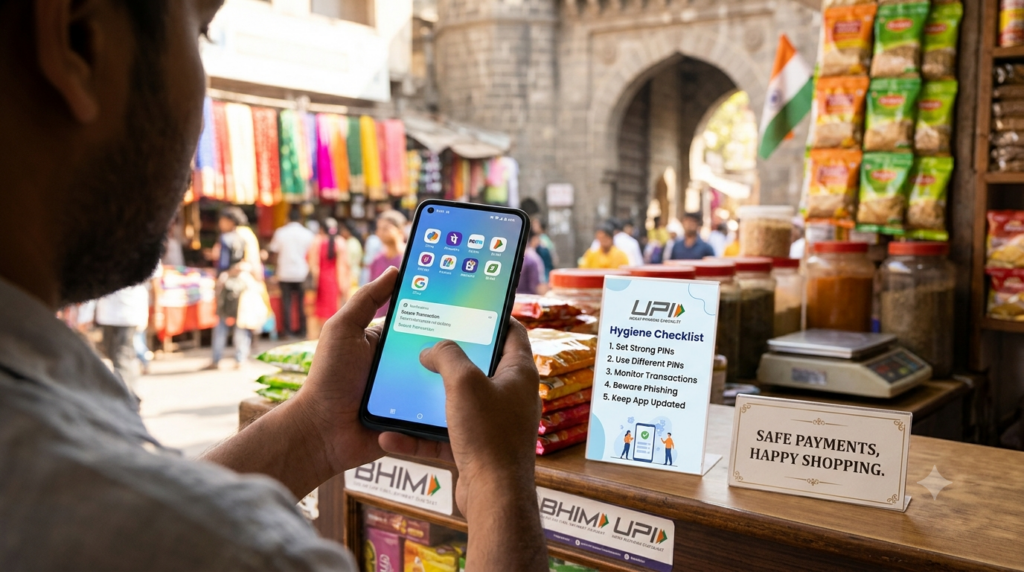
India has made digital payments incredibly convenient.
Whether you’re buying groceries, paying for a cab, splitting a restaurant bill, or sending money to a friend, UPI has become part of everyday life.
You probably use applications such as Google Pay, PhonePe, Paytm, or BHIM.
But convenience can sometimes make people careless.
When sending money takes just a few seconds, we often stop checking where that money is going.
That’s why understanding UPI hygiene is an essential part of money basics before your first salary.
UPI hygiene refers to the safe habits and precautions you should follow while using Unified Payments Interface (UPI) for digital transactions.
UPI was developed by the National Payments Corporation of India (NPCI) and enables instant money transfers between bank accounts.
However, safe usage depends on how carefully you handle your payment credentials and verify transactions.
Your UPI PIN is confidential.
Never share it with:
Your bank will never need your UPI PIN to credit money into your account.
This is one of the most important things to remember.
Imagine someone tells you:
“Your refund is ready. Scan this QR code and enter your UPI PIN to receive the amount.”
Stop immediately.
Entering your UPI PIN generally authorises a payment from your account. You do not need to enter it simply to receive money.
Always check the direction of the transaction.
Are you paying someone, or are you actually receiving money?
Before completing a transaction:
Never assume that a QR code is genuine just because someone sent it to you.
You may receive messages such as:
Fraudsters often use urgency and fear to make people click suspicious links.
Never enter your banking credentials or OTP on unknown websites.
Someone may call pretending to be a bank employee and ask you to download an application to resolve a payment issue.
Be extremely cautious.
Remote-access or screen-sharing applications can expose sensitive information on your device.
Never give an unknown person access to your phone while using banking applications.
Keep SMS or app notifications enabled for your bank account.
Regularly review your transactions.
If you notice an unauthorised transaction, contact your bank immediately and report the incident through the appropriate official channels.
In India, financial cyber fraud can also be reported through the National Cyber Crime Helpline 1930.
This is a useful habit for people who make frequent digital payments.
You can maintain:
Transfer a planned amount to your spending account at the beginning of the month.
This creates an additional layer of budgeting discipline and helps you monitor your everyday expenses.
UPI is a payment tool, not a spending plan. Use it conveniently, but never stop paying attention to your money.

Let’s talk about something that attracts almost every first-time earner.
EMIs.
You start earning, and suddenly the things you previously couldn’t afford seem affordable.
A smartphone for ₹60,000.
A laptop for ₹80,000.
A motorcycle for ₹1.5 lakh.
A premium smartwatch.
A new television for your parents.
And the salesperson says:
“Sir, don’t worry. Just ₹2,499 per month!”
Sounds manageable, right?
But here’s the question:
Can you afford the product, or can you only afford the monthly EMI?
There is a big difference.
EMI stands for Equated Monthly Instalment.
It is a fixed periodic payment made towards repaying a loan. An EMI generally includes two components:
Your monthly EMI depends on factors such as:
The longer the repayment period, the more interest you may end up paying, depending on the loan terms.
Suppose you want to purchase a smartphone costing ₹60,000.
You choose a 12-month EMI option.
For illustration, assume:
Your EMI would be approximately ₹5,416 per month.
Your total repayment would be around ₹64,992.
That means you would pay approximately ₹4,992 above the original purchase amount, excluding any additional applicable charges.
Now imagine purchasing multiple products on EMI:
| Purchase | Monthly EMI |
|---|---|
| Smartphone | ₹5,416 |
| Laptop | ₹3,500 |
| Television | ₹2,000 |
| Total | ₹10,916 |
You may have started with just one purchase, but now almost ₹11,000 of your monthly salary is committed to EMIs.
If your take-home salary is ₹30,000, that’s a significant portion of your income.
And you haven’t even paid rent, groceries, transportation, or other expenses.
This is how lifestyle expenses can slowly become financial pressure.
A ₹3,000 EMI may look affordable.
But multiply it by 12, 18, or 24 months.
Also consider the total amount payable.
Always evaluate the complete purchase cost rather than looking only at the monthly instalment.
No-cost EMI offers are not automatically free.
Depending on the arrangement, the interest cost may be offset through a discount, while processing fees, taxes, or other charges may still apply.
Before accepting the offer, check:
The Reserve Bank of India requires transparency in credit card EMI conversions, including disclosure of principal, interest, and upfront discounts.
Don’t assume that a product is cheaper simply because the advertisement says “No Cost EMI.”
Buy Now, Pay Later (BNPL) services allow eligible customers to purchase products or services and pay later under specified terms.
The danger begins when you start using them for routine expenses.
For example:
You may not feel the financial impact immediately because the money isn’t leaving your account at the time of purchase.
But eventually, all those payments become due.
Treat BNPL as a form of credit, not additional income.
Understand the repayment terms, applicable charges, and consequences of missing payments before using it.
This is a particularly expensive habit.
Suppose your credit card bill is ₹20,000.
You see a minimum amount due of ₹1,000 and decide to pay only that amount.
You may think you’ve successfully managed your bill.
But the remaining outstanding balance can attract finance charges and interest.
Repeatedly paying only the minimum amount can allow debt to accumulate.
Whenever possible, pay the entire statement balance by the due date.
You have just started earning, and you already have:
Each individual payment may look manageable.
Together, they can reduce your financial flexibility.
Before taking any loan, ask yourself:
“Will this purchase genuinely improve my life, or am I buying it because I can access credit?”
That simple question can prevent many unnecessary financial commitments.

Another important money basic before your first salary is understanding your credit history.
A credit score is a numerical representation of your creditworthiness based on information in your credit history.
Lenders may use credit scores and other financial information when evaluating loan or credit card applications.
In India, credit information companies such as TransUnion CIBIL maintain credit records.
Your credit history can influence how lenders assess your application for:
A good credit history can be helpful when you need credit in the future.
If you eventually choose to use a credit card:
You do not need to take a loan just to build a credit score.
If you don’t need credit, there is no reason to borrow unnecessarily.
Financial discipline is more important than having multiple credit cards or loans.
Now let’s bring everything together.
Before spending your first salary, complete these basic financial tasks.
| Task | Why It Matters |
|---|---|
| Understand your take-home salary | Know the actual amount credited after deductions |
| Prepare a monthly budget | Control unnecessary spending |
| Track daily expenses | Understand where your money goes |
| Create an emergency fund | Prepare for unexpected expenses |
| Maintain a separate savings account | Protect money meant for future goals |
| Enable bank alerts | Monitor transactions |
| Secure your UPI PIN | Prevent unauthorised payments |
| Understand credit card terms | Avoid unnecessary interest |
| Evaluate EMIs carefully | Prevent excessive debt |
| Review your finances monthly | Identify mistakes early |
You don’t have to complete everything on your first payday.
Start with the essentials and gradually develop better habits.

If you’re receiving your first salary soon, here’s a practical plan to follow.
At the end of the month, ask yourself:
Don’t judge yourself if your first month’s budget doesn’t work perfectly.
The purpose of tracking is to learn, not to feel guilty.
Financial discipline develops through repeated decisions.

Your first year of employment is an exciting period.
You are earning, becoming independent, meeting new people, and experiencing a different lifestyle.
However, this is also when many people develop financial habits that stay with them for years.
Here are some common mistakes to watch out for.
1. Increasing your lifestyle expenses immediately after receiving a salary.
Just because you can afford something doesn’t mean you need it.
2. Comparing your lifestyle with your colleagues.
Someone may own an expensive phone or drive a premium vehicle. You don’t know their financial situation, family support, savings, or outstanding loans.
3. Spending your entire first salary on celebrations.
Enjoy your achievement, but don’t forget to keep something aside for your future.
4. Ignoring small expenses.
₹100 here and ₹200 there may seem insignificant. Over a month, these transactions can add up.
5. Investing without understanding the product.
Don’t invest simply because a colleague, friend, influencer, or social media advertisement recommends something.
Understand the risk, liquidity, charges, and investment horizon before committing money.
6. Sharing financial information carelessly.
Never share OTPs, banking passwords, UPI PINs, or confidential account details with unknown individuals.
7. Delaying financial planning until you earn more.
You don’t need a ₹1 lakh salary to start managing money properly.
You need awareness and consistency.

Managing your first salary is only the beginning of financial independence.
As your income grows, you should gradually understand other personal finance concepts.
Here are a few areas worth learning:
Inflation: Understand why the purchasing power of money decreases over time.
Compounding: Learn how returns can accumulate over longer periods when returns are reinvested, while remembering that investment returns are not guaranteed.
Insurance: Understand the difference between health insurance and life insurance and why financial protection matters.
Taxation: Learn about your salary structure, deductions, income tax, and applicable tax rules.
Investing: Understand different asset classes, risk levels, diversification, and your investment time horizon before investing.
Retirement Planning: Recognise the value of starting long-term financial planning early in your career.
For reliable beginner-friendly financial education, you can explore the investor education resources provided by SEBI.
The important thing is to keep learning instead of making financial decisions based entirely on social media trends.
Start by understanding your take-home salary and preparing a monthly budget. Allocate money towards essential expenses, personal spending, and savings. Build an emergency fund, track your transactions, and avoid unnecessary EMIs or credit card debt.
The 50-30-20 rule is a budgeting method that allocates approximately 50% of income towards needs, 30% towards wants, and 20% towards savings and financial goals. You can adjust these percentages depending on your salary, location, and responsibilities.
There is no universal amount that works for everyone. Saving 20% is a useful starting target if your financial situation allows it. If you have significant essential expenses, begin with a smaller amount and increase it gradually.
UPI is a widely used digital payment system, but users must follow basic security practices. Never share your UPI PIN or OTP, verify the receiver before making payments, avoid suspicious links, and remember that you don’t need a PIN to receive money.
It depends on your financial situation and whether the purchase is genuinely necessary. Before accepting an EMI, calculate the total repayment amount, interest, processing fees, and other charges. Avoid taking on a long-term commitment simply because the monthly payment appears small.
One common mistake is increasing lifestyle expenses immediately after receiving a salary without building savings or understanding financial commitments. Unnecessary credit card spending, multiple EMIs, and impulse purchases can also create financial pressure.
Not necessarily. A credit card is a financial product, not a symbol of financial independence. Consider one only if you understand its terms, can control your spending, and can pay the complete outstanding balance on time.
Celebrate your achievement, take care of essential expenses, contribute towards your savings, and spend a reasonable amount on something meaningful to you. Your first salary should be a balance between enjoying your achievement and building financial discipline.
Every student should understand budgeting, savings, banking, UPI security, credit cards, EMIs, emergency funds, basic taxation, and responsible borrowing. These practical skills help young adults make informed financial decisions as they become independent.
Your first salary represents something special.
It represents your education, hard work, independence, and the beginning of a new chapter.
You deserve to enjoy it.
Buy something you’ve always wanted. Take your parents out for dinner. Celebrate with your friends. Enjoy the feeling of earning your own money.
But don’t forget to build something for your future, too.
Learn to budget before spending. Understand UPI safety before making digital payments. Think twice before accepting an EMI. Start saving before your expenses increase.
Most importantly, remember:
Earning money is a professional skill. Managing money is a life skill.
And the earlier you develop that skill, the more confidently you can make financial decisions throughout your life.

At SH Development Academy, we believe that education should go beyond academic qualifications.
Preparing for professional life involves understanding your strengths, developing the right mindset, making informed career decisions, and continuously learning practical skills.
Under the guidance of Santosh Hariharan — DMIT Consultant, Parent & Career Coach, and Success Mindset Coach for Students — we help individuals and families explore their strengths, interests, aptitude, and career direction.
Whether you’re a student preparing for your first job, a graduate exploring career opportunities, or a parent helping your child make important career decisions, the right guidance can make the journey clearer.
If you’re interested in understanding your strengths and exploring our career guidance and DMIT services, we’d be happy to help.
🌐 Explore SH Development Academy:
https://shdevelopmentacademy.lovable.app
📞 Call / WhatsApp:
+91 8421315400 | +91 7303290862
⭐ Trusted by 400+ parents and families
Read our Google reviews to learn more about the experiences of families who have connected with us:
https://share.google/ac9hkh20zcXadkJs9
Your career gives you the opportunity to earn. Your financial habits help you make the most of what you earn. Start building both wisely.
These authoritative resources can strengthen the article’s credibility and provide readers with additional learning material:
Success & Happiness are the two most important yet elusive things which every human being yearns to achieve in life. Real success and happiness can be savoured only when one enjoys good health and good family relations, along with a good professional career and sound financial stability.
Our Visitor


 Users Today : 3