

Have you ever applied for a job, felt confident about your experience, and still wondered why you weren’t getting interview calls?
You have the degree. You have worked for a few years. You have handled responsibilities, completed projects, and developed professional experience. Yet, when you look at job openings, you often find yourself asking:
What exactly are recruiters looking for?
Do I have the right skills for this position?
Should I learn Excel, Power BI, Python, Salesforce, or something else?
Am I missing something that other candidates already have?
One of the biggest mistakes job seekers make is preparing their resumes based on what they THINK employers want rather than what employers are ACTUALLY asking for.
They enrol in random courses, collect certificates, add generic skills to their resumes, and apply to hundreds of vacancies without understanding the hiring requirements.
There is a smarter approach.
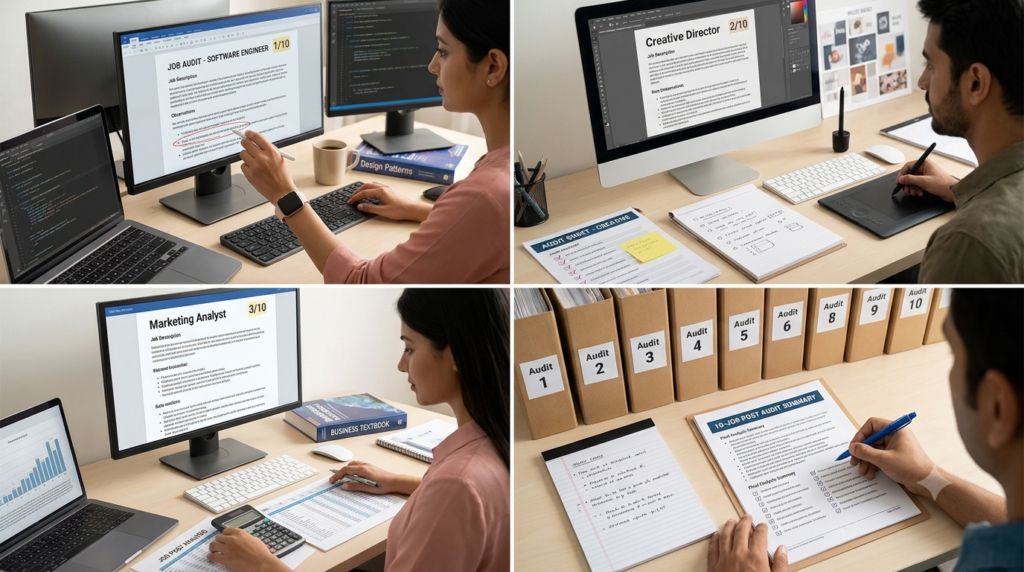
The 10-Job-Post Audit is a simple, practical exercise that helps you identify the skills, tools, qualifications, and competencies repeatedly mentioned by recruiters in job descriptions for your target role.
Instead of guessing what to learn next, you study 10 actual job postings, identify common patterns, compare them with your existing abilities, and create a focused career development plan.
And the best part?
You can complete this exercise in approximately 60 minutes.
Whether you are a fresher looking for your first opportunity, an experienced professional planning a job switch, or someone returning to work after a career break, this exercise can help you make more informed career decisions.
Let’s understand how to do it.
Download: The 10 Job Post Audit – Skills Guide

The 10-Job-Post Audit is a structured job-market research exercise in which you analyse 10 job descriptions for the same target position to identify the skills employers repeatedly demand.
Think of it as doing your own small-scale recruitment research.
For example, suppose you want to become a Data Analyst.
Instead of immediately enrolling in a Data Analytics course, search for 10 Data Analyst job openings on LinkedIn Jobs, Naukri, Indeed, or company career websites.
Now carefully examine what employers are asking for.
You may notice recurring requirements such as:
If the same skills appear across multiple job descriptions, they deserve your attention.
You now have something more valuable than generic career advice: a list of skills based on actual job-market requirements.
The objective is simple: Stop guessing what to learn. Start learning what your target career actually demands.
The employment landscape is changing rapidly.
Technology, artificial intelligence, automation, digital transformation, and changing business requirements are influencing how companies recruit and evaluate candidates.
In its 2026 Campus Workforce Trends report, Deloitte India highlighted the growing role of AI in recruitment. Its survey of 257 organisations found that 86% reported AI or Agentic AI transforming recruitment processes, while 72% used AI for resume screening.
The report also highlighted the increasing importance of learning agility, adaptability, collaboration, and role-specific skills.
This indicates that simply having a degree or a particular job title may not be enough to communicate your suitability for a position. You also need to demonstrate relevant capabilities.
Source: Deloitte India – Campus Workforce Trends 2026
Here is why the 10-Job-Post Audit is particularly useful:
Many candidates prepare for jobs based on assumptions.
A commerce graduate may believe that accounting knowledge alone is enough for a finance position. However, several current job descriptions may also ask for Excel, financial modelling, ERP software, reporting, and analytical skills.
Studying multiple postings gives you a clearer picture of the requirements.
Have you ever purchased an online course because someone told you that a particular skill was in demand?
The problem is that a skill being popular doesn’t necessarily mean it is relevant to your desired position.
The audit helps you prioritise learning based on repeated requirements in your target job market.
You may already possess 60–70% of the skills required for your desired position.
However, you may be missing two or three important technical skills.
The audit helps you separate what you already know from what you need to develop.
A resume should communicate why your experience and abilities are relevant to a particular position.
When you understand the language used in job descriptions, you can present your existing experience more clearly and naturally.
Instead of applying for unrelated positions, you can identify a realistic target role and work towards meeting its requirements.
This is particularly useful when planning a career transition.
Let’s break down the entire exercise into three practical phases.
| Phase | Activity | Time |
|---|---|---|
| Phase 1 | Collect and extract information from 10 job postings | 30 minutes |
| Phase 2 | Identify recurring skills and analyse patterns | 15 minutes |
| Phase 3 | Compare skills, identify gaps, and plan improvements | 15 minutes |
| Total | Complete Job-Post Audit | 60 minutes |
You only need a laptop or smartphone, internet access, and a simple spreadsheet or notebook.

This is where you collect the actual information.
Before opening any job portal, decide which position you want to target.
Don’t make the mistake of mixing different job roles.
For example, if you want to become a Digital Marketing Executive, don’t collect job descriptions for:
These positions may share some skills, but their primary responsibilities are different.
Start with one clearly defined position.
Some examples:
For Commerce Graduates:
For Management Graduates:
For Technology Professionals:
For Experienced Professionals:
If you are changing careers, choose a realistic entry-level or transition role rather than comparing yourself with senior-level job requirements.
Now search for your chosen position.
You can use platforms such as:
For example, search:
“Data Analyst Jobs in Pune”
Or:
“HR Executive Jobs in Pune”
If you are looking for opportunities outside Pune, you can also compare openings in Bengaluru, Mumbai, Hyderabad, or other locations where you are willing to work.
Important: Select 10 reasonably recent and active job postings for similar experience levels.
Don’t blindly collect the first 10 results.
Check:
Try to select postings from different employers so that your analysis isn’t based on the preferences of just one company.
Now comes the most important part.
Open each job description and focus on these sections:
Extract the skills and requirements into three categories.
A. Hard Skills and Technical Tools
These are specific, practical abilities that can usually be demonstrated or assessed.
Examples:
B. Soft Skills and Professional Competencies
These describe how you work and interact with others.
Examples:
C. Certifications, Qualifications and Methodologies
These are formal credentials, domain knowledge, or recognised working approaches.
Examples:
Don’t automatically assume that every certificate mentioned is compulsory. Separate mandatory qualifications from preferred ones.
You can use the following simple format:
| Job Posting | Hard Skills / Tools | Soft Skills | Certifications / Methodologies |
|---|---|---|---|
| Job 1 | Excel, SQL, Power BI | Communication | Relevant degree |
| Job 2 | SQL, Python, Excel | Problem-solving | Python certification preferred |
| Job 3 | Excel, Tableau, SQL | Analytical thinking | Relevant degree |
| Job 4 | SQL, Power BI | Communication, teamwork | Domain knowledge |
| Job 5 | Excel, Python | Problem-solving | Relevant degree |
| Job 6 | SQL, Power BI | Analytical thinking | Relevant degree |
| Job 7 | Excel, SQL | Teamwork | Tableau preferred |
| Job 8 | Python, Power BI | Communication | Relevant degree |
| Job 9 | Excel, SQL, Tableau | Problem-solving | Relevant degree |
| Job 10 | SQL, Excel | Analytical thinking | Python preferred |
Note: This is an illustrative example to demonstrate the audit process, not a representation of actual live job listings.
Once you have completed this step, you will have a collection of skills that employers are mentioning across your target role.
Now let’s find out which ones matter most.

Collecting 10 job descriptions is only half the work.
The real value comes from identifying patterns.
You need to understand which skills are repeatedly requested and which ones appear only occasionally.
Go through your spreadsheet and count the number of job descriptions mentioning each skill.
Using our illustrative Data Analyst example:
| Skill | Number of Job Posts | Percentage |
|---|---|---|
| SQL | 9 | 90% |
| Excel | 8 | 80% |
| Power BI | 6 | 60% |
| Python | 4 | 40% |
| Tableau | 3 | 30% |
| Communication | 7 | 70% |
| Problem-solving | 6 | 60% |
| Analytical thinking | 5 | 50% |
This gives you a simple picture of what employers repeatedly expect.
You can now divide the results into three priority levels.
These are the most frequently mentioned skills in your sample.
For example:
If these skills are relevant to the responsibilities and requirements of your target position, they deserve serious attention.
If you don’t possess them, consider how you can develop and demonstrate them.
These skills appear frequently enough to deserve attention.
For example:
Depending on the specific role, these may help strengthen your profile and make you more versatile.
These are less frequently mentioned in your sample.
For example:
Don’t ignore them completely.
A skill appearing in only two job descriptions could still be essential for a specialised position.
One important distinction: These frequency categories are a practical prioritisation method, not universal recruiter rules. A mandatory qualification appearing in only one job description may be more important than a general skill appearing in all 10.
Always consider the context in which the employer mentions a skill.
This is a step many candidates overlook.
Consider these two statements:
Job Description A:
“Must have strong knowledge of Advanced Excel and financial reporting.”
Job Description B:
“Knowledge of Power BI will be an added advantage.”
Both mention technical skills, but they don’t communicate the same hiring priority.
The first describes an essential requirement.
The second describes an additional advantage.
Create separate columns for:
This prevents you from spending weeks learning a skill that is only occasionally preferred while ignoring a more important requirement.

Now you know what employers are looking for.
But the most important question remains:
How many of these skills do YOU actually have?
This is where your audit becomes a personal career development plan.
Create a simple comparison table.
| Required Skill | Employer Demand | My Current Level | Action Required |
|---|---|---|---|
| Advanced Excel | High | Intermediate | Improve |
| SQL | High | Beginner | Learn |
| Power BI | Medium | No experience | Develop |
| Communication | High | Good | Practise |
| Problem-solving | Medium | Good | Demonstrate |
Be honest while completing this exercise.
Don’t mark yourself as an expert just because you have watched a few tutorials.
Similarly, don’t underestimate yourself if you have already developed a skill through practical work experience.
For example, you may have experience creating reports in Excel without having an official Excel certification.
Your practical experience matters.
Look at your comparison table.
You will generally find three situations.
Situation 1: High Demand + Low Skill Level
These are your priority development areas.
Example: SQL appears in 9 out of 10 job postings, but you have only basic knowledge.
Action: Create a structured learning plan and practise using real datasets.
Situation 2: High Demand + Strong Skill Level
These are your existing strengths.
Example: Communication appears in 7 out of 10 job postings, and you have several years of client-facing experience.
Action: Highlight this experience in your resume with practical examples.
Situation 3: Low Demand + No Skill Level
These may not deserve immediate attention unless they are essential for a particular employer or specialised role.
Action: Avoid investing time and money in every trending tool. Focus on the requirements that matter most for your target position.
Recruiters should be able to understand your professional relevance quickly.
Your resume should communicate three things:
For example:
Before:
“Hardworking and dedicated professional seeking an opportunity to grow in a reputed organisation.”
This statement is generic and doesn’t communicate much about your actual capabilities.
After:
“Detail-oriented Finance Professional with experience in financial reporting, Advanced Excel, account reconciliation, and data analysis. Skilled in preparing financial reports, managing accounting records, and supporting business decisions.”
The second version is more specific and communicates relevant capabilities.
However, include only skills you genuinely possess.
Don’t copy every keyword from job descriptions simply to make your resume look relevant.
Listing skills is important, but demonstrating them is even more valuable.
Consider this example.
Weak Resume Statement:
“Knowledge of Excel and reporting.”
Stronger Resume Statement:
“Used Advanced Excel to prepare monthly performance reports, analyse operational data, and identify reporting discrepancies.”
The second statement explains how you used the skill.
Where possible, include measurable results.
For example:
“Automated monthly reporting using Excel, reducing manual reporting time by approximately 25%.”
Only use numbers you can genuinely support.
This makes your resume more credible and gives interviewers something meaningful to discuss.

You may have heard people say that your resume must be ATS-friendly.
ATS stands for Applicant Tracking System. These systems help organisations manage applications and recruitment workflows.
Depending on the software and employer configuration, an ATS may help recruiters organise applications, search candidate information, and evaluate how closely profiles match certain job requirements.
This is why relevant keywords matter.
For example, suppose a job description specifically mentions:
“Customer Relationship Management (CRM), Salesforce, Lead Generation, and Business Development.”
If you have genuine experience with these areas, your resume should communicate that clearly.
For example:
“Managed lead generation activities, maintained customer records using Salesforce CRM, and supported business development through client follow-ups.”
This is more useful than simply writing:
“Good communication and management skills.”
1. Use Relevant Job Description Language
Use the same terminology where it accurately describes your experience.
For example, if the employer mentions “Stakeholder Management” and you have performed that responsibility, use the relevant phrase.
2. Include Technical Tools Naturally
Mention software, platforms, and tools you have actually used.
3. Connect Skills With Work Experience
Don’t just create a long list of keywords. Demonstrate how you used those skills.
4. Keep Your Resume Easy to Read
Use clear headings, consistent formatting, and a straightforward structure.
5. Never Stuff Keywords
Adding skills you don’t possess can damage your credibility during interviews.
Also remember: ATS platforms differ. There is no universal keyword threshold that guarantees shortlisting or automatic rejection. A well-matched resume improves the clarity of your application, but it cannot guarantee an interview.
The method is useful across industries, but the skills you discover will depend on your target role.
Let’s look at a few examples.
Analyse 10 HR Executive job descriptions.
You may find recurring requirements such as:
Your skill development plan may include learning recruitment processes, improving Excel, understanding HR documentation, and becoming familiar with an HRMS platform.
Your audit may reveal:
If you already understand social media but lack paid advertising experience, you have identified a specific development area.
You may discover recurring requirements such as:
Your next step could be learning SQL, practising requirement documentation, and creating sample business analysis projects.
Your audit may reveal:
You can use this information to prioritise technical learning and practical accounting exposure.
The important thing is to conduct a separate audit for each target role rather than assuming every job in the same industry requires identical skills.
The exercise is simple, but a few mistakes can lead you in the wrong direction.
Comparing an HR Executive with an HR Manager may create confusion because the responsibilities and experience requirements are different.
Solution: Select similar job titles and experience levels.
Old vacancies may not reflect current requirements.
Solution: Prioritise recent and active openings.
Just because AI, Python, or Power BI is trending doesn’t mean every professional needs to learn them.
Solution: Focus on skills relevant to your target position.
Some candidates believe they need a certificate to prove every skill.
But employers may also value real project experience, demonstrated results, and practical knowledge.
Solution: Build evidence through projects, work samples, internships, and professional experience.
Adding unfamiliar technical terms to your resume may help it look impressive, but it can create problems during interviews.
Solution: Learn the skill, practise it, and include it only when you can explain your understanding honestly.
One company may require a certification while another may prioritise practical experience.
Solution: Look for patterns across multiple employers, but always read individual job requirements carefully.
Your audit should not end with a spreadsheet.
The real purpose is to turn your findings into action.
Here is a simple 30-day implementation plan.
| Timeline | Action | Expected Outcome |
|---|---|---|
| Week 1 | Complete the 10-job-post audit | Understand employer requirements |
| Week 2 | Select 2–3 priority skill gaps | Create a focused learning plan |
| Week 3 | Practise through projects or practical exercises | Build demonstrable skills |
| Week 4 | Update your resume and LinkedIn profile | Improve professional positioning |
For example, if you are targeting a Data Analyst position and your audit reveals that SQL, Excel, and Power BI are frequently requested, you could prioritise these skills.
Build a small project using a publicly available dataset.
Prepare a dashboard.
Practise explaining your findings.
Add the project to your portfolio.
Now you are not just telling employers that you know something. You have evidence to demonstrate it.
Before submitting your application, pause and answer these questions:
These questions encourage you to make more thoughtful career decisions rather than applying randomly.
Here is something I want every student and working professional to understand.
Knowing what recruiters want is important.
But knowing what YOU are good at, what interests you, and what kind of work suits you is equally important.
You may analyse 10 job postings and discover that Data Analytics is a promising career option.
But do you genuinely enjoy working with numbers, identifying patterns, solving analytical problems, and spending time with data?
Similarly, you may find that Sales positions have attractive growth opportunities.
But do you enjoy communicating with people, handling objections, building relationships, and working towards targets?
A good career decision should not be based only on market demand. It should also consider your individual strengths, interests, abilities, qualifications, and long-term goals.
This is where self-awareness becomes important.
Before investing your time and money in a new course, certification, or career transition, understand what you bring to the table.
The 10-Job-Post Audit tells you what the market is asking for.
Self-assessment helps you understand where you stand.
Career guidance helps you connect the two.
A job-post audit is a structured process of analysing multiple job descriptions to identify frequently requested skills, qualifications, software, certifications, and professional competencies. It helps job seekers understand employer expectations and make better decisions about resume preparation and skill development.
Analysing 10 similar job descriptions helps you identify recurring requirements across different employers. Instead of relying on one company’s expectations, you get a broader view of the skills commonly requested for your target role.
Ten postings are a practical starting sample, not a statistically representative picture of the entire job market.
Start by identifying a specific job title. Search for recent job openings on LinkedIn, Naukri, Indeed, and company career pages. Review the responsibilities and qualifications sections and note recurring technical skills, software, certifications, and professional competencies.
Include skills that are relevant to the position and that you genuinely possess. Prioritise technical abilities, relevant software knowledge, professional competencies, and skills supported by practical experience or achievements.
Ten job descriptions are a useful starting point for identifying patterns. If you are targeting a specialised or senior-level position, analysing 15–20 relevant postings may provide additional insights.
Absolutely. Freshers can use this exercise to understand what employers expect from entry-level candidates. It can also help them identify relevant courses, internships, projects, and practical skills to develop before applying.
Yes. If you are planning to move into a different industry or job role, comparing job requirements with your existing abilities can help you identify transferable skills and areas where you need additional training.
No. Relevant keywords can improve how clearly your resume communicates its alignment with a role, but ATS systems differ and employers consider several factors during recruitment. There is no guaranteed keyword formula for getting shortlisted.
No. Focus first on mandatory qualifications and frequently requested skills that are directly relevant to your target role. Consider your existing experience, the importance of each requirement, and the time needed to develop it.
Repeat the exercise whenever you plan a significant career move or notice that job requirements in your target industry are changing. Reviewing relevant postings every few months can also help you identify emerging skills and update your learning priorities.

You don’t need to apply for 100 jobs to understand what employers are looking for.
Sometimes, studying 10 relevant job descriptions carefully can teach you more about your target role than spending hours watching random career advice videos.
The 10-Job-Post Audit gives you a practical starting point.
It helps you understand:
But remember, career success is not just about collecting certificates or matching keywords.
It’s about building the right combination of skills, interests, practical experience, and professional capabilities.
Don’t prepare for a career based on assumptions. Study the market, understand yourself, and prepare strategically.
Sometimes, the biggest challenge isn’t learning a new skill.
It’s knowing which skills are worth investing your time in and which career direction genuinely aligns with your strengths and interests.
At SH Development Academy, we believe career decisions should begin with self-awareness and a clear understanding of individual abilities, interests, and aspirations.
Under the guidance of Santosh Hariharan – DMIT Consultant, Parent & Career Coach, and Success Mindset Coach for Students, we help students and professionals explore their strengths and make more informed academic and career decisions.
Our career guidance approach can help you reflect on:
✅ Your strengths and areas of development.
✅ Your interests and career preferences.
✅ Your aptitude and professional potential.
✅ Possible career directions aligned with your profile.
✅ Areas where additional learning or skill development may be beneficial.
We also offer online Psychometric Aptitude Test-based Career Guidance Consultations to help individuals explore their abilities, interests, and career preferences.
Remember, no single assessment can guarantee career success or select a perfect job for you. The purpose of career guidance is to provide additional insights so that you can make better-informed decisions.
If you are a student planning your future, a working professional considering a job switch, or someone feeling confused about the next career step, let’s explore your options together.
Learn more about our DMIT and Career Guidance services:
https://shdevelopmentacademy.lovable.app
📞 Call / WhatsApp:
+91 8421315400 | +91 7303290862
⭐ Trusted by 400+ parents and individuals
Read our Google reviews to learn more about the experiences of families who have trusted our guidance:
https://share.google/ac9hkh20zcXadkJs9
Your career is too important to be left to guesswork. Understand your strengths, identify the right skills, and take your next step with clarity.
Success & Happiness are the two most important yet elusive things which every human being yearns to achieve in life. Real success and happiness can be savoured only when one enjoys good health and good family relations, along with a good professional career and sound financial stability.
Our Visitor


 Users Today : 7