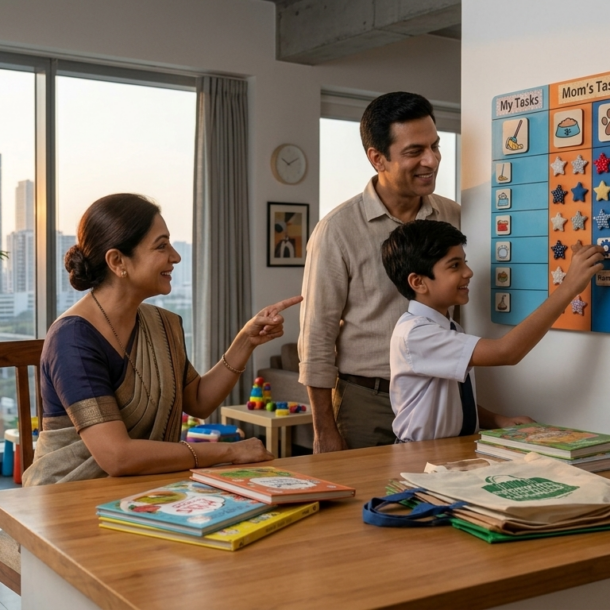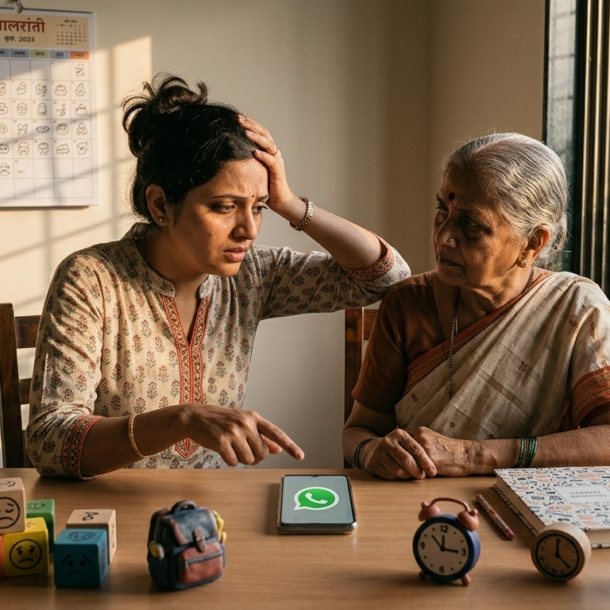

An honest guide for Indian parents who want to stop comparing their children, rebuild parenting confidence, and help their kids grow at their own pace.
Have you ever opened Instagram for five minutes, only to leave feeling that you are somehow falling behind as a parent?
You see a child who is just five years old, reading English fluently. Another child is winning medals in sports. Someone else’s child is learning three musical instruments, scoring excellent marks, and speaking confidently in front of a crowd. And then you look at your own child and wonder, “Am I doing enough? Should my child be doing more at this age?”
If these thoughts sound familiar, you are not alone.
Welcome to the Instagram parenting comparison trap—the habit of comparing your everyday parenting experience with the carefully selected, picture-perfect moments you see on social media.
For Indian parents, this pressure can feel even stronger. Between school performance, tuition classes, extracurricular activities, family expectations, and questions about future careers, parenting can already feel like a full-time responsibility. Instagram adds another invisible benchmark: what other children appear to be achieving.
But here is something every parent deserves to remember: you are seeing someone else’s highlight reel, not their entire family life.
Your child’s development is not a competition. And being a good parent does not mean raising a child who looks impressive on social media.
In this guide, we’ll explore why the Instagram parenting comparison trap affects your confidence, how it can influence your child’s self-esteem, and what you can do to break the cycle without giving up social media altogether.
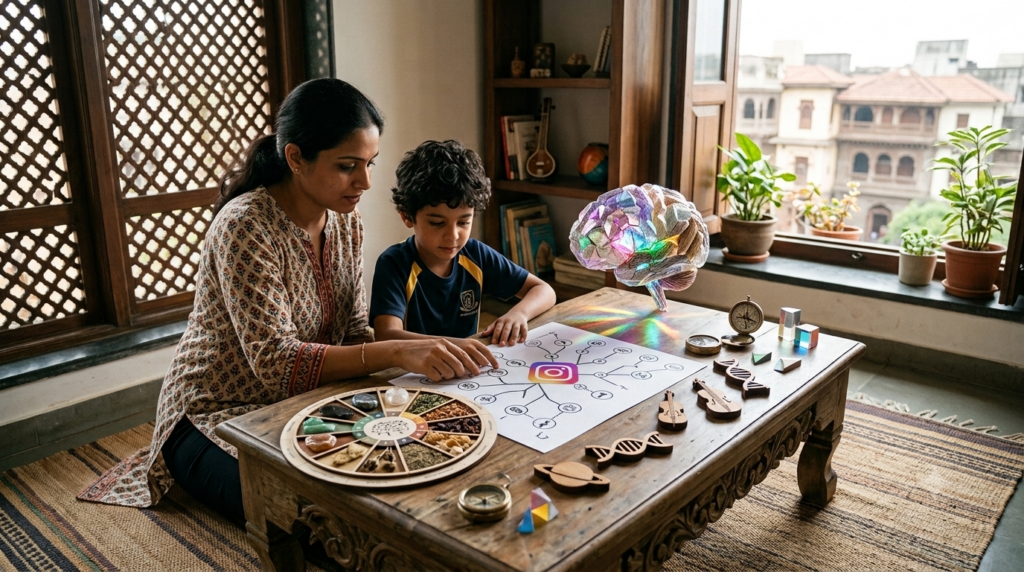
The Instagram parenting comparison trap happens when parents start judging their own parenting, their child’s progress, or their family’s happiness by looking at what other families post online.
Imagine a mother in Pune who is trying to help her child with homework after a tiring day at work. Her child is distracted, the homework is unfinished, and dinner is waiting to be prepared.
She opens Instagram during a short break and sees another mother sharing a video of her child independently completing homework, reading books, and following a perfect daily routine.
Suddenly, her own ordinary evening feels like a parenting failure.
But is it really?
You don’t know what happened before that video was recorded. Perhaps the child needed several reminders. Perhaps the clip took multiple attempts. Or perhaps that family genuinely has a good routine—but struggles with something entirely different.
The problem isn’t admiring another family’s progress. The problem begins when you use that family’s visible success as proof that you or your child are not good enough.
Research published in Acta Psychologica examined how mothers experienced parenting-related Instagram accounts. The findings showed that these accounts could provide useful knowledge and a sense of community, but could also reduce parents’ feelings of parenting competence, particularly when social comparisons became negative.
In other words, Instagram itself isn’t necessarily the enemy. The way we interpret what we see matters.

Social media rewards content that catches attention. A child winning a competition, scoring excellent marks, speaking confidently, or displaying an impressive talent naturally makes an appealing post.
What you rarely see is the full journey behind that moment.
You don’t see every failed attempt, every difficult morning, every disagreement over homework, or the ordinary days when nothing particularly exciting happens.
When you repeatedly compare your unfiltered daily life with someone else’s selected highlights, the comparison is unfair from the beginning.
A practical reminder: Before comparing your family with an Instagram post, ask yourself, “Am I comparing my entire reality with just one moment of theirs?”
That simple question can help you pause before turning admiration into self-criticism.
One child starts reading early. Another speaks English confidently. Someone else’s child learns coding, wins a swimming competition, or scores 95% in an examination.
Before you know it, you may start asking:
For Indian parents, this pressure can become particularly intense around school admissions, tuition, board examinations, competitive entrance tests, and choosing a stream after Class 10.
But children do not all develop the same interests, skills, or confidence at the same time.
A child who isn’t interested in public speaking today may become a confident communicator with practice and encouragement. A child who struggles with mathematics may show impressive creativity, persistence, practical problem-solving, or social understanding.
Instead of asking whether your child is ahead of another child, ask whether they are developing in ways that support their individual needs.
Not all comparison begins with photographs of high-achieving children.
Sometimes, it begins with well-intentioned advice:
Many of these suggestions may be useful in the right circumstances. The problem is treating every recommendation as a universal rule.
A routine that works beautifully for one family may be unrealistic for another. Parents have different work schedules, financial circumstances, support systems, and family responsibilities. Children also differ in temperament, interests, and needs.
Use parenting advice as a resource, not as a checklist you must complete perfectly.
When a child’s achievement receives hundreds of likes, it can look like public proof of successful parenting.
Over time, parents may begin to associate visible achievements with their own worth as a mother or father.
This can create a subtle but exhausting pattern: every report card, competition, performance, and milestone starts feeling like a judgment of how well you are raising your child.
Your child doesn’t need to become an achievement that validates your parenting.
They need a parent who can celebrate their success, support them through setbacks, and help them develop without making love or approval feel conditional on performance.
Children grow up with different opportunities, resources, interests, temperaments, and learning experiences.
One child may have access to private coaching, music lessons, a quiet study room, and plenty of adult support. Another may be balancing schoolwork with a longer commute, shared living space, or limited access to extracurricular activities.
These differences do not determine a child’s future, but they do affect the circumstances in which children learn and grow.
Comparing outcomes without considering context can lead to unrealistic expectations.
Your responsibility is not to recreate another family’s circumstances. It is to understand your own child’s needs and provide the best support you reasonably can.
The comparison trap doesn’t always stay inside a parent’s mind. Sometimes, it enters everyday conversations at home.
A parent sees another child winning a prize and later asks their own child, “Why can’t you do that?” A parent notices a friend’s daughter reading ahead of her class and begins putting additional pressure on their son.
The intention may be to motivate. The effect, however, can be quite different.
Imagine hearing these statements regularly:
“You should be more like your cousin.”
“Look at your friend. She always gets better marks.”
“Your classmate has already learned this. Why haven’t you?”
A child may not interpret these words as helpful guidance. They may interpret them as a message that who they are is somehow disappointing.
Over time, repeated comparisons can make children more reluctant to try unfamiliar things, admit mistakes, or discuss difficulties with their parents.
Instead of thinking, “I can improve this skill,” they may start thinking, “I’m not as good as everyone else.”
Children naturally want to make their parents proud. That is not a bad thing.
However, when approval appears to depend mainly on marks, medals, certificates, or visible accomplishments, children may learn to measure their worth through external validation.
They might become afraid of failure, avoid activities in which they aren’t immediately successful, or hide mistakes because they worry about disappointing their parents.
A healthier message is:
“I am proud of the effort you put in. Let’s understand what was difficult and work on it together.”
This acknowledges effort without pretending that outcomes never matter. It teaches children that performance can improve without making their self-worth dependent on a result.
A child who enjoys drawing may feel pressured to pursue coding because it is popular among classmates. A child who enjoys working with people may be pushed toward a career simply because relatives consider it prestigious.
When comparison becomes the main guide for decisions, a child’s individual interests can get overlooked.
Parents should expose children to different experiences and help them develop useful skills. But they should also make room for curiosity, experimentation, and changing interests.
The goal is not to raise a child who looks successful to everyone else. It is to help raise a child who can develop their abilities, make thoughtful choices, and build a meaningful life.
You don’t need to delete Instagram or stop learning from other parents. You need a healthier relationship with the content you consume and the expectations you bring into your home.

Start noticing which accounts leave you feeling informed and encouraged—and which leave you feeling guilty, inadequate, or anxious.
Mute or unfollow accounts that repeatedly trigger unhealthy comparisons. Follow realistic parenting educators, child development professionals, and communities that discuss both challenges and progress.
You are allowed to protect your peace without judging anyone else’s content.

Replace “Why isn’t my child like that child?” with “What has my child improved over the last few months?”
Perhaps your child now starts homework with fewer reminders, asks questions more confidently, reads for longer, or handles disappointment better.
These improvements matter even if they never become an Instagram post.
Keep a simple monthly note of your child’s efforts, new skills, and challenges. It can help you recognise progress that daily routines often hide.

Instead of saying, “Your friend can do this. Why can’t you?”, try asking:
These questions help you understand the problem before deciding how to address it.

Parenting comes with mistakes, tired days, uncertainty, and moments when you wish you had handled a situation differently.
Instead of telling yourself, “I’m a terrible parent,” try, “This was a difficult moment. What can I learn from it?”
You can take responsibility for a mistake without turning it into a judgment about your entire identity as a parent.

Choose goals based on your child’s actual needs rather than what another family is doing.
For one child, the priority may be developing a consistent study routine. For another, it may be building confidence, learning to manage frustration, or finding an activity they genuinely enjoy.
Keep goals small, specific, and realistic. Review them together and adjust when necessary.

Not every moment needs to be productive, educational, or shareable.
Read a story together. Take a walk. Let your child talk about their day without immediately turning the conversation into a lesson. Enjoy an activity without measuring how well they perform.
Children need opportunities to play, rest, make mistakes, and connect with their parents—not just opportunities to achieve.

Children notice how adults talk about themselves and other people.
If they repeatedly hear you criticise your appearance, compare your achievements, or feel inferior to other parents, they may learn to evaluate themselves in similar ways.
Talk openly about social media: “We only see part of someone’s life online. We don’t know their whole story.”
This helps children develop a more thoughtful understanding of what they see and share.
These practical steps are consistent with research suggesting that the emotional effects of social comparison depend partly on how parents interpret what they see. A 2023 study of parents of young children linked negative feelings during online comparisons with greater distress and lower parenting self-efficacy.
Sometimes, the change is subtle. You may not even realise that Instagram is influencing the way you think about your child.
Here are a few signs worth paying attention to:
One difficult day doesn’t mean you are caught in an unhealthy pattern. What matters is whether these feelings are becoming frequent and affecting your relationship with your child or your own well-being.
Research published online in February 2026 continued to examine how parents’ social comparisons on social media relate to distress and parenting self-efficacy over time. This reinforces the value of paying attention to how online comparisons make us feel, rather than focusing only on how much time we spend online.
If feelings of anxiety, inadequacy, or distress persist or interfere with daily life, speaking with a qualified mental health professional can be helpful.
In India, parenting decisions rarely happen in isolation. School results, board examinations, entrance tests, family expectations, and conversations with relatives can all influence how parents view their child’s progress.
When Instagram adds another layer of comparison, it becomes easy to believe that a successful childhood must follow a fixed formula.
But a child’s development is not a race with a common finish line.
A child who excels academically may need help developing emotional resilience. A child who is quiet in class may express themselves confidently in a familiar environment. A child who struggles with a particular subject may thrive in another area.
None of these observations alone defines a child’s future.
As parents, we need to observe our children over time, listen to their concerns, understand their individual circumstances, and provide opportunities for growth.
That means balancing encouragement with realistic expectations, structure with flexibility, and guidance with the freedom to explore.
Your child does not need to be the best child in someone else’s Instagram story. They need the support to become the best version of themselves.
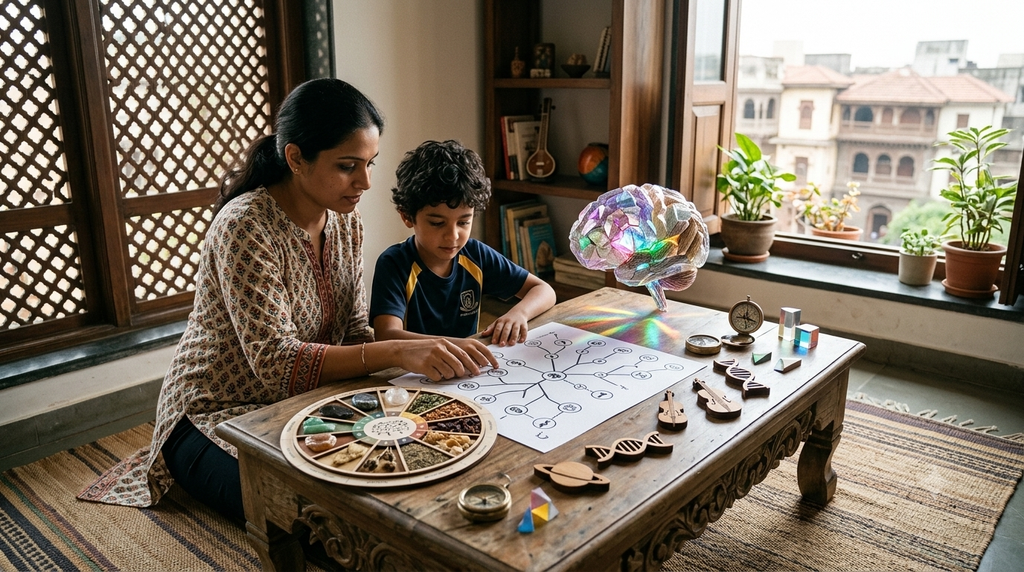
Absolutely—understanding your child can help you make more thoughtful parenting decisions.
When you know what your child enjoys, what they find challenging, how they respond to feedback, and what motivates them, you have a more meaningful starting point for guiding their development.
For example, rather than assuming a child who avoids homework is lazy, you can explore whether the work feels too difficult, whether distractions are getting in the way, whether the child needs a better routine, or whether there is an underlying learning or emotional concern.
Similarly, rather than enrolling your child in every activity that appears popular, you can observe their interests and offer opportunities to discover what they genuinely enjoy.
At SH Development Academy, our approach to parenting and career guidance focuses on helping parents understand their children and make more informed decisions about their growth.
A DMIT consultation may be one option for parents interested in exploring fingerprint-based reports as a starting point for discussion. However, it is important to understand that DMIT has not been established as a scientifically validated way to determine a child’s intelligence, personality, learning style, or future career from fingerprints alone. A report should never replace observing your child, speaking with their teachers, or using validated psychological assessments when appropriate.
The most valuable parenting insights come from combining careful observation, open communication, appropriate assessment, and practical guidance.
The next time an Instagram post makes you question your parenting, pause before changing your child’s routine or setting a new expectation.
Ask yourself these five questions:
Use this checklist whenever online comparisons leave you feeling inadequate.What exactly triggered my comparison?Do I know the full story behind what I saw?What are my child’s actual needs right now?What progress has my child made recently?What is one supportive action I can take today?
0 of 5 reflected onReset
You don’t have to solve every parenting challenge today. Sometimes, the best next step is simply to stop comparing, observe your child more carefully, and respond to the need in front of you.
The Instagram parenting comparison trap is the habit of judging your parenting or your child’s development against carefully selected images, achievements, and experiences shared by other families online. It can lead to guilt, anxiety, unrealistic expectations, and reduced parenting confidence.
Parents may compare children because they want to ensure their child is developing well and has the best possible opportunities. Seeing other children’s academic achievements, milestones, talents, and routines can trigger concerns about whether their own child is progressing quickly enough.
Social media can provide helpful information, encouragement, and a sense of community. However, repeated negative comparisons may make parents feel less capable or more distressed. Research suggests that the emotional impact depends partly on the nature of the comparison and how parents interpret it.
Start by curating your social media feed, recognising your child’s individual progress, avoiding comparisons in everyday conversations, and setting goals based on your child’s needs. Remind yourself that an online post rarely tells the whole story of a family’s life.
Not necessarily. Observing other children can give parents ideas about activities, skills, or developmental milestones worth exploring. Comparison becomes unhelpful when it creates shame, leads to unrealistic expectations, or causes parents to overlook their child’s individual needs.
Recognise genuine effort, celebrate progress, encourage interests, and help your child learn from mistakes. Give specific feedback, such as “You kept practising even when that question was difficult,” rather than comparing their performance with a classmate’s.
Not necessarily. You can continue using Instagram for learning and connection while being selective about the accounts you follow and noticing how particular content affects you. If scrolling repeatedly leaves you distressed, taking a break or setting boundaries may help.
Dear parent, you will always find a child who scores higher, learns faster, speaks more confidently, or achieves something your child hasn’t achieved yet.
And that is okay.
There will also be areas where your child grows beautifully in their own way—areas that may never appear in a photograph, earn a certificate, or attract a hundred likes.
Your job is not to keep your child ahead of everyone else. Your job is to help them develop their abilities, navigate their challenges, build confidence, and discover what matters to them.
The next time you see a “perfect child” on Instagram, remind yourself that you are seeing a moment, not a complete childhood.
Close the app if you need to. Spend a little time with your child. Ask them what they enjoyed today, what they found difficult, or what they would love to learn next.
Sometimes, the most powerful parenting decision is to stop looking at everyone else’s family and start paying closer attention to your own.

At SH Development Academy, we believe that better parenting begins with understanding—not comparison.
Guided by Santosh Hariharan, DMIT Consultant, Parent & Career Coach, and Success Mindset Coach for Students, we help parents explore practical ways to support their children’s strengths, confidence, learning, and future development.
Whether you are concerned about your child’s study habits, confidence, interests, or career direction, a personalised parenting or career guidance consultation can help you identify practical next steps suited to your family’s needs.
SH Development Academy
Call or WhatsApp +91 8421315400 +91 7303290862
Enquire About Parenting Guidance
Read what other parents have shared
Click here to see 400+ Google reviews
Because your child’s journey deserves understanding, encouragement, and room to grow—not comparison.
Success & Happiness are the two most important yet elusive things which every human being yearns to achieve in life. Real success and happiness can be savoured only when one enjoys good health and good family relations, along with a good professional career and sound financial stability.
Our Visitor


 Users Today : 6