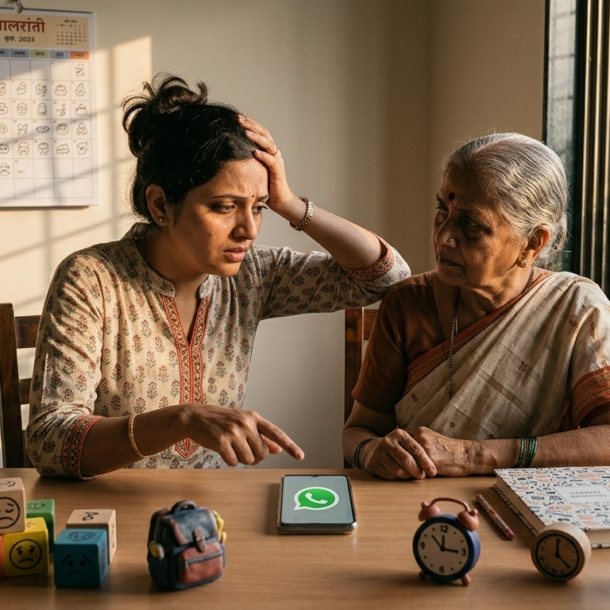

Parenting comes with hundreds of questions, and very few parents have all the answers.
Why is my child suddenly becoming stubborn? Am I handling screen time correctly? Should I be worried about delayed speech? How much academic pressure is too much? And when my child struggles with studies, should I listen to the teacher, consult an expert, or follow the advice of another parent?
Today, finding parenting advice is easy. Finding reliable, trustworthy parenting information sources is the real challenge.
One Google search can lead you to medical advice, parenting blogs, Instagram reels, YouTube videos, and personal opinions—all offering different solutions to the same problem. Ask a few parents in your WhatsApp group, and you may receive five different answers before lunchtime! 😅
As parents, we don’t need more information simply for the sake of it. We need information that helps us make better decisions for our children.
That is where the 3-Source Rule can help.
Instead of blindly following one person’s opinion or getting overwhelmed by everything you read online, build a trusted parenting information stack using three complementary sources: qualified doctors and child development professionals, your child’s school and teachers, and experienced parents or trusted peers.
Each source offers a different perspective. When used wisely, they can help you understand your child’s needs, separate facts from assumptions, and decide when professional guidance is necessary.
In this guide, we’ll explore how the 3-Source Rule works, which parenting websites are worth exploring in 2026, how Indian parents can evaluate conflicting advice, and how to build a practical system for making more informed parenting decisions.
The 3-Source Rule is a practical way to check parenting advice before acting on it. It encourages you to look at three different perspectives rather than relying entirely on one source.
Source 1: Doctors and child development experts
For health, developmental concerns, emotional wellbeing and professional guidance.
Source 2: Schools and teachers
For classroom behaviour, learning progress, friendships and academic observations.
Source 3: Experienced parents and trusted peers
For practical experiences, emotional support and ideas that may work in everyday family life.
One important clarification: the 3-Source Rule is a practical framework, not a formally validated medical rule. You don’t need three opinions for every parenting decision. For urgent health concerns, seek appropriate medical care immediately rather than waiting to compare sources.
The real principle is simple: use expertise for facts, observations for context, and personal experiences for ideas—not as a substitute for professional advice.
Parenting advice has never been more accessible. Yet the sheer volume of information can make it harder to know what to believe.
Imagine a Pune parent whose 10-year-old spends two hours every evening completing homework. A social media creator suggests stricter discipline. A relative recommends more tuition classes. Another parent says the child simply needs more screen time restrictions.
All three may be speaking from their own experiences, but none has necessarily understood the child’s specific situation.
Perhaps the child has difficulty understanding the subject. Perhaps the workload is excessive. Perhaps the child is tired, anxious or struggling with attention.
The solution depends on the underlying problem.
This is why reliable parenting information sources matter. They help parents move beyond assumptions and look at a child’s needs more carefully.
In 2026, parents can start with resources such as the CDC’s positive parenting guides, UNICEF Parenting India, and the Child Mind Institute’s guidance on behaviour and mental health. These resources cover child development, everyday parenting, emotional wellbeing and common challenges.
The goal isn’t to become an expert in every aspect of child development. It is to know where to look, whom to ask, and when an issue requires more than general advice.
When it comes to your child’s health, development, nutrition, sleep, behaviour or emotional wellbeing, qualified professionals should be your first point of reference.
A parenting influencer may share a helpful routine, but a paediatrician can assess whether a child’s symptoms need medical attention. Similarly, a qualified child psychologist can help assess persistent emotional or behavioural difficulties.
Here are some useful resources parents can bookmark.

Run by the American Academy of Pediatrics, this website offers parent-focused information on children’s health, safety, development and common medical concerns.

Centers for Disease Control and Prevention (CDC)
Its positive parenting resources cover developmental milestones and age-specific guidance, from infancy through the teenage years. Its parenting pages were reviewed or updated in February 2026.

UNICEF Parenting India
Particularly useful for Indian parents seeking accessible guidance on early childhood development, positive parenting, mental wellbeing and children’s safety.

Child Mind Institute
Provides information on children’s mental health, learning challenges, behaviour, emotional regulation and family relationships.

Mayo Clinic and Cleveland Clinic
Their health education resources can help parents understand common childhood health issues and prepare informed questions for a healthcare professional.

ZERO TO THREE
Focuses on the development and emotional needs of babies and toddlers, including early relationships and responsive caregiving.
zerotothree.org
Consider speaking to a qualified professional if your child has:
Online articles can help you understand a concern, but they cannot examine your child or provide an individual diagnosis.
A useful parenting habit: before searching Google, write down what you have actually observed, how long it has been happening, and what you want to understand. This makes your search more focused and your conversation with a professional more productive.
Parents see one side of their child. Teachers often see another.
At home, your child may be talkative, energetic and confident. In the classroom, the same child may hesitate to answer questions, avoid group activities or struggle to complete written work.
Neither observation automatically tells the whole story. Together, however, they can help you understand what your child is experiencing.
Teachers can share observations about:
These observations are especially useful when deciding whether a child needs a change in study routine, additional academic support or a more detailed assessment.
Instead of asking only, “Is my child doing well?”, ask questions that lead to specific observations.
For example:
Notice the difference. You’re not asking the teacher to label your child as intelligent, lazy or weak. You’re gathering information that can help you support them.
Don’t assume that one of you must be wrong.
A child may behave differently in different environments. They may feel secure at home but anxious at school, or they may concentrate well in a structured classroom but struggle with independent study.
Compare the specific observations, look for patterns, and discuss possible next steps.
For parents in Pune and across India, a constructive parent-teacher meeting can be one of the most useful—and underused—parenting information sources available.

Sometimes, what a parent needs most is not another research article. It is a conversation with someone who has been through a similar experience.
Another parent may share how they established a homework routine, handled a child’s reluctance to attend school, or helped their teenager balance studies and extracurricular activities.
These conversations can be reassuring. They remind us that parenting difficulties are common and that other families have learned useful lessons along the way.
But there is one important distinction: a parent’s experience is valuable, even when their solution may not be right for your child.
Suppose another parent tells you that taking away their child’s mobile phone completely solved a concentration problem.
You try the same approach, but your child becomes more secretive and the arguments increase.
Does that mean the other parent was wrong? Not necessarily. Their child, family rules, circumstances and reasons for using the phone may have been different.
Rather than copying the solution, explore the principle behind it. Perhaps the useful lesson is to establish consistent boundaries, agree on screen-free study periods and create a routine that your child understands.
You can then adapt the approach to your own family.
Useful sources include:
Be cautious of groups that encourage fear, shame parents for making different choices, promote unverified remedies or discourage professional help.
A supportive parenting community should help you think more clearly—not make you feel that everyone else is raising their children better than you.
Let’s say your 12-year-old has suddenly started avoiding homework and getting lower marks.
Instead of immediately calling the child lazy or increasing tuition hours, use the 3-Source Rule to understand the situation.
1. Seek professional guidance when needed
If the change is persistent or accompanied by emotional, sleep or attention difficulties, discuss it with an appropriate healthcare or child development professional.
2. Speak to the teacher
Find out whether the child is struggling with specific subjects, classroom participation, understanding instructions or completing work.
3. Learn from other parents
Ask what routines have worked for them, but adapt their suggestions to your child’s circumstances rather than copying them blindly.
4. Observe your own child
Try one appropriate change at a time, discuss how your child feels, and review whether the situation improves. If the problem persists, seek further assessment instead of continuing to experiment indefinitely.
The purpose isn’t to collect three opinions and choose whichever one sounds best. It is to combine reliable information, real-world observations and appropriate professional guidance to make a better-informed decision.
Not every website that looks professional provides accurate information. And a video with millions of views is not necessarily more reliable than an article read by a few hundred parents.
Before following online advice, ask yourself these questions.
Look for a named author with relevant qualifications or experience. For medical and developmental topics, prefer qualified professionals and recognised health organisations.
Does the article explain the basis for its recommendations? Does it refer to reputable research or recognised professional guidance?
Be particularly careful with claims that promise instant results or suggest that one technique works for every child.
Advice for a three-year-old may be entirely unsuitable for a 15-year-old.
Look for age-specific guidance that considers the child’s developmental stage, circumstances and individual needs.
Check its publication or review date, particularly when the subject involves health guidance, online safety, technology or educational policies.
For example, the CDC’s positive parenting resources include age-specific guidance and pages updated in February 2026.
Be cautious of absolute statements such as:
Children differ, and the same behaviour can have different causes.
Reliable parenting information should help you recognise when a situation requires an expert. It should not discourage medical care or promise to replace professional assessment.
These platforms can be useful. The problem isn’t the platform itself; it is how the information is created and used.
Parenting blogs: Useful for practical ideas and relatable experiences. Check the author’s expertise, evidence and sources.
Instagram and YouTube: Convenient for discovering tips and hearing from professionals. However, short videos often simplify complicated issues to fit the format.
AI tools: Helpful for organising questions, explaining unfamiliar terms and generating ideas for routines or parent-teacher discussions. However, AI can produce inaccurate information or present uncertain claims too confidently. Verify important health and developmental information with reputable sources and qualified professionals.
Online parent communities: Helpful for emotional support and exchanging experiences, but personal stories should not be treated as medical evidence.
My recommendation is simple: use digital platforms to discover questions worth exploring, then verify important answers through reliable sources.
Even well-intentioned parents can fall into these traps.
The best parenting decisions are rarely made in a panic. They come from observing your child, asking better questions and responding thoughtfully.
Sometimes, parents have plenty of information about their child’s marks, interests and daily routine but still struggle to connect the dots.
You may know that your child dislikes studying, avoids certain activities or becomes frustrated easily. What you need is a clearer understanding of the child’s individual needs and practical ways to support them.
This is where an appropriate child assessment or personalised consultation may be worth considering.
At SH Development Academy, our work in DMIT, parent guidance and career counselling focuses on helping parents reflect on their child’s strengths, interests, learning experiences and development.
However, it is important to choose the right tool for the question you want answered.
A DMIT (Dermatoglyphics Multiple Intelligence Test) uses fingerprint patterns to generate a profile, but fingerprint patterns have not been established as a reliable scientific method for determining a child’s intelligence, personality or future career suitability. A DMIT report should therefore not replace validated developmental assessments, direct observation, school feedback or professional advice.
For concerns involving learning difficulties, developmental delays, emotional wellbeing or mental health, consult an appropriately qualified professional. For career exploration and general parenting guidance, a structured consultation can help you organise your observations and decide on practical next steps.
The aim should always be to understand your child better—not to put them into a fixed category.
You don’t need to bookmark 100 websites or join 20 parenting groups. Start with a few dependable sources and use them consistently.
0 of 6Bookmark one reputable medical or child development resource.Save the contact details of your child’s paediatrician or relevant professional.Schedule regular, constructive conversations with your child’s teacher.Choose one supportive parent community with sensible moderation.Write down recurring concerns and the advice you have verified.Review whether your chosen strategies are actually helping your child.
Reset checklist
Once you have this foundation, you can approach parenting questions with greater confidence. You will know where to start, whom to consult and when not to rely on general advice.
For health and development, start with qualified healthcare professionals and recognised resources such as HealthyChildren.org, CDC, UNICEF Parenting India and the Child Mind Institute. Teachers provide valuable information about classroom behaviour and learning, while experienced parents can offer practical support.
Check the author’s qualifications, supporting evidence, publication date and whether the advice is appropriate for your child’s age. Be cautious of absolute claims, guaranteed outcomes and recommendations that discourage professional help.
It depends on the question. Consult healthcare professionals for health and developmental concerns, teachers for classroom observations, and other parents for shared experiences. These sources complement one another but are not interchangeable.
Yes, when used thoughtfully. They can provide ideas and help parents discover questions to explore. Verify important claims through reputable sources, especially when the advice concerns health, development or mental wellbeing.
Check what evidence each recommendation is based on, whether the advice applies to your child’s circumstances, and whether the professionals are addressing the same question. If the disagreement concerns a health or developmental issue, seek clarification from an appropriately qualified professional.
A DMIT report can be a starting point for a conversation about parenting and your child’s interests, but fingerprint analysis has not been established as a reliable way to determine intelligence, personality or career potential. Use it cautiously and alongside observation, school feedback and appropriate validated assessments.
Nobody becomes a perfect parent by reading more articles, following more influencers or collecting more opinions.
Good parenting comes from understanding your child, remaining open to learning and being willing to change your approach when something isn’t working.
The next time you face a parenting challenge, pause before acting on the first piece of advice you receive.
Check a reliable source. Speak to your child’s teacher when appropriate. Learn from other parents without assuming their experience applies to everyone. And when a concern goes beyond everyday parenting, seek qualified professional guidance.
Remember the 3-Source Rule: expertise for reliable information, schools for observations, and peers for practical support. Your own child’s needs should guide the final decision.
Every child has a different set of interests, experiences, strengths and challenges. Sometimes, a conversation with an experienced parent and career coach can help you organise what you have observed and identify practical next steps.
At SH Development Academy, Santosh Hariharan—a DMIT Consultant, Parent & Career Coach, and Success Mindset Coach for Students—works with parents and students on child development, parenting guidance and career-related decisions.
If you would like to discuss your child’s needs and explore whether a DMIT consultation is appropriate for your family, you can get in touch below.

Parenting guidance • Child potential discussions • Career counselling
Call or WhatsApp
+91 8421315400
+91 7303290862
Enquire About a DMIT Consultation (click here)
Read feedback from parents and families
Your child doesn’t need a parent who knows every answer. They need a parent who knows how to find reliable answers, ask for help when needed, and keep learning alongside them. ❤️
Success & Happiness are the two most important yet elusive things which every human being yearns to achieve in life. Real success and happiness can be savoured only when one enjoys good health and good family relations, along with a good professional career and sound financial stability.
Our Visitor


 Users Today : 2