How Fingerprints Reveal Intelligence: Myth, Science & What Parents Should Know in 2026
By Site Administrator
Have you ever looked at your child’s tiny fingerprints and wondered… can these patterns really tell something about their intelligence?
It may sound surprising—but in recent years, especially across India, many parents have started exploring the idea that fingerprints can reveal intelligence, learning style, and even career potential.
This concept is largely linked to a method called DMIT (Dermatoglyphics Multiple Intelligence Test)—a topic that’s gaining both popularity and debate in 2026.
In this blog, let’s break it down honestly—
✔ What it means
✔ How it works
✔ What science says
✔ What it can (and cannot) tell you
What Does “How Fingerprints Reveal Intelligence” Actually Mean?
The idea comes from a field called Dermatoglyphics—the study of fingerprint patterns.
The core belief is simple:
👉 Fingerprints are formed during pregnancy
👉 Brain development also happens at the same time
👉 Therefore, fingerprint patterns may be linked to brain development
Based on this theory, some experts use fingerprint analysis to understand:
- Intelligence types
- Learning styles
- Personality traits
- Brain dominance (left vs right)
- Natural strengths
This is where DMIT testing comes into play.
The Biological Link: Fingerprints & Brain Development
Here’s the interesting part.
During pregnancy:
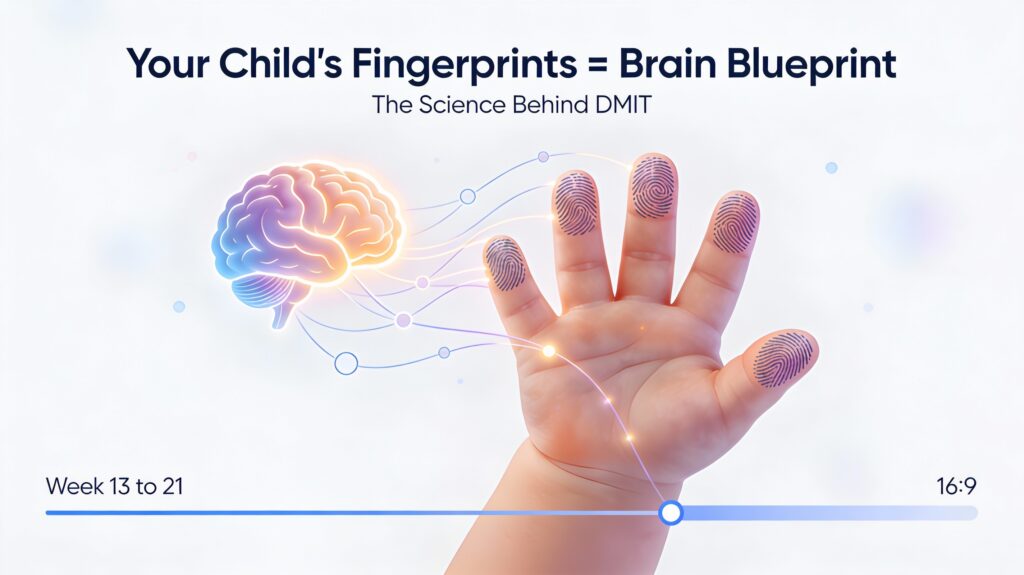
🧬 Fingerprints develop between 13th to 21st week
🧠 Brain cells are also rapidly forming during the same period
Because both develop from the same embryonic layer (ectoderm), some researchers believe there may be a connection.
This is why many DMIT practitioners claim:
👉 Fingerprints reflect neurological wiring
👉 Each pattern corresponds to certain brain functions
However—this is important—
⚠️ The connection is still not universally accepted in mainstream science
Types of Fingerprint Patterns & What They Indicate
There are three primary fingerprint patterns:
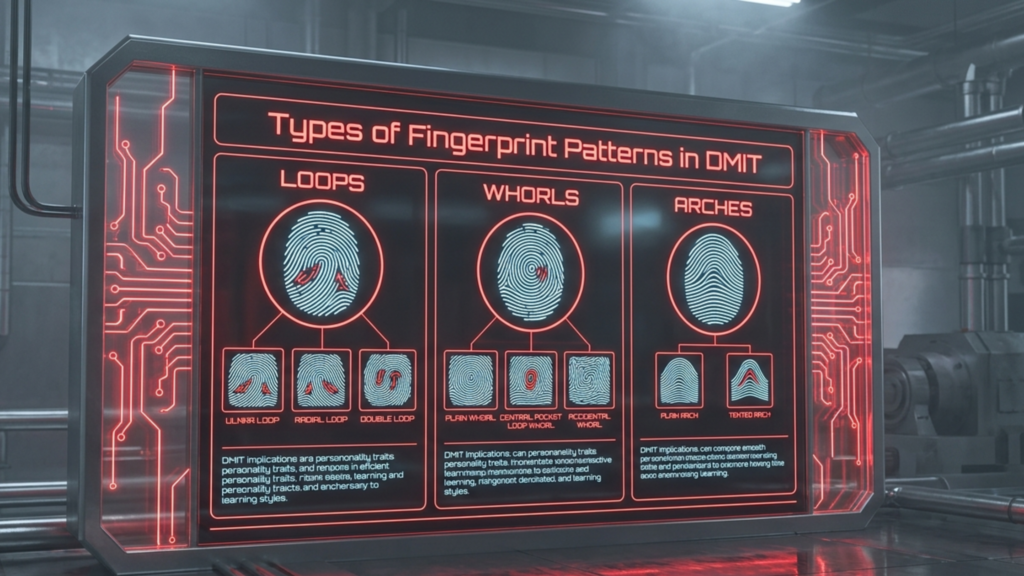
1. Loops
- Most common pattern
- Associated with adaptability and flexibility
- Often linked with balanced thinkers
2. Whorls
- Circular patterns
- Associated with strong individuality
- Often linked with leadership and independence
3. Arches
- Simple wave-like pattern
- Associated with practicality and discipline
In DMIT analysis, experts study:
- Pattern type
- Ridge count
- Finger placement
to map potential abilities.
How DMIT Claims to Reveal Intelligence
The DMIT (Dermatoglyphics Multiple Intelligence Test) is based on the theory of Multiple Intelligences proposed by Howard Gardner.
According to this model, intelligence is not just IQ—it includes:
- Linguistic intelligence
- Logical-mathematical intelligence
- Spatial intelligence
- Musical intelligence
- Bodily-kinesthetic intelligence
- Interpersonal intelligence
- Intrapersonal intelligence
- Naturalistic intelligence
DMIT claims that by analyzing fingerprints, it can identify:
✔ Which intelligence is dominant
✔ How a child learns best
✔ Which career paths may suit them
✔ Whether they are analytical or creative
How the Process Works
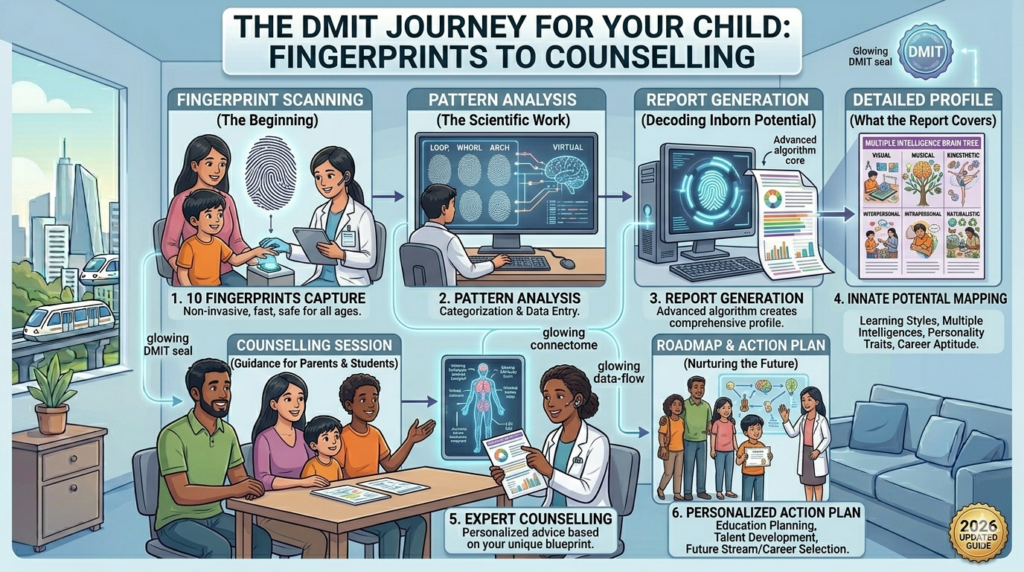
Here’s how fingerprint-based intelligence analysis typically works:
1. Scanning
All 10 fingerprints are captured using a biometric scanner.
2. Analysis
Software analyzes:
- Pattern types (loops, whorls, arches)
- Ridge density
- Finger combinations
3. Mapping
Patterns are mapped to brain lobes and intelligence areas.
4. Report Generation
A detailed report is created showing:
- Intelligence profile
- Learning style
- Personality traits
- Strengths & weaknesses
- Career suggestions
What Fingerprint Intelligence Analysis Claims to Reveal
According to DMIT practitioners, fingerprint analysis can help identify:
✨ Natural talents
✨ Learning preferences (visual, auditory, kinesthetic)
✨ Personality traits
✨ Strength areas
✨ Behavioral patterns
✨ Career inclination
For parents, this can feel like a shortcut to understanding their child better.
The Scientific Debate: Is It Really Proven?
Now let’s talk honestly.
While the idea is fascinating, it is also widely debated.
What supporters say:
✔ Fingerprints and brain develop together
✔ Patterns may reflect neural connections
✔ Useful for guidance and self-awareness
What critics say:
❌ Fingerprint patterns may be largely random
❌ No strong evidence linking fingerprints directly to IQ or EQ
❌ Early research (like that of Francis Galton) did not establish intelligence links
Even some government and academic sources state:
👉 There is no conclusive scientific proof that fingerprints alone can determine intelligence.
So… Does It Work?
Here’s the balanced truth:
✔ It may offer insights into tendencies and preferences
✔ It can be useful as a guidance tool
❌ It should NOT be treated as absolute truth
Think of it like this:
👉 Not a prediction tool
👉 Not a guarantee
👉 But a possible direction indicator
Why Parents Still Find Value in It
Despite debates, many parents in Pune and across India explore this because:
- They want early clarity about their child
- Schools don’t provide personalized insights
- Career confusion starts early
- Every child is different
When used responsibly, it can help:
✔ Understand learning style
✔ Reduce pressure on children
✔ Improve parenting approach
✔ Guide extracurricular choices
Limitations You Should Know
Before you decide anything, keep this in mind:
⚠️ It is not a medical or psychological diagnosis
⚠️ It cannot predict exact career success
⚠️ It should not label or limit a child
⚠️ Results depend heavily on the quality of analysis
Final Thoughts: What Should You Believe?
The idea that fingerprints reveal intelligence is fascinating—but not absolute.
✔ There is some biological connection
✔ There is practical application in guidance
❌ But there is no full scientific agreement
So the smartest approach is:
👉 Use it as one of many tools
👉 Combine it with observation, interest, and education
👉 Focus on nurturing—not labeling
A Smarter Way to Use This Insight
If your goal is not just curiosity but real clarity about your child’s future, then structured and scientifically designed assessments can help more reliably.
Instead of depending only on fingerprint-based analysis, combining it with psychometric aptitude testing + expert counselling gives a more complete picture.
🎯 Career Guidance Consultation for Real Clarity
If you’re a parent who wants to truly understand your child’s:
✔ Strengths & weaknesses
✔ Learning style
✔ Career direction
✔ Personality traits
✔ Aptitude level
Then a professional Career Guidance Consultation can make a big difference.
At SH Development Academy, we help parents and students move from confusion to clarity using structured assessments and expert guidance.
Your session will be guided by Santosh Hariharan —
DMIT Consultant, Parent & Career Coach, and Success Mindset Coach for Students.
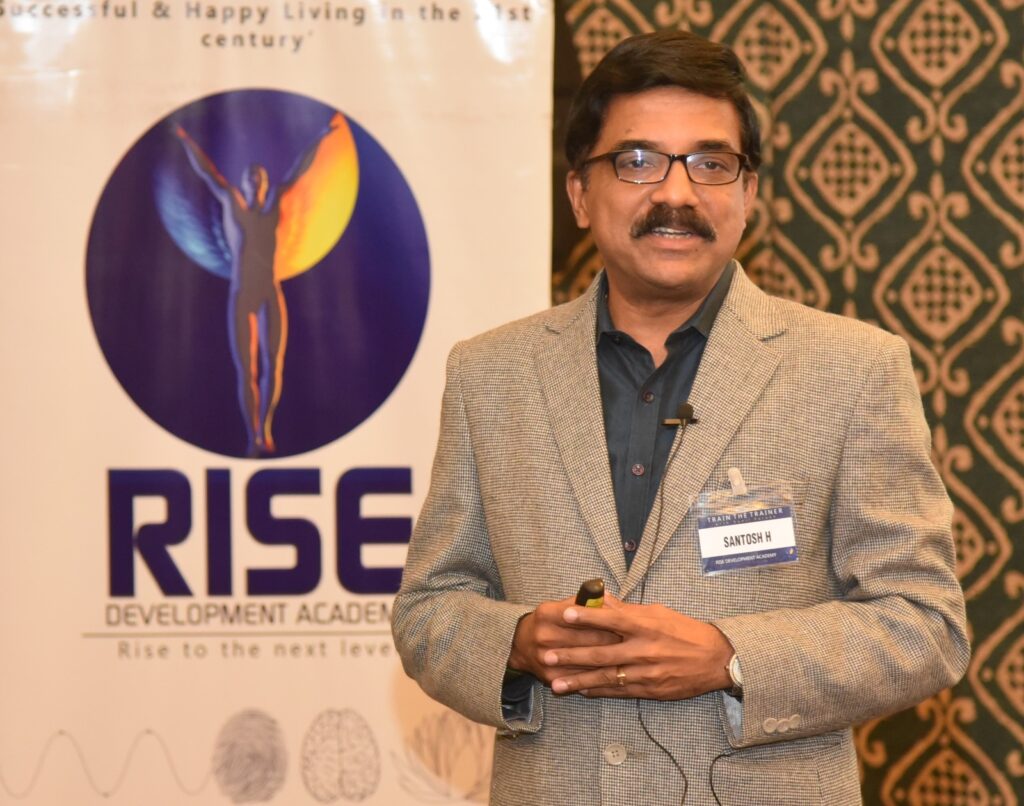
💬 Instead of guessing your child’s future… understand it better.
👉 Book your Career Guidance Consultation today and take the first step toward the right direction.
Click here to see 310+ Google reviews
Phone : +91 8421315400 | +91 7303290862
Email : santosh.hariharan@shdacademy.com
Pune Office Address :
622, Moonstone buzz, Vardhaman spaces, Opp JSPM college, Near Skoda Showroom, Mumbai Banglore highway, Tathawade Pune-33
Success & Happiness are the two most important yet elusive things which every human being yearns to achieve in life. Real success and happiness can be savoured only when one enjoys good health and good family relations, along with a good professional career and sound financial stability.
Our Visitor


 Users Today : 4