
Choosing the right career for your child has never been more challenging. New-age careers, AI-driven industries, changing skill demands, and increasing competition have made career decisions more complex than ever. As a result, many parents are now asking an important question:
“Should we choose a DMIT assessment or go for traditional career counselling?”
The truth is, both have their own role. But understanding the difference can help you make a better decision for your child’s future.
In this blog, we’ll compare DMIT vs Traditional Career Counselling, explain how each works, and help you understand which approach may be more beneficial at different stages of your child’s journey.

Traditional career counselling is a guidance process where a counsellor helps students explore suitable education and career options based on factors such as:
A career counsellor usually gathers information through conversations, questionnaires, and sometimes psychometric assessments before suggesting possible career paths.
For many years, this has been the standard approach used by schools and career guidance centres.
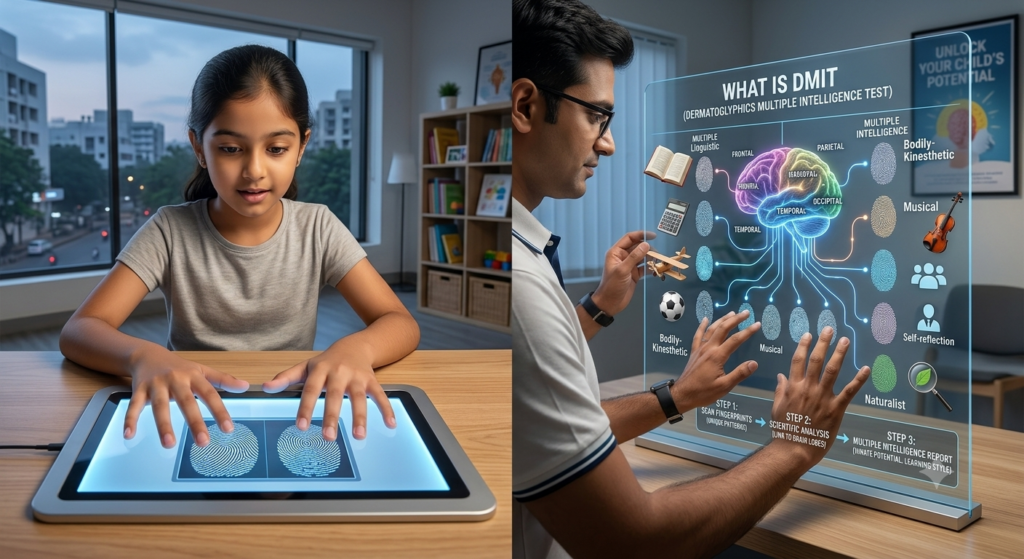
DMIT (Dermatoglyphics Multiple Intelligence Test) is a fingerprint-based assessment designed to provide insights into a person’s natural learning preferences, multiple intelligences, personality tendencies, and potential strengths.
The report is used as a guidance tool to help parents and students better understand:
Rather than focusing only on academic performance, DMIT aims to provide a broader understanding of how a child naturally learns and develops.
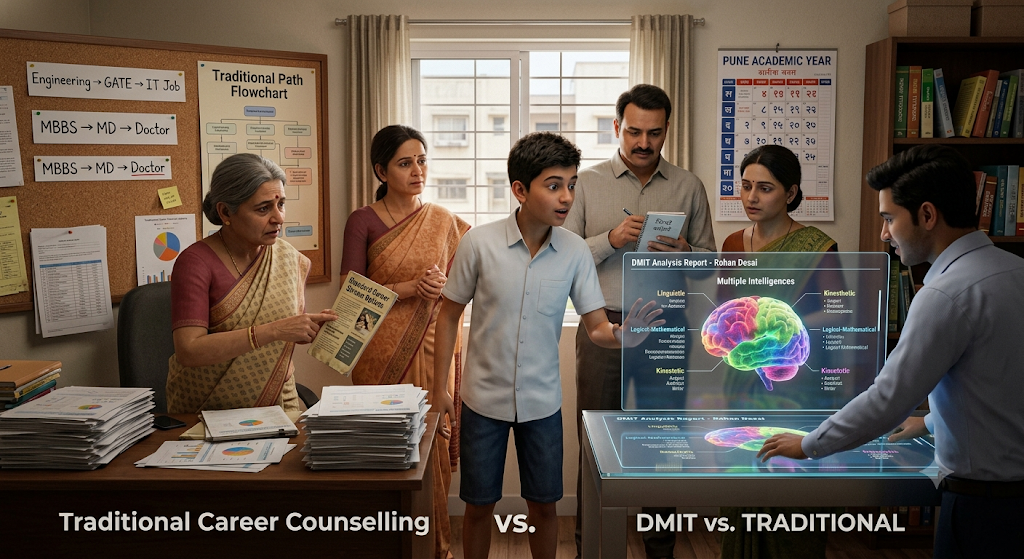
| DMIT | Traditional Career Counselling |
|---|---|
| Focuses on understanding natural abilities and learning preferences | Focuses on interests, academic performance, and discussions |
| Uses fingerprint-based assessment as part of the process | Relies mainly on interviews, questionnaires, and observations |
| Helps parents understand how their child learns | Helps students explore career options |
| Can be done at an early age | Usually sought during higher secondary years |
| Supports parenting, learning, and career planning | Primarily supports education and career decisions |
Both approaches can complement each other rather than compete.
For children between 4 and 12 years, parents often have questions like:
At this stage, understanding a child’s natural strengths and learning preferences can help parents make better decisions about learning methods, extracurricular activities, and communication.
Traditional career counselling is generally less relevant at this age because career decisions are still many years away.
As children move into 8th, 9th, 10th, 11th, and 12th standard, career-related questions become more important.
Students begin thinking about:
This is where traditional career counselling becomes valuable because it helps students evaluate educational pathways, while a DMIT assessment can add another layer of understanding about the student’s learning preferences and strengths.
Using both together often provides a more comprehensive picture than relying on either one alone.
One of the biggest mistakes many parents make is assuming that marks alone define their child’s potential.
A student scoring average marks may be:
Similarly, high marks don’t automatically indicate the right career fit.
Career decisions should consider:
This is why a well-rounded guidance process is so important.
Many parents unintentionally:
Early guidance often reduces confusion and helps students prepare with greater confidence.
This is one of the most common questions parents ask.
The simple answer is No.
DMIT should not be viewed as a replacement for professional career counselling.
Instead, it can be used as an additional guidance tool that helps parents and counsellors better understand a child’s natural learning preferences and strengths.
A balanced career decision is usually based on multiple factors, including:
Instead of asking:
“Which career earns the highest salary?”
Ask questions like:
When career decisions are based on understanding rather than assumptions, students are more likely to remain motivated and confident.
There is no single test or counselling session that can guarantee a child’s future.
However, the earlier parents begin understanding their child’s strengths, interests, and learning preferences, the better equipped they are to guide them.
Whether you choose DMIT, traditional career counselling, or a combination of both, the goal should always be the same:
Helping your child make informed decisions with confidence—not under pressure.

If you’re looking for deeper insights into your child’s learning preferences, strengths, and overall development, a professional DMIT Consultation can be a valuable starting point.
At SH Development Academy, Santosh Hariharan—DMIT Consultant, Parent & Career Coach, and Success Mindset Coach—has guided hundreds of families in making informed educational and career decisions through practical, personalized counselling.
⭐ Trusted by 400+ parents and students
👉 Click here to see 400+ Google Reviews:
400+ Google Reviews
📝 Book Your DMIT Consultation:
DMIT Consultation Booking Form
📞 Call or WhatsApp:
+91 8421315400 | +91 7303290862
Helping parents understand their children better today can lead to smarter educational and career decisions tomorrow.
Success & Happiness are the two most important yet elusive things which every human being yearns to achieve in life. Real success and happiness can be savoured only when one enjoys good health and good family relations, along with a good professional career and sound financial stability.
Our Visitor


 Users Today : 0