Imagine your child has a school assignment due tomorrow. Instead of spending an hour researching, thinking, and writing, they open ChatGPT, type the question, copy the answer, and submit it.
Assignment completed. Time saved. But one important question remains: What has your child actually learned?
Now imagine a different situation. Your child uses ChatGPT to understand a difficult concept, asks for examples, tests their understanding, writes the answer independently, and checks it against their textbook.
The same technology. A completely different learning experience.
This is why AI literacy for students has become such an important topic for parents, teachers, and schools in 2026. Artificial intelligence is changing how students research information, practise skills, solve problems, and prepare for their future careers. Simply telling children to avoid AI is no longer enough. They need to learn how to use it responsibly.
As parents, our goal should not be to raise children who depend on AI for every answer. It should be to help them become confident thinkers who know when to use AI, how to question its responses, and why their own understanding matters.
In this guide, we’ll explore what AI literacy means, how students can use ChatGPT ethically, five practical steps for responsible AI use, and how parents can help children develop the skills they will need in an AI-powered world.
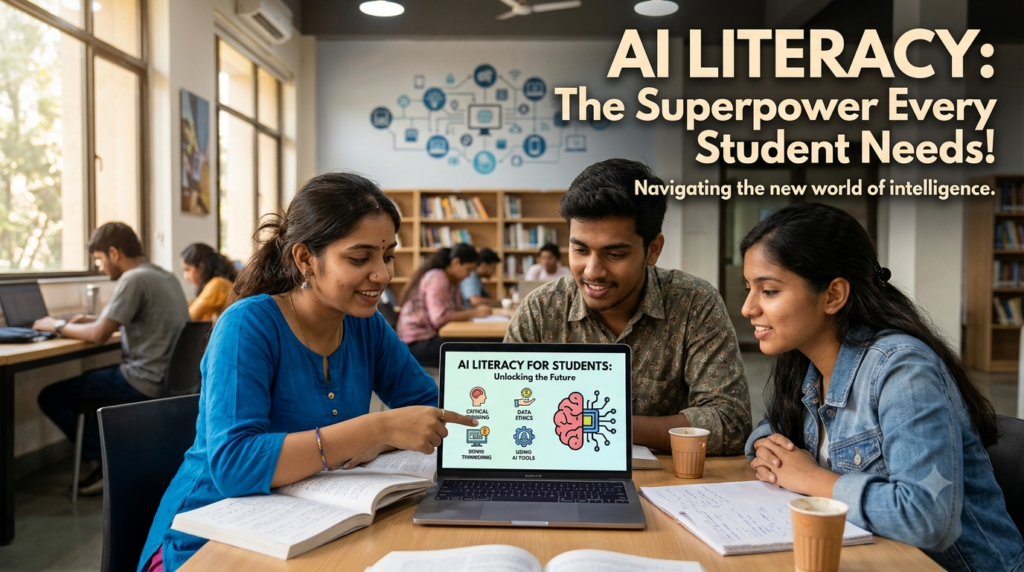
AI literacy for students means understanding how artificial intelligence works, using AI tools effectively, checking their answers critically, and making responsible decisions about when and how to use them.
It goes beyond knowing how to open ChatGPT or write a prompt.
A student with good AI literacy understands that AI can be helpful but can also produce incorrect information, miss important context, or present an answer confidently without sufficient evidence.
The OECD and European Commission’s 2026 AI literacy framework for primary and secondary education emphasises the knowledge, skills, and attitudes students need to understand AI, evaluate its outputs, and use it ethically and creatively.
In practical terms, an AI-literate student can:
For Indian students preparing for board examinations, competitive exams, college, and future employment, these skills can be valuable. AI literacy is not about using technology for every task. It is about knowing when technology helps—and when doing the work yourself is essential.
AI tools are increasingly becoming part of education, research, and professional life. Schools and universities are still adapting their policies, so the rules for using AI can differ between institutions and assignments.
UNESCO’s guidance on generative AI in education stresses the importance of human-centred learning, privacy, age-appropriate use, and educational policies that protect learners while allowing meaningful use of technology.
For students, learning responsible AI use offers several practical benefits.
Imagine a Class 9 student struggling to understand photosynthesis.
Instead of copying a definition, they can ask ChatGPT to explain the concept in simple language, provide an everyday example, and quiz them afterwards.
The student still needs to understand the textbook content and answer questions independently. But AI can provide an additional explanation when a teacher or parent is not immediately available.
ChatGPT can make mistakes. It may provide outdated facts, incorrect calculations, or references that don’t support its claims.
Students who learn to verify information develop a valuable habit: don’t confuse a confident answer with a correct answer.
Students can ask AI to create practice questions, flashcards, revision schedules, or mock quizzes based on topics they are studying.
Used appropriately, these activities can help students identify gaps in their understanding before an examination.
A student who learns how to ask specific questions and request step-by-step explanations may become more capable of working through difficult concepts independently.
The goal is not to remove teachers or parents from the learning process. It is to help students make better use of the resources available to them.
AI literacy can help students develop transferable skills such as problem-solving, information evaluation, communication, creativity, and responsible technology use.
However, simply using AI frequently does not automatically build these abilities. Students must actively practise them.
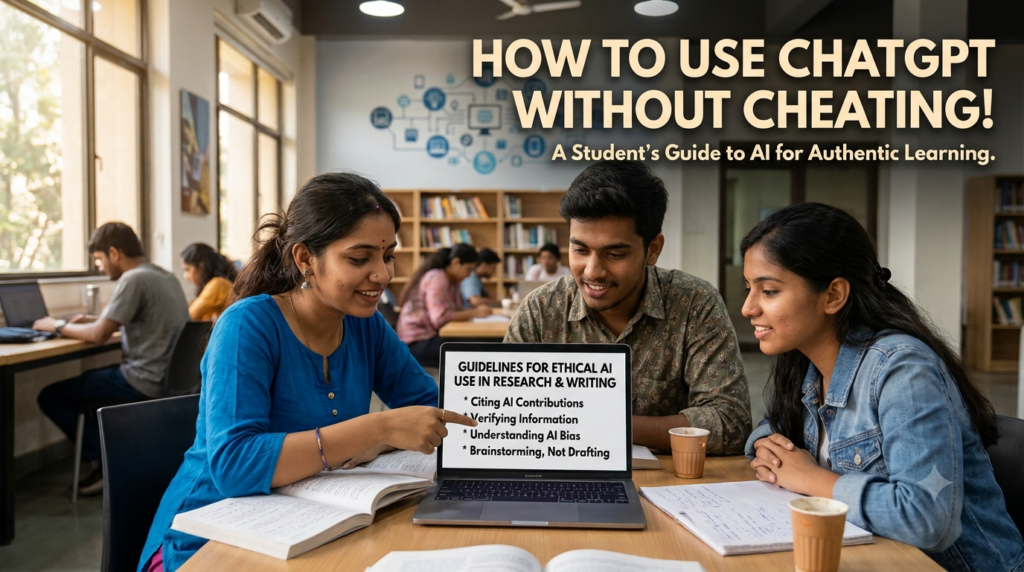
Here is a simple framework that parents can teach their children, whether they are studying in Class 6, preparing for Class 10 or 12 board examinations, or pursuing college studies.
Think first
Before opening ChatGPT, spend a few minutes attempting the task independently.
Read the question, recall what you already know, write down your initial thoughts, and identify exactly where you’re stuck.
Example: Instead of immediately asking AI to write an essay on environmental pollution, first list three causes, three effects, and possible solutions in your own words.
Why this matters: Your first attempt helps you practise independent thinking. AI should support that process, not replace it.
Learn the concept
Give ChatGPT a clear instruction that encourages learning rather than copying.
Try this prompt:
“I’m a Class 9 student learning photosynthesis. Explain the concept in simple language with an everyday example. Don’t write my homework answer. Ask me three questions to check whether I understand it.”
Copy prompt
You can also ask for hints, a simpler explanation, or a worked example of a similar problem.
Why this matters: The objective is to understand how an answer is reached, not merely obtain the answer.
Check before trusting
Never assume that every AI-generated statement is correct.
Check important information against your textbook, class notes, teacher’s instructions, or reliable sources. For current affairs and research assignments, examine the original sources rather than relying only on an AI summary.
Try this prompt:
“List the factual claims in this explanation that I should verify. Suggest reliable sources to check them, and tell me which parts may be uncertain.”
Copy prompt
Remember that AI may suggest sources incorrectly, too. Open the sources and confirm that they actually support the information.
Why this matters: Independent verification is a core part of AI literacy.
Your work, your understanding
Once you understand the topic, close the AI response or put it aside and explain the concept in your own words.
Use your own reasoning, examples, and classroom learning. If your assignment permits AI assistance, use it only within the stated rules and acknowledge that assistance when required.
A useful test: Could you explain your answer to your teacher without opening ChatGPT? Could you answer follow-up questions about it?
If not, revisit the topic before submitting your work.
Why this matters: An assignment should demonstrate what you have learned, not simply what an AI tool can produce.
Use AI responsibly
Before using ChatGPT for an assignment, check what your school or teacher allows.
Students should also follow the platform’s age requirements. ChatGPT requires users to be at least 13, and users aged 13–17 need parent or guardian permission. Parents should check the applicable terms and school rules before allowing a child to use an AI tool.
Why this matters: Responsible AI use combines academic honesty, privacy awareness, and respect for the rules.
Sometimes, the difference between using AI responsibly and cheating can be subtle. These examples can help students and parents understand the distinction.
| School task | Responsible use of ChatGPT | Unethical or inappropriate use |
|---|---|---|
| English essay | Brainstorm ideas, then write independently if permitted | Copy an entire essay and submit it as your own |
| Mathematics | Ask for a hint or explanation of a similar problem | Copy solutions without understanding them |
| Science project | Explore possible topics and verify facts | Invent experiments or results that never happened |
| History assignment | Identify questions to research and check original sources | Submit unverified AI-generated facts and references |
| Exam preparation | Generate practice questions and test yourself | Use unauthorised AI assistance during an exam |
| Presentation | Practise explaining ideas and improve your outline | Present AI-generated content as your own research when rules prohibit it |
The important point is that the same AI tool can support learning or undermine it, depending on how it is used and what the assignment permits.
When in doubt, ask the teacher before using AI.
As a parent, you don’t need to be a technology expert to help your child use AI wisely.
What matters is creating an environment where your child feels comfortable asking questions, thinking independently, and being honest about how they complete their work.
Here are six practical ways to get started.
A blanket ban may prevent some uses, but it doesn’t teach children how to make responsible decisions when AI is available.
Instead, ask your child to explain how they used the tool, what they learned, and which information they verified.
Keep in mind that restrictions may still be appropriate depending on your child’s age, school rules, and the task.
After completing an assignment, ask:
These questions encourage understanding rather than dependence.
Give your child opportunities to solve problems before reaching for digital assistance.
For example, let them attempt a mathematics problem, brainstorm ideas for a project, or explain a chapter before asking AI for help.
The purpose isn’t to make learning unnecessarily difficult. It is to ensure that children continue practising the thinking skills they will need throughout life.
Encourage your child to ask:
This habit is useful not only for ChatGPT but also for social media, online videos, search engines, and information they encounter in everyday life.
Children should understand that they don’t need to share personal information to get a useful explanation.
Teach them to avoid uploading identifiable school documents, passwords, private photographs, financial information, or confidential information about friends and classmates.
Parents should also review age-appropriate safeguards and applicable account settings.
Children notice how adults use technology.
If parents constantly depend on digital tools without questioning their answers, children may adopt similar habits.
Show them how you compare information, verify important facts, acknowledge uncertainty, and use technology to improve your work without surrendering your own judgement.
The larger lesson is simple: technology should strengthen our thinking, not become a substitute for it.
Even students who have good intentions can develop habits that reduce the educational value of AI.
Watch out for these common mistakes:
Copying the first answer: An initial response may be incomplete, inaccurate, or unsuitable for the assignment.
Believing everything AI says: ChatGPT can generate plausible but incorrect information.
Using AI before attempting the task: Students may miss valuable opportunities to practise independent problem-solving.
Making superficial edits to copied work: Changing a few words doesn’t turn someone else’s work into original thinking.
Ignoring school policies: A use case that is permitted for one assignment may be prohibited for another.
Sharing sensitive information: Students may disclose more personal information than a task requires.
Depending on AI for every decision: Excessive reliance can reduce opportunities to develop independent judgement if students stop practising the underlying skills.
The solution isn’t to make students afraid of AI. It is to help them understand its limitations and use it with purpose.
AI literacy for students is the ability to understand AI tools, use them effectively, evaluate their responses, recognise their limitations, and make ethical decisions about their use. It includes critical thinking, privacy awareness, academic honesty, and responsible problem-solving.
Yes, when the teacher or school’s rules permit it. Students may be allowed to use ChatGPT to understand concepts, practise questions, brainstorm ideas, or receive feedback. They should not use it to misrepresent AI-generated work as their own or violate assignment instructions.
Students can begin by attempting the task independently, asking ChatGPT for explanations rather than finished answers, verifying important information, writing their own responses, and following school disclosure requirements.
Its suitability depends on the student’s age, how the tool is used, and the safeguards in place. Parents should follow platform age requirements, review privacy practices, supervise younger users, and encourage children to seek help from trusted adults when necessary.
There is no single answer for every family. Some situations require restrictions, particularly when a school prohibits AI use or a child is too young to use a service. In other situations, supervised and age-appropriate use can help children learn how to question information and use technology responsibly.
AI can assist with explanations, practice, and personalised learning activities, but it cannot replace all the responsibilities of a teacher. Teachers provide educational judgement, feedback, human relationships, classroom guidance, and support that extend beyond generating answers.
AI literacy can help students evaluate information, solve problems, communicate clearly, and use digital tools responsibly. These are transferable skills that can support future study and employment, although no single skill guarantees career success.
As parents, we naturally want our children to stay ahead.
We want them to score well, develop useful skills, make good career decisions, and succeed in a rapidly changing world.
AI can be a valuable part of that journey. But the real advantage won’t necessarily belong to the student who uses ChatGPT the most.
It may belong to the student who knows when to use AI, when to question it, when to put it aside, and how to think independently.
So the next time your child opens ChatGPT for a school assignment, don’t focus only on whether they completed the task.
Ask what they learned, what they questioned, and whether they can explain the answer in their own words.
Because in an AI-powered world, knowledge matters—but so do curiosity, judgement, creativity, honesty, and the ability to learn independently.
These are the qualities we should help our children develop, with or without AI.
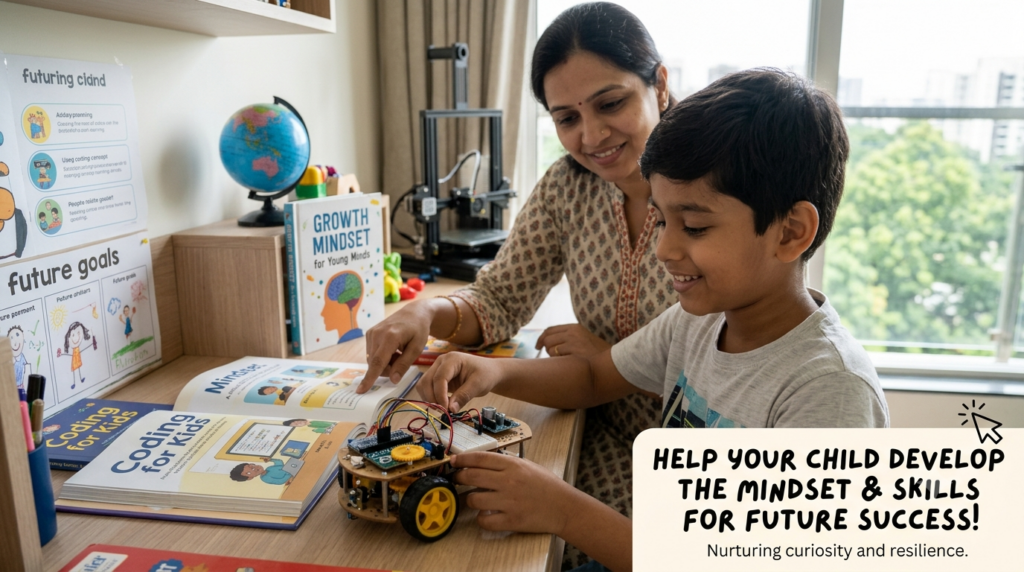
At SH Development Academy, we believe that student success involves more than marks alone. Children also need self-awareness, confidence, sound learning habits, independent thinking, and clarity about their strengths and future direction.
Santosh Hariharan — DMIT Consultant, Parent & Career Coach, and Success Mindset Coach for Students — works with parents and students to help them make more informed decisions about personal development, learning, and career guidance.
If you’re looking for guidance to better understand your child’s strengths and support their development in an increasingly technology-driven world, we’d be happy to help you explore the available services.
Explore the services offered by SH Development Academy and learn how personalised guidance may support your child’s growth.Explore Our Services
Call or WhatsApp
+91 8421315400
+91 7303290862
⭐ Read our Google reviews
See feedback from parents and families
 OpenAI
Success & Happiness are the two most important yet elusive things which every human being yearns to achieve in life. Real success and happiness can be savoured only when one enjoys good health and good family relations, along with a good professional career and sound financial stability.
Our Visitor


 Users Today : 6