
Your child brings home a report card. You look at the marks, calculate the percentage, compare the results with last term, and immediately start thinking about what needs to improve.
But here’s a question worth asking:
Are marks alone enough to tell you whether your child is ready for the real world?
Imagine two students. One consistently scores 95% but struggles to communicate, handle failure, or make decisions independently. The other scores 80%, asks thoughtful questions, works well with others, adapts to change, and confidently solves everyday problems.
Which student is better prepared to face life’s challenges?
The answer isn’t as simple as comparing percentages.
In India, academic marks continue to play an important role in school assessments, entrance examinations, college admissions, and eligibility for certain courses. Parents are right to take education seriously. However, marks tell only part of the story; they don’t capture every skill a child needs to thrive.
As education, technology, and workplaces evolve in 2026, students also need communication, critical thinking, emotional intelligence, adaptability, creativity, and the ability to keep learning.
For parents in Pune and across India, the challenge is finding the right balance: helping children perform academically while preparing them for life beyond the classroom.
In this guide, we’ll explore the 10 skills that matter more than marks in India, why each skill matters, and how you can start developing these abilities in your child without adding more pressure to an already busy school schedule.
Because the goal isn’t to make marks unimportant. It’s to make sure your child’s development goes far beyond them.
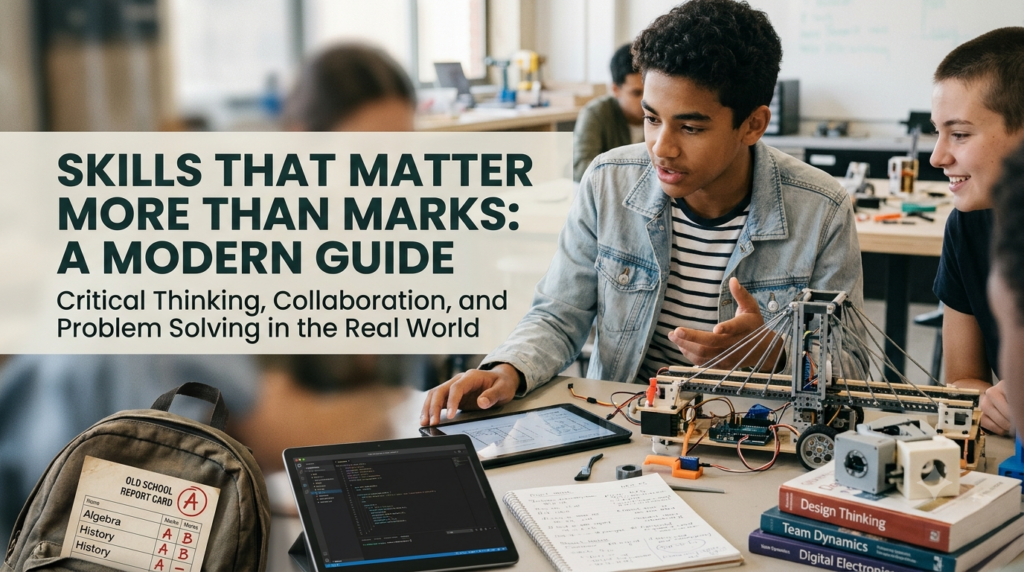
For decades, many Indian families have viewed academic marks as the primary measure of a child’s success. Good marks often mean better admission opportunities, parental appreciation, and a sense of security about the future.
There is nothing wrong with aiming for good academic results. Strong reading, writing, mathematics, and subject knowledge remain essential foundations.
But the world is changing.
India’s National Education Policy (NEP) 2020 and the National Curriculum Framework for School Education emphasise conceptual understanding, critical thinking, creativity, problem-solving, and holistic development rather than rote memorisation alone.
The shift is also visible in the workplace. The World Economic Forum’s Future of Jobs Report 2025 identified analytical thinking, resilience, flexibility, leadership, creative thinking, and motivation as important skills for employers. Technological literacy and lifelong learning also feature prominently as work evolves towards 2030.
What does this mean for your child?
It means that preparing for the future involves more than preparing for the next examination. Children need opportunities to apply what they learn, express their ideas, make decisions, solve problems, and recover from setbacks.
Let’s explore the 10 skills that can help your child thrive beyond the report card.

Imagine your child scores 95% in a science examination. They can reproduce definitions and explain textbook concepts accurately.
Now ask them a question they haven’t encountered before.
Can they use what they know to work out the answer? Can they compare different possibilities? Can they explain why they chose one solution over another?
This is where critical thinking comes in.
Critical thinking is the ability to question information, examine evidence, consider alternatives, and reach reasoned conclusions. Problem-solving is the ability to apply that thinking to a challenge.
Both matter because real life rarely gives us a textbook question with the correct answer printed at the back.
A child who develops critical thinking can gradually learn to:
These abilities are particularly important in a world where children encounter AI-generated answers, online information, and conflicting opinions every day.
Instead of immediately giving your child the answer, ask:
For younger children, solving puzzles, building blocks, and simple experiments can help. For teenagers, discussing news stories, comparing viewpoints, or planning a family activity within a budget offers opportunities to practise reasoning.
Parenting tip: Don’t always rush to rescue your child from a difficult problem. Give them time to think, make mistakes, and try again.
Your child may have excellent ideas, strong subject knowledge, and impressive creativity. But can they explain their thinking clearly?
Can they ask a teacher for help when they don’t understand a concept? Can they express disagreement respectfully? Can they introduce themselves confidently in an interview?
These are communication skills, and they influence far more than public speaking.
Communication includes listening carefully, speaking clearly, writing effectively, asking questions, understanding others, and adapting your message to the situation.
In India’s multilingual environment, children can develop these abilities in their mother tongue, English, Hindi, Marathi, or other languages relevant to their lives. The goal is effective expression and understanding, not making a child feel inferior because of their accent.
Communication helps students participate in group projects, build friendships, seek help, explain their ideas, and eventually navigate college and professional environments.
A child who communicates well is not necessarily the loudest person in the room. Sometimes, the strongest communicator is the one who listens carefully and asks the right question.
If your child is shy, don’t force them to perform in front of a crowd. Start with small conversations, familiar people, and gradually more challenging situations.
Remember: Confidence grows when children feel heard, not when they are constantly told to speak up.
Your child loses a match, receives lower marks than expected, or has an argument with a close friend.
What happens next?
Do they understand what they are feeling? Can they communicate their disappointment? Can they calm down, seek support, and decide what to do next?
Emotional intelligence involves recognising and understanding emotions, responding thoughtfully, and navigating relationships with empathy.
It doesn’t mean a child should never cry, feel angry, or become disappointed. Those emotions are a normal part of life.
The goal is to help children understand their feelings rather than being controlled by every feeling they experience.
Children who practise emotional awareness can learn to:
These skills can support relationships, classroom participation, and everyday decision-making.
Start by acknowledging your child’s feelings.
Instead of saying, “Stop crying. It’s only a small thing,” try:
“I can see that this really disappointed you. Would you like to tell me what happened?”
Once your child feels heard, you can help them think through possible solutions.
You can also model emotional regulation yourself. If you lose your temper, acknowledge it and apologise when appropriate.
Children learn a great deal by watching how adults handle anger, stress, disagreement, and mistakes.
A useful reminder for parents: The goal isn’t to raise a child who never experiences difficult emotions. It’s to raise one who gradually learns how to understand and manage them.

Every child will experience setbacks.
A test may not go well. A sports team may lose. A friendship may change. A subject that once felt easy may suddenly become difficult.
The question isn’t whether your child will face challenges. It’s how they will learn to respond when they do.
Resilience is the ability to recover, adjust, and keep moving forward after difficulties. Adaptability is the ability to respond constructively when circumstances change.
These are among the skills highlighted in the World Economic Forum’s research on changing workplace requirements.
A child who sees every mistake as proof of failure may stop trying new things. A child who learns to treat mistakes as feedback has more opportunities to improve.
Resilience doesn’t mean tolerating every hardship silently or pretending everything is fine. It includes knowing when to ask for help, take a break, or try a different approach.
Praise the process, not just the outcome.
Instead of only saying, “You got 90%—excellent!”, try:
“I noticed you changed your revision strategy and practised the difficult questions. That was a good decision.”
Avoid rescuing your child from every disappointment. Offer support while allowing age-appropriate responsibility.
Normalise mistakes. Share examples of times you learned something after getting it wrong.
Teach flexible thinking. When a plan fails, ask, “What could we try differently next time?”
This is especially valuable for teenagers facing board examinations, entrance tests, and decisions about future study.
One of the most important questions a child can learn to answer is:
“Who am I, what am I good at, and what do I need to improve?”
Many children grow up knowing their marks, class rank, and examination results, but have very little opportunity to reflect on their interests, preferences, values, and individual strengths.
Self-awareness helps bridge that gap.
It involves recognising your abilities, interests, emotional patterns, preferences, and areas where you need further development.
Imagine a student who enjoys designing, building models, and solving practical problems but struggles with rote memorisation.
If the family judges their entire ability by marks alone, the child may begin to believe they are not capable.
But when parents notice the child’s curiosity, practical reasoning, persistence, and creativity, they can help them build on those strengths while still supporting academic improvement.
This doesn’t mean ignoring weaknesses. It means developing the whole child instead of defining them by one number.
Ask your child:
Let children explore different activities before deciding what they are good at.
Self-awareness is developed through experience and reflection. It is not something that can be determined by one test or a single conversation.
Have you ever reminded your child to start studying so many times that the reminder itself becomes an argument?
“Finish your homework.”
“Have you revised for tomorrow’s test?”
“Why are you still on your phone?”
For many families, the challenge isn’t a lack of ability. It’s helping children organise their time, manage distractions, and complete tasks without constant supervision.
Time management and self-discipline help students take increasing responsibility for their work.
A student may understand a subject well but struggle to complete assignments because they start too late. Another may have several extracurricular interests but find it difficult to balance them with schoolwork.
Planning and self-discipline help children manage these competing demands.
They also teach an important life lesson: motivation may fluctuate, but useful routines can help us continue making progress.
Start with a realistic daily plan. Include study time, breaks, meals, play, sleep, and family time.
Break large tasks into smaller steps. “Complete the entire science syllabus” can feel overwhelming. “Revise one chapter and answer five practice questions” is more manageable.
Help children identify distractions. Agree on when phones, games, and social media should be put aside.
Encourage independent planning. As children grow older, allow them to create their own schedules and review what worked.
Avoid turning every task into a parental reminder. Gradually transfer responsibility to your child, with support appropriate to their age.
The goal is not a perfectly organised timetable. It is helping children learn to manage their own responsibilities.
Some of the best questions children ask have nothing to do with their textbooks.
“Why does the moon follow our car?”
“What if we designed a house that uses no electricity?”
“Can I build my own game?”
These questions are opportunities to develop curiosity and creativity.
Creativity is not limited to drawing, music, or performing arts. It also includes finding new approaches, imagining possibilities, experimenting, and connecting ideas in unexpected ways.
Curiosity is the willingness to explore, ask questions, and learn beyond what is immediately required.
As technology and AI tools become more widely used, children need opportunities to do more than reproduce information. They need to ask meaningful questions, evaluate answers, develop original ideas, and understand how to apply knowledge responsibly.
India’s education framework emphasises curiosity, inquiry, experimentation, and innovation as important parts of learning.
Most importantly, don’t judge every creative activity by how productive it looks.
A child building an imaginary city out of cardboard may be practising planning, spatial reasoning, storytelling, and problem-solving.
Give curiosity room to grow.
Today’s children are growing up surrounded by digital technology. They use smartphones, educational applications, online videos, search engines, and increasingly, AI tools.
But being able to use an app doesn’t automatically mean a child is digitally literate.
Digital literacy includes finding information, evaluating its reliability, protecting personal information, recognising online risks, and using technology responsibly.
A student may receive a convincing answer from an AI tool that contains errors. They may encounter misleading social media posts, online scams, cyberbullying, or content designed to manipulate attention.
Children need to learn how to navigate these situations thoughtfully.
Teach verification. Encourage your child to compare important claims with reliable sources instead of believing the first search result.
Discuss privacy. Explain why passwords, personal details, photographs, and location information should be protected.
Teach responsible AI use. AI can help brainstorm, explain difficult concepts, or provide practice questions. It should not replace a child’s own thinking or be used to submit work dishonestly.
Set healthy boundaries. Agree on age-appropriate screen-time expectations, device-free family moments, and sufficient sleep.
Stay curious about your child’s digital world. Ask which applications they use and what they enjoy online rather than approaching every conversation as an interrogation.
The aim is not to keep children away from technology entirely. It is to help them become capable, discerning, and responsible users of it.
A child may perform brilliantly in individual examinations but struggle when working with classmates.
They may find it difficult to share responsibility, listen to another person’s opinion, handle disagreement, or accept that someone else has a better idea.
These are opportunities to develop teamwork, empathy, and leadership.
Leadership does not mean being the loudest person in a group or always getting one’s way. Good leadership involves responsibility, listening, cooperation, sound judgement, and helping others work towards a shared goal.
From school projects and sports teams to university assignments and professional workplaces, people regularly need to work with others.
Empathy helps children recognise that another person may have feelings or experiences different from their own. Teamwork teaches them to contribute, negotiate, and resolve disagreements.
When siblings argue, for example, resist the urge to decide instantly who is right every time. Where appropriate, help them explain their perspectives and work towards a fair solution.
Children don’t learn teamwork simply by being told to share. They learn through repeated opportunities to practise it.
Your child may know how to solve percentage problems in mathematics.
But can they apply percentages when comparing discounts? Do they understand the difference between wanting something and needing it? Can they save towards a goal rather than spending all their pocket money immediately?
Financial literacy helps children understand money, budgeting, saving, spending, and the consequences of financial decisions.
Decision-making is closely related: it involves considering options, evaluating consequences, and choosing a reasonable course of action.
Children will eventually make decisions about education expenses, daily spending, savings, digital payments, and financial commitments.
They don’t need to become financial experts at a young age. They need age-appropriate opportunities to understand that money involves choices and trade-offs.
For younger children: Use a simple savings jar and help them save towards a small goal.
For primary-school children: Give them a small, age-appropriate budget for an outing or purchase.
For teenagers: Discuss budgeting, bank accounts, digital payment safety, discounts, subscriptions, and the importance of avoiding impulsive purchases.
Involve them in practical decisions. When planning a family outing, explain how you compare costs and prioritise expenses.
Avoid making children feel guilty about family finances or involving them in adult financial worries. The goal is education, not anxiety.
Financial literacy helps children connect classroom mathematics with everyday life.
The good news is that you don’t have to wait until your child reaches Class 10 or 12 to begin.
Skills develop gradually through everyday experiences, and the approach should match the child’s age, interests, and maturity.
India’s National Education Policy outlines four broad stages of school education, providing a useful reference for age-appropriate learning and development.
| Age group | Skills to emphasise | Everyday examples |
|---|---|---|
| Ages 3–8 | Communication, curiosity, emotional awareness, basic self-discipline | Storytelling, play, naming feelings, putting toys away |
| Ages 8–11 | Problem-solving, teamwork, creativity, responsibility | Puzzles, group projects, simple household tasks |
| Ages 11–14 | Critical thinking, time management, digital literacy, resilience | Planning homework, researching a topic, learning from mistakes |
| Ages 14–18 | Decision-making, self-awareness, financial literacy, leadership, career exploration | Budgeting, projects, career conversations, independent study planning |
These are flexible guidelines, not fixed developmental deadlines. Children develop at different rates, and some skills may need more support than others.
The most important thing is to give your child regular opportunities to practise.
This is where many parents get stuck.
You understand that your child needs more than marks. You want to nurture communication, creativity, confidence, or problem-solving. But how do you know which areas to focus on first?
Start by observing your child in different situations.
Notice which activities naturally attract your child’s attention.
Do they enjoy explaining ideas? Building things? Organising group activities? Solving puzzles? Helping friends? Creating stories?
One observation doesn’t define a child’s ability. Look for patterns over time.
Children often reveal useful information when they feel free to answer honestly.
Ask what they enjoy learning, which activities make them feel confident, and what they would like to try.
Listen without immediately turning their answer into a career recommendation.
Your child may behave differently at home, in class, and during extracurricular activities.
Feedback from people who know your child in different settings can help you build a more balanced picture.
Children cannot discover every strength by sitting at a desk.
Sports, art, music, science projects, reading, volunteering, and practical activities can all provide useful opportunities for exploration.
A professionally selected assessment may help explore specific questions about aptitude, interests, personality, or learning needs.
The choice of assessment should depend on what you want to understand. No single test can comprehensively measure every ability or determine a child’s future.
At SH Development Academy, our approach to child and career guidance centres on helping parents understand their child’s needs and explore suitable next steps through discussion and assessment where appropriate.
The answer is both.
This is an important distinction. The argument that skills matter beyond marks should not become an excuse to neglect academics.
Reading, writing, mathematics, subject knowledge, and examination preparation remain essential. Marks may determine eligibility for courses, scholarships, and competitive opportunities, depending on the institution and programme.
At the same time, academic performance alone does not describe a child’s entire potential.
A balanced approach looks at three areas:
Academic knowledge
Understanding subjects, building foundational skills, and developing effective study habits.
Personal capabilities
Critical thinking, communication, emotional regulation, adaptability, and self-awareness.
Practical experience
Applying knowledge through projects, responsibilities, hobbies, teamwork, and real-world decisions.
When parents support all three areas, children have more opportunities to develop academically while also preparing for the demands of everyday life.
Instead of asking only, “How many marks did you get?”, try asking:
These questions do not replace academic discussions. They make them more meaningful.
You don’t need to enrol your child in ten different classes to start building these abilities.
Begin with a few small actions at home.
Observe and understand
Notice your child’s interests, strengths, frustrations, and daily routines. Ask open-ended questions without judging their answers.
Practise communication and emotional awareness
Set aside a few minutes daily for an uninterrupted conversation. Help your child put feelings into words and listen to other perspectives.
Encourage independent thinking
Let your child plan a small project, solve a practical problem, manage a task, or research a topic of interest.
Review progress together
Discuss what your child enjoyed, what felt difficult, and which skills they would like to practise next. Celebrate effort and improvement.
Keep the plan flexible around schoolwork, examinations, rest, and play.
You are not trying to create a perfect child in 30 days. You are building an environment where useful skills can develop over time.
Critical thinking, communication, emotional intelligence, resilience, adaptability, self-awareness, time management, creativity, digital literacy, teamwork, and financial literacy are valuable complements to academic knowledge. The most relevant skills depend on a child’s age, interests, and future goals.
Yes. Academic marks are important for many educational and professional opportunities, but they are not the only factor that influences success. Skills, knowledge, practical experience, persistence, interests, and access to opportunities can all matter. Average marks should prompt an honest look at a student’s needs and goals, not a judgement of their entire future.
Use everyday activities as learning opportunities. Encourage conversations, shared household responsibilities, reading, problem-solving, budgeting, hobbies, and age-appropriate decision-making. Children develop skills through practice, feedback, and experience.
Indian education policy and curriculum frameworks recognise the importance of holistic development, including critical thinking, communication, creativity, problem-solving, and social-emotional skills. How these skills are implemented varies by school, board, and educational setting.
Observe recurring interests and behaviours, seek feedback from teachers, provide varied experiences, and talk to your child about what they enjoy. If you need more structured guidance, consider an appropriate assessment interpreted in context rather than relying on a single score or label.
Rather than abandoning academic expectations, aim for a healthier balance. Set realistic goals, support effective study habits, recognise effort, and make room for other aspects of development. If your child is struggling academically, try to understand the underlying difficulty instead of relying only on pressure or comparison.
Dear parents, the next time you look at your child’s report card, take a moment to look beyond the numbers.
Notice how they handle disappointment. Notice whether they can ask for help, explain their ideas, work with others, and keep trying when something becomes difficult.
Notice what makes them curious. Notice what they enjoy learning. Notice how they treat people when there is nothing to gain.
These everyday observations can tell you important things about the person your child is becoming.
Your responsibility is not to develop every skill at once or turn every hobby into a competitive advantage. It is to help your child build a strong academic foundation while giving them the space, guidance, and encouragement to grow in other areas.
Marks may open certain doors, but the ability to think, communicate, adapt, and make thoughtful decisions helps children navigate the opportunities and challenges beyond them.
And that is what preparing your child for the future should really mean.
At SH Development Academy, we understand that parenting can become confusing when you are trying to balance academic expectations, your child’s interests, and questions about their future.
You may be wondering:
Santosh Hariharan, DMIT Consultant, Parent & Career Coach, and Success Mindset Coach for Students, works with parents and students to explore these questions through guidance and appropriate assessments.
Our DMIT and career guidance services are intended to support informed conversations about child development. DMIT fingerprint analysis should not be treated as a scientifically established way to determine intelligence, personality, or future career suitability on its own. For aptitude and career decisions, assessments should be interpreted alongside a child’s demonstrated skills, interests, experiences, and goals.
If you want to take a more thoughtful approach to understanding your child, explore our services and see whether a consultation is right for your family.
Explore DMIT and child development guidance with SH Development Academy.Explore Our Services
Call or WhatsApp
+91 8421315400
+91 7303290862
⭐ Read what parents have shared about their experiences.
Success & Happiness are the two most important yet elusive things which every human being yearns to achieve in life. Real success and happiness can be savoured only when one enjoys good health and good family relations, along with a good professional career and sound financial stability.
Our Visitor


 Users Today : 7