
In today’s digital world, children spend a significant part of their day looking at screens. From online classes and homework to YouTube videos, mobile games, and television, screen time has quietly become a part of everyday childhood.
For Indian parents, especially those managing school, tuition classes, homework, and extracurricular activities, one question is becoming increasingly important: How can we protect our children’s eyes while allowing them to use digital devices when needed?
One simple habit worth teaching your child is the 20-20-20 rule.
The rule is easy to remember, takes very little time, and can help children develop healthier screen habits. Whether your child is in primary school, preparing for board examinations, or attending online classes, this small break can make a difference to their daily eye-care routine.
In this guide, we’ll explain the 20-20-20 rule for children in India, how it works, why it matters, how parents can implement it at home, and what other eye-care habits children should follow in 2026.
The 20-20-20 rule is a simple eye-care habit recommended to help reduce digital eye strain during prolonged screen use.
Here is how it works:
Every 20 minutes
Remind your child to take their eyes off the screen.
Look at something 20 feet away
That is approximately 6 metres away, such as a distant tree or building.
Continue for 20 seconds
Let your child relax their focus before returning to the task.
For example, if your child starts online tuition at 5:00 PM, remind them to look away from the screen for 20 seconds at approximately 5:20 PM, then continue the lesson. Repeat the habit every 20 minutes during prolonged screen use.
The idea is to give the eyes a regular break from focusing on a nearby object. Pediatric eye-care guidance recommends this practice to help ease eye fatigue associated with extended screen use.
One important point: The 20-20-20 rule is a helpful habit, not a guarantee against eyesight problems. It does not replace age-appropriate screen limits, outdoor activity, or professional eye examinations.
Think about a typical school day for a child in India.
The morning begins with school. After returning home, there may be homework, tuition, online learning apps, and revision. Once the academic work is finished, the child may want to relax by watching videos or playing games on a mobile phone.
Before parents realise it, the child has spent hours looking at objects just a short distance from their face.
Extended near work and screen use can contribute to digital eye strain, which may cause tired eyes, dryness, headaches, or temporary blurred vision. Children may also blink less frequently when concentrating on screens, which can make their eyes feel dry or uncomfortable.
For Indian parents, the challenge is not necessarily to eliminate every screen. Online education and digital learning tools are part of modern life. The real challenge is to create a healthy balance between screen use, study, sleep, outdoor play, and family interaction.
The Indian Academy of Pediatrics has also emphasised age-appropriate screen limits and ensuring that digital media does not replace essential activities such as physical exercise, sleep, and social interaction.
That is why teaching the 20-20-20 rule early can be a practical step toward healthier digital habits.
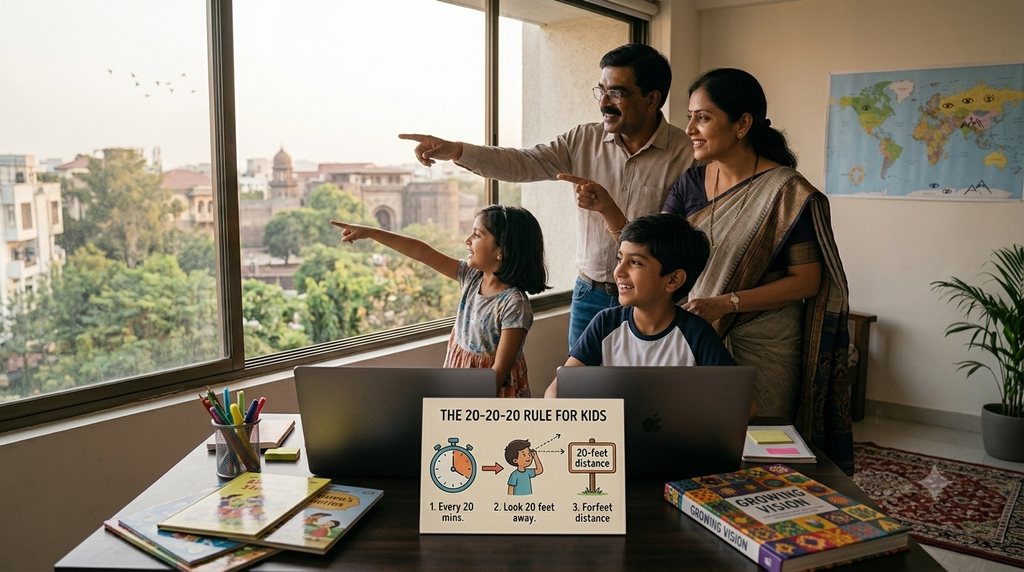
When children concentrate on a screen for long periods, their eyes continually focus at a relatively close distance.
Regularly looking into the distance gives them a break from sustained near focusing and may help reduce eye fatigue.
Children often become so absorbed in a game, video, or online class that they forget to blink normally.
A screen break is a good opportunity to blink naturally several times and allow the surface of the eyes to remain comfortable. If dryness persists, consult an eye-care professional rather than assuming that breaks alone will solve it.
Some children complain of headaches, tired eyes, or temporary blurred vision after long periods of screen use.
Regular breaks may help ease symptoms associated with digital eye strain. However, recurring headaches or blurred vision should not automatically be blamed on screens; they may require an eye examination.
One of the most useful benefits is behavioural.
When children learn to pause rather than stare continuously at a screen, they begin developing a healthier relationship with technology.
Parents can make the habit easier by using a timer, setting reminders, and following the same rule themselves.
A 20-second eye break does not have to mean sitting still. Your child can stand up, stretch gently, look out of a window, or walk a few steps.
For longer study sessions, encourage additional movement breaks and outdoor play. These activities complement eye-care habits rather than replacing them.
As a parent, you probably already remind your child to finish homework, keep their room clean, and avoid excessive mobile use. But asking a child to remember one more rule can sometimes feel like a challenge!
The trick is to make the 20-20-20 rule a habit rather than another instruction.
1. Use a timer during online classes

Set a quiet reminder every 20 minutes. Explain to your child that it is time to look away from the screen for 20 seconds.
2. Choose a distant object in advance

Ask your child to look at a distant tree, building, or other object roughly 20 feet away. A nearby wall or toy will not provide the same distance.
3. Follow the rule yourself

Children learn more easily when they see adults practising the same habits. Take your own screen breaks instead of reminding your child while continuing to scroll.
4. Reward consistency, not perfection

Praise your child for remembering the break. A simple checklist or colourful reminder near the study table can make the habit fun.
The 20-20-20 rule does not mean children can spend unlimited time on screens as long as they take breaks.
Parents need to consider their child’s age, the purpose of screen use, sleep, physical activity, and overall development.
The Indian Academy of Pediatrics’ published recommendations provide the following guidance:
| Age group | Published screen-time guidance |
|---|---|
| Below 2 years | Avoid screen exposure |
| 2–5 years | Maximum 1 hour of supervised screen time per day |
| 5–10 years | Less than 2 hours per day |
These are recommendations from the cited IAP guidance, not a claim that every child’s individual needs are identical. Educational requirements and updated professional advice should also be considered.
For older children and teenagers, screen use needs to be balanced carefully with studying, exercise, sleep, hobbies, and relationships. Set practical family boundaries around recreational screen use, particularly before bedtime.
The 20-20-20 rule is a useful starting point, but it works best as part of a broader eye-care routine.
Encourage your child to play outdoors, walk, cycle, or participate in sports. Spending time outdoors is associated with a lower risk of developing myopia, or short-sightedness, in children. The World Health Organization also recommends regular breaks during near work and outdoor time as part of myopia prevention guidance.
Avoid allowing children to hold mobile phones just a few centimetres from their faces.
Keep devices at a comfortable distance, use larger screens when practical, and position laptops so children do not need to lean forward to read the content.
A child should not have to strain to read a screen in a very dark room or deal with strong reflections from a window.
Adjust screen brightness to suit the surrounding light and position the screen to minimise glare.
Remind children to blink normally while reading, gaming, or attending online classes. If they continue to experience dry or irritated eyes, seek professional advice.
Try to switch off recreational screens before bedtime and keep devices away during sleep. The IAP’s parent guidance recommends switching screens off around an hour before bedtime to help protect sleep routines.
Children need opportunities for movement, creative play, conversation, and social interaction. Screen breaks are useful, but they should not become the only physical activity in a child’s day.
Do not wait for your child to complain about eyesight. Indian ophthalmology consensus guidance recommends vision assessment before school entry, around ages 3–4, with earlier assessment when symptoms or risk factors warrant it.
This is an important distinction for parents.
The 20-20-20 rule primarily aims to ease digital eye strain. It is not a proven guarantee against myopia or permanent eye damage.
Myopia is a condition in which distant objects appear blurred. Its development is influenced by multiple factors, including genetics and environmental factors such as prolonged near work and limited outdoor time. Regular outdoor activity and appropriate eye-care follow-up are important parts of prevention and management.
You may also have heard that blue light from screens permanently damages children’s eyes. Current American Academy of Ophthalmology guidance does not support the claim that ordinary screen blue light damages the eyes. However, excessive screen use can still interfere with sleep, reduce physical activity, and contribute to discomfort.
Therefore, focus on practical habits rather than frightening your child about mobile phones.
Do not rely on screen breaks alone if your child has ongoing symptoms.
Arrange an eye examination if you notice:
These symptoms do not automatically indicate a serious condition, but they deserve attention. Seek urgent medical care for sudden vision changes, significant eye pain, or an eye injury.
It means that every 20 minutes of screen use, children should look at an object approximately 20 feet away for at least 20 seconds. This can help reduce eye strain from prolonged near focusing.
It is a widely recommended practical measure for relieving digital eye strain. However, evidence for its long-term preventive effects is more limited. It should not be presented as a guaranteed way to prevent myopia or other eye conditions.
Yes, with parental reminders. However, for younger children, the priority should also be age-appropriate screen limits, active play, and sufficient sleep.
Yes. It can be used during prolonged use of phones, tablets, laptops, and desktop computers. It is also sensible to take breaks during other close-up activities.
Blue-light glasses should not be assumed necessary for protecting children’s eyes from screen damage. If a child has headaches, blurred vision, or discomfort, consult an eye-care professional to identify the actual cause.
Use a repeating timer, a reminder card near the study table, or a simple family screen-break routine. Consistency and parental example are usually more helpful than repeatedly scolding children.
As parents, we cannot always remove screens from our children’s lives. They use them for school, communication, learning, and entertainment.
But we can teach them to use technology more thoughtfully.
The 20-20-20 rule for children in India is a simple habit to introduce at home: look away every 20 minutes, focus on something 20 feet away, and continue for 20 seconds.
Combine this with reasonable screen limits, outdoor play, healthy sleep routines, comfortable study arrangements, and regular eye examinations when appropriate.
Most importantly, remember that protecting your child’s health is not about creating a long list of restrictions. It is about helping them develop habits they can follow independently as they grow.
Every child has different habits, interests, learning needs, and ways of responding to guidance. As parents, understanding these differences can help you create routines that work better for your family.
At SH Development Academy, Santosh Hariharan helps parents and students with child development guidance, DMIT consultations, career guidance, and success mindset coaching.
If you would like to understand your child’s strengths and explore how to support their development, learn more about our services:
Learn more about the DMIT service offered by SH Development Academy.
Read feedback from parents and families:
Call or WhatsApp
+91 8421315400
+91 7303290862
Success & Happiness are the two most important yet elusive things which every human being yearns to achieve in life. Real success and happiness can be savoured only when one enjoys good health and good family relations, along with a good professional career and sound financial stability.
Our Visitor


 Users Today : 19