

Practical parenting advice for Indian families who want healthier eating habits, less mealtime conflict, and a consistent approach between both parents.
Have you ever packed a healthy tiffin for your child, only to discover that they barely touched it at school? Or perhaps one parent insists on home-cooked food while the other happily offers chocolates, biscuits, or screen time during meals to keep the child eating.
And then the familiar argument begins.
“You always give them junk food!”
“At least my child eats something!”
“Why can’t you follow the same rules I’ve set?”
If these situations sound familiar, you’re not alone. For many Indian families, food has become more than a question of nutrition. It can become a daily source of disagreement between parents, especially when they have different ideas about healthy eating, portion sizes, treats, school tiffins, and mealtimes.
This is where co-parenting nutrition rules become important.
Whether you’re raising a toddler, managing a primary-school child’s lunchbox, or helping a teenager develop healthier eating habits, the goal is not to make both parents think exactly alike. The goal is to create a shared approach that supports your child’s nutritional needs without turning every meal into a power struggle.
In this guide, we’ll explore how Indian parents can align on tiffins, treats, meal timing, screen habits, and food boundaries—even when their parenting styles are different.
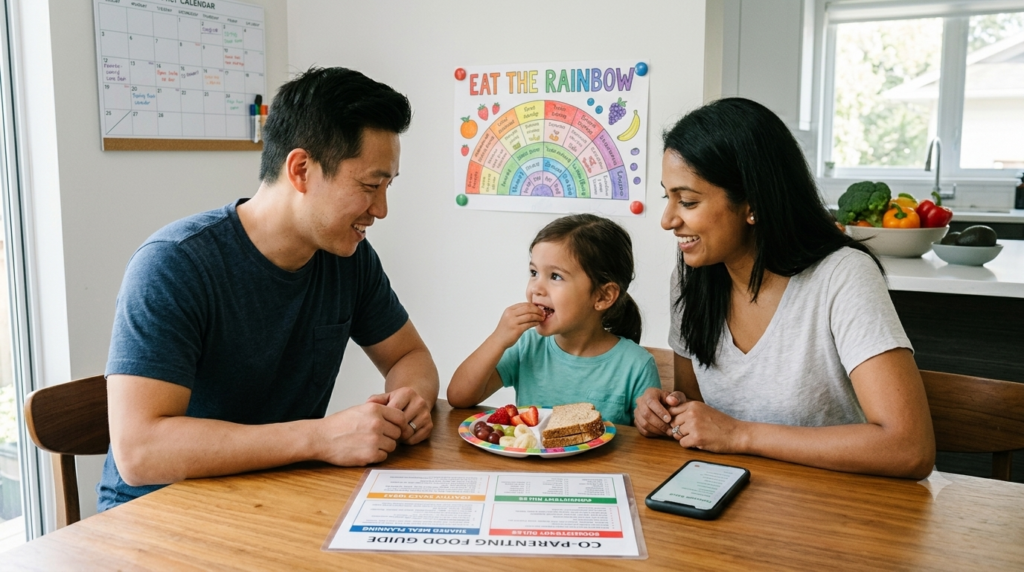
Co-parenting nutrition rules are shared agreements between parents about what their child eats, when meals and snacks are offered, how treats are handled, and how food-related decisions are communicated.
These rules are particularly helpful when parents have different approaches to food or when a child moves between two households.
For example, one parent may believe sweets should be avoided completely, while the other feels that occasional treats are perfectly normal. Neither conversation needs to become a fight. Parents can agree on reasonable boundaries that protect their child’s health while allowing flexibility.
A good co-parenting nutrition plan answers five basic questions:
The objective is not to control every bite. It is to establish a predictable, supportive food environment in which children can develop healthier habits over time. Consistent routines and responsive feeding practices are also recommended in pediatric guidance.
In my experience with parenting conversations, many disagreements that appear to be about food are actually about something deeper: expectations, anxiety, responsibility, and the fear of doing the wrong thing for a child.
Let’s look at some common situations in Indian households.
One parent carefully plans meals, prepares home-cooked food, and limits packaged snacks. They may feel frustrated when the other parent gives the child biscuits, chips, chocolates, or sugary drinks without discussing it first.
The strict parent may think, “I’m trying so hard to protect our child’s health. Why are we undoing that effort?”
The other parent may feel accused or controlled.
The solution: Agree on everyday food habits and reasonable exceptions instead of expecting either parent to follow an unspoken standard.
In many Indian families, grandparents show affection through food.
A grandparent might say, “Let the child eat one more ladoo. Childhood comes only once!”
Meanwhile, the parents may be trying to establish boundaries around sweets.
Instead of turning this into a generational argument, agree on a simple family rule: treats can be enjoyed occasionally, but they do not replace regular meals.
One parent may worry that the child isn’t eating enough. The other may focus on the nutritional quality of the food.
This can lead to pressure at the dining table:
“Finish your tiffin.”
“Just one more bite.”
“You haven’t eaten anything!”
However, children’s appetites naturally vary. Forcing them to finish every portion can make mealtimes stressful and interfere with their ability to respond to hunger and fullness cues.
Between school, tuition, homework, sports, office hours, and commuting, Indian families often have limited time to plan meals.
One parent may prepare a tiffin at 7 a.m., while the other handles dinner after returning from work.
Without communication, children may end up eating irregularly or relying too often on convenient packaged foods.
The answer is not to create a perfect schedule. It is to agree on a routine that your family can realistically maintain.
For many Indian parents, the school tiffin is where nutrition disagreements begin.
One parent packs vegetables and roti. The child returns with half the food untouched. The next day, the parent adds a favourite snack. A few days later, the lunchbox becomes a daily negotiation.
Here is a more practical approach.
An untouched tiffin does not automatically mean that the parent packed the wrong food or that the child is being difficult.
The child might not have been hungry, might have had too little time to eat, or might dislike the texture or temperature of a particular food.
Ask calm, specific questions:
These questions help you understand the problem instead of immediately blaming the child or the other parent.
Instead of deciding the lunchbox menu every morning, create a list of foods your child generally enjoys and rotate them through the week.
Here are some Indian-friendly ideas.
Monday: Vegetable poha

An easy-to-eat option with vegetables. Adjust the portion to your child’s appetite.
Tuesday: Vegetable paratha

Pair with curd or another suitable accompaniment, considering food safety for school storage.
Wednesday: Idli

A familiar, easy-to-handle option for children who enjoy South Indian food.
Thursday: Paneer or vegetable sandwich

A convenient alternative with protein-rich ingredients and vegetables.
Friday: Vegetable pulao

A familiar one-box meal that can be adapted to your child’s preferences.
These are suggestions, not a prescribed diet. Children have different nutritional requirements, allergies, preferences, and appetites. Choose meals accordingly and consult a qualified pediatrician or dietitian when individualized advice is needed.
Children are often more willing to try foods when they have some age-appropriate choice.
You could ask, “Would you prefer idli or vegetable paratha tomorrow?”
Notice that you’re offering a choice between two acceptable options rather than asking, “What do you want to eat?” and leaving the entire decision open.
This gives children a sense of involvement without making them responsible for managing their nutrition.
Let’s be realistic. Most families will have birthdays, festivals, restaurant outings, family gatherings, and occasions when children enjoy their favourite treats.
The goal is not to create a home where a child feels guilty for eating a chocolate.
The goal is to prevent treats from becoming the centre of every food-related decision.
Parents can discuss these questions privately:
The exact rules will differ from family to family. What matters is that both parents understand and broadly support them.
Consider this familiar statement:
“If you finish all your vegetables, I’ll give you chocolate.”
It may seem harmless, but repeatedly making a preferred food the reward for eating another food can reinforce the idea that the first food is something unpleasant to endure.
Similarly, taking away meals or using food to punish a child is not a helpful way to build healthy habits.
A better approach is to offer balanced meals, keep treats in perspective, and let children gradually develop familiarity with different foods. Pediatric guidance recommends avoiding food rewards and pressure to eat.
Avoid saying, “Your father always spoils you,” or “Your mother never lets you enjoy anything.”
Instead, discuss the situation privately and agree on how to handle similar situations in the future.
Your child should not have to choose sides in a disagreement about a biscuit.
Meal timing can be especially challenging when children attend school, tuition, music classes, sports practice, or evening activities.
One parent may insist on dinner at 7 p.m., while the other may find that unrealistic because of work commitments.
Rather than fighting over an exact time, create a flexible routine.
Agree on approximate windows for breakfast, lunch, dinner, and snacks, taking into account your child’s age, school hours, and hunger.
For example, a school-going child might have breakfast before school, a mid-morning snack if appropriate, lunch at school, an after-school snack, and dinner in the evening.
This is an example of a routine, not a universal schedule. Younger children may need more frequent eating opportunities, while teenagers may have different requirements.
Regular routines can help children know what to expect and reduce repeated negotiations over food.
If a child is repeatedly eating snacks throughout the afternoon, they may not feel hungry when dinner arrives.
Instead of constantly offering something to eat, plan reasonable snack opportunities between meals.
However, do not use this principle to ignore genuine hunger. The aim is a predictable routine, not rigid food restriction.
If a parent’s work schedule means dinner is consistently late, look for a practical alternative.
For example, the child might eat an earlier family meal with one parent, while the other joins later when possible. Alternatively, the family might agree on a suitable snack followed by dinner, depending on the child’s needs and timing.
Consistency does not mean every family member must eat at precisely the same time. It means having a plan everyone understands.
This is particularly important in separated or divorced families, but it applies to all co-parenting arrangements.
Avoid asking:
“What did your mother give you to eat?”
“Did your father let you have chips again?”
“Tell your mother she needs to stop giving you sweets.”
These questions put the child in the middle of an adult disagreement.
Instead, communicate directly with the other parent. If you share custody, consider a simple shared note or calendar for relevant meal information, food allergies, school events, and any special dietary instructions.
Keep the conversation factual rather than accusatory.
For example:
Hi, I think we should agree on a few simple food routines for our child so we can both follow a similar approach.
Can we discuss school tiffins, everyday snacks, treats, and approximate meal timings? I don’t expect everything to be perfect, but having a shared plan could help us avoid confusion and make mealtimes less stressful for everyone.
Let’s keep it practical and focus on what’s best for our child.
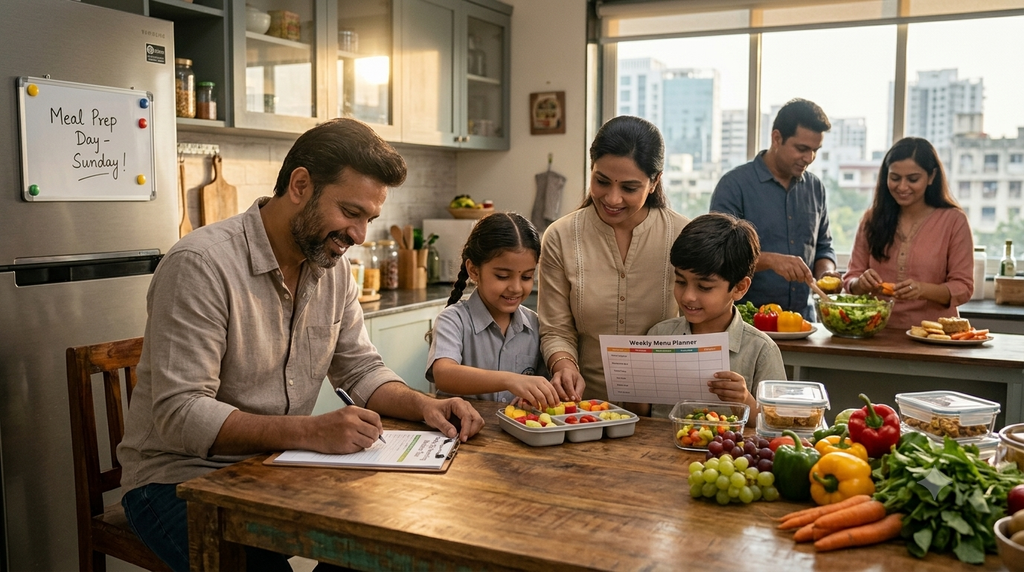
You don’t need a complicated spreadsheet or a list of dozens of restrictions. Start with a few rules that address your family’s biggest challenges.
Use this checklist during your next parenting discussion. Start with the essentials; you can revisit the plan as your child grows.
School tiffins
Agree on a shortlist of meals the child enjoys and review what comes back uneaten.
Treats and packaged snacks
Decide on reasonable household boundaries and how to handle celebrations.
Meal and snack routine
Set realistic time windows around school, work, tuition, and activities.
Screens at meals
Agree on when devices are put away and how exceptions are handled.
Respect for hunger
Avoid force-feeding, shaming, and requiring the child to finish every bite.
Parent communication
Discuss concerns directly, privately, and without blaming each other.
0 of 6 discussedCopy checklist
Review the agreement after a few weeks. If a rule is creating more stress than it solves, discuss how to adjust it.
A family routine should support the child, not become another source of pressure.
Picky eating is a common source of disagreement between parents.
One parent may want the child to try every food on the plate, while the other prefers to prepare a separate meal whenever the child refuses dinner.
Neither extreme necessarily solves the problem.
Try these practical steps:
The American Academy of Pediatrics recommends continued, low-pressure exposure to a variety of foods and discourages mealtime battles.
If your child has persistent feeding difficulties, significant food restrictions, pain when eating, poor growth, or symptoms that concern you, consult a pediatrician rather than treating the issue as a parenting disagreement.
Co-parenting across two homes introduces additional challenges.
One home may have a fixed dinner routine, while the other has more flexible timings. The available foods, school travel arrangements, and weekend activities may also differ.
The aim should be consistent principles, not identical kitchens.
Where practical, agree on the basics:
Other details, such as which vegetables are served or what a typical breakfast looks like, may reasonably differ between homes.
Children should not feel that enjoying a meal at one parent’s home is a betrayal of the other parent.
If you have a concern, address it privately and focus on a specific behaviour or practical solution.
For example, “Could we agree to pack a snack for the long drive?” is more productive than, “You never plan meals properly.”
Even well-intentioned parents can fall into patterns that make food more stressful than it needs to be.
| Common mistake | A better approach |
|---|---|
| Forcing a child to finish the plate | Offer suitable portions and respect hunger and fullness cues. |
| Banning every favourite treat | Create sensible boundaries that can be maintained. |
| Giving sweets to stop every tantrum | Comfort the child in other ways when appropriate. |
| Criticising the other parent over food | Discuss concerns privately and constructively. |
| Preparing a completely separate meal after every refusal | Offer familiar foods alongside the family meal when appropriate. |
| Expecting identical routines in both homes | Agree on shared principles and allow reasonable flexibility. |
| Judging nutrition from one meal | Look at the child’s overall eating pattern and growth. |
Healthy eating is not about achieving perfection every day. It is about establishing habits that are sustainable for the whole family. Current CDC guidance similarly emphasises healthy food choices, family role-modelling, and practical daily routines.
Here is something worth reflecting on: two parents can want exactly the same outcome and still approach it very differently.
One parent may show care by planning every detail. The other may show care by offering flexibility and avoiding conflict.
One may become anxious when a child skips a meal. The other may believe the child will eat when hungry.
The difficulty begins when these differences become personal judgements about who is the better parent.
Children benefit when adults can provide structure without unnecessary pressure, while allowing appropriate independence. This means offering nutritious options, maintaining reasonable routines, and letting children develop awareness of their own hunger and fullness signals.
It also means recognising that parenting is not only about what you tell your child to do. It is about the emotional environment in which your child learns those habits.
A tense dinner table can turn even a healthy meal into a negative experience. A calmer environment makes it easier for children to explore foods, communicate preferences, and participate in family routines.
They are shared agreements between parents about children’s meals, snacks, tiffins, treats, and eating routines. They help parents offer a consistent approach without requiring every meal to be identical.
Not necessarily. Parents should agree on important health and safety requirements and maintain broadly consistent routines. They can still have different menus, cooking styles, and reasonable household preferences.
Keep a range of suitable foods available, establish clear expectations about treats, and avoid turning every request into an argument. Involve your child in choosing snacks and explain boundaries calmly.
Generally, avoid forcing a child to finish every bite. Find out whether the issue is taste, portion size, lack of time, or another difficulty. If there are ongoing concerns about growth or nutrition, consult a pediatrician.
Start by discussing the specific concern rather than criticising their parenting overall. Agree on a small number of important shared principles and review what is realistically achievable. If conflict is persistent, a family counsellor or qualified mediator may help.
Establish predictable meal opportunities, minimise distractions where practical, avoid pressure or shaming, and make family meals an opportunity for connection rather than interrogation.
When parents disagree about tiffins, treats, or meal timing, the solution is rarely another argument about who is right.
It starts with a willingness to understand each other’s concerns, agree on a few practical boundaries, and remember that the purpose of these rules is to support the child’s well-being.
You don’t need to become perfect parents overnight. Start with one change: a shared tiffin plan, a calmer dinner routine, or an agreement to stop criticising each other in front of your child.
Small, consistent changes can make everyday parenting easier.
And remember, every child is different. Their age, preferences, developmental needs, temperament, and family environment all influence how routines work in practice.
Understanding your child—and understanding how you respond as a parent—is an important part of building a healthier home.
At SH Development Academy, we believe effective parenting starts with understanding the child in front of you—not comparing them with other children or expecting every child to respond in the same way.
Santosh Hariharan, DMIT Consultant, Parent & Career Coach, and Success Mindset Coach for Students, helps parents explore their child’s strengths, developmental needs, learning preferences, and areas where more thoughtful guidance may be useful.
If you’re looking for a broader understanding of your child and practical ways to support their growth, explore our DMIT service and counselling information.

Learn more about the DMIT assessment and the guidance available through SH Development Academy.Explore DMIT Services
Read what other parents have shared
Explore our Google reviews to learn about families’ experiences with our services.
Click here to see 400+ Google reviews
Contact SH Development Academy
+91 8421315400
+91 7303290862
Please note: DMIT is not a nutritional assessment, and it cannot determine a child’s dietary requirements or diagnose feeding difficulties. For nutrition-specific concerns, consult a qualified pediatrician or registered dietitian. Parenting guidance and child assessments should complement, not replace, appropriate professional advice.
Success & Happiness are the two most important yet elusive things which every human being yearns to achieve in life. Real success and happiness can be savoured only when one enjoys good health and good family relations, along with a good professional career and sound financial stability.
Our Visitor


 Users Today : 24