
Every evening, the same scene plays out in many Indian homes.
School ends. Your child comes home tired. There is homework waiting, perhaps a tuition class at 5 PM, an activity class after that—and somewhere in between, your child is asking:
“Can I go outside and play?” 🏃
And parents are left wondering:
Should I send my child for extra tuition or let them play?
For many parents, especially when marks start becoming important, tuition feels like the safer choice. After all, more study time should mean better results, right?
Not necessarily.
Children need academic support—but they also need movement, play, rest, social interaction and unstructured time for healthy development.
So the better question is not “After-school tuition vs play?”
It is:
“How can I create the right balance between learning and play for my child?”
And the answer can be very different for a 6-year-old, a 10-year-old and a 16-year-old.
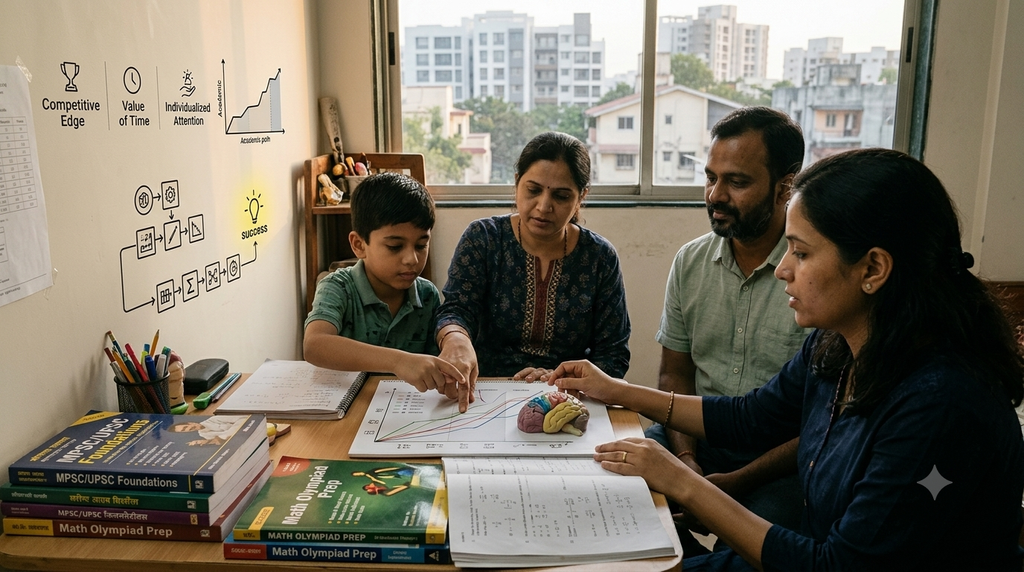
The pressure on children can start surprisingly early.
Parents often worry about:
As a result, the school day is often followed by another structured learning session.
Tuition can certainly be useful when a child genuinely needs subject-specific support.
But tuition should solve a particular learning problem—not automatically become an extension of the school day.
Play is sometimes treated as something children can do after the “important work” is finished.
But play itself is an important part of growing up.
Through age-appropriate play, children get opportunities to develop:
🏃 Physical coordination and fitness
🧠 Problem-solving and decision-making
🤝 Cooperation and social skills
🎨 Creativity and imagination
❤️ Emotional expression
💪 Confidence and independence
Outdoor play also gives children a break from sitting, screens and structured academic activities.
So when a child says, “I want to play,” it doesn’t automatically mean “I don’t want to study.”
Sometimes it simply means:
“I’ve been working hard and my brain needs a different kind of activity.”
There isn’t one answer that works for every child.
The key is need, not pressure.
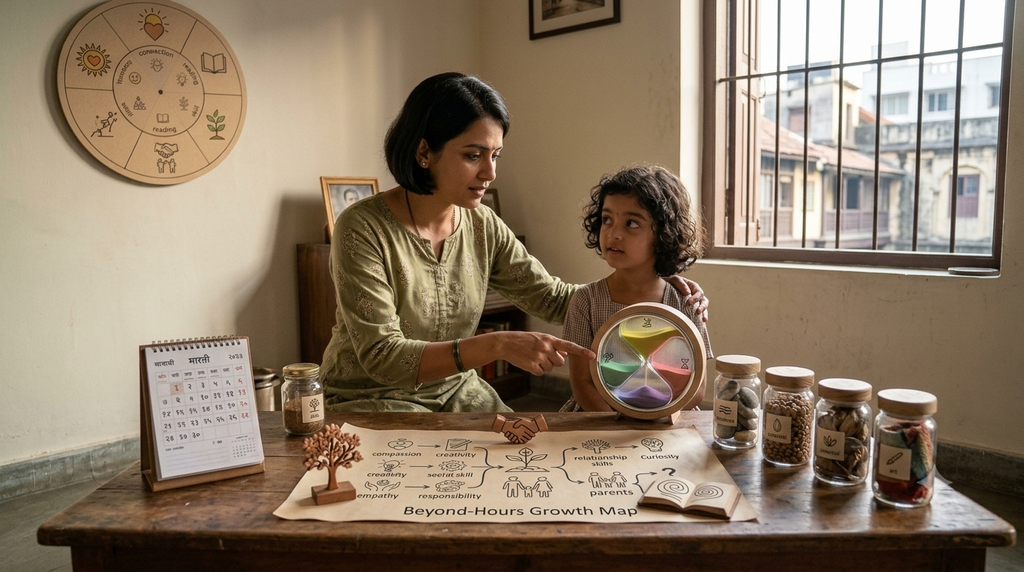
A child studying for three hours doesn’t automatically learn more than a child who studies for one focused hour.
Similarly, spending two hours playing doesn’t mean the child is wasting time.
What matters is quality, age, individual needs and balance.
A tired child sitting over a textbook may spend an hour “studying” while absorbing very little.
A refreshed child may accomplish the same task much more effectively.
That is why parents should look beyond the clock.
Ask:
“Is my child actually learning?”
rather than simply:
“How many hours did my child study?”
This is where things become interesting.
Two children can sit in the same classroom, have the same teacher and receive the same homework—but respond very differently.
One child may enjoy:
📚 Reading quietly
Another may learn better through:
🧩 Practical activities
Another may need:
🗣️ Discussion and explanation
Another may require:
🏃 Movement and hands-on learning
Understanding your child’s individual learning preferences can help parents decide how much structured academic support is actually useful.
This is one reason parents sometimes explore DMIT and other child-assessment tools as part of a broader conversation about their child’s strengths, learning preferences and development.
However, no single assessment should be treated as a complete description of a child. Parents should combine any assessment insights with everyday observation, school feedback and the child’s own interests.
This is where parents often feel guilty.
They think:
“If my child is weak in studies, I should increase tuition.”
Sometimes that is exactly what is required.
But before adding another class to the timetable, ask:
Is it because of:
The reason behind the struggle matters more than simply adding more hours.
Instead of thinking in extremes, think about creating a balanced evening.
For example:
School → Snack & Rest → Play/Physical Activity → Focused Study → Dinner → Light Revision/Reading → Sleep
The exact schedule will depend on the child’s age, school timings and academic requirements.
The goal isn’t to create a perfectly packed timetable.
The goal is to create a routine the child can actually sustain.
For younger children, especially in the primary years, parents should be careful about filling every afternoon with classes.
Children need opportunities to:
Academic foundations matter, but childhood shouldn’t become a continuous cycle of school → tuition → homework → sleep.
As children move into higher classes, academic demands naturally increase.
This is where targeted tuition can become useful if there are genuine learning gaps.
But even then, don’t remove play completely.
A middle-school child still needs:
The objective should be structured support without over-scheduling.
For teenagers, the equation changes again.
Academic pressure becomes more serious because students begin thinking about:
At this stage, additional academic support may be necessary for some students.
But teenagers also need time to recharge.
A sustainable routine is generally more useful than a timetable where every hour is occupied.
This is an important distinction.
A tutor can teach mathematics.
A tutor can explain chemistry.
A tutor can help with exam preparation.
But children also need parents who understand:
“What is happening with my child?”
Is your child genuinely struggling?
Or simply exhausted?
Is your child avoiding studies because of laziness?
Or because they don’t understand the subject?
Is your child spending too much time on the phone?
Or are they using the phone because they have no other meaningful activity?
These questions require parental observation and conversation, not just another tuition class.
Before paying for another class, sit down with your child and ask:
“What do you find difficult?”
Then ask:
“What do you enjoy?”
And finally:
“What do you think would help you?”
You may discover something you hadn’t noticed.
Sometimes the solution is tuition.
Sometimes it is a different teaching approach.
Sometimes it is a better study routine.
And sometimes the child simply needs a little breathing space.
Before deciding between more tuition and more play, ask yourself:
Look at patterns—not one bad test.
Marks alone don’t tell the whole story.
Don’t underestimate the importance of movement.
Children don’t need every minute planned.
If your child is constantly exhausted, something may need to change.
The answer is not “tuition” or “play.”
It is the right balance for your particular child.
📚 Tuition can provide targeted academic support when it is genuinely needed.
🏃 Play supports physical, social, emotional and cognitive development.
😴 Rest allows the child to recover.
❤️ Family time builds connection.
🎯 Focused study develops academic discipline.
A successful childhood needs more than marks.
This is perhaps the most important takeaway for parents.
Instead of asking:
“How many classes should I put my child into?”
start asking:
“What does my child actually need?”
Every child has different strengths, interests, learning preferences and areas that need support.
At SH Development Academy, we encourage parents to look at the whole child—not just marks.
A DMIT consultation can be one way to begin a structured conversation around a child’s strengths, learning preferences and potential. It should be used as a guidance tool, alongside parental observation, school feedback and the child’s interests—not as a replacement for them.
If you’re a parent who is constantly wondering:
“Am I pushing my child too much?”
“Does my child need tuition?”
“What kind of learning approach suits my child?”
“Where are my child’s natural strengths?”
A DMIT Consultation can help you start looking at these questions from a more individual perspective.
At SH Development Academy, Santosh Hariharan brings his experience as a DMIT Consultant, Parent & Career Coach and Student Success Mindset Coach to help parents understand their children and make more informed parenting and academic decisions.
You can also speak with us directly:
📞 +91 8421315400 | +91 7303290862
⭐ 400+ parents have trusted our guidance.
Click here to see our 400+ Google Reviews
Because sometimes, the best thing a parent can do isn’t add another class to the timetable—it is first understanding the child sitting in front of them.
Success & Happiness are the two most important yet elusive things which every human being yearns to achieve in life. Real success and happiness can be savoured only when one enjoys good health and good family relations, along with a good professional career and sound financial stability.
Our Visitor


 Users Today : 6