

Parenting can sometimes feel like a full-time job with no training manual.
You want your child to study well, stay disciplined, build confidence, make good choices, develop useful skills—and eventually choose the right career.
So naturally, parents try to do everything.
More classes.
More activities.
More advice.
More reminders.
More checking.
But what if better parenting isn’t always about doing more?
What if it is about identifying the few things that make the biggest difference?
That is the idea behind 80/20 parenting.

The 80/20 rule, also known as the Pareto Principle, is commonly expressed as the idea that a relatively small number of inputs can produce a large share of the results.
In parenting, we can use this as a practical thinking framework rather than a mathematical formula.
Instead of asking:
“How can I improve everything about my child?”
Ask:
“Which few things, if improved, would make the biggest positive difference?”
For one child, it may be sleep and routine.
For another, it may be confidence and communication.
For another, it may be study habits and concentration.
And for another, it may simply be reducing constant comparison.
The 20% will not be the same for every child.
That is where understanding your individual child becomes important.
Parenting in 2026 comes with a unique set of challenges.
Children are surrounded by:
📱 Constant digital stimulation
📚 Academic competition
🎮 Gaming and entertainment
🏆 Comparison with peers
🎯 Increasing pressure to “perform”
Parents, meanwhile, are bombarded with advice about what their child should be doing.
The result?
Many parents end up focusing on quantity instead of quality.
“How many hours did you study?”
“How many marks did you get?”
“How many classes are you attending?”
But sometimes the more important questions are:
Is your child actually learning?
Does your child know how to learn?
Does your child believe in themselves?
Do you understand how your child naturally thinks and learns?

There is no universal parenting formula.
However, in my experience working with parents and students, a few areas repeatedly deserve attention.
Two children can sit in the same classroom, listen to the same teacher and receive the same homework—but learn very differently.
Some children respond better to:
Instead of immediately concluding that a child is “not interested in studies,” first ask:
“Are we helping this child learn in a way that works for them?”
Parents naturally notice what their child is not doing well.
Low marks.
Poor handwriting.
Lack of concentration.
Slow reading.
But constantly focusing on weaknesses can affect confidence.
Try a different approach:
Identify the child’s strengths and build from there.
A child who is good at communication may develop confidence through public speaking.
A child who loves building things may learn better through practical activities.
A child who enjoys solving puzzles may respond well to logical challenges.
Strengths can become the foundation for development.
Sometimes the biggest parenting improvement doesn’t require another class or another app.
It requires a better conversation.
Instead of:
“Why did you get such low marks?”
Try:
“Which part did you find difficult?”
Instead of:
“You never concentrate.”
Try:
“What usually distracts you when you’re studying?”
The first approach can create defensiveness.
The second can create understanding.
Better questions often lead to better parenting decisions.
A child can recover from a poor test score.
But repeatedly hearing:
“You are lazy.”
“You are not good enough.”
“Look at your cousin.”
“Your friend scores better than you.”
can gradually affect how they see themselves.
Correct the behaviour when necessary—but don’t make the child feel that they are the problem.
There is a big difference between:
“This habit needs to change.”
and
“You are not capable.”
Modern parenting can easily become a race of activities.
School + tuition + coding + sports + music + dance + competitions…
More isn’t automatically better.
Ask:
“Why are we choosing this activity?”
Does it develop a genuine interest?
Does it build a useful skill?
Does the child enjoy it?
Does it complement their strengths?
Sometimes the smartest decision is not adding another activity—but removing one that isn’t helping.
This is important.
The 80/20 parenting rule is not an excuse to ignore important areas of your child’s development.
Children still need:
The idea is simply to identify the areas where your attention can create the greatest positive impact.
This is where a DMIT report can become a useful parenting reference point.
Parents often know their child very well—but they may not always know how to interpret what they observe.
A DMIT consultation can provide a structured discussion around areas such as:
Instead of randomly trying different parenting strategies, the report can become a starting point for asking better questions about your child.
Think of it as a conversation tool—not a crystal ball.
DMIT should not be treated as a guaranteed prediction of a child’s future or as a replacement for professional psychological or educational assessment where those are needed.
Take five minutes today and write down:
What does your child naturally enjoy or do well?
Where do you repeatedly face difficulty?
Ask yourself:
“If I could improve just ONE thing in the next 30 days, what would create the biggest positive change?”
Start there.
Don’t try to transform everything at once.
There is no perfect child.
And there is no perfect parent.
The goal is to understand your child well enough to provide the right support at the right stage.
Sometimes your child doesn’t need more pressure.
They need more understanding.
Sometimes they don’t need another class.
They need confidence.
Sometimes they don’t need longer study hours.
They need a better study approach.
And sometimes, parents don’t need more parenting advice.
They need better insight into the child sitting in front of them.
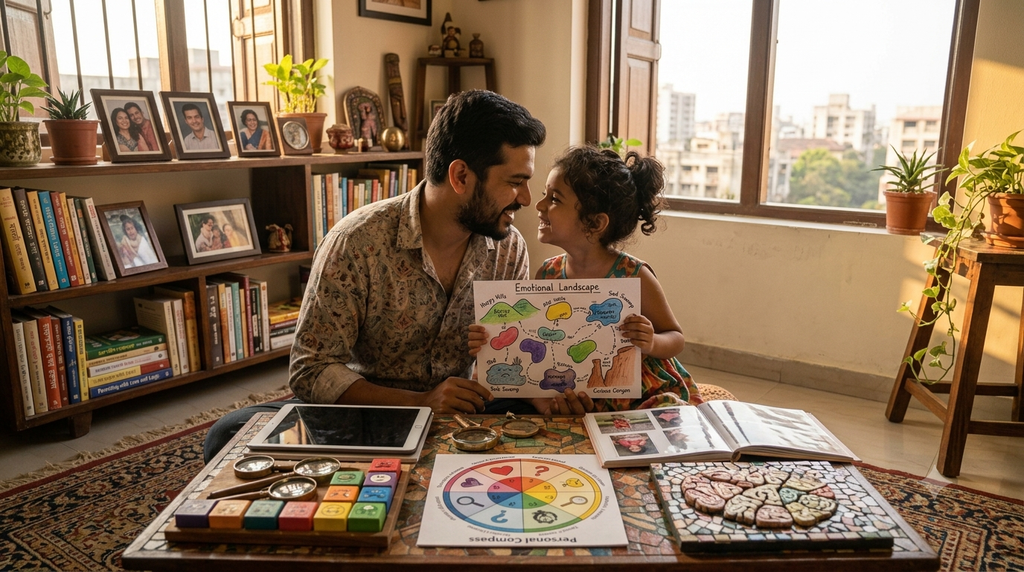
At SH Development Academy, we work with parents and students to understand individual strengths, learning preferences, personality tendencies and possible career directions through DMIT consultation and parent-focused guidance.
Santosh Hariharan is a DMIT Consultant, Parent & Career Coach, and Success Mindset Coach for Students, with extensive experience working with parents and students.
If you’re wondering:
“Am I really understanding my child?”
or
“What should I focus on at this stage of my child’s development?”
A personalised DMIT consultation can be a useful starting point for that conversation.
📞 +91 8421315400 | +91 7303290862
And if you’d like to know what other parents have experienced with our guidance:
Don’t try to do everything.
Start by understanding what matters most for your child—and focus there.
Success & Happiness are the two most important yet elusive things which every human being yearns to achieve in life. Real success and happiness can be savoured only when one enjoys good health and good family relations, along with a good professional career and sound financial stability.
Our Visitor


 Users Today : 3