Returning to work after a career break—or starting something completely new while raising a family—is a big decision.
And for many mothers, the question isn’t simply:
“Which career has more scope?”
The more important question is:
“Which career can I realistically build while managing my family, energy, responsibilities and long-term goals?”
If you are exploring career options for working moms, two fields that naturally come up are Data Analytics and Digital Marketing.
Both offer opportunities to work with modern businesses, build new skills and potentially access flexible or hybrid work. But they are very different in the kind of work they demand.
So, Data Analytics vs Digital Marketing for moms — which one is actually a better fit?
Let’s look at it from a mother’s point of view—not just from the perspective of job titles and salaries.
First: There Is No “Best Career” for Every Mom
This is something I tell people during career counselling quite often.
A career that works beautifully for one mother may become stressful for another.
Your decision should depend on your:
In other words, don’t choose a career just because it is trending. Choose one that fits you.
That becomes particularly important today because technology is changing the skills employers value. The World Economic Forum’s Future of Jobs Report 2025 identifies analytical thinking as a leading core skill, while AI and big data, technological literacy, creative thinking, resilience and lifelong learning are among the skills expected to grow in importance through 2030.

Data Analytics is about taking information—numbers, customer behaviour, business data, sales figures and other datasets—and turning it into useful insights.
A data analyst may work with:
For example, imagine an online company has 10,000 customers.
A data analyst might help answer:
Which products are selling the most?
Why are customers dropping off?
Which marketing campaign generated better results?
What does the sales data tell us about future demand?
So if you naturally enjoy numbers, logic, patterns and problem-solving, Data Analytics may be worth exploring.

Digital Marketing is about helping a business attract, engage and convert customers through digital channels.
This can include:
For example, a digital marketer might help a coaching institute generate enquiries through Instagram and Google, create content, run advertising campaigns and analyse which campaigns are bringing better-quality leads.
If you enjoy communication, creativity, psychology, content, persuasion and understanding people, Digital Marketing may feel more natural.
Here’s a simple way to look at it:
| Data Analytics | Digital Marketing |
|---|---|
| Numbers & data | People & communication |
| Analytical thinking | Creative thinking |
| Problem-solving | Marketing & persuasion |
| Excel, SQL, Power BI etc. | SEO, social media, ads, content etc. |
| More structured work | Often more dynamic |
| Data-driven decisions | Customer-driven decisions |
| Good for analytical minds | Good for communicative/creative minds |
Neither is automatically better.
The better option is the one that matches your strengths and lifestyle.
This is where the comparison becomes interesting.
Many mothers aren’t looking for a conventional 9-to-6 career immediately.
They may want:
Work + Family + Personal Time
Digital Marketing can sometimes offer more opportunities for freelance, consulting, agency and project-based work. However, flexibility depends heavily on the employer, role and client expectations.
Data Analytics can also have hybrid or remote opportunities, but many roles are structured around business teams, reporting cycles and organisational schedules.
So don’t assume:
“Digital marketing = work whenever I want.”
That’s not always true.
A client-facing digital marketing role can involve campaign deadlines, meetings, content calendars and urgent requests.
Similarly, an analytics role can have deadlines around monthly reporting, business reviews and projects.
Flexibility comes from the specific role—not merely the career name.
Ask yourself:
✔️ Do I enjoy working with Excel or numbers?
✔️ Do I like finding patterns?
✔️ Do I enjoy solving logical problems?
✔️ Can I sit for extended periods analysing information?
✔️ Does technology interest me?
✔️ Do I enjoy making decisions based on evidence rather than intuition?
If most of your answers are yes, Data Analytics may be worth exploring.
You don’t have to be a mathematics genius.
But you should be willing to develop analytical and technical skills.
Now ask yourself:
✔️ Do I enjoy writing or communicating?
✔️ Do I understand what makes people interested in something?
✔️ Do I enjoy social media?
✔️ Am I creative?
✔️ Do I like experimenting with ideas?
✔️ Would I enjoy helping businesses attract customers?
If these sound like you, Digital Marketing could be a strong option.
And your previous experience can sometimes become an advantage.
For example, a mother who previously worked in sales, HR, teaching, customer service or business development may already possess communication and people skills that can transfer into digital marketing.
This is one of the biggest concerns I hear from mothers.
“I have been away from work for 5 years. Can I really start again?”
Yes—but don’t underestimate the importance of upskilling and building evidence of your current abilities.
Your career gap doesn’t erase your previous experience.
If you previously worked in:
you may already have valuable transferable skills.
The question becomes:
How can you combine your previous experience with a new-age skill?
For example:
HR + Digital Marketing → Employer Branding / Recruitment Marketing
Finance + Data Analytics → Business / Financial Analytics
Sales + Data Analytics → Sales Analytics
Teaching + Digital Marketing → Education Marketing / Content
This is often smarter than starting completely from zero.

There’s no universal answer.
Your learning experience will depend on your existing skills.
But remember:
“Easy to learn” and “easy to build a career in” are two different things.
Both require practice, continuous learning and real-world experience.
Both fields are evolving.
Data and AI-related skills are clearly becoming increasingly important across industries. The World Economic Forum expects AI and big data to be among the fastest-growing skill areas through 2030. At the same time, marketing and media skills are also expected to evolve as technology changes how businesses reach customers.
The bigger lesson for a mother returning to work is:
Don’t build your career around one tool. Build transferable skills.
For example:
Instead of simply learning “Power BI,” learn data interpretation and business decision-making.
Instead of simply learning “Instagram marketing,” learn customer psychology, content strategy, performance marketing and analytics.
Tools change.
Strong skills stay valuable.
Both can potentially lead to freelance work.
You could eventually offer:
You could potentially offer:
However, freelancing isn’t automatically flexible or easy.
You still need to find clients, deliver consistently and build credibility.
This is where many career decisions go wrong.
People often search:
“Which career pays more?”
But your initial income depends on several factors:
A beginner in either field may start modestly.
With experience, specialisation and strong results, opportunities can improve.
So instead of asking:
“Which career gives the highest salary?”
Ask:
“Which career can I become genuinely good at—and continue developing for the next 5–10 years?”
That’s a much better career question.
If you are still confused, try this:
🧠 Analytical
📊 Number-oriented
🔍 Curious
💻 Technology-friendly
🧩 Problem-solving oriented
💬 Communicative
🎨 Creative
🧠 People-oriented
📱 Digitally active
🎯 Persuasive
And if you’re somewhere in the middle?
That’s perfectly normal.
That’s when personalised career assessment becomes useful.
This is perhaps the most important advice I would give a working mother.
Every few months, there’s a new “hot career.”
Today it’s AI.
Tomorrow it may be something else.
But your career is not a trend.
It’s a long-term investment of your:
Time + Energy + Skills + Family Resources
Before enrolling in an expensive course, take a step back.
Understand yourself first.
Then understand the career.
Then decide whether the two actually fit.
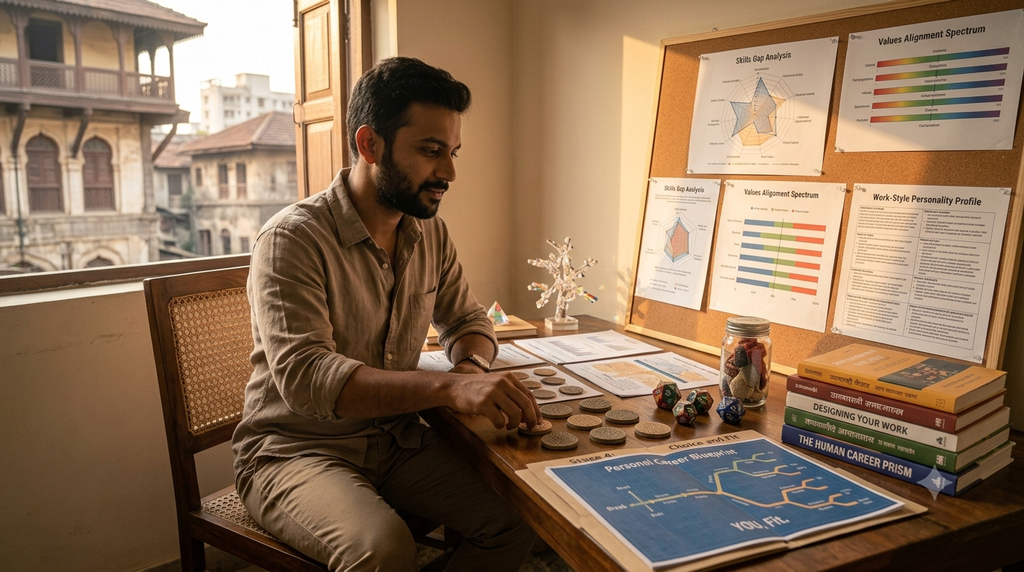
A professional career assessment can help you explore the connection between:
Your Aptitude + Personality + Interests + Strengths + Career Preferences
This is particularly useful when you’re considering two completely different fields such as Data Analytics vs Digital Marketing.
Instead of asking:
“Which career is popular?”
you can start asking:
“Which career is more aligned with me?”
That’s a much more meaningful question.
There is no single winner.
Numbers + Logic + Technology + Problem-Solving
Communication + Creativity + People + Business
But for a working mom, there’s one more factor that matters:
Your ideal career should not only look good on paper.
It should work with your life.
And that’s why career planning should begin with understanding you, rather than blindly following the latest career trend.

If you’re a working mom—or a mother planning to return to work after a career break—and you’re confused between Data Analytics, Digital Marketing or other career options, you don’t have to make the decision alone.
At SH Development Academy, we believe career guidance should begin with understanding the individual—not simply recommending whatever career is currently trending.
A DMIT & Career Guidance Consultation can help you understand your strengths, interests, aptitude and potential career directions so you can make a more informed decision.
If you’re ready to explore your next career step, you can book your consultation here:
⭐ 400+ parents have trusted our guidance.
See 400+ Google Reviews
📞 Call / WhatsApp: +91 8421315400 | +91 7303290862
Your career restart doesn’t have to mean starting from zero. Sometimes, it simply means starting again—with better clarity.
Success & Happiness are the two most important yet elusive things which every human being yearns to achieve in life. Real success and happiness can be savoured only when one enjoys good health and good family relations, along with a good professional career and sound financial stability.
Our Visitor


 Users Today : 6