
Artificial Intelligence (AI) is no longer a futuristic concept—it’s already transforming the way we live, learn, work, and solve problems. From ChatGPT and self-driving cars to medical diagnosis, fraud detection, and personalized recommendations on Netflix or Amazon, AI is becoming a part of our everyday lives.
Because of this rapid growth, AI Engineer has become one of the most in-demand and highest-paying career options in 2026. Companies across industries are actively looking for professionals who can build intelligent systems, automate processes, and solve real-world problems using AI.
But here’s the question many students and parents ask us during career counselling sessions:
“What skills are actually required to become an AI Engineer?”
Is it only about coding?
Do you need to be a maths genius?
Can an average student become an AI Engineer?
What should students start learning after 10th or 12th?
These are genuine questions—and the answers are more encouraging than you might think.
Over the last few years, Artificial Intelligence has moved from being a niche technology to becoming a core business tool. Today, AI is being used in almost every industry:
This widespread adoption has created an enormous demand for skilled AI professionals worldwide.
According to recent industry reports, companies are investing heavily in Generative AI, Machine Learning, Large Language Models (LLMs), AI Automation, Computer Vision, and Robotics, making AI Engineering one of the most future-proof career choices for students.

There are several reasons why AI Engineering is attracting students across India.
AI Engineers are among the highest-paid technology professionals. Even fresh graduates with strong practical skills can earn attractive salaries, while experienced AI professionals often command premium compensation in India and abroad.
AI professionals don’t work in just one industry. They have opportunities in:
This flexibility makes AI one of the most versatile career paths available today.
AI is a field that constantly evolves. New tools, frameworks, and technologies emerge regularly, making it an exciting career for students who enjoy solving problems and learning new things.
The skills required for AI Engineering are recognized worldwide. This opens opportunities not only in India but also in countries like the USA, Canada, Germany, Singapore, Australia, and the UAE.
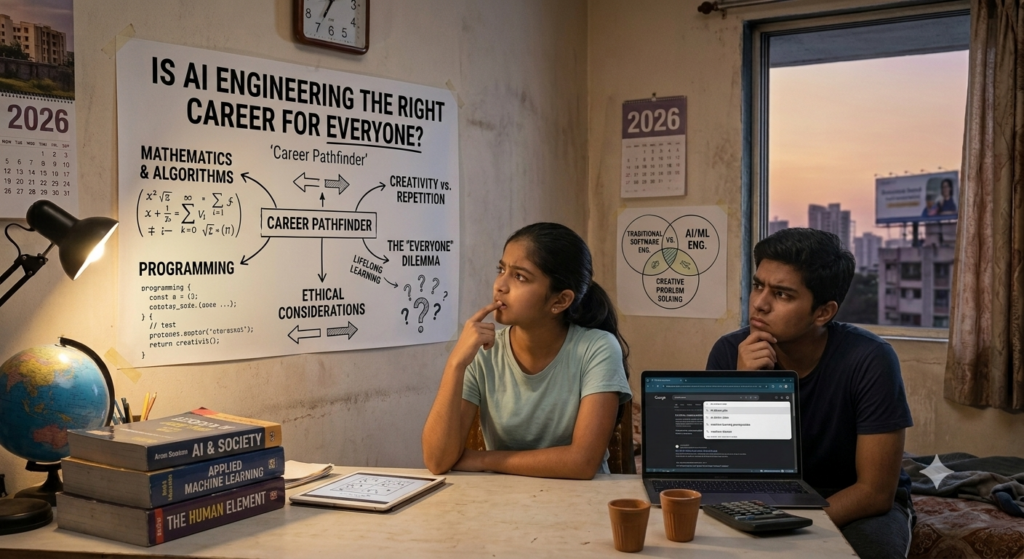
This is one of the most important questions that parents often overlook.
Many students choose AI simply because it’s trending.
However, choosing a career only based on market demand isn’t always the best decision.
As a DMIT Consultant, Parent & Career Coach, I’ve seen students struggle because they selected careers based on popularity rather than their natural strengths and interests.
A successful AI Engineer usually enjoys:
If a student’s natural abilities align with these traits, AI Engineering can become an excellent career choice.
On the other hand, if a student has stronger creative, interpersonal, artistic, or entrepreneurial strengths, there may be other careers where they can perform even better.
That’s why understanding your child’s natural aptitude before choosing a career is just as important as understanding market trends.
In this comprehensive guide, we’ll cover:
✅ The top technical and soft skills required to become an AI Engineer
✅ A step-by-step roadmap after 10th, 12th, or graduation
✅ Programming languages every AI student should learn
✅ Essential mathematics and machine learning concepts
✅ Latest AI tools and technologies in 2026
✅ Salary expectations and career opportunities
✅ How to know if AI Engineering is the right career for you
Whether you’re a school student, college student, parent, or someone planning a career switch, this guide will help you understand what it really takes to build a successful career in Artificial Intelligence.
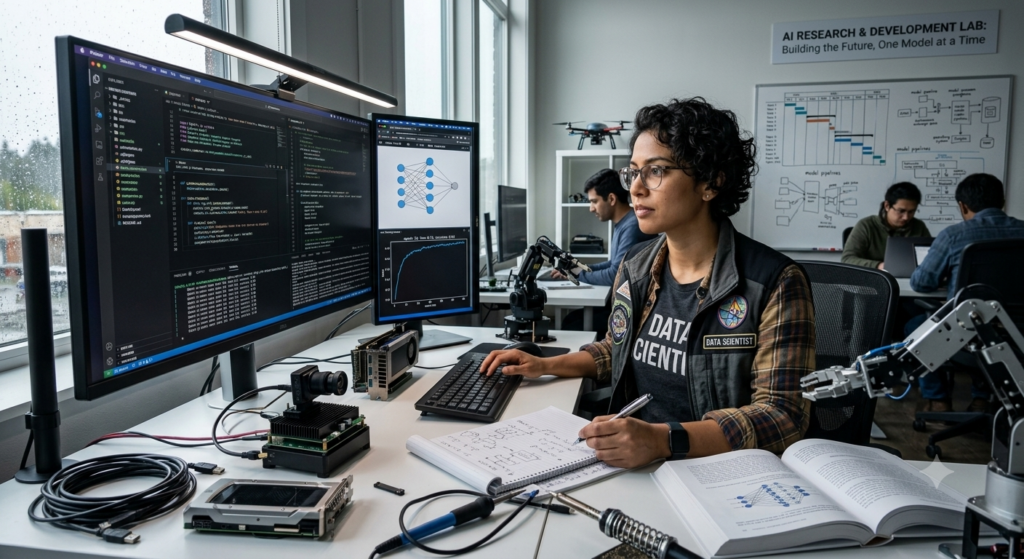
When students hear the term AI Engineer, they often imagine someone sitting in front of multiple computer screens writing thousands of lines of code all day.
The reality is quite different.
An AI Engineer is someone who builds intelligent systems that can learn from data, make predictions, solve problems, and automate tasks that normally require human intelligence.
Think about the AI tools you use every day.
Behind each of these smart systems is a team of AI Engineers who design, train, test, and improve these technologies.
Simply put, an AI Engineer teaches computers how to think smarter—not like humans, but in ways that help solve real-world problems more efficiently.
The work of an AI Engineer goes far beyond coding.
Depending on the company and project, an AI Engineer may be responsible for:
AI Engineers create models that can identify patterns from large amounts of data.
For example:
The more quality data these models receive, the smarter they become.
One of the biggest parts of an AI Engineer’s job is working with data.
They clean messy datasets, remove errors, organize information, and prepare it before training AI models.
There’s a famous saying in the AI industry:
“Garbage in, garbage out.”
Even the smartest AI model cannot produce good results if it’s trained using poor-quality data.
Once the data is ready, AI Engineers train algorithms to recognize patterns.
For example, if you’re creating an AI system that identifies cats and dogs, you’ll train it using thousands of labeled images until it learns the difference on its own.
This process is called Machine Learning.
Building an AI model is only half the work.
AI Engineers constantly evaluate:
They continuously improve the model so it becomes more reliable over time.
Once the model performs well, it is integrated into websites, mobile apps, software, or business systems.
For example:
A hospital may use AI to detect diseases from X-rays.
A bank may use AI to identify suspicious transactions.
An e-commerce company may use AI to recommend products based on customer preferences.
One of the biggest advantages of becoming an AI Engineer is that your skills are valuable across almost every industry.
Here are some sectors actively hiring AI professionals in 2026:
AI helps doctors detect diseases earlier, analyze medical images, and personalize treatments.
Banks use AI for:
Companies use AI to:
AI powers:
Educational platforms now use AI to:
Modern farming uses AI for:
Factories rely on AI to:
AI Engineers also help businesses build:
Many students ask,
“What does an AI Engineer actually do every day?”
A typical workday may include:
✔ Writing Python code
✔ Cleaning and analyzing datasets
✔ Training machine learning models
✔ Testing AI algorithms
✔ Collaborating with software developers
✔ Discussing business problems with clients
✔ Improving AI accuracy
✔ Learning new AI tools and frameworks
One interesting aspect of this profession is that learning never stops.
Artificial Intelligence evolves rapidly, and successful AI Engineers continuously upgrade their knowledge to stay ahead.
Absolutely not.
Many students believe that becoming an AI Engineer is only about learning programming languages like Python.
While coding is essential, it’s only one piece of the puzzle.
The best AI Engineers combine technical knowledge with:
In fact, companies today are looking for professionals who can not only build AI models but also understand how those models solve real business problems.
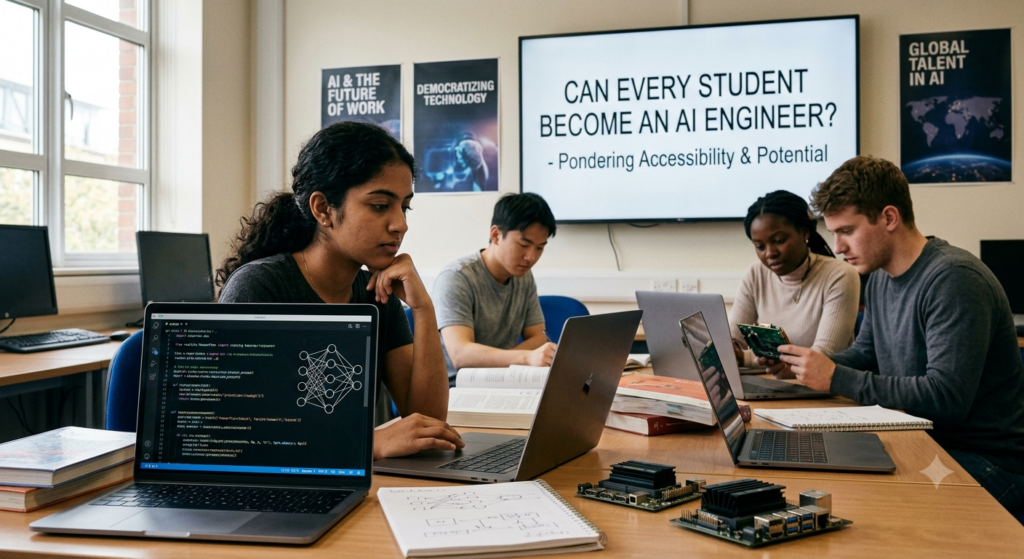
This is where career guidance becomes extremely important.
AI Engineering is a fantastic career—but it isn’t the perfect fit for everyone.
Students who usually enjoy AI tend to have strengths in:
However, every child has unique natural abilities.
Some are naturally inclined toward design, psychology, business, communication, sports, entrepreneurship, or the creative arts.
Choosing a career simply because it’s popular can lead to years of frustration if it doesn’t align with a student’s strengths.
As a DMIT Consultant, Parent & Career Coach, I’ve seen students flourish when they choose careers that match both their natural aptitude and future industry demand.
AI Engineering is undoubtedly one of the fastest-growing professions—but the right career is the one where your abilities, interests, and opportunities come together.
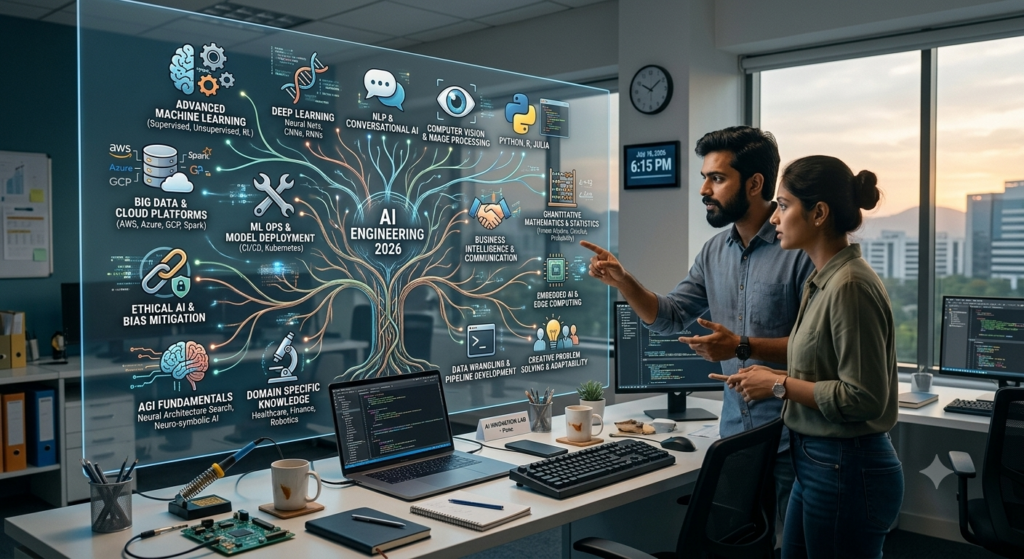
Now that you understand what an AI Engineer does, let’s answer the most important question:
What skills are required to become an AI Engineer in 2026?
The good news is—you don’t need to master everything on Day 1.
The best AI Engineers develop their expertise step by step. They start with programming, strengthen their mathematical foundation, learn Machine Learning, and gradually explore advanced areas like Generative AI, Computer Vision, and Large Language Models (LLMs).
Let’s explore the most important skills every aspiring AI Engineer should develop.
If AI Engineering had one universal language, it would be Python.
Almost every AI application today is built using Python because it is:
✅ Easy to learn
✅ Beginner-friendly
✅ Supported by thousands of AI libraries
✅ Widely used in industry
Popular Python libraries include:
Although Python is the most important language, learning Java, C++, or R can also be helpful depending on your career goals.
Don’t just memorize Python syntax.
Build projects.
Projects teach far more than theory ever can.
This is one skill many students try to avoid—but it’s incredibly important.
You don’t have to become a mathematician, but you should understand concepts like:
Why?
Because Machine Learning algorithms rely heavily on mathematical concepts to identify patterns and make predictions.
The stronger your mathematical thinking, the easier AI concepts become.
Machine Learning is the heart of Artificial Intelligence.
Instead of giving computers fixed instructions, Machine Learning allows them to learn from data.
For example:
Suppose you show an AI model 50,000 images of cats and dogs.
Eventually, it learns to identify new images without being explicitly programmed.
That’s Machine Learning.
Important concepts include:
This is one of the most essential skills required to become an AI Engineer.
Deep Learning is an advanced branch of Machine Learning inspired by how the human brain processes information.
It powers many modern AI applications like:
🤖 ChatGPT
🎤 Voice Assistants
🚗 Self-driving Cars
📸 Face Recognition
🎬 AI Video Generation
Deep Learning uses Artificial Neural Networks to solve highly complex problems.
Frameworks you’ll commonly use include:
In 2026, Deep Learning skills are in exceptionally high demand because of the rapid growth of Generative AI.
AI Engineers don’t just build intelligent systems.
They also write efficient code.
This is where Data Structures and Algorithms become important.
Students should understand:
Strong DSA skills help you:
Artificial Intelligence runs on one thing:
Data.
Without quality data, even the smartest AI model won’t perform well.
AI Engineers should know how to:
Common tools include:
A good AI Engineer spends almost as much time understanding data as building AI models.
Every AI system stores and retrieves large amounts of information.
That’s why database knowledge is essential.
Students should learn:
Popular databases include:
Good database skills make AI applications more efficient.
Most modern AI applications are deployed on cloud platforms instead of personal computers.
Popular cloud providers include:
Learning cloud computing helps AI Engineers:
Cloud skills have become a major advantage in AI careers.
Have you ever chatted with ChatGPT?
Used Google Translate?
Asked Alexa a question?
That’s Natural Language Processing (NLP).
NLP enables computers to understand, process, and generate human language.
Applications include:
With Generative AI growing rapidly, NLP has become one of the hottest skills in AI Engineering.
Computer Vision teaches machines to “see” and interpret images and videos.
Examples include:
📷 Face Unlock on smartphones
🚗 Self-driving vehicles
🏥 Medical image analysis
🏭 Quality inspection in factories
🛒 Cashier-less stores
Students interested in AI should definitely explore Computer Vision projects.
If there is one skill that’s transforming AI careers in 2026, it’s this.
Generative AI refers to systems that create new content like:
Examples include:
Understanding how Large Language Models work—and how to integrate them into applications—is becoming a highly valuable skill for AI Engineers.
Prompt Engineering has emerged as a practical skill in the era of Generative AI.
It involves writing clear, structured instructions that help AI models produce better results.
For example:
Instead of asking,
“Write an article.”
An effective prompt would specify:
While Prompt Engineering alone isn’t enough to become an AI Engineer, it’s an increasingly useful complementary skill.
Building an AI model is only the beginning.
Companies also need systems to:
This process is known as MLOps.
Understanding tools like:
can significantly improve your employability.
Technical skills are important.
But companies hire people who solve problems—not just write code.
Successful AI Engineers constantly ask:
Developing analytical thinking is just as important as learning programming.
This surprises many students.
AI Engineers don’t work alone.
They regularly collaborate with:
Being able to explain complex AI concepts in simple language is a major advantage.
Great communication often separates good AI Engineers from outstanding ones.
After reading this list, you might feel overwhelmed.
Don’t be.
Even experienced AI professionals weren’t born knowing Machine Learning, Python, Deep Learning, or Cloud Computing.
They learned one concept at a time.
If you’re currently in school or college, focus on building a strong foundation first.
Remember:
The goal isn’t to learn everything quickly. The goal is to keep learning consistently.
Artificial Intelligence rewards curiosity more than perfection.
If you’re currently studying in 8th–12th standard, don’t worry about mastering advanced AI frameworks immediately.
Instead, focus on:
✅ Logical thinking
✅ Mathematics fundamentals
✅ Python programming
✅ Problem-solving
✅ Curiosity about technology
✅ English communication skills
These foundational skills will make learning advanced AI much easier in the future.
As a Parent & Career Coach, I often advise parents not to push children into trending careers simply because they are popular. AI Engineering is an exciting field, but the best results come when a student’s natural aptitude, interests, and strengths align with the demands of the profession. Understanding these early—through thoughtful career guidance—can help students make more confident and informed decisions.
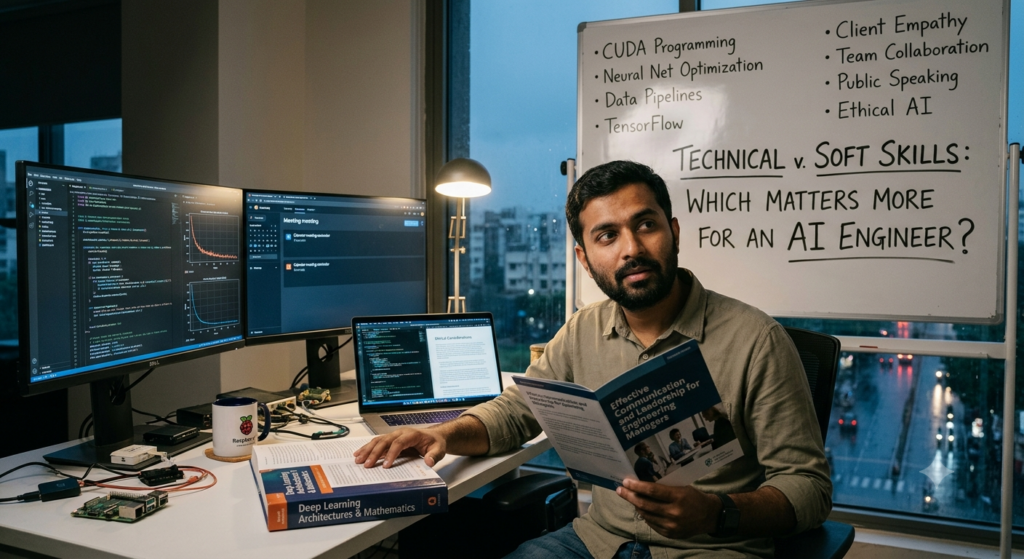
If you ask most students what it takes to become an AI Engineer, the answer is usually:
“I need to learn Python, Machine Learning, and Artificial Intelligence.”
They’re not wrong—but they’re only seeing half the picture.
In today’s AI-driven world, technical skills can help you get a job, but soft skills often determine how far you grow in your career.
As AI becomes more integrated into businesses, companies are looking for professionals who can not only build intelligent systems but also communicate ideas, solve real-world problems, collaborate with teams, and think creatively.
In simple words, an AI Engineer needs both a brilliant mind and excellent people skills.
Let’s understand why.
Technical skills are the practical abilities required to design, build, train, and deploy AI systems.
These are the skills you learn through study, practice, coding, and real-world projects.
Some of the most important technical skills include:
These skills help you build intelligent applications.
Without technical knowledge, becoming an AI Engineer is almost impossible.
Soft skills are personal qualities that determine how effectively you work with people, solve problems, and adapt to new challenges.
Unlike coding, these skills aren’t taught through programming books.
They’re developed through experience, communication, teamwork, and continuous learning.
Some essential soft skills for AI Engineers include:
AI Engineers solve business problems—not just coding problems.
For example:
A hospital doesn’t need “Machine Learning.”
It needs a solution that helps doctors detect diseases earlier.
The ability to understand the real problem before writing code is one of the most valuable skills an AI Engineer can have.
Imagine you’ve built an excellent AI model.
Now your client asks,
“How exactly does this system work?”
If you can’t explain it in simple language, people may struggle to trust your solution.
Great AI Engineers know how to communicate technical concepts to:
Clear communication builds trust.
Large AI projects are rarely completed by one person.
You’ll often work with:
Being a good team player is just as important as writing good code.
Artificial Intelligence changes incredibly fast.
Just think about the last few years.
We’ve seen:
Technologies that were considered advanced a few years ago have already evolved significantly.
Successful AI Engineers never stop learning.
They continuously:
Curiosity is one of the biggest advantages in this profession.
Sometimes the first solution isn’t the best solution.
AI Engineers constantly ask questions like:
Critical thinking helps AI Engineers build smarter and more ethical systems.
AI projects often involve:
Managing time effectively helps professionals stay productive without compromising quality.
| Technical Skills | Soft Skills |
|---|---|
| Python Programming | Communication |
| Machine Learning | Problem-Solving |
| Deep Learning | Critical Thinking |
| SQL & Databases | Teamwork |
| Data Science | Adaptability |
| Cloud Computing | Leadership |
| Generative AI | Time Management |
| NLP & Computer Vision | Creativity |
Both are essential.
One helps you build AI systems.
The other helps you build a successful career.
The honest answer is:
You need both.
Think of it like driving a car.
Technical skills are the engine.
Soft skills are the steering wheel.
An engine without steering won’t take you safely to your destination.
Similarly, excellent communication without technical expertise won’t make you an AI Engineer.
The most successful professionals develop both together.
Companies hiring AI Engineers in 2026 are no longer evaluating candidates only on coding ability.
They also assess whether you can:
✅ Solve practical problems
✅ Work collaboratively
✅ Learn quickly
✅ Communicate effectively
✅ Think creatively
✅ Understand customer needs
Many interviews now include discussions about real-world case studies rather than just technical questions.
This shift reflects the growing importance of business understanding alongside technical expertise.
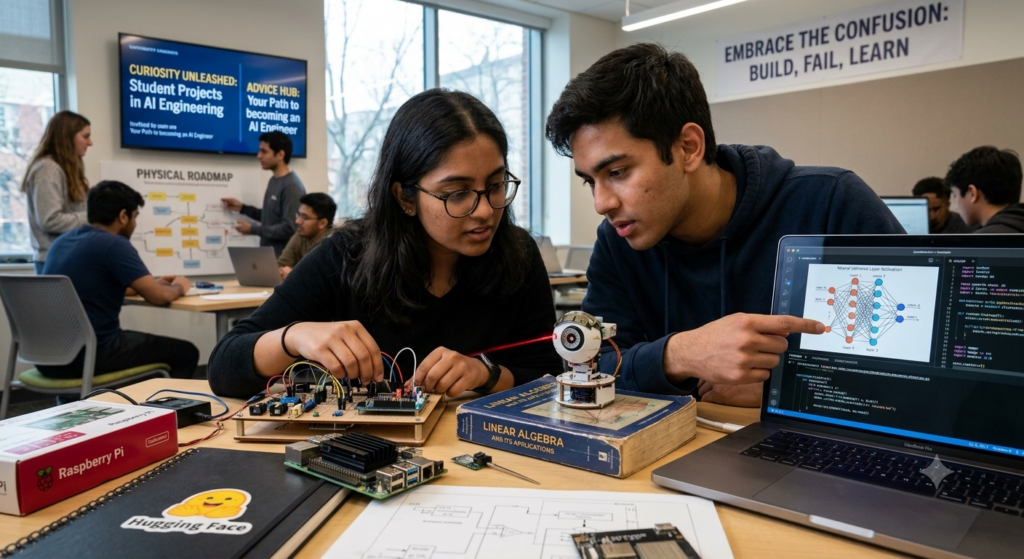
If you’re currently in school or college, don’t spend all your time only learning programming languages.
Develop yourself as a well-rounded learner.
Here’s a balanced approach:
These habits will help you stand out in the future.
As parents, it’s natural to focus on marks, coding classes, and certifications.
But future-ready careers like AI require much more than academic performance.
Children also need:
As a DMIT Consultant, Parent & Career Coach, I’ve observed that students who succeed in emerging careers are those whose natural strengths are nurtured alongside technical education.
Understanding your child’s aptitude early can help you choose the right learning path instead of following trends blindly.
Remember:
Every child can learn technology. But not every child learns, thinks, or grows in the same way.
Recognizing those differences is one of the most valuable gifts a parent can give.
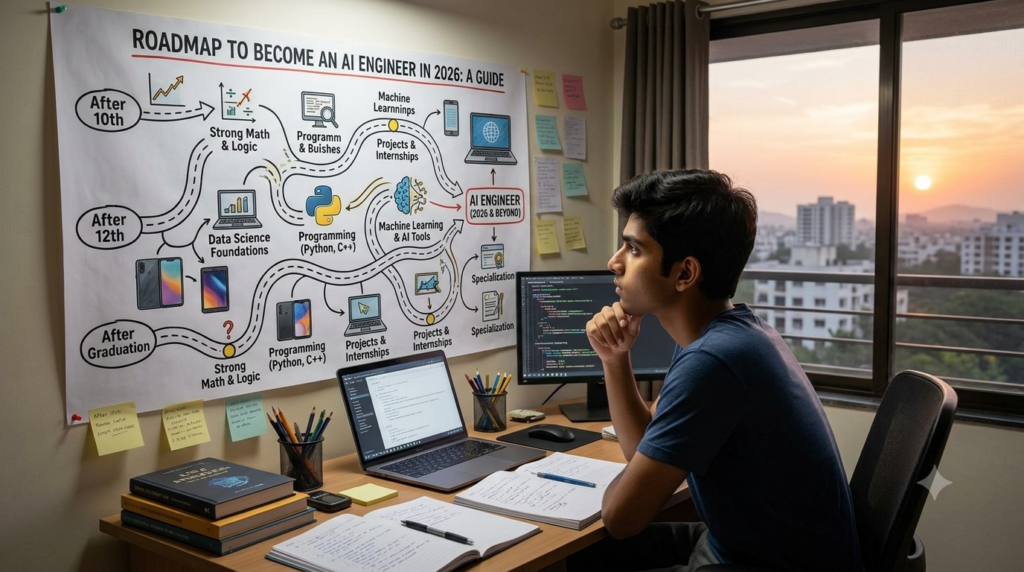
One of the most common questions students ask during career counselling is:
“What should I do after 10th if I want to become an AI Engineer?”
Parents also wonder:
“Should my child start learning AI now or wait until college?”
The good news is that there isn’t just one path to becoming an AI Engineer.
Whether you’re in school, college, or even a working professional looking for a career switch, you can build a successful career in Artificial Intelligence with the right roadmap.
Let’s break it down step by step.
If you’ve just completed your 10th standard, don’t rush into learning advanced AI or Machine Learning.
Instead, focus on building a strong foundation.
This stage is about preparing your mind—not becoming an AI expert overnight.
Most students aspiring to become AI Engineers choose:
✅ Science (PCM – Physics, Chemistry & Mathematics)
This provides a strong base for engineering entrance exams and computer science.
However, if you’re passionate about technology and choose another stream, it doesn’t necessarily end your AI journey. Today, many students learn AI through online courses and practical projects.
The key is maintaining a strong interest in mathematics, logical thinking, and programming.
Mathematics is the language of Artificial Intelligence.
Focus on mastering:
Don’t study mathematics only to score marks.
Try understanding why concepts work.
That mindset will help tremendously when you begin Machine Learning.
This is the perfect time to start learning Python.
Instead of watching endless tutorials, build small projects like:
Projects build confidence much faster than theory.
Participate in:
These experiences develop logical thinking, creativity, and confidence.
After completing Class 12, students have several pathways into AI Engineering.
Many universities now offer specialized degrees in:
These programs provide structured learning and industry exposure.
This remains one of the strongest choices.
A Computer Science degree provides:
You can later specialize in AI through electives, certifications, internships, and projects.
Students who don’t pursue engineering can also enter the AI field through:
These degrees, combined with practical AI skills, can open excellent career opportunities.
Already completed your degree?
Don’t worry.
Many successful AI Engineers started learning AI after graduation.
You can transition into AI if you have backgrounds like:
Even professionals from non-technical backgrounds can move into AI with consistent learning and project-based experience.
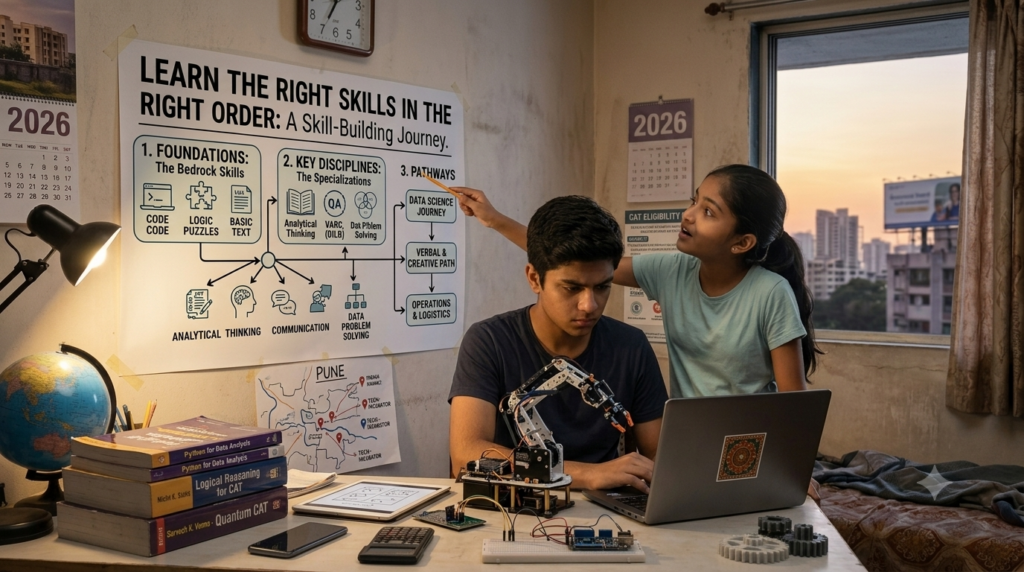
Many beginners make one common mistake.
They jump directly into Deep Learning or ChatGPT APIs without understanding the basics.
A better learning sequence looks like this:
⬇
⬇
⬇
⬇
⬇
This progression helps you build a strong foundation instead of struggling with advanced concepts too early.
This is one of the biggest mistakes students make.
Many collect certificates…
Very few build projects.
Recruiters are far more impressed by a student who has created:
than someone with ten certificates and no practical work.
Your portfolio becomes your proof of skill.
GitHub acts like your digital portfolio.
Upload every project you build.
Employers often check GitHub to understand:
Students who actively maintain GitHub profiles often stand out during interviews.
Along with academics, try to:
Learning from real projects builds confidence that textbooks cannot provide.
Many technically brilliant students struggle during interviews because they cannot explain their ideas clearly.
As an AI Engineer, you’ll often need to:
Good communication can significantly accelerate your career growth.
As parents, it’s natural to get excited about AI because it’s one of the fastest-growing careers in the world.
However, please don’t make the mistake of deciding your child’s career based only on trends.
Artificial Intelligence is an excellent profession—but it’s not the right fit for every student.
Some children naturally enjoy:
Others may have stronger abilities in:
As a DMIT Consultant, Parent & Career Coach, I’ve seen many students feel pressured into choosing careers simply because they are “popular.”
The better approach is to first understand your child’s natural aptitude, interests, personality, and learning style, and then match those strengths with future-ready careers like AI.
When a student’s abilities and career path align, learning becomes enjoyable, confidence grows, and long-term success becomes much more achievable.
Artificial Intelligence is undoubtedly shaping the future.
But remember…
Choosing a career isn’t about following what’s trending today.
It’s about finding the intersection of:
✅ Your natural strengths
✅ Your interests
✅ Your willingness to learn
✅ Future career opportunities
That’s the combination that creates lasting success.
Artificial Intelligence is one of the fastest-changing fields in the world.
Every few months, new tools, frameworks, and technologies emerge. Just a few years ago, terms like Generative AI, Prompt Engineering, and AI Agents were unfamiliar to most people. Today, they are among the most sought-after skills in the technology industry.
This is why learning AI isn’t something you do once—it’s a journey of continuous learning.
The good news?
You don’t need an expensive degree from a foreign university to become an AI Engineer. With the right combination of education, online courses, practical projects, and consistent practice, students can build industry-ready AI skills.
Let’s explore some of the best learning options available in 2026.

This is a question many parents ask.
“Can my child become an AI Engineer just by doing online courses?”
The answer depends on the student’s career goals.
A formal degree provides:
On the other hand, online courses provide:
The best combination is often:
A recognized degree + practical online certifications + real-world projects.
Students after Class 12 can consider:
Specialized programs focusing entirely on AI technologies.
Currently one of India’s fastest-growing engineering programs.
Still considered one of the safest and strongest pathways into AI.
Suitable for students interested in software development and AI.
An excellent option for students interested in analytics and Artificial Intelligence.
While degrees build foundations, certifications help students stay updated with the latest industry tools.
Some globally recognized learning platforms include:
Google offers beginner-friendly AI learning resources covering:
Microsoft provides certifications focused on:
Ideal for students interested in deploying AI applications on cloud platforms.
Popular for:
Founded by AI pioneer Andrew Ng, this platform offers practical courses in:
Offers university-backed AI programs from institutions like:
Provides advanced AI programs from:
You don’t always have to spend money.
Many excellent free resources are available.
Some of the best AI educators regularly upload high-quality tutorials, coding sessions, and project walkthroughs.
Thousands of open-source AI projects can be explored to understand how professionals write code.
One of the best platforms for:
Working on Kaggle projects significantly improves practical skills.
An essential platform for students interested in:
Here’s one important truth:
Companies hire skills—not certificates.
Imagine two students.
Who do you think recruiters will prefer?
Almost always, Student B.
Projects demonstrate your ability to apply knowledge to solve real problems.
If you’re starting your AI journey, try creating projects like:
🤖 AI Chatbot
🎬 Movie Recommendation System
📸 Face Recognition Attendance System
📈 Stock Price Prediction
🏥 Disease Prediction Model
📝 Resume Screening AI
🌐 Language Translator
🎙️ Voice Assistant
🛒 Product Recommendation Engine
These projects strengthen both technical knowledge and confidence.
Absolutely.
Generative AI has become one of the biggest technological shifts in recent years.
Learning tools like:
will give students a competitive advantage.
However, remember:
Using AI tools is different from understanding how AI actually works.
Future AI Engineers should focus on both.
One of the biggest reasons students are attracted to Artificial Intelligence is its excellent earning potential.
While salaries vary depending on skills, projects, company, location, and experience, here’s a general overview:
| Experience Level | Approximate Annual Salary (India) |
|---|---|
| Entry-Level (0–2 years) | ₹6–12 LPA |
| Mid-Level (3–6 years) | ₹12–25 LPA |
| Senior AI Engineer | ₹25–50+ LPA |
| AI Architect / AI Lead | ₹50 LPA to ₹1 Crore+ (top companies) |
Professionals with expertise in Generative AI, Large Language Models (LLMs), MLOps, and AI Automation are often among the highest-paid specialists in the technology sector.
Remember, salary depends on skills and practical experience, not just degrees.
In one word:
Yes.
But with one important condition.
Artificial Intelligence isn’t just a trending career—it requires genuine interest in solving problems, learning continuously, and adapting to rapid technological change.
Students who enjoy:
are likely to find AI Engineering both rewarding and fulfilling.
If you’re choosing AI only because “everyone says it’s the future,” pause for a moment.
A successful career is built when your natural strengths meet market opportunities.
As parents, it’s natural to get excited when you hear about high-paying careers like AI Engineering.
But one of the biggest mistakes I see during career counselling sessions is this:
Parents first decide the career…
…and only then try to fit the child into it.
The process should be the opposite.
First, understand your child’s:
Then evaluate whether careers like Artificial Intelligence, Data Science, Engineering, Medicine, Design, Commerce, Law, or Entrepreneurship align with those strengths.
When children choose careers that match both their abilities and future opportunities, they are more likely to stay motivated, perform well, and enjoy long-term success.
Artificial Intelligence is shaping the future of every industry.
The demand for skilled AI Engineers will continue to grow over the coming years, creating exciting opportunities for students willing to learn and innovate.
However, before deciding on AI—or any career—remember that the best career isn’t simply the one with the highest salary. It’s the one that aligns with who you are.
A child who understands their strengths, develops the right skills, and follows a structured learning roadmap will always have a stronger foundation than someone who follows trends without direction.

Choosing a career after 10th or 12th can feel overwhelming—for both students and parents.
Questions like:
are difficult to answer through guesswork alone.
At SH Development Academy, we help students and parents make informed career decisions through our DMIT & Career Guidance Consultation.
Under the guidance of Santosh Hariharan—DMIT Consultant, Parent & Career Coach, and Success Mindset Coach—students gain insights into their:
✅ Natural aptitude and intelligence profile
✅ Learning style and cognitive strengths
✅ Career interests and personality traits
✅ Future-ready career options aligned with their abilities
Instead of choosing a career based only on trends, help your child choose a path that matches both their potential and the future job market.
👉 Book your DMIT & Career Guidance Consultation today:
https://docs.google.com/forms/d/e/1FAIpQLSd6-u-BEr3ESzoHq2CXjkYZIr41O1eqh3ip97Lj3JbZ-6xSPA/viewform
⭐ See why 400+ parents and students trust our guidance:
https://share.google/ac9hkh20zcXadkJs9
📞 Call / WhatsApp:
+91 8421315400 | +91 7303290862
Your child’s future deserves more than assumptions—it deserves informed guidance.
Success & Happiness are the two most important yet elusive things which every human being yearns to achieve in life. Real success and happiness can be savoured only when one enjoys good health and good family relations, along with a good professional career and sound financial stability.
Our Visitor


 Users Today : 10