Choosing the right course after Class 12 is one of the biggest decisions in a student’s life. Every year, thousands of students and parents find themselves asking the same question: “BCA vs BTech – which course is better?” The answer isn’t as simple as choosing the course with the highest salary or the most popular degree. The right choice depends on your interests, aptitude, long-term career goals, learning style, and the kind of work you see yourself doing in the future.
With technologies like Artificial Intelligence (AI), Cybersecurity, Cloud Computing, Data Science, Full Stack Development, and Machine Learning reshaping the IT industry in 2026, both Bachelor of Computer Applications (BCA) and Bachelor of Technology (BTech) offer excellent career opportunities. However, they prepare students for different career paths and learning experiences.
As a Career Coach, I’ve met many students who chose a course simply because their friends did or because someone told them it had “better scope.” Unfortunately, many of them later realized that the course didn’t match their interests or strengths. That’s why understanding the difference between BCA and BTech before making a decision is so important.
In this detailed guide, we’ll compare BCA vs BTech based on eligibility, curriculum, career opportunities, salary, skills, higher education, and future scope so that you can make an informed decision.
If you’re confused between BCA and BTech, you’re certainly not alone.
Both courses are related to computers and technology. Both can lead to careers in software development, IT companies, and emerging technology fields. Both offer attractive salary packages and opportunities to work with top companies.
So why is it so difficult to choose?
Because many students only compare the course names without understanding what they actually study, the skills they develop, and the type of careers they prepare for.
Some common questions students ask are:
The truth is that there is no universally “better” course. There is only a course that is better for you.
Your decision should depend on factors such as:
Choosing a course based only on salary or public opinion can often lead to frustration later.
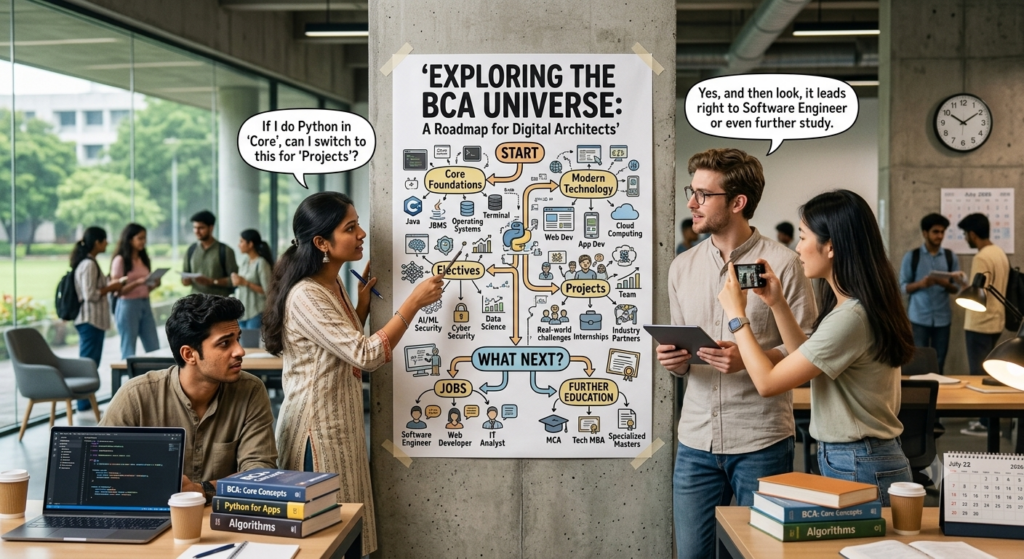
Bachelor of Computer Applications (BCA) is a three-year undergraduate degree focused on computer applications, programming, software development, and IT fundamentals.
The course is designed for students who want to build careers in software development, web development, application development, cloud computing, database management, cybersecurity, or IT services.
Unlike engineering programs, BCA focuses more on practical software skills than hardware engineering.
Although the syllabus varies across universities, students generally study:
Many colleges now include industry-relevant technologies such as:
This makes BCA highly relevant for today’s IT industry.
BCA is an excellent option for students who:
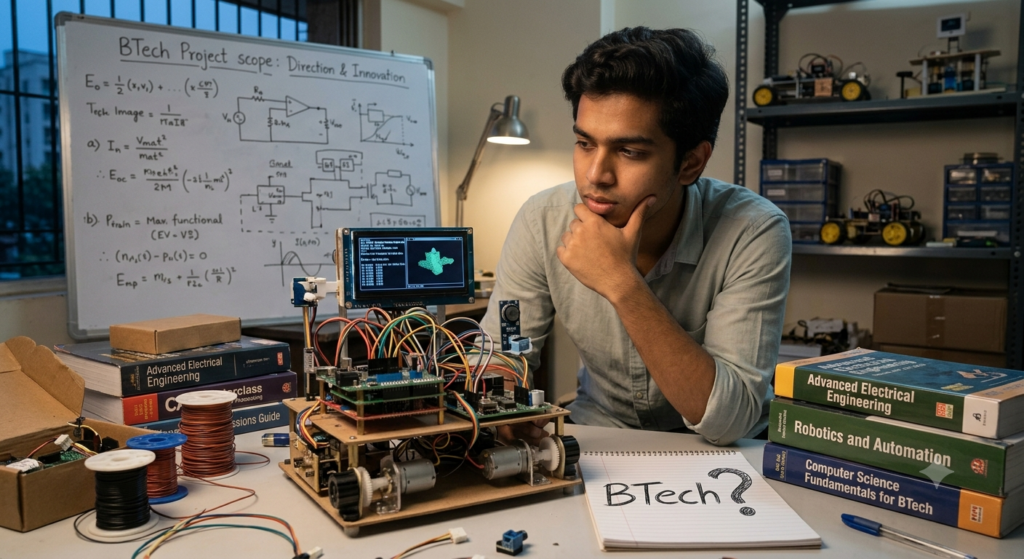
Bachelor of Technology (BTech) is a four-year professional engineering degree that combines theoretical engineering concepts with practical technical knowledge.
Students can choose from multiple specializations such as:
For students interested in software careers, Computer Science Engineering (CSE) is usually the preferred specialization.
Students typically study:
Compared to BCA, BTech covers deeper engineering concepts and technical theory, making it suitable for students interested in software engineering as well as research, system design, and product development.
BTech is ideal for students who:
| Feature | BCA | BTech (Computer Science) |
|---|---|---|
| Full Form | Bachelor of Computer Applications | Bachelor of Technology |
| Duration | 3 Years | 4 Years |
| Focus | Software Applications | Engineering & Technology |
| Eligibility | 10+2 | 10+2 (PCM in most colleges) |
| Programming | High | High |
| Engineering Subjects | No | Yes |
| Mathematics Level | Moderate | Advanced |
| Career Focus | Software Development, IT Services | Software Engineering, Product Development, Engineering |
| Higher Education | MCA, MBA, Certifications | MTech, MBA, MS, Certifications |
One of the biggest deciding factors between BCA and BTech is eligibility.
Most universities require:
This flexibility makes BCA a popular choice for students who did not study Physics, Chemistry, and Mathematics (PCM).
Admission to BTech generally requires:
If you have not studied PCM in Class 12, pursuing a traditional BTech program may not be possible in many institutions.
Although the difference appears to be only one year, it can significantly impact your career planning.
Students often enter the workforce earlier or continue with MCA or specialized certifications.
The additional year provides deeper technical knowledge, industrial training, internships, engineering projects, and broader exposure to engineering concepts.
The skills you develop during your degree are often more important than the degree itself.
Students generally develop:
BCA emphasizes practical implementation and application development.
Along with programming, BTech students also learn:
This combination prepares graduates for both software engineering and technical innovation.
This is where many students make a mistake.
A degree alone does not guarantee success.
In today’s technology-driven world, employers increasingly value practical skills, projects, internships, certifications, communication, and problem-solving abilities alongside academic qualifications.
Whether you choose BCA or BTech, your willingness to continuously learn and adapt will play a much bigger role in your career than the course title itself.

Choosing between BCA vs BTech isn’t just about selecting a college course—it’s about choosing a career path that aligns with your interests, strengths, and long-term goals.
With India’s digital economy growing rapidly and technologies like Artificial Intelligence (AI), Data Science, Cybersecurity, Cloud Computing, Blockchain, and Automation creating new job opportunities, both BCA and BTech graduates are in demand.
But do they offer the same career opportunities?
Let’s find out.
Gone are the days when BCA graduates had limited options. In 2026, companies are hiring skilled professionals based on technical expertise and practical experience, not just their degree.
If you enjoy coding, building websites, developing mobile apps, or working with software, BCA can open doors to a rewarding IT career.
Today, many BCA graduates also work as freelancers, startup founders, or remote developers for international clients.
BTech graduates, especially those specializing in Computer Science Engineering (CSE), generally have access to a broader range of technical and engineering roles.
Because BTech includes engineering fundamentals, students are also considered for research, product development, and advanced technical positions.
Many leading product-based companies also recruit BTech graduates for software engineering roles through campus placements.
One of the most common questions students ask is:
“Which course offers a higher salary—BCA or BTech?”
The honest answer is:
Your skills matter more than your degree.
A highly skilled BCA graduate with strong programming expertise, internships, and real-world projects can often earn more than a BTech graduate who lacks practical skills.
However, as a general trend:
| Experience | BCA Graduate | BTech Graduate |
|---|---|---|
| Freshers | ₹3–6 LPA | ₹4–8 LPA |
| 3–5 Years | ₹6–12 LPA | ₹8–18 LPA |
| 5–10 Years | ₹12–25+ LPA | ₹15–35+ LPA |
Figures vary based on company, skills, certifications, location, and job role.
Students working in AI, Cloud Computing, Cybersecurity, and Full Stack Development often command significantly higher salaries than traditional software roles.
Remember: Companies today hire problem-solvers, not just degree holders.
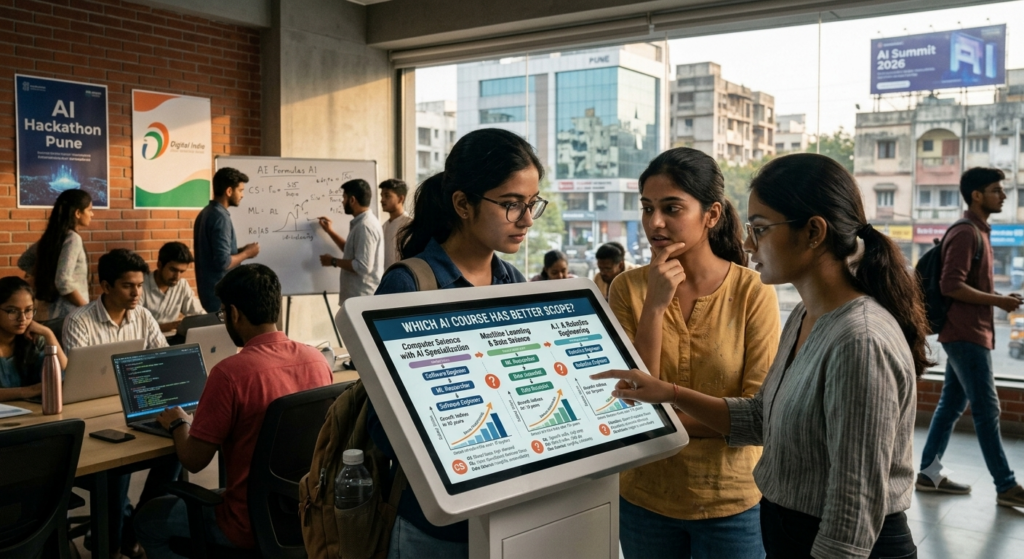
Artificial Intelligence is no longer the future—it’s the present.
Industries like healthcare, finance, manufacturing, education, and e-commerce are rapidly adopting AI-driven solutions.
Absolutely.
Many BCA graduates learn:
through certifications and practical projects.
Yes.
BTech Computer Science programs often include AI-related subjects as part of their curriculum, giving students an academic advantage in understanding advanced concepts.
Verdict:
Both BCA and BTech students can build successful AI careers if they continuously upskill.
As cyber threats continue to rise, cybersecurity has become one of the fastest-growing technology domains.
Both BCA and BTech graduates can pursue careers such as:
Professional certifications often matter more than the degree in this field.
Data is often called the “new oil.”
Every industry generates massive amounts of data that need skilled professionals to analyze and interpret.
Students from both BCA and BTech backgrounds can pursue careers in:
Learning Python, SQL, Power BI, Tableau, and statistics can significantly improve career prospects.
Many students choose to continue their education after BCA.
Popular options include:
One of the most popular choices for BCA graduates, offering advanced technical knowledge and improved career opportunities.
Ideal for students interested in:
Students can specialize in:
Industry-recognized certifications often help students stay competitive in the job market.
BTech graduates have multiple pathways depending on their career goals.
Suitable for students interested in research, specialization, or academic careers.
Many engineering graduates transition into management roles through an MBA.
Students aspiring for global careers often pursue a Master of Science (MS) in countries like the USA, Canada, Germany, Australia, or the UK.
Even BTech graduates continue learning through certifications in AI, Cloud Computing, Cybersecurity, and Data Science to remain industry-ready.
Technology has made it easier than ever to start a business.
Whether you complete BCA or BTech, you can launch:
Many successful entrepreneurs have built thriving businesses through practical skills, innovation, and execution rather than relying solely on academic qualifications.
Students often ask whether BCA or BTech is a better choice for international opportunities.
Both degrees can lead to global careers, but the pathway may differ.
BTech is widely recognized for engineering-related master’s programs and technical roles across many countries.
BCA graduates also have opportunities abroad, particularly after completing higher education such as an MCA, MS, or relevant certifications.
Ultimately, international opportunities depend on:
✅ Shorter duration (3 years)
✅ Flexible eligibility for many students
✅ Practical programming focus
✅ Lower overall education cost
✅ Faster entry into the IT industry
✅ Strong engineering foundation
✅ Broader technical knowledge
✅ Better campus placement opportunities in some colleges
✅ Greater access to product-based companies
✅ Suitable for research and higher technical education
Not true.
Salary depends on your skills, experience, certifications, internships, and ability to solve real-world problems—not just your degree.
Many leading companies hire talented BCA graduates who demonstrate exceptional technical skills, strong portfolios, and practical experience.
Today’s technology industry values continuous learning.
Many professionals from non-engineering backgrounds have built successful careers by mastering in-demand technologies.
This is one of the biggest misconceptions.
With the growing demand for software developers, AI specialists, cloud professionals, and cybersecurity experts, skilled BCA graduates have excellent career opportunities.
After comparing every important aspect of BCA vs BTech, let’s answer the question that really matters:
“Which course is the right choice for me?”
The answer isn’t based on what your friends are choosing or which course is currently trending. It’s about choosing a career path that matches your interests, aptitude, learning style, and long-term goals.
Many students make the mistake of selecting a course because:
Unfortunately, this often leads to frustration, lack of motivation, and even career changes later.
The best career decisions are based on self-awareness, not assumptions.
BCA can be an excellent choice if you:
✅ Love programming and software development.
✅ Want to start your IT career sooner with a 3-year degree.
✅ Enjoy creating websites, mobile apps, or software applications.
✅ Prefer practical learning over engineering theory.
✅ Did not study Physics, Chemistry, and Mathematics (PCM) in Class 12 but want to build a career in Information Technology.
✅ Plan to specialize later through MCA, certifications, or industry training.
For students who are self-motivated and enjoy continuous learning, BCA offers tremendous opportunities in today’s digital economy.
BTech may be the better option if you:
✅ Enjoy Mathematics and analytical thinking.
✅ Are interested in engineering concepts and problem-solving.
✅ Want to work on advanced technologies like Artificial Intelligence, Robotics, Embedded Systems, or Product Engineering.
✅ Aspire to work in research, product development, or core engineering roles.
✅ Want access to broader engineering career opportunities.
If you enjoy understanding how technology works—not just using it—BTech can provide a stronger engineering foundation.
Every year, we meet students who say:
“I chose Engineering because everyone told me it has good scope.”
Or…
“I selected BCA because my friends joined the same college.”
Unfortunately, many of these students later realize that the course doesn’t match their interests or natural abilities.
A successful career isn’t built by following the crowd.
It’s built by choosing a path that aligns with who you are.
Remember:
A student who enjoys programming will usually perform better in software development than someone who joins engineering only because of peer pressure.
Likewise, a student who genuinely enjoys engineering concepts is likely to thrive in BTech.
The technology industry has changed significantly.
Companies no longer hire candidates based only on degrees.
They look for people who can:
Whether you’re pursuing BCA or BTech, developing these skills will have a far greater impact on your career than the name of your degree.
Build a strong portfolio.
Work on internships.
Learn industry-relevant tools.
Keep upgrading your skills.
That is what employers value today.
Every child is unique.
Some students naturally excel at logical reasoning.
Others are highly creative.
Some love coding.
Others enjoy designing products.
Some have leadership qualities.
Others are excellent problem-solvers.
The challenge is that many students don’t know their own strengths before choosing a career.
This is where career guidance becomes extremely valuable.
Instead of guessing, students should understand:
Choosing the right course becomes much easier when you understand yourself first.
At SH Development Academy, we’ve guided hundreds of students and parents through one of the most important decisions of their lives—choosing the right career path.
Our Career Guidance Consultation combines professional counselling with scientific assessment tools to help students make informed decisions rather than emotional ones.
Depending on the student’s profile, we may recommend tools such as a Psychometric Aptitude Assessment or DMIT (Dermatoglyphics Multiple Intelligence Test) to better understand their:
The goal isn’t to tell students what they must become.
The goal is to help them discover careers where they are most likely to grow, enjoy their work, and succeed.
After everything we’ve discussed, here’s the simple truth:
Neither BCA nor BTech is universally better.
The better course is the one that matches your interests, abilities, and career aspirations.
If you’re passionate about software development, enjoy practical programming, and want to enter the IT industry quickly, BCA can be a fantastic choice.
If you’re interested in engineering, advanced technologies, and a broader technical education, BTech may be the right path.
The important thing is not to choose based on trends or opinions.
Choose based on clarity.
Because the right career choice today can save years of confusion tomorrow.
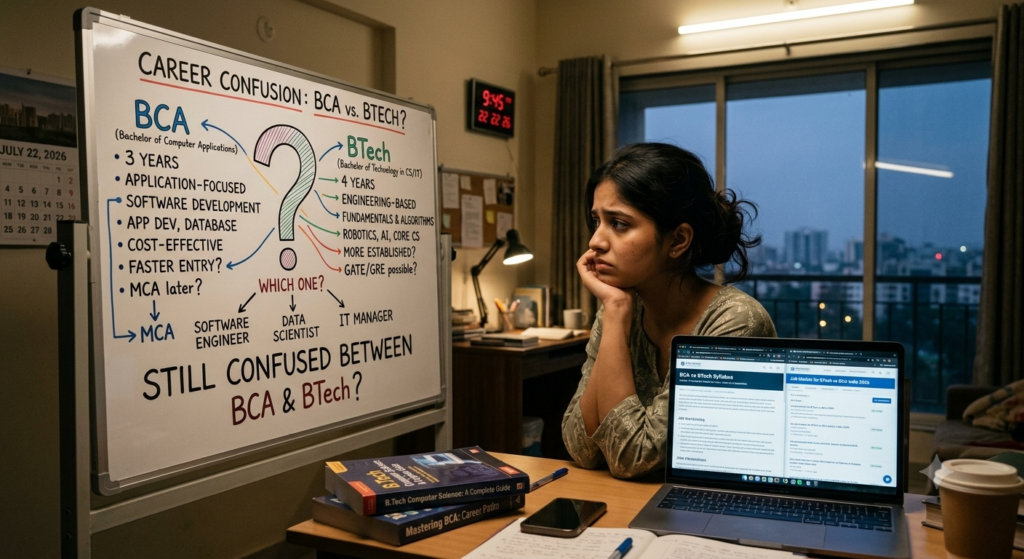
Choosing a career after Class 12 is one of the biggest decisions a student will make. Instead of relying on advice from friends or relatives, get professional guidance based on your unique strengths and aspirations.
At SH Development Academy, we help students and parents make confident career decisions through our Career Guidance Consultation, led by Santosh Hariharan—a DMIT Consultant, Parent & Career Coach, Student Success Coach, and Certified Career Analyst with years of experience helping students identify the right academic and career direction.
Whether you’re confused between BCA vs BTech, Engineering vs Commerce, or any other career choice, we’re here to guide you with clarity and confidence.
🌟 Why Students & Parents Trust Us
✅ Personalized Career Guidance
✅ Scientific Career Assessment (Psychometric & DMIT, where appropriate)
✅ One-to-One Expert Counselling
✅ Practical Roadmap for Academic & Career Success
⭐ See why 400+ parents and students have trusted our guidance:
👉 https://share.google/ac9hkh20zcXadkJs9
📅 Book Your Career Guidance Consultation:
👉 https://docs.google.com/forms/d/e/1FAIpQLSd6-u-BEr3ESzoHq2CXjkYZIr41O1eqh3ip97Lj3JbZ-6xSPA/viewform
📞 Call or WhatsApp Us:
+91 8421315400 | +91 7303290862
Your future deserves more than a guess. Let’s choose the career that’s right for you.
Success & Happiness are the two most important yet elusive things which every human being yearns to achieve in life. Real success and happiness can be savoured only when one enjoys good health and good family relations, along with a good professional career and sound financial stability.
Our Visitor


 Users Today : 10