

Choosing a career in design has become one of the most exciting options for students in India. With industries like UI/UX Design, Product Design, Animation, Fashion, Interior Design, Graphic Design, and Industrial Design growing rapidly, thousands of students now aspire to study at premier institutes like the Indian Institutes of Technology (IITs).
However, one question that confuses many students and parents is:
“What is the difference between UCEED and CEED?”
Many assume these two exams are the same because both are conducted by IITs and relate to design. But in reality, UCEED and CEED serve different purposes, are meant for different education levels, and open different career opportunities.
As a DMIT Consultant, Parent & Career Coach, I often meet students who spend months preparing for the wrong examination simply because they don’t understand the difference. Choosing the correct exam at the right stage can save valuable time and help you build a successful design career.
In this comprehensive guide, we’ll explain everything you need to know about the Difference Between UCEED and CEED in simple language.

UCEED (Undergraduate Common Entrance Examination for Design) is a national-level entrance examination conducted annually by the Indian Institute of Technology (IIT) on behalf of the UCEED-CEED Implementation Committee.
The exam is designed for students who have completed or are appearing for Class 12 (Higher Secondary) and wish to pursue a Bachelor of Design (B.Des.) degree.
Students qualifying UCEED can seek admission into participating institutes, including selected IITs and other design colleges that accept UCEED scores.
Simply put,
UCEED = Undergraduate Design Entrance Exam
It is the first step for students who dream of becoming professional designers immediately after school.
CEED (Common Entrance Examination for Design) is also conducted by IITs, but it is meant for a completely different group of students.
CEED is designed for graduates who want to pursue:
Unlike UCEED, CEED is not for Class 12 students.
Students generally appear for CEED after completing:
In simple words,
CEED = Postgraduate Design Entrance Exam
| Feature | UCEED | CEED |
|---|---|---|
| Full Form | Undergraduate Common Entrance Examination for Design | Common Entrance Examination for Design |
| Conducted By | IIT | IIT |
| Level | Undergraduate | Postgraduate |
| Eligibility | Class 12 Students | Graduates |
| Course | B.Des. | M.Des., PhD |
| Purpose | Design after school | Higher studies in design |
| Target Students | School Students | College Graduates |
This is the biggest difference that every student should understand before starting preparation.
Every year, thousands of students search:
The confusion happens because:
But your educational qualification decides which exam is right for you.
If you’re studying in Class 11 or 12, your focus should be UCEED.
If you’ve already completed graduation and wish to specialize in design, CEED is the right choice.
Understanding eligibility is one of the most important parts of choosing the correct examination.
Students can generally apply if they:
Since eligibility rules may change slightly each year, students should always verify the latest official notification before applying.
Students can generally apply after completing an eligible bachelor’s degree.
Accepted backgrounds include:
One of the biggest advantages of CEED is that students from various educational backgrounds can transition into design.
UCEED is ideal for students who:
Students who enjoy both creativity and logical thinking often perform well in UCEED.
CEED is best suited for graduates who:
Many engineering graduates also choose CEED because product design and user experience combine technical knowledge with creativity.
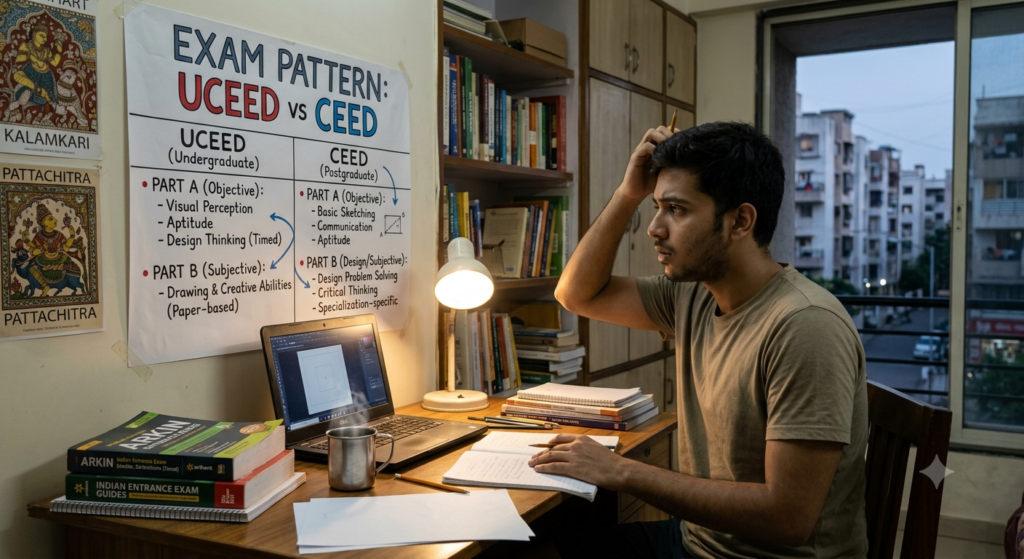
Although both examinations evaluate creativity and aptitude, their exam patterns differ.
The UCEED examination typically evaluates:
Understanding shapes, forms, and visual information.
Original thinking and innovative ideas.
Attention to detail and visual analysis.
Problem-solving ability using logical thinking.
Understanding usability, aesthetics, and functionality.
Students may be required to demonstrate freehand drawing, visualization, and creative representation.
CEED also evaluates creativity but at a more advanced level.
The examination generally focuses on:
How candidates solve real-world design problems.
Ability to analyze user needs and create practical solutions.
Generating innovative concepts with strong reasoning.
Presenting ideas visually and conceptually.
Candidates are expected to demonstrate advanced visualization abilities compared to undergraduate applicants.
While both exams test creativity, the depth differs.
Typical areas include:
The focus is on identifying students with strong creative potential after school.
The CEED syllabus is more advanced and generally includes:
Instead of simply testing talent, CEED evaluates whether graduates are ready for advanced design education and professional design thinking.
One of the biggest myths among students is:
“I can’t draw well, so I can’t become a designer.”
This is not entirely true.
Basic sketching and visual communication skills are helpful, especially for expressing ideas. However, both exams evaluate much more than artistic talent. Creativity, observation, logical reasoning, problem-solving, visualization, empathy for users, and design thinking all play a significant role.
Many successful designers are not professional artists—they excel because they think creatively and solve problems effectively.
One of the biggest advantages of qualifying UCEED is the opportunity to apply for some of India’s most respected design institutions.
The primary participating institutes for UCEED 2026 include:
Apart from these, many reputed universities and private institutions also accept UCEED scores, including FLAME University (Pune), MIT World Peace University (Pune), CEPT University, BITS Design School, D. Y. Patil School of Design, and several others. The list of result-sharing institutes continues to grow, giving students more choices every year. (UCEED)
Students qualifying CEED can apply for postgraduate design programs (M.Des. and Ph.D.) offered by leading institutes such as:
Several universities also use CEED scores as part of their admission process for design programs. However, qualifying CEED alone does not guarantee admission. Most institutes also conduct interviews, portfolio reviews, or additional selection rounds. (CEED IITB)
One common misconception is that design only means drawing or graphic designing.
The reality is very different.
Today’s design industry offers exciting careers across technology, manufacturing, healthcare, mobility, entertainment, and digital products.
After completing a B.Des. through UCEED, students can build careers as:
Design physical products used every day—from furniture and electronics to consumer products.
Create user-friendly websites, mobile applications, and digital experiences.
This is currently one of the fastest-growing and highest-paying design careers.
Design machines, automobiles, appliances, medical equipment, and industrial products.
Improve the way users interact with software, apps, and smart devices.
Work in branding, advertising, publishing, and digital marketing.
Create graphics, animations, films, gaming assets, and multimedia content.
Many design graduates launch their own design studios, startups, or creative agencies.
Since CEED leads to postgraduate specialization, graduates often move into senior design roles.
Career options include:
An M.Des. can also open doors to teaching, research, and leadership positions within the design industry.
Salary depends on several factors:
Generally:
Fresh graduates may find opportunities in design firms, startups, IT companies, product companies, and manufacturing industries.
Postgraduates often qualify for specialized and leadership-oriented roles, which can lead to higher salary potential over time.
Rather than chasing salary alone, students should focus on developing a strong portfolio, creativity, and problem-solving skills. These qualities often matter more than marks in the design industry.
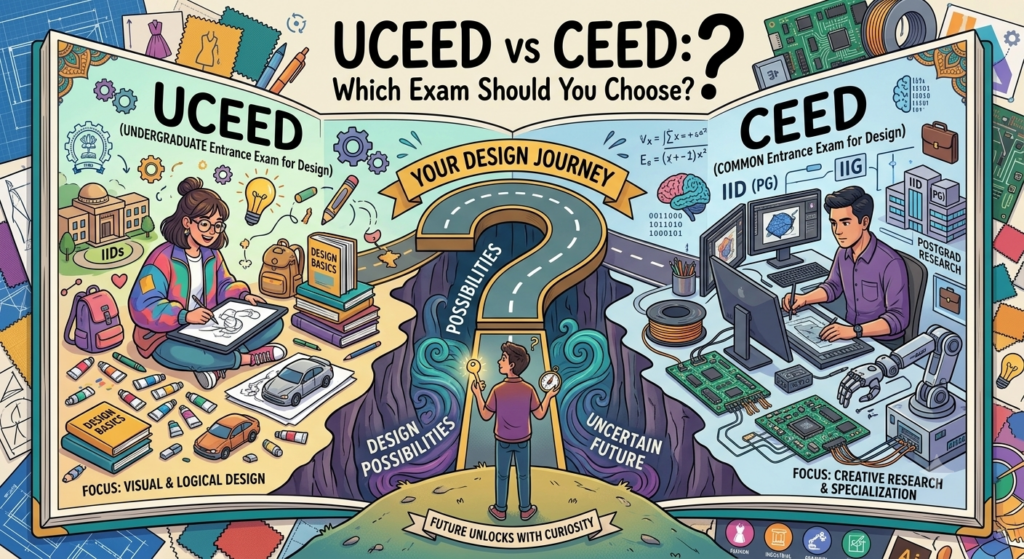
The answer depends entirely on where you are in your academic journey.
Choose UCEED if:
✔ You are studying in Class 11 or 12.
✔ You want to pursue a Bachelor of Design (B.Des.).
✔ You wish to start your design career immediately after school.
Choose CEED if:
✔ You have already completed graduation.
✔ You want to pursue an M.Des. or advanced studies in design.
✔ You are planning to specialize in a specific design field or transition into a design career.
Neither exam is “better.” They simply serve different stages of a student’s educational journey.
This is perhaps the most important question.
Every year, I meet students who say:
“I love drawing, so I’ll become a designer.”
Or parents who say:
“My child is creative, so design seems like the right option.”
But creativity alone doesn’t determine success in design.
Successful designers also need:
Similarly, some students naturally possess these strengths but never consider design as a career because they are unaware of their own potential.
This is why choosing a career should never be based only on marks, trends, or friends’ opinions.
It should begin with understanding your natural strengths.
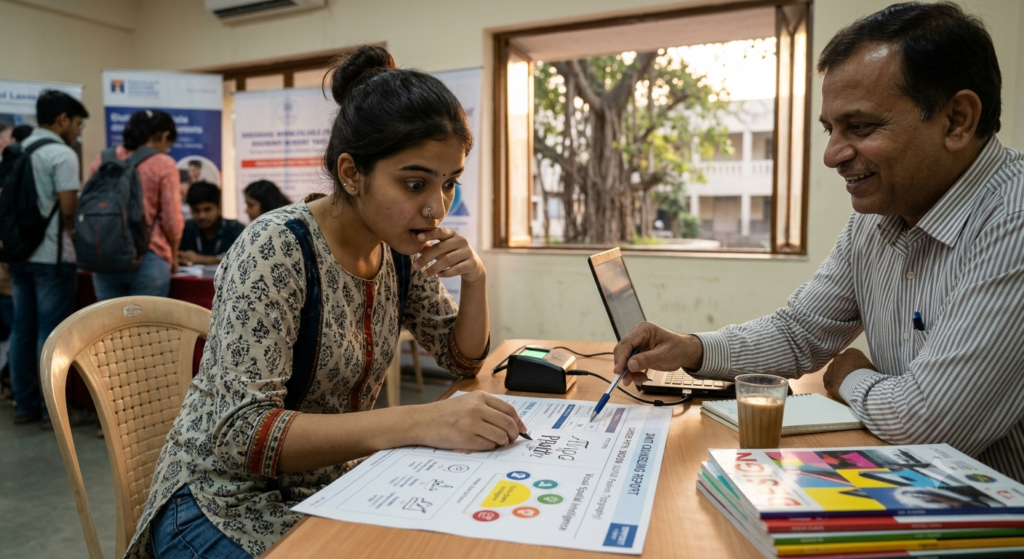
A DMIT (Dermatoglyphics Multiple Intelligence Test) does not decide your career, nor does it predict your future.
Instead, it provides valuable insights into a student’s natural learning style, dominant intelligences, personality traits, and areas of potential.
For students considering creative careers such as design, architecture, animation, UI/UX, or product design, a professionally interpreted DMIT report can become a useful discussion tool alongside interests, aptitude, academic performance, and career counselling.
At SH Development Academy, we encourage students and parents to use DMIT as one part of a broader career guidance process—not as the only deciding factor. Our aim is to help families make informed decisions based on a child’s unique strengths rather than assumptions.
Both exams are competitive but designed for different educational levels. UCEED assesses undergraduate aspirants, while CEED evaluates graduates for advanced design studies.
No. CEED is meant for candidates who have completed (or are completing) an eligible bachelor’s degree. (CEED IITB)
Yes. Students from engineering and several other academic backgrounds can apply, provided they meet the eligibility criteria. (CEED IITB)
No. A qualifying score does not automatically guarantee admission. Seat availability, merit rank, counselling, and institute-specific requirements all play an important role. (UCEED)
Basic drawing and visualization skills are useful, but both exams also evaluate creativity, observation, logical reasoning, design aptitude, and problem-solving.
The exams share some common design aptitude concepts, but they target different academic levels. Students preparing for CEED generally require a deeper understanding of design thinking and advanced problem-solving. Many aspirants and mentors note that there is overlap in portions of the syllabus, though preparation depth differs. (Reddit)
The difference between UCEED and CEED is simple once you understand their purpose.
If you’re a Class 12 student, UCEED is your gateway to a Bachelor of Design.
If you’re a graduate, CEED is your pathway to advanced design education and specialization.
However, before preparing for either exam, take a step back and ask yourself an important question:
“Is design truly aligned with my natural strengths, interests, and abilities?”
Choosing the right career isn’t about following trends—it’s about understanding yourself first.

Many students spend months preparing for entrance exams without first understanding whether the career truly matches their strengths.
At SH Development Academy, we help students make informed career decisions through personalized DMIT Consultation and Career Guidance.
Under the guidance of Santosh Hariharan—DMIT Consultant, Parent & Career Coach, and Success Mindset Coach for Students—you’ll gain deeper insights into your learning style, strengths, and career preferences, helping you make confident educational choices.
⭐ See what parents and students say about us:
Click here to see 400+ Google Reviews
📝 Book your DMIT Consultation:
DMIT Consultation Booking Form
📞 Call or WhatsApp:
+91 8421315400 | +91 7303290862
Your future deserves more than guesswork. The right guidance today can help you make a more confident career decision tomorrow.
Success & Happiness are the two most important yet elusive things which every human being yearns to achieve in life. Real success and happiness can be savoured only when one enjoys good health and good family relations, along with a good professional career and sound financial stability.
Our Visitor


 Users Today : 2