
As parents, we naturally want our children to excel in studies, sports, and life. We invest in good schools, tuition classes, extracurricular activities, and the best opportunities we can afford.
But here’s a question every parent should ask:
Is my child emotionally strong enough to handle life’s challenges?
In my years as a DMIT Consultant, Parent & Career Coach, I’ve observed something important. The children who succeed in the long run are not always the smartest or the highest scorers. They are often the ones who can handle setbacks, bounce back from failures, manage emotions, and stay confident under pressure.
In today’s fast-changing world, emotional strength has become just as important as academic success.
Let’s understand how to make children emotionally strong and help them build resilience that lasts a lifetime.
Being emotionally strong doesn’t mean a child never cries, feels upset, or experiences disappointment.
In fact, emotionally strong children experience the same emotions as everyone else.
The difference is that they learn how to:
Emotional strength is not about avoiding emotions. It is about learning how to handle them effectively.

Today’s children are growing up in a very different environment than previous generations.
They face:
Many children appear happy on the outside but silently struggle with:
This is why emotional intelligence and emotional resilience are becoming critical life skills.
Many parents focus on marks but miss emotional warning signs.
Watch out for:
These signs don’t mean something is wrong with your child. They often indicate a need for emotional development and support.

Many children feel emotions but don’t know how to describe them.
Instead of saying:
“Don’t cry.”
Try asking:
“What are you feeling right now?”
Teach words like:
Children who understand their emotions can manage them better.
One of the biggest parenting mistakes today is trying to remove every obstacle from a child’s path.
Failure teaches:
If a child loses a competition, performs poorly in an exam, or faces rejection, resist the urge to immediately fix everything.
Sometimes the greatest growth comes from overcoming challenges.
When children are praised only for achievements, they may develop a fear of failure.
Instead of saying:
“You got 95%, excellent.”
Also say:
“I’m proud of how hard you worked.”
This encourages a growth mindset.
Emotionally strong children learn to trust their judgment.
Allow children to make age-appropriate decisions about:
This builds confidence and responsibility.
Instead of providing every answer, ask questions like:
This develops critical thinking and emotional resilience.
Children learn more from what parents do than what parents say.
If parents:
Children naturally learn those behaviors.
Remember:
You are your child’s first role model.
Comparison is one of the biggest confidence killers.
Many parents unknowingly say:
“Look at your cousin.”
“Your friend scored higher.”
“Why can’t you be like him?”
Every child is unique.
Different children have different:
Comparison creates insecurity rather than motivation.
One important insight I’ve learned while working with students and parents is this:
Many emotional struggles arise because children are misunderstood.
A creative child may be pressured to become highly academic.
A practical learner may be forced into theoretical learning.
An introverted child may constantly be told to be more outgoing.
Over time, this mismatch creates frustration, stress, and low confidence.
This is why understanding a child’s natural personality becomes so important.
Many parents know:
But very few truly understand:
When parents gain this understanding, parenting becomes easier and more effective.
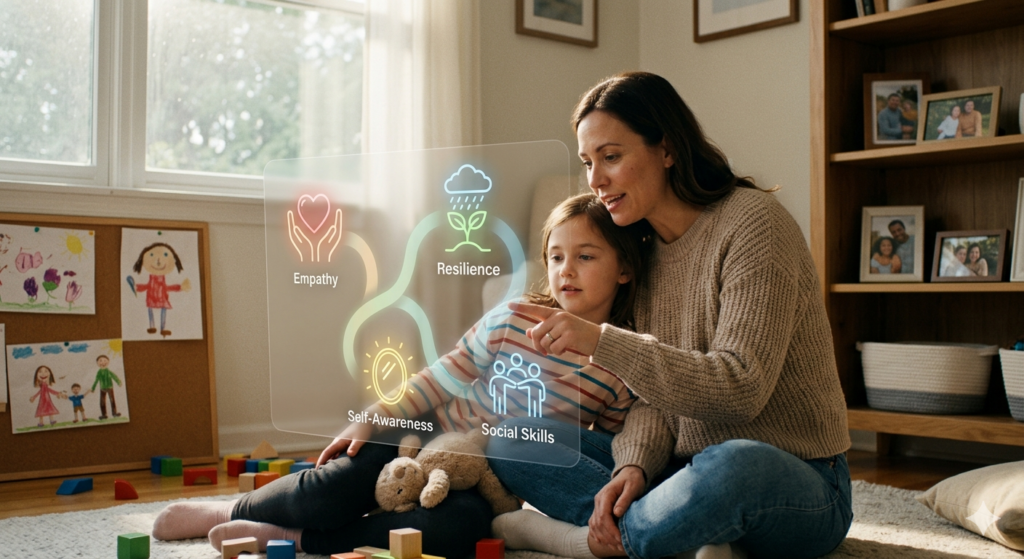
One of the most valuable aspects of a DMIT assessment is that it helps parents understand their child’s unique blueprint.
A professionally interpreted DMIT report can provide insights into:
This understanding allows parents to:
✔ Communicate more effectively
✔ Reduce unnecessary pressure
✔ Build confidence in the right way
✔ Support emotional development
✔ Guide career decisions appropriately
Many parents tell us that the biggest benefit of DMIT wasn’t for the child alone—it transformed the way they parented.
Marks are important.
Academic success is valuable.
But life ultimately rewards people who can:
These qualities come from emotional strength.
And emotional strength begins at home.
Encourage emotional expression, allow healthy failures, focus on effort, teach problem-solving skills, and provide unconditional support.
Overprotection, constant criticism, comparison, unrealistic expectations, and lack of emotional understanding can contribute to emotional struggles.
Emotional intelligence helps children manage emotions, build relationships, handle stress, and develop resilience.
Absolutely. Emotional resilience is a skill that can be developed through consistent parenting, guidance, and self-awareness.
As parents, we often focus on improving our child’s performance.
But before performance comes understanding.
When you understand:
You become a better guide, mentor, and parent.
And that’s where real transformation begins.
Every child is different.
What works for one child may not work for another.
If you want deeper insights into your child’s natural strengths, personality traits, learning style, and emotional tendencies, a DMIT consultation can provide valuable guidance.
At SH Development Academy, we help parents understand their children beyond academics and marks.
Under the guidance of Santosh Hariharan — DMIT Consultant, Parent & Career Coach, and Success Mindset Coach — families gain practical insights that help improve parenting, confidence building, emotional development, and career planning.

⭐ See why hundreds of parents trust our guidance:
Click Here to See 310+ Google Reviews
📞 Call Us:
+91 8421315400
+91 7303290862
📝 Book Your DMIT Consultation:
DMIT Consultation Booking Form
Because emotionally strong children don’t just perform better in school—they thrive in life. 🌱
Success & Happiness are the two most important yet elusive things which every human being yearns to achieve in life. Real success and happiness can be savoured only when one enjoys good health and good family relations, along with a good professional career and sound financial stability.
Our Visitor


 Users Today : 24