

Close
  • Home
  • About Us
  • Service
    • Workshop
    • Personal Coaching
    • Psychometric Aptitude Test
    • Dermatoglyphic Assessment of Human Potential
    • Parenting Coach
  • Gallery
  • Testimonials
  • Enquiry
  • Resources
    • Blogs
    • Downloads
  • Contact
  • +91 84213 15400
  • santosh.hariharan@shdacademy.com
Facebook Linkedin Youtube
SH Development Academy logo
  • Home
  • About Us
  • Services
    • Workshops
    • Personal Coaching
    • Psychometric Aptitude Test
    • Dermatoglyphic Assessment of Human Potential
    • Parenting Coach
    • Language Training
  • Gallery
  • Testimonials
  • Enquiry
  • Resources
    • Blogs
    • Downloads
  • Contact

SH Development Academy logo
  • Home
  • About Us
  • Services
    • Workshops
    • Personal Coaching
    • Psychometric Aptitude Test
    • Dermatoglyphic Assessment of Human Potential
    • Parenting Coach
    • Language Training
  • Gallery
  • Testimonials
  • Enquiry
  • Resources
    • Blogs
    • Downloads
  • Contact

Career  ·  Direction  ·  Productivity

Why Marks Don’t Define Intelligence: What Every Parent Needs to Understand in 2026

By admin 

For generations, parents have been taught to believe one simple equation:

Good Marks = Intelligent Child

And naturally, when a child scores less, many parents start worrying.

“Why is my child not scoring well?”
“Is my child less intelligent than others?”
“Will my child’s future be affected?”

As a DMIT Consultant, Parent & Career Coach, I have met hundreds of parents who carry these concerns.

The reality is that marks measure academic performance—not intelligence.

In fact, some of the world’s most successful entrepreneurs, artists, leaders, athletes, innovators, and creators were never school toppers.

The problem isn’t that children lack intelligence.

The problem is that we often define intelligence too narrowly.

Let’s understand why marks don’t define intelligence and what parents should focus on instead.


Table of Contents

Toggle
  • The Biggest Myth in Education
  • Intelligence Is Much Bigger Than Marks
  • Every Child Is Intelligent in Their Own Way
    • Logical Thinkers
    • Creative Thinkers
    • Communicators
    • Leaders
    • Kinesthetic Learners
  • Why School Marks Don’t Measure the Full Potential of a Child
  • Some of the World’s Most Successful People Were Not Top Rankers
  • Why Some Intelligent Children Get Average Marks
    • Different Learning Styles
    • Lack of Interest
    • Exam Anxiety
    • Hidden Talents
  • The Danger of Labeling Children Based on Marks
  • What Children Really Need From Parents
  • Marks Matter, But They Are Not Everything
    • Wrong Belief #1
    • Wrong Belief #2
  • The Skills That Matter Most in the Future
    • Communication Skills
    • Creativity
    • Emotional Intelligence
    • Leadership
    • Critical Thinking
    • Adaptability
    • Collaboration
    • Problem-Solving
  • How Parents Can Discover Their Child’s True Strengths
  • Why Understanding a Child Is More Important Than Judging Them
  • A Real Question Every Parent Should Ask
  • How DMIT Can Help Parents Understand Their Child Better
  • Frequently Asked Questions
    • Do marks indicate intelligence?
    • Can a child with average marks be successful?
    • What is more important than marks?
    • Why does my intelligent child get low marks?
    • How can I understand my child’s strengths better?
  • Every Child Is More Than a Report Card
  • Want to Discover Your Child’s Hidden Strengths?

The Biggest Myth in Education

The Biggest Myth in Education

One of the most common myths in education is:

“If a child gets good marks, they are intelligent. If they get average marks, they are not.”

But think about this:

A report card usually measures:

  • Memory
  • Writing ability
  • Exam performance
  • Subject understanding
  • Time management during exams

While these are important skills, they represent only a small part of human intelligence.

A child can struggle with exams and still be exceptionally gifted in many other areas.


Intelligence Is Much Bigger Than Marks

Imagine asking these questions:

  • Can your child solve real-life problems?
  • Can your child communicate confidently?
  • Can your child lead others?
  • Can your child think creatively?
  • Can your child build strong relationships?
  • Can your child adapt to challenges?

These abilities often matter more in life than exam scores.

Yet most school report cards don’t measure them.


Every Child Is Intelligent in Their Own Way

One of the most important concepts parents should understand is that intelligence comes in different forms.

Some children are naturally:

Logical Thinkers

They enjoy:

  • Mathematics
  • Analysis
  • Problem-solving

Creative Thinkers

They love:

  • Art
  • Design
  • Innovation
  • Storytelling

Communicators

They excel at:

  • Public speaking
  • Teaching
  • Influencing
  • Networking

Leaders

They naturally:

  • Take initiative
  • Organize groups
  • Inspire others

Kinesthetic Learners

They learn best through:

  • Action
  • Movement
  • Practical experience

These children often struggle in traditional classroom settings despite being highly capable.


Why School Marks Don’t Measure the Full Potential of a Child

Why Marks Don't Define Intelligence

Schools are designed to evaluate certain academic skills.

However, they often don’t assess:

  • Creativity
  • Leadership
  • Emotional intelligence
  • Entrepreneurship
  • Social skills
  • Innovation
  • Practical intelligence

As a result, many talented children are misunderstood.

Parents may assume:

“My child is average.”

When in reality, the child simply has strengths that are not reflected in exam scores.


Some of the World’s Most Successful People Were Not Top Rankers

History gives us countless examples.

Many successful individuals were not known for extraordinary academic scores.

What made them successful was:

  • Persistence
  • Creativity
  • Vision
  • Leadership
  • Communication
  • Problem-solving ability

Success in life is rarely determined by marks alone.


Why Some Intelligent Children Get Average Marks

This surprises many parents.

A child can be highly intelligent and still perform poorly in exams.

Why?

Different Learning Styles

Not every child learns the same way.

Some are:

  • Visual learners
  • Auditory learners
  • Kinesthetic learners

When teaching methods don’t match a child’s learning style, performance suffers.


Lack of Interest

Children often excel in subjects they enjoy.

When interest is low, marks usually drop.


Exam Anxiety

Many bright students struggle under pressure.

Their intelligence doesn’t disappear during exams.

Their anxiety affects performance.


Hidden Talents

Some children invest more energy in:

  • Sports
  • Music
  • Art
  • Technology
  • Leadership activities

Their strengths simply lie elsewhere.


The Danger of Labeling Children Based on Marks

One of the most damaging things a parent can do is label a child.

Statements like:

❌ “You’re not smart enough.”

❌ “Your cousin scores better than you.”

❌ “You’ll never succeed.”

can have long-term effects on confidence.

Over time, children start believing these labels.

And when confidence drops, performance often drops too.


What Children Really Need From Parents

Children don’t need constant comparison.

They need understanding.

They need parents who can identify:

  • Their strengths
  • Their interests
  • Their learning style
  • Their natural abilities

When children feel understood, they become more confident.

When confidence increases, performance often improves naturally.


Marks Matter, But They Are Not Everything

Let’s be clear.

Marks are important.

They can:

  • Open educational opportunities
  • Create academic options
  • Reflect effort and discipline

But they are only one piece of the puzzle.

Parents should avoid two extremes:

Wrong Belief #1

“Marks don’t matter at all.”

This isn’t true.


Wrong Belief #2

“Marks are everything.”

This isn’t true either.

The healthiest approach is balance.


The Skills That Matter Most in the Future

As we move further into the AI-driven world of 2026 and beyond, employers are increasingly valuing:

Communication Skills

Creativity

Emotional Intelligence

Leadership

Critical Thinking

Adaptability

Collaboration

Problem-Solving

These skills often contribute more to long-term success than exam scores alone.


How Parents Can Discover Their Child’s True Strengths

Instead of focusing only on marks, ask:

  • What activities excite my child?
  • What does my child learn quickly?
  • What comes naturally to them?
  • Where do they show confidence?
  • What do teachers notice about them?

The answers often reveal strengths that report cards cannot.


Why Understanding a Child Is More Important Than Judging Them

As parents, our goal should not be to create perfect report cards.

Our goal should be to help children become:

  • Confident
  • Capable
  • Self-aware
  • Responsible
  • Successful in their own way

The first step is understanding who they truly are.

Not just what they scored in an exam.


A Real Question Every Parent Should Ask

Instead of asking:

“Why are my child’s marks low?”

Ask:

“What kind of intelligence does my child naturally possess?”

That single shift can completely change how you guide your child.
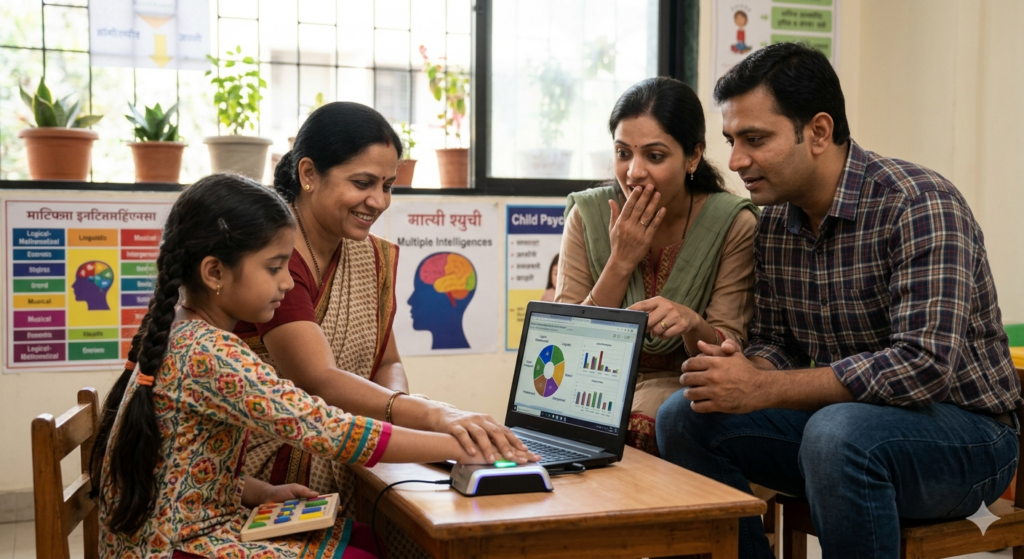

How DMIT Can Help Parents Understand Their Child Better

Why School Marks Don't Measure the Full Potential of a Child

One challenge parents face is that strengths are not always visible.

A child may have talents that haven’t yet emerged in school.

This is where tools like DMIT can help.

A professionally interpreted DMIT assessment can provide insights into:

✔ Learning style

✔ Natural strengths

✔ Personality traits

✔ Multiple intelligences

✔ Career inclinations

✔ Areas where a child may need support

DMIT is not about predicting the future.

It is about helping parents understand their child more deeply so they can guide them more effectively.


Frequently Asked Questions

Do marks indicate intelligence?

Marks indicate academic performance but do not measure all forms of intelligence.

Can a child with average marks be successful?

Absolutely. Many successful people were average students but excelled because of their strengths, skills, and determination.

What is more important than marks?

Confidence, communication skills, creativity, emotional intelligence, adaptability, and problem-solving ability are all important for long-term success.

Why does my intelligent child get low marks?

Possible reasons include learning style mismatch, lack of interest, exam anxiety, low confidence, or strengths in non-academic areas.

How can I understand my child’s strengths better?

Observation, professional guidance, psychometric assessments, and DMIT consultations can help identify natural abilities and learning preferences.


Every Child Is More Than a Report Card

One exam cannot define a child’s future.

One report card cannot measure a child’s full potential.

And one set of marks certainly cannot define intelligence.

As parents, our responsibility is not to compare children.

It is to understand them.

When children are guided according to their strengths, they gain confidence.

When they gain confidence, they perform better.

And when they perform better, success follows naturally.


Want to Discover Your Child’s Hidden Strengths?

Santosh Hariharan — DMIT Consultant, Parent & Career Coach, and Success Mindset Coach

At SH Development Academy, we help parents move beyond marks and understand the unique potential within every child.

Guided by Santosh Hariharan — DMIT Consultant, Parent & Career Coach, and Success Mindset Coach — our DMIT consultations help parents gain clarity about:

✔ Learning styles

✔ Natural talents

✔ Personality traits

✔ Multiple intelligences

✔ Career suitability

✔ Parenting strategies

👉 Book Your DMIT Consultation Today

DMIT Consultation Booking Form

📞 Call: +91 8421315400 | +91 7303290862

⭐ See what parents are saying about us:

Click Here to See 310+ Google Reviews

Because your child’s future deserves to be built on their strengths—not just their marks. 🌱🚀


Leave A Reply Cancel reply

Your email address will not be published. Required fields are marked *

*

*

Parenting Teenagers in the Digital Age
Parenting Teenagers in the Digital Age: A Practical Guide for Modern Parents in 2026
Previous Article
The Biggest Career Mistakes Parents Make
The Biggest Career Mistakes Parents Make (And How to Avoid Them in 2026)
Next Article

About Us

Design Your Life Now!

Success & Happiness are the two most important yet elusive things which every human being yearns to achieve in life. Real success and happiness can be savoured only when one enjoys good health and good family relations, along with a good professional career and sound financial stability.

Our Visitor

023262
Users Today : 11

Our Services

Dermatoglyphic Assessment of Human Potential
Career Counselling & Success Coaching for Students
Personal Coaching/ Business Coaching
Mind Craft
Mind Craft Relax
Mind Craft Money
Mind Sharp Student
Mind Sharp Parent
Mind Sharp Sales Champion

Resources

Blogs
Downloads

Contact Us

  • 622, Moonstone buzz, Vardhaman spaces, Opp JSPM college, Near Skoda Showroom,  Mumbai Banglore highway Tathawade Pune-33
  • +91 8421315400
    +91 8421315400
  • +91 7303290862
    +91 7303290862
  • santosh.hariharan@shdacademy.com
    santosh.hariharan@shdacademy.com

Copyright 2025 All Right Reserved.

Maintained by Lunarteck Web Studio

  • Whats app
  • Send Enquiry
  • Call
Loading

Loading

Loading

  • Home
  • About Us
  • Service
    • Workshop
    • Personal Coaching
    • Psychometric Aptitude Test
    • Dermatoglyphic Assessment of Human Potential
    • Parenting Coach
  • Gallery
  • Testimonials
  • Enquiry
  • Resources
    • Blogs
    • Downloads
  • Contact